Here’s a situation that plays out more often than most enterprise teams would like to admit.A leadership team gets excited about top blockchain trends, green-lights a six-figure development budget, and six months later, realizes the solution they built doesn’t actually integrate with their existing ERP system. Or worse, the use case never needed blockchain in the first place.
That’s not a hypothetical. It’s the reason blockchain PoC development exists and it’s why the smartest enterprises from logistics giants to mid-market financial firms refuse to skip it, no matter how confident they feel about the idea.
But most resources on blockchain development costs either give you vague ballpark rangesor skip straight to the technical deep-dive without answering the one question every decision-maker is actually asking: how much is this going to cost, and is it actually worth it?
This guide gives you both. We’ll walk through honest cost breakdowns, real timelines, and a clear framework for deciding when a PoC makes sense versus when you’re ready to go straight to production. And because the goal isn’t just to build, it’s to build something that gets you ROI – we’ll also cover what separates a successful enterprise blockchain solution from the expensive ones that get shelved.
Quick answer: A blockchain PoC typically costs between $25,000 and $80,000, depending on complexity, team size, and platform. Full production deployment ranges from $150,000 to $500,000+. Read on for the full breakdown.
What is Blockchain PoC?
A blockchain PoC is a small-scale, working model built to test whether a blockchain-based solution is feasible for a specific business problem. It’s not a prototype, and it’s not a pilot, though people often use these terms interchangeably.
The distinction matters, especially when you’re budgeting.
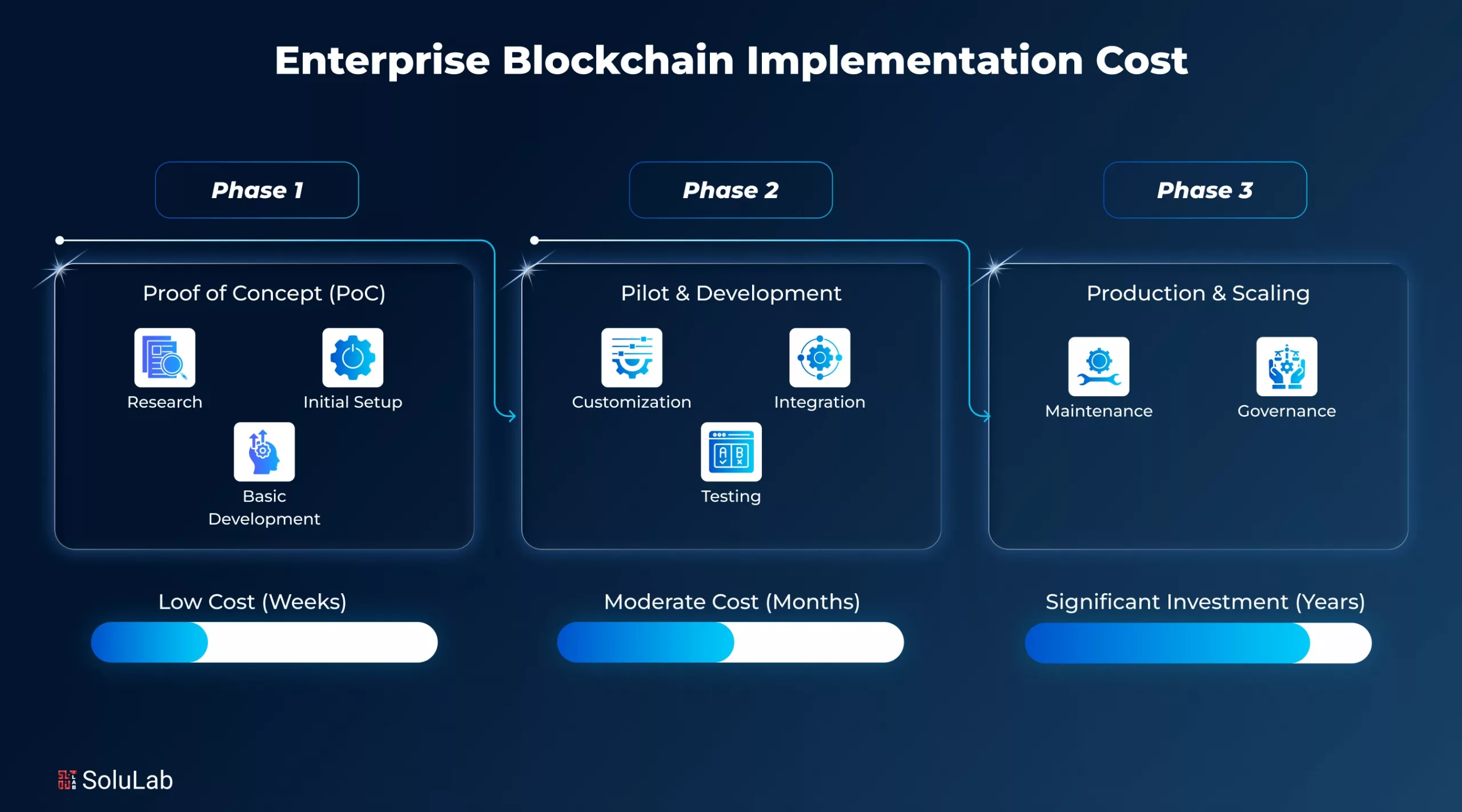
| Stage | Purpose | Typical Duration | Typical Cost |
|---|---|---|---|
| Proof of Concept (PoC) | Validate technical feasibility and core logic | 4–8 weeks | $15,000 – $50,000 |
| Pilot / MVP | Test in a limited real-world environment | 2–4 months | $60,000 – $130,000 |
| Full Production | Scalable, compliant, enterprise-grade deployment | 6–18 months | $140,000 – $200,000+ |
The PoC stage is essentially your risk management tool. Before you ask your CFO to sign off on a half-million-dollar blockchain build, you want evidence that the core idea works, that the consensus mechanism performs under your data load, that it integrates with your existing systems, and that the user experience makes sense for your team.
A PoC gives you that evidence in weeks, not months.
And perhaps more importantly, it gives you something concrete to show stakeholders. Because in most enterprises, the hardest part isn’t building the technology, it’s getting internal buy-in to fund and prioritise a blockchain initiative.
A working PoC changes the conversation from ‘we think this could work’ to ‘here’s proof it already does.
When Does an Enterprise Actually Need Blockchain?
Before we talk about costs, it’s worth asking a harder question because one of the most expensive blockchain mistakes is building for the wrong blockchain development use cases.
Blockchain adds the most value when a business problem involves at least three of the following:
- Multiple parties that don’t fully trust each other but need to share data
- A need for immutable, tamper-evident records (audits, provenance, compliance)
- Elimination of a slow or expensive intermediary (banks, clearinghouses, brokers)
- Cross-border transactions or multi-jurisdictional regulatory requirements
- Smart contract automation of complex, conditional business logic
If your problem only involves two parties, or if a traditional database could solve it just as well, blockchain probably isn’t your answer.
A good PoC development partner will tell you that upfront, and that kind of honesty is actually one of the signals you should be looking for when choosing a vendor.
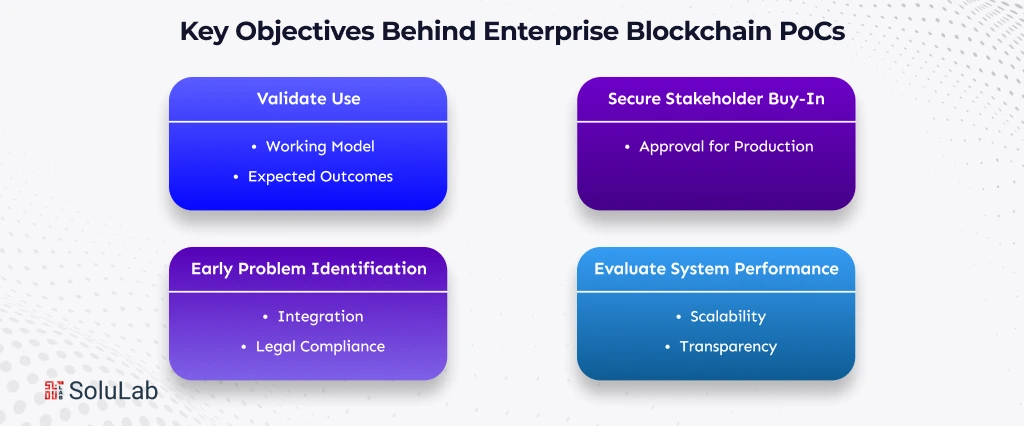
Key Objectives Behind Enterprise Blockchain PoCs
The primary goal of blockchain PoC is to validate a use case through a working model. It checks for feasibility and expected outcomes. Startup businesses generally use PoC to evaluate their system scalability, transparency, and immunity. Not only do these PoC also identify potential problems early, including integration challenges or legal compliance issues. At last, it aids in securing buy-in from makers, and the transparency decides the approval of production.
How Enterprise Blockchain Implementation Actually Works?
Blockchain adoption is a strategic shift in how your business handles trust, data, and process automation. For enterprises ready to move beyond the hype, success comes down to one thing: execution.
Here’s how a structured blockchain implementation unfolds, and what separates teams that scale from those that stall.
1. Defining Business Goals Before Writing a Single Line of Code
The most expensive mistake enterprises make is jumping into development without clarity. Every successful blockchain project starts with a focused discovery phase:
- What problem are we solving? Supply chain visibility? Automated contract execution? Cross-border settlement?
- Is blockchain the right tool? If your problem involves trust, transparency, or eliminating intermediaries, it likely is.
- What are the technical constraints? Data privacy requirements, permissioned access, smart contract complexity, and integration with legacy systems all need to be mapped upfront.
The cleaner your requirements, the faster and cheaper your build. Vague goals lead to costly pivots.
Matching Use Cases to Real Business Value
Not every workflow needs a blockchain. The ones that do share common traits: multiple parties, low-trust environments, and a need for an immutable audit trail. Cross-border payments, digital identity verification, and supply chain provenance are proven fits. Forcing blockchain onto a problem it wasn’t built for is how PoCs die.
Scoping Technical, Legal, and Operational Requirements
A PoC isn’t just an engineering exercise. Before development begins, teams need to account for:
- Technical scope — API architecture, node configuration, on-chain vs. off-chain data decisions
- Legal scope — Regulatory compliance (GDPR, industry-specific rules), data residency, and smart contract enforceability
- Operational scope — Team structure, sprint timelines, testing protocols, and internal sign-off processes
Miss any one of these, and you’ll pay for it later.
2. The PoC Development Process, Stage by Stage
A well-run blockchain Proof of Concept removes uncertainty at every phase, building confidence before you commit to full-scale development.
Stage 1 — Theoretical Framework & Functional Mapping
Define the problem, draft the solution hypothesis, and model how blockchain will handle your data flows. Logic diagrams, data structures, and expected transaction behavior are locked in here. Everyone, technical and non-technical needs to see the same picture.
Stage 2 — Feasibility Validation & Product Planning
Can your infrastructure support the transaction volume? Do you need a public chain, a private permissioned network, or a hybrid? This stage answers those questions and translates them into a realistic development roadmap.
Stage 3 — Platform Selection & Integration Assessment
Ethereum, Hyperledger Fabric, Polygon, or Solana – each comes with different trade-offs in speed, cost, decentralization, and developer ecosystem. The right choice depends on your use case, not on trends. Legacy system integration is evaluated here too, since smooth interoperability is what keeps implementation costs from spiraling.
Breaking Down the Real Cost of Blockchain PoC Development
The cost of a blockchain PoC varies significantly based on four main factors: team composition, platform choice, scope complexity, and your geographic location or outsourcing model. Here’s how these actually play out in practice.
1. Team Composition and Man-Hour Estimates
A standard blockchain PoC team typically includes a blockchain architect, one to two backend developers, a frontend developer (if there’s a UI component), and a QA engineer. For an 8-week PoC, here’s what you’re looking at in terms of hours and cost:
| Role | Hours (8-week PoC) | Rate (USD/hr) | Cost Range |
|---|---|---|---|
| Blockchain Architect | 120–160 hrs | $80–$150 | $9,600 – $24,000 |
| Backend Developer (x2) | 200–280 hrs each | $50–$120 | $10,000 – $33,600 |
| Frontend Developer | 80–120 hrs | $40–$100 | $3,200 – $12,000 |
| QA Engineer | 60–80 hrs | $35–$80 | $2,100 – $6,400 |
| Project Manager | 40–60 hrs | $50–$100 | $2,000 – $6,000 |
| Total | 500–700 hrs | $27,000 – $82,000 |
These rates reflect a blended onshore/nearshore team model. When you hire blockchain developers offshore (India, Eastern Europe), you typically get similar quality at 40–60% lower cost, and this is where partnering with experienced blockchain development services rather than building an in-house team tends to make the most financial sense for PoC work.
2. Platform and Infrastructure Costs
Your choice of blockchain platform has a direct impact on cost and not always in the direction you’d expect. Open-source platforms like Hyperledger Fabric or Ethereum reduce licensing costs but can demand more development hours because of their complexity. Commercial or managed platforms add licensing fees but reduce build time.
| Platform | License Cost | Best For | Relative Dev Time |
|---|---|---|---|
| Hyperledger Fabric | Free (open-source) | Enterprise permissioned chains | High |
| Ethereum / Polygon | Free + gas fees | DeFi, public-facing apps | Medium |
| Avalanche | Free + network fees | High-throughput enterprise apps | Medium |
| AWS Managed Blockchain | $0.30–$2.50/node/hr | Rapid deployment, less ops overhead | Low |
| Solana | Free + minimal fees | High-speed, low-cost transactions | Medium |
Beyond the platform itself, you’ll also need to budget for cloud infrastructure (typically $1,000–$5,000/month for a PoC environment on AWS or Azure), third-party APIs or SDKs ($2,000–$8,000 one-time), and basic security tooling. Budget roughly $8,000–$20,000 for tooling and infrastructure across a PoC engagement.
The Hidden Costs Most Teams Forget
Here’s something a lot of cost guides conveniently skip over: the soft costs. These are the expenses that don’t show up on a developer invoice but absolutely show up when a PoC runs over time or gets shelved.
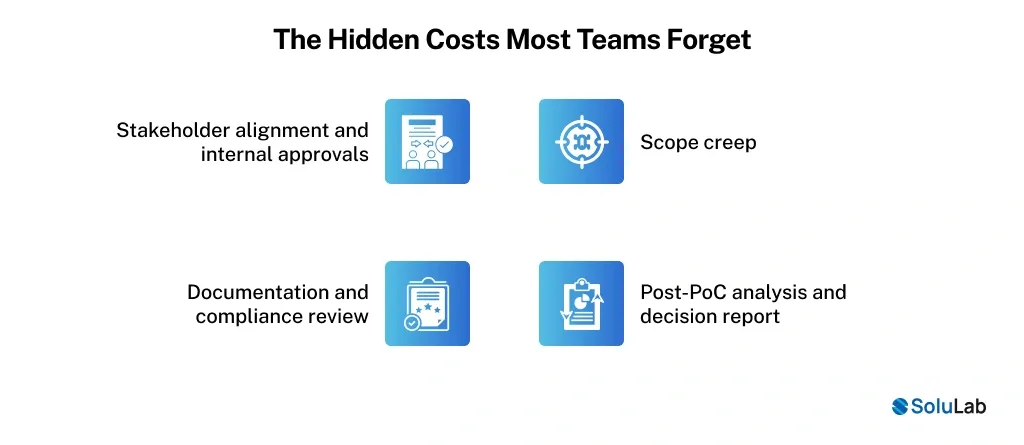
- Stakeholder alignment and internal approvals — especially in large enterprises, this can add weeks
- Documentation and compliance review — required if the PoC touches personal data or financial records
- Scope creep — which happens in almost every PoC when the initial excitement outpaces the original brief
- Post-PoC analysis and decision report — the written deliverable that actually secures production budget
A 10–20% contingency buffer ($3,000–$15,000 depending on PoC size) is not pessimism, it’s just good project management.
Build it in from the start.
What It Actually Costs From Blockchain PoC to Production
A successful PoC proves the idea works. But moving that idea to production is a fundamentally different engineering problem, and this is where many enterprises underestimate the complexity.
Production deployment introduces real-world scale, regulatory compliance, enterprise risk detection platforms, and performance under genuine load. The architecture often needs to be redesigned rather than simply extended, because PoC code is built for validation, not for reliability at scale.
1. Architecture and Network Design
In production, you’re no longer testing, you’re building for hundreds or thousands of concurrent users, potentially across multiple jurisdictions.
This means choosing between public, private, or hybrid blockchain configurations, designing for fault tolerance, and establishing governance models that define who controls node access, permissions, and upgrade cycles.
Network setup alone, including node deployment, consensus configuration, and API access layers, can take six to ten weeks on a complex enterprise implementation. And because this phase involves legal and compliance teams, timelines can extend further.
2. Full Production Cost Breakdown
| Cost Category | Estimated Range |
|---|---|
| Architecture redesign & development | $20,000 – $70,000 |
| Smart contract development & audit | $20,000 – $50,000 |
| Security audit (mandatory for production) | $25,000 – $40,000 |
| UI/UX and frontend development | $5,000 – $15,000 |
| Integration with legacy systems | $15,000 – $35,000 |
| Compliance and legal review | $10,000 – $30,000 |
| Infrastructure (annual, cloud + nodes) | $20,000 – $40,000/yr |
| Ongoing maintenance & support | $15,000 – $30,000/yr |
| Total (Year 1) | $130,000 – $310,000+ |
These numbers can feel significant. But they’re best understood in context: for enterprises where blockchain eliminates intermediary fees, reduces fraud loss, or automates a manual reconciliation process that currently costs a team weeks every quarter, the ROI timeline is often 12–24 months. And for some use cases in trade finance or supply chain, the savings in Year 1 alone offset the blockchain development cost.
Evaluating PoC Results Before Scaling Further
Once the PoC is done, it’s time to analyze the outcomes. Did it perform as expected? Were all test cases successful?
Technical Validation and Use Case Suitability
Teams evaluate if the blockchain model handled data as expected. If it failed under load or missed conditions, the use case might need revision. Scalability tests are run, especially for enterprise-level applications. Security audits are also conducted.
Stakeholder Feedback and Data-Driven Insights
Results are shared with business and technical leadership. Stakeholders check if KPIs were met. They assess the business value created by the PoC. Feedback shapes the final decision—whether to move ahead, revise, or stop entirely.

How to Choose the Right Blockchain PoC Development Partner?
This is, honestly, where most enterprise blockchain decisions go wrong, not in the technology choice, but in the vendor choice. A PoC is a discovery process, and the team you trust with it shapes everything that follows: your budget expectations, your timeline, and whether you end up with a working model or a polished PowerPoint.
Here’s what to actually look for, based on what separates successful enterprise blockchain implementations from costly dead ends:
- Multi-platform expertise, not just Ethereum. A vendor who only builds on one chain will fit your problem to their tool, not the other way around.
- Willingness to say ‘you might not need blockchain.’ Counterintuitively, this is a green flag. It means they’re solving your problem, not selling you a platform.
- PoC deliverables that include documentation, not just code, because getting production budget approved requires a written business case.
- Security-first thinking from day one, including smart contract audit plans built into the PoC phase, not added as an afterthought later.
- References or case studies from your industry, because blockchain in healthcare has very different compliance requirements than blockchain in logistics.
Common Mistakes Enterprises Make that you should Avoid
Because no cost guide is complete without the things that quietly make costs balloon, here are the four mistakes that come up most consistently in enterprise blockchain projects:
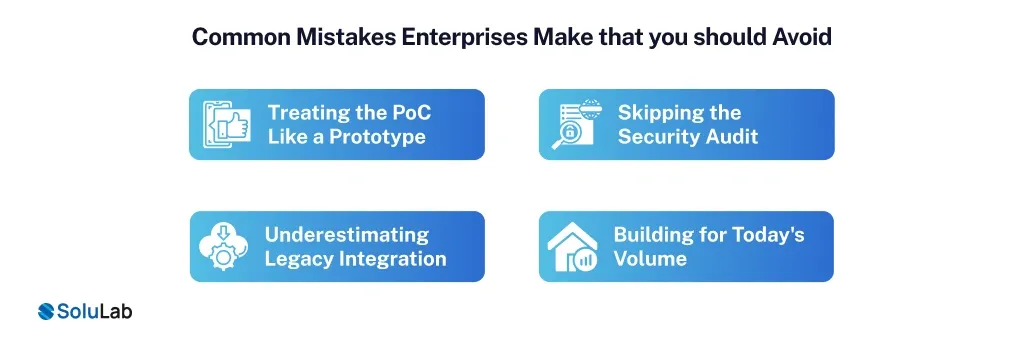
1. Treating the PoC Like a Prototype
A PoC tests feasibility. A prototype tests user experience. These are different goals, and conflating them leads to scope creep, extended timelines, and a PoC budget that’s been quietly used to build a half-finished product. Define the scope before you start, specifically, what questions does this PoC need to answer?
2. Skipping the Security Audit
Smart contracts, once deployed, are essentially immutable. A bug in production isn’t a hotfix – it can mean losing funds or exposing sensitive data permanently. Enterprise PoCs should include, at a minimum, a lightweight security review, and production code must have a formal third-party audit. Budget for this from the start.
3. Underestimating Legacy Integration
The blockchain itself is often the easy part. Getting it to talk to your existing ERP, CRM, or financial systems is where projects genuinely stall. Integration complexity is frequently the highest hidden cost in enterprise blockchain and it’s one that’s very hard to estimate without a technical discovery session.
4. Building for Today’s Volume
A blockchain network designed for current transaction volumes may not handle 5x growth two years from now. Production architecture needs to be designed with scale in mind from the beginning, even if you’re not deploying at scale today. Retrofitting a blockchain network for scalability after the fact is expensive.
Is Blockchain PoC Development Really Worth It?
Perhaps the most honest way to answer this is to look at what happens when enterprises skip it. Projects that go straight to production without a PoC tend to encounter integration failures they didn’t anticipate, budget overruns caused by scope changes mid-build, and, in the worst cases, a completed system that nobody actually uses because the use case wasn’t properly validated.
A PoC that costs $40,000 and takes eight weeks isn’t overhead. It’s insurance. And in most cases, the insights from a well-run PoC actually reduce the total production cost because the architecture decisions made after validation are better than the ones made purely from theory.
The question isn’t really ‘can we afford a PoC?’
It’s ‘Can we afford to skip it?’
If you have made a decision, we have delivered enterprise blockchain solutions across Hyperledger, Ethereum, Polygon, Avalanche, and Solana from initial feasibility through production-grade deployment. If you’re evaluating blockchain for your organisation, start with a conversation with us.
Conclusion
Adopting blockchain isn’t just a technology upgrade—it’s a strategic move that can redefine how your enterprise operates. The journey from PoC to full-scale production demands the right expertise, tailored strategies, and seamless integration with existing systems.
As a trusted blockchain development company, SoluLab empowers enterprises to navigate every stage of their blockchain journey—right from identifying high-impact use cases to building scalable, secure, and cost-effective production-grade solutions. With proven expertise across platforms like Hyperledger, Ethereum, Polygon, Avalanche, and Solana, we ensure your blockchain implementation is future-ready, compliant, and delivers measurable ROI.
Contact us today to transform your business with leading-edge blockchain solutions!
FAQs
Shipra Garg is a tech-focused content strategist and copywriter specializing in Web3, blockchain, and artificial intelligence. She has worked with startups and enterprise teams to craft high-conversion content that bridges deep tech with business impact. Her work translates complex innovations into clear, credible, and engaging narratives that drive growth and build trust in emerging tech markets.