
Digital banking is no longer just about better UI and faster onboarding. It is about building financial infrastructure that competes with global capital flows.
Stablecoins have crossed $150+ billion in circulation globally and continue to grow as enterprises and fintechs adopt blockchain-based payment rails. At the same time, AI is transforming how liquidity, lending, and risk are managed.
When you combine both, you get: AI-powered stablecoin embedded directly inside a Neo Bank App with stablecoin yield functionality.
This is not about crypto speculation. It is about programmable finance. It is about offering smarter returns, 100% global access, and automated risk monitoring within a regulated framework.
For enterprises planning a white-label neo bank launch, this can redefine revenue models and customer retention strategies. Let’s break it down!
Key Takeaways
- Remittance capturing 1–3% of that flow through a Neo Bank App with AI-Powered Stablecoin Yield can significantly expand transaction revenue and deposits.
- In economies facing 6–15% inflation, demand for USD-linked value storage is structural, not speculative. A compliant fiat-backed stablecoin offering meets an existing need.
- Reducing settlement from 2–3 days to near real-time strengthens treasury efficiency and customer satisfaction. Faster cycles mean faster capital reuse.
What exactly is an AI-powered stablecoin yield, and how does it work inside a neo banking app?
An AI-powered stablecoin yield product allows users to earn returns on a fiat-backed stablecoin like USD-pegged digital assets, directly within their banking interface.
Unlike volatile crypto tokens, fiat-backed stablecoins are typically backed 1:1 by reserves such as treasury bills or cash equivalents. This creates stability while enabling blockchain-based settlement.
How AI enhances yield generation
AI-driven engines monitor:
- Liquidity pools
- DeFi lending protocols
- Institutional credit markets
- Treasury yield spreads
- On-chain risk signals
Based on predictive modelling, the system dynamically allocates capital to optimize returns. These are known as AI-optimized stablecoin yields.
Instead of static APY models, allocation adjusts in real time based on market conditions, counterparty risk, and volatility.
How Does it works inside a neo bank?
In a Crypto Neo Bank Platform Like JP Morgan, the user experience is simple:
- User deposits funds
- Funds convert into a stablecoin
- AI engine allocates across yield strategies
- Returns are reflected in the app dashboard
From a customer perspective, it feels like a savings account. From an infrastructure perspective, it is a programmable Stablecoin Yield Banking Platform.
For enterprises building a White-Label Neo Bank App with AI-Powered Stablecoin Yield, this creates a new asset class inside the app without complex user friction.
Why Should A Neo Bank Integrate Stablecoin Yield Instead Of Traditional Savings Products?
Integrating AI-powered stablecoin yield products can transform how neo banks attract customers, enhance engagement, and optimize returns.
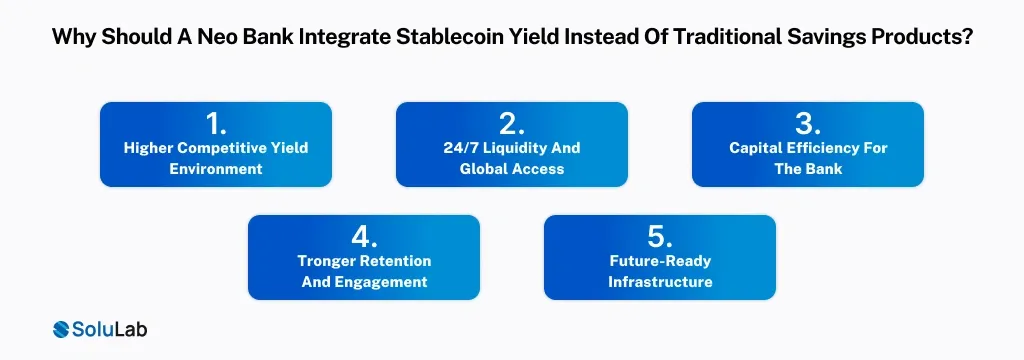
1. Higher competitive yield environment
Traditional bank savings rates in many regions range between 2% to 5%. Stablecoin yield strategies, depending on structure and regulation, can offer competitive returns by accessing global liquidity pools.
This positions a building crypto-friendly neo banking solution as a premium offering.
2. 24/7 liquidity and global access
Traditional banking is bound by clearing cycles. Stablecoin rails operate 24/7. Cross-border transfers that usually take 2–3 days can settle in minutes.
For enterprises operating in multiple geographies, this improves treasury efficiency.
3. Capital efficiency for the bank
With AI allocation models, capital is not sitting idle. This enhances balance sheet utilization while maintaining reserve-backed security structures.
4. Stronger retention and engagement
Yield-bearing accounts increase app stickiness. Users are less likely to withdraw funds when they see dynamic returns and performance dashboards powered by AI analytics.
5. Future-ready infrastructure
As we can see, the neo banking ecosystem is running towards embedded finance, tokenized deposits and coded payments. If you launch a white-label neo baking app with AI powered stabelcoin yield, you can increase your growth by 3x.
Top 5 Strategic Benefits For Users In Emerging Markets And Cross-Border Corridors
Stablecoin yield is not just a feature upgrade. In emerging markets, it can shift how people protect wealth, move money, and access global finance.
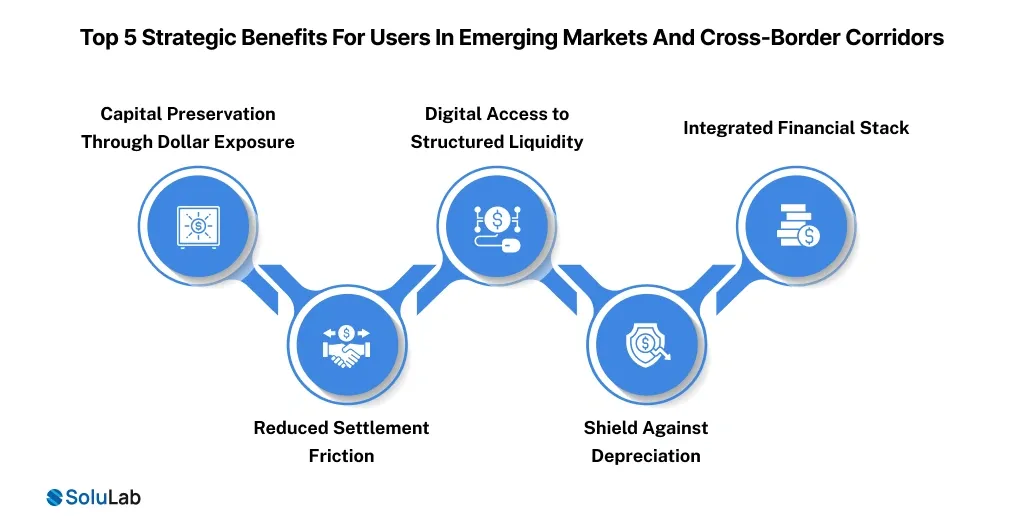
1. Capital Preservation Through Dollar Exposure
In many emerging economies, inflation consistently ranges between 6% and 15%. In extreme cycles, it goes much higher. Traditional savings accounts often fail to keep pace.
Users holding a fiat-backed stablecoin gain indirect exposure to USD-backed reserves without opening offshore accounts.
This matters in regions where:
- Local currencies depreciate 5–20% annually
- Access to dollar banking is restricted
- Capital controls limit foreign currency savings
Stable assets act as a digital safety layer inside a regulated, crypto-friendly neo banking solution.
This combination of stability + yield is what makes AI-powered stablecoin yield strategically powerful in inflation-prone regions.
2. Reduced Settlement Friction
Remittance flows into low and middle-income countries cross hundreds of billions of dollars annually. Many corridors still charge 5–7% in transfer fees and take days to settle.
This means:
- No banking hour dependency
- Faster liquidity access
- Lower correspondent banking layers
For corridors like Gulf to South Asia or the US to Latin America, speed and cost efficiency directly impact household income.
With stablecoins with AI-powered yield strategies, funds can generate returns even during holding periods.
For enterprises building a White-Label Neo Bank App with AI-Powered Stablecoin Yield, this is a differentiated remittance proposition.
3. Digital Access to Structured Liquidity
Through a Stablecoin Yield Banking Platform, users can indirectly access diversified liquidity pools that would otherwise require institutional-level entry.
AI-driven allocation models monitor risk exposure, counterparty strength, and liquidity metrics in real time. This democratizes yield opportunities that were previously limited to institutional investors.
Traditional global investment products require:
- High minimum deposits
- Complex onboarding
- Cross-border compliance procedures
A Customized Crypto Neo Bank Platform simplifies this into a mobile-first interface. This reduces friction while expanding global financial participation.
4. Shield Against Depreciation
When local currencies decline rapidly, savings lose value even without spending.
Holding a fiat-backed stablecoin provides:
- Dollar-denominated stability
- Predictable value storage
- Reduced exposure to sudden devaluation
This is especially relevant in economies facing external debt pressure or trade imbalances.
AI engines can dynamically rebalance allocations based on macro signals, liquidity stress, or yield compression.
In a mature neo banking ecosystem, this becomes a foundational risk mitigation tool rather than just a yield feature.
5. Integrated Financial Stack
A Crypto Neo Bank Platform with AI-Powered Stablecoin Yield can combine:
- Digital identity and KYC
- Wallet infrastructure
- Cross-border transfers
- Micro-lending
- Yield generation
This creates a unified financial experience. In Africa, Southeast Asia, and parts of the Middle East, millions are underbanked but digitally connected.
A well-designed White-Label Neo Bank App with AI-Powered Stablecoin Yield allows users to:
- Store value securely
- Earn returns
- Move funds globally
- Access credit pathways
For enterprises, this is not just inclusion. It is a scalable market expansion.

How Do Different International Regulatory Corridors Shape Stablecoin Yield Products?
Regulation is now defining the growth trajectory of stablecoins.
1. United States
Recent regulatory frameworks require stablecoins to be fully backed by liquid reserves and subject to oversight.
This increases institutional confidence but may limit high-risk yield structures.
Enterprise takeaway: build a compliant architecture from day one using a trusted stablecoin development company.
2. European Union
The MiCA framework mandates transparency, capital requirements, and licensing for stablecoin issuers.
For a White-Label Neo Bank App with AI-Powered Stablecoin Yield, compliance layers must be embedded into the product stack.
3. Middle East
UAE and Bahrain are positioning themselves as fintech hubs with structured crypto licensing regimes.
Yield products targeting Gulf remittance corridors must align with regional virtual asset regulations.
4. Asia-Pacific
Singapore and Japan emphasize consumer protection and reserve transparency. AI-driven yield strategies must include robust risk disclosures and audit trails.
Regulatory Strategy for Enterprises
When building a stablecoin payment platform, enterprises should:
- Integrate automated AML monitoring
- Maintain transparent reserve reporting
- Separate custodial and yield allocation layers
- Conduct third-party audits
A strong regulatory posture increases investor trust and enterprise partnerships.
What Are The Cost And Revenue Implications For A Neobank Launching An AI-Enabled Stablecoin Yield Product?
For enterprises evaluating a white-label neo bank launch, understanding economics is critical.
1. Cost Considerations
- Stablecoin integration and wallet infrastructure
- AI engine development and monitoring tools
- Compliance and licensing
- Cybersecurity and smart contract audits
- Liquidity partnerships
Partnering with an experienced Neo Banking App Development Company reduces time-to-market.
2. Revenue Streams
- Yield spread margins
- Subscription-based premium accounts
- Transaction fees on conversions
- Cross-border transfer margins
- Institutional treasury products
A crypto neo bank platform with AI-powered stablecoin yield diversifies revenue beyond interchange fees.
3. ROI Outlook
With global stablecoin volumes crossing hundreds of billions annually and increasing enterprise adoption, yield-based neo banking can significantly improve:
- Customer lifetime value
- Deposit retention
- Cross-border transaction volume
- Treasury efficiency
Enterprises that integrate AI-driven yield models early will likely capture higher market share in the evolving neo-banking ecosystem.

Conclusion
As discussed, combining stablecoins with AI-driven allocation reshapes how deposits are stored, deployed, and monetized. It improves capital efficiency, strengthens cross-border liquidity, and creates measurable revenue layers inside the neo banking ecosystem.
For enterprises exploring a neo bank app with AI-powered stablecoin yield, SoluLab is here to help you.
- Increase deposit retention by 20–35% through yield-linked balance incentives.
- Reduce cross-border settlement cycles from 2–3 days to near real-time.
- Unlock new margin layers beyond traditional 1–2% interchange spreads.
With our 250+ developers, we are here to make your vision come true. Contact us today to know our stablecoin platform development services and solutions.
FAQs
Deepika is a content writer who blends storytelling with strategic thinking. She explores topics across digital innovation, emerging tech, and the evolving blockchain industry. She enjoys breaking down complex ideas into simple, engaging narratives in the growing global markets.