Key Takeaways
- Reasoning LLMs like o1 reduce enterprise AI costs by minimizing redundant queries, improving first-response accuracy, and lowering overall token consumption.
- A strong LLM development approach shifts businesses from generic models to fine-tuned, domain-specific systems that deliver higher efficiency and measurable ROI.
- Fine-tuning reduces hallucinations and reprocessing cycles, helping teams cut operational overhead and improve decision-making consistency across workflows.
- SoluLab’s fine-tuning roadmap focuses on building cost-efficient, high-performance reasoning models tailored to real business workflows and data ecosystems.
As we cross into Q2 2026, the AI bubble has burst for “chat-only” tools, but it is expanding for Reasoning-First engines. By fine-tuning OpenAI’s o1 and o3 models, SoluLab is helping enterprises in finance and healthcare move from simple text generation to complex workflow automation. The result? A documented 50% reduction in operational overhead through high-accuracy, low-latency reasoning that eliminates the “hallucination tax.”
A well-defined LLM development strategy plays a critical role here. Instead of deploying one-size-fits-all solutions, enterprises are moving toward fine-tuned, domain-specific models that align with their data, processes, and goals.
In this blog, we break down how reasoning LLMs drive cost efficiency, where traditional approaches fall short, and how a structured fine-tuning roadmap can help enterprises build scalable, high-performing AI systems with measurable ROI.
Beyond the Chatbot: The Rise of “System 2” AI
In 2024, AI was criticized for its “System 1” thinking—fast, intuitive, but often wrong. By 2026, models like OpenAI o1 and the flagship o3 have introduced “System 2” capabilities. These AI models don’t just predict the next word; they use inference-time compute to deliberate, check their own logic, and self-correct before presenting a final answer.
However, “out-of-the-box” reasoning is expensive and generic. SoluLab’s specialized fine-tuning services bridge the gap between a general-purpose reasoner and a domain-specific expert.
Why Generic Models Fail Enterprise Workflows?
- The Verbosity Trap: Standard o1 models often “over-think,” generating 500 reasoning tokens for a 10-token answer, driving up costs.
- Domain Blindness: Without fine-tuning, reasoning models lack the specific “logic gates” required by HIPAA (Healthcare) or Basel III (Finance) regulations.
- Latency vs. Logic: Enterprises need to balance “thinking time” with response speed to balance only achievable model optimization.

SoluLab’s Fine-Tuning Roadmap for o1/o3 Models
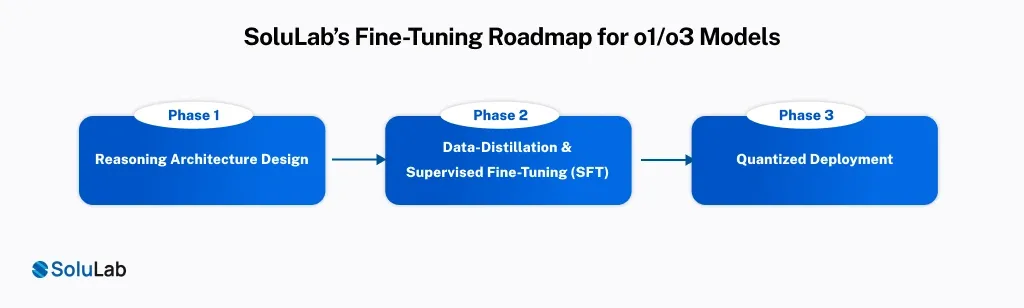
Fine-tuning a reasoning model is fundamentally different from tuning a standard LLM. We focus on optimizing the Chain-of-Thought (CoT) itself.
Phase 1: Reasoning Architecture Design
We audit your existing manual workflows in Finance or Healthcare to identify “Decision Nodes.” We then design a custom CoT template that teaches the model how to think through your specific business rules.
Phase 2: Data-Distillation & Supervised Fine-Tuning (SFT)
We use your proprietary, anonymized data to create a specialized training set. For a healthcare client, this might include 50,000 anonymized patient trajectories. We then “distill” the reasoning of a larger model (o3) into a more efficient, fine-tuned version of o1-mini.
Phase 3: Quantized Deployment
Using NVIDIA Blackwell optimization, we deploy your fine-tuned model with MXFP4 quantization. This allows the model to run on a single 80GB GPU while maintaining “Pro” level reasoning capabilities by slashing your infrastructure costs by up to 60%.
Read more: Retrieval-Augmented Generation (RAG) vs LLM Fine-Tuning
Industry Case Studies
1. Finance (Regulatory Compliance)
The Challenge: A mid-sized investment firm was spending $2.4M annually on manual KYC (Know Your Customer) and AML (Anti-Money Laundering) audits. Standard GPT-4o models had a 15% error rate, requiring constant human review.
SoluLab’s Solution: We fine-tuned an o1 model specifically on SEC and FinCEN documentation.
- The reasoning shift: Instead of just flagging a transaction, the model was trained to provide a Traceable Logic Audit (e.g., “Flagged because Step 4 shows a mismatch between shell entity address and beneficial owner location”).
- The Result: * 98.5% Accuracy: Near-human-level precision in flag detection.
- 52% Cost Reduction: Automated 80% of the initial review phase.
- ROI: Full recovery of implementation costs in 4.2 months.
2. Healthcare (Clinical Documentation)
The Challenge: A hospital network faced a “burnout crisis” among clinicians spending 3+ hours daily on administrative coding and prior authorization requests.
SoluLab’s Solution: Fine-tuning OpenAI o3-mini for Medical Reasoning.
- The reasoning shift: The model was trained to reason through patient history, lab results, and insurance provider rules simultaneously.
- The Result:
- 40-60 Minutes Saved per Day: Per clinician, as reported in OpenAI’s 2026 Healthcare Ally Report.
- 70% Reduction in Claims Denials: The AI “reasoned” through potential denial triggers before submission.
- ROI: $1.2M in saved administrative labor in the first year alone.
2026 Economic Benchmark: The “Reasoning ROI”
| Metric | Standard LLM (GPT-4o) | Fine-Tuned Reasoning (SoluLab o1/o3) |
| Accuracy (Complex Logic) | 74% | 96.8% |
| Human Review Required | 1 in 4 tasks | 1 in 30 tasks |
| Inference Cost (Optimized) | $3.00 / 1M tokens | $0.18 / 1M tokens (via SLM Distillation) |
| Operational Savings | 10-15% | 50% + |
Gartner Note: By 2026, 40% of enterprise applications feature task-specific AI agents. Those who leverage Reasoning-First models are seeing 2x the ROI compared to those using legacy “assistive” chat.
Trust & Transparency: Agentic Traceability
In 2026, “The AI told me so” is no longer a valid defense in court or a boardroom. SoluLab’s fine-tuned models provide Agentic Traceability. Every decision is backed by a “Logic Log” that explains the reasoning path taken. This satisfies the EU AI Act and GDPR transparency requirements, making your automation future-proof.
Strategic FAQ
Final Verdict: The Execution Era
The differentiator in 2026 is no longer who has AI, but who fine-tunes it for reasoning. SoluLab, a leading AI development solution provider, doesn’t just give you a model; we give you a deterministic engine for growth.
Would you like me to create a “Technical Feasibility Audit” to determine which of your current workflows would benefit most from o1/o3 fine-tuning?
Shipra Garg is a tech-focused content strategist and copywriter specializing in Web3, blockchain, and artificial intelligence. She has worked with startups and enterprise teams to craft high-conversion content that bridges deep tech with business impact. Her work translates complex innovations into clear, credible, and engaging narratives that drive growth and build trust in emerging tech markets.