Building a financial product and not sure whether to go the traditional route or the blockchain-native one? That choice used to be simple. Payments, lending, borrowing — all of that ran through banks and established institutions, and that was that.
Then blockchain technology showed up and changed the framing entirely. Crypto did more than create a new kind of money. It split the financial stack into two competing models: Decentralized Finance (DeFi) and Centralized Finance (CeFi).
The global DeFi market was valued at USD 20.48 billion in 2024, and analysts expect it to grow at a 53.7% clip from 2025 through 2030. That’s not a niche anymore.
This post breaks down what each model actually is, how they differ, and where both are headed. Let’s get into it.
What is Centralized Finance (CeFi)?
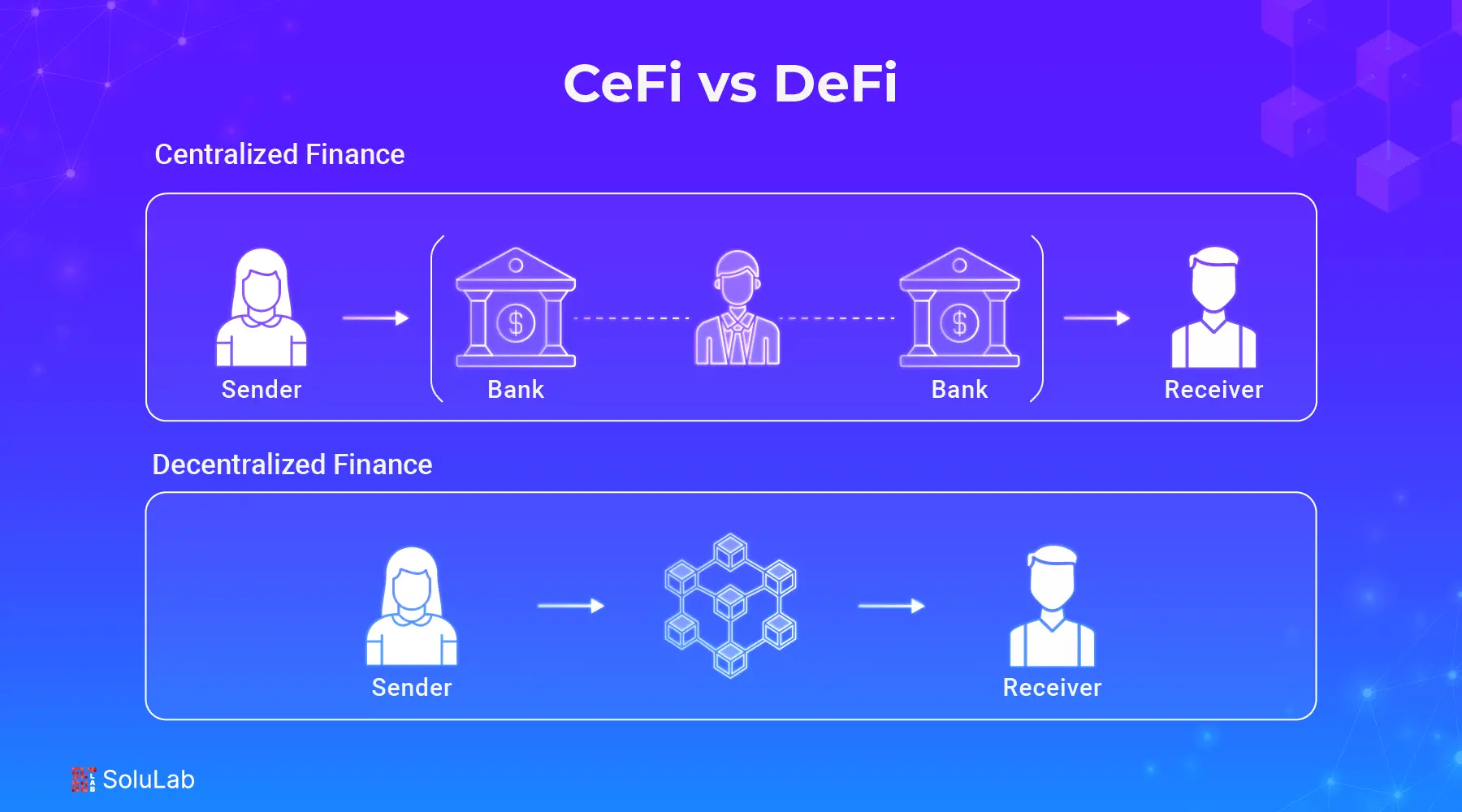
CeFi is the system most people already live inside. Banks, brokerages, payment processors — these are all CeFi. They sit in the middle of every transaction, moving money, maintaining records, and keeping the system running. That middleman role is both CeFi’s core function and its biggest structural constraint. A handful of large institutions end up holding a lot of power.
That said, CeFi does some things well. User-friendly interfaces, regulatory protection, insured deposits, customer support — these matter, especially for people who aren’t crypto-native. Plenty of users still trust CeFi precisely because of the oversight. But as blockchain matures, more teams are also exploring what a Decentralized finance development company can offer them in terms of transparent, automated alternatives.
- Depend on middlemen to handle money and smooth transactions.
- Legal supervision and regulatory adherence to safeguard users.
- Financial services with well-established procedures and user-friendly interfaces.
- Centralized authority over financial operations and decision-making.
- Limited openness regarding fee structures and operations.
Here are some examples of CeFi platforms:
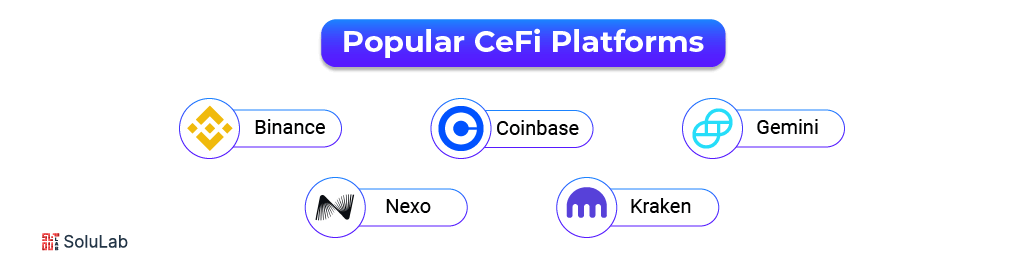
- Binance
- Coinbase
- Gemini
- Kraken
- Nexo
What is Decentralized Finance (DeFi)?
DeFi is built on a different premise entirely. At its core is Decentralized finance, or DeFi. Instead of a bank processing your loan, a smart contract does it. Smart contracts are self-executing programs that run when conditions are met, no human approval required, no office hours, no counter-party risk from an employee making a bad call.
The structural shift is significant. Anyone with an internet connection can participate. No credit check. No geographic restriction. No account approval. Decentralized finance companies are driving this forward, building open financial services that cut out the intermediary layer entirely, which makes the whole system more accessible by design.
- The removal of middlemen allows for P2P transactions to occur directly.
- Transparency is achieved by making blockchain records available to the public.
- Unrestricted access to services without requiring authorization or identification.
- Financial items that can be programmed and customized with smart contracts.
Here are some examples of DeFi platforms:
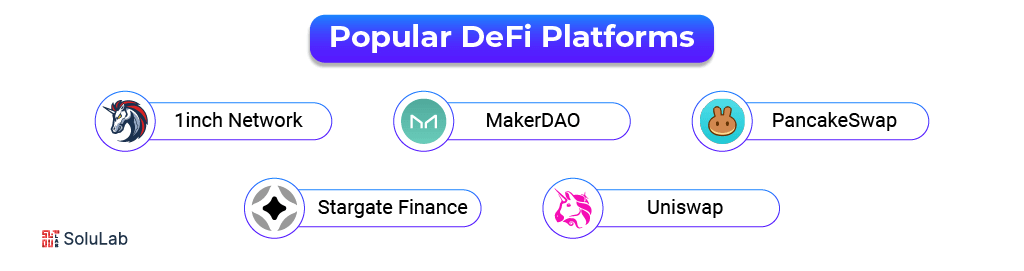
- 1inch Network
- MakerDAO
- PancakeSwap
- Stargate Finance
- Uniswap
Read More: How to Build DeFi Apps from Scratch?
DeFi vs CeFi: Key Differences
Here’s the real question underneath all the comparisons: do you trust people, or do you trust code?
With DeFi, you’re betting that the protocol does what it says. With CeFi, you’re betting that the institution behind it does. Both bets carry real risk. Neither is a free pass.
Both systems offer crypto-linked financial services, but the way they deliver them is quite different. Here’s a side-by-side breakdown of what sets them apart.
| Attributes | DeFi | CeFi |
| Funds Custody | The user has complete authority over funds custody. | Outside of the user’s custody |
| Services available | Borrowing, Lending, Payments, Trading | Trading, Borrowing, Fiat-to-crypto, Payments and Lending |
| Personal Information | Proof of Work | Pluggable Framework |
| Security | Not accountable for funds. | Vulnerable in case of security bridges on the exchange. |
| Market Cap | $16 billion | $324 billion |
| Customer Service | NA | Provided by major changes. |
| Risk Factor | Security relies on the technology you are using. | Centralized exchanges are responsible for security. |
1. Atomicity
DeFi transactions are atomic. They either complete fully or revert entirely — there’s no such thing as a half-processed state. That guarantee comes from smart contracts, and it eliminates a whole class of failure modes. In CeFi, settlement can take time and passes through multiple parties, which creates real windows for delays and partial processing.
2. Custody
In DeFi, your assets stay in your wallet. Non-custodial by default, no third party holding your funds. CeFi flips that: the platform holds your assets for you. Convenient, yes. But you’re trusting a company with your money, and if that company gets hacked or goes under, that trust has real consequences.
3. Transaction Cost
DeFi costs depend on network load. On Ethereum, gas fees can spike sharply during congestion — sometimes to the point where a small transaction doesn’t make economic sense. CeFi fees are usually fixed and easier to predict, though they can run higher overall because of the infrastructure sitting behind them.
4. Security
DeFi security lives in the code. A vulnerability in a smart contract is a real attack surface, and exploits have cost users significant funds. CeFi security runs through traditional systems, but those systems have their own history of hacks, insider fraud, and data breaches. Neither model has a clean track record.
Read Also: Key Green Finance Trends
Future of CeFi and DeFi
The future isn’t one model winning and the other disappearing. Most serious observers expect these two systems to converge rather than compete. CeFi brings the user experience, the compliance infrastructure, and the trust that mainstream adoption requires. DeFi brings self-custody, permissionless access, and yield mechanisms that traditional finance can’t easily replicate.
Decentralized finance platforms are already at the center of this shift, running transparent, open services that don’t require an account manager. As regulation catches up and blockchain technology matures, the realistic path forward is deeper integration: CeFi institutions pulling in DeFi protocols to offer better yields and more flexibility to their users.
That combination — CeFi’s security guardrails with DeFi’s programmability — could produce a financial layer that’s more open than the one we have today. That’s not guaranteed. But it’s the direction things are moving.
Conclusion
CeFi and DeFi are solving the same problem from opposite angles: how do you move value reliably, at scale, across the world? CeFi does it through trusted intermediaries and regulated infrastructure. DeFi does it through code, public ledgers, and economic incentives baked into the protocol.
Neither is a clean winner. DeFi protocols often allow flexible transaction ordering, which opens the door for both innovation and manipulation — a real tradeoff that teams need to think through. The right choice depends on who your users are, what your regulatory exposure looks like, and how much control you want to hand over to a protocol versus retain in your own system.
SoluLab, a DeFi Development Company, can help you pick the right one as per your requirements. Contact us today to discuss further!
FAQs
1. Which is more secure, DeFi or CeFi?
CeFi is generally seen as more secure for most users, mostly because of regulatory oversight and deposit insurance. DeFi gives you full transparency and removes institutional counter-party risk, but smart contract bugs are a genuine exposure. The honest answer: both have been exploited; the risk type is just different.
2. What are the transaction costs in DeFi and CeFi?
DeFi cuts out the intermediary layer, so base fees are often lower — but they fluctuate with network congestion. CeFi fees are more predictable and tend to be higher on average because you’re paying for the infrastructure and support behind them. Unlike centralized crypto exchanges, decentralized platforms don’t have fixed fee schedules, so costs can move a lot depending on which chain and how busy it is.
3. Can I access DeFi and CeFi globally?
Broadly, yes. DeFi is borderless by design — if you have a wallet and an internet connection, you can use it. CeFi platforms often have geographic restrictions or KYC requirements that block access in certain regions.
4. Is DeFi or CeFi better for beginners?
CeFi is the easier starting point. Familiar interfaces, customer support, and regulated accounts lower the barrier significantly. DeFi rewards users who understand wallets, gas, and how protocols actually work — getting it wrong can mean losing funds with no recourse.
5. What is the role of intermediaries in CeFi?
In CeFi, banks, credit institutions, and payment processors handle the plumbing: transaction processing, record-keeping, compliance. They are the system. A Decentralized Finance (DeFi) development company builds alternatives that replace that layer with blockchain and smart contracts, so the protocol itself does what the intermediary used to do.
Shipra Garg is a tech-focused content strategist and copywriter specializing in Web3, blockchain, and artificial intelligence. She has worked with startups and enterprise teams to craft high-conversion content that bridges deep tech with business impact. Her work translates complex innovations into clear, credible, and engaging narratives that drive growth and build trust in emerging tech markets.