Your bank shuts at five. Your transfer clears on Tuesday, maybe. And somebody in the middle takes a slice at every hop, though nobody ever sends you an itemised bill for it. Decentralized Finance, or DeFi, throws out that arrangement entirely. No intermediaries. Open-source protocols anyone can read. Access that does not ask which passport you hold. Lending, borrowing, insurance, asset management: all of it is being rebuilt in the open.
Today, you can take a loan with no bank involved, earn passive income by staking crypto, or trade at three in the morning on a Sunday, all from a phone. And the surface keeps growing. Decentralized identification systems, cross-chain integrations, AI-powered investing tools: these were fringe experiments not long ago. They are not fringe anymore.
The global DeFi market is projected to grow at a CAGR of roughly 49%, reaching $351.8 bn by 2031. So this blog covers three things: why DeFi is pulling in users now, how the machinery actually works, and what is coming next. Let’s get into it.
Why is DeFi’s popularity rising now?
Because it removes the things people quietly resent about traditional finance. The interest rates on lending and borrowing run noticeably better than what a bank will quote you, which is the first thing most newcomers notice. The second thing is who gets in. Plenty of people never clear a bank’s qualifying criteria, through no fault of their own, and a protocol does not run that check.
Then there is the openness. Every blockchain transaction sits in a public record that anyone can inspect. Put those together, wider inclusion, fewer gatekeepers, higher return potential, and the explosive growth stops looking mysterious.
Core Pillars of DeFi: What Investors Should Know?
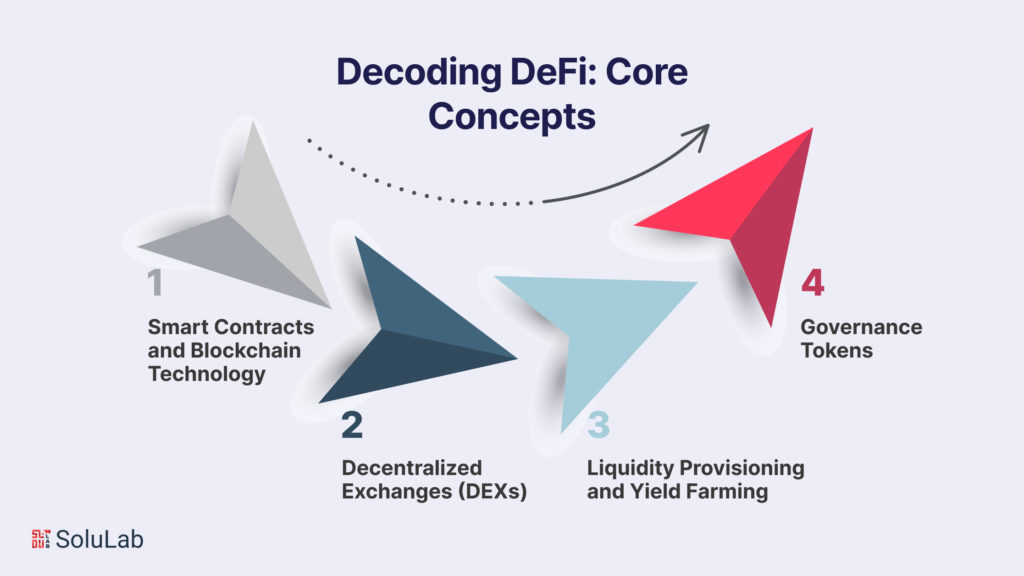
You cannot read DeFi trends properly without the plumbing underneath them. DeFi is not a buzzword, whatever the 2021 marketing did to it; it is a set of interlocking parts built on blockchain technology, and the trends later in this piece only make sense if you know those parts. So here they are, plainly.
Smart Contracts and Blockchain Technology
Smart contracts sit at the centre of all of it. They are self-executing agreements with the terms written directly into code, which means the transaction fires the moment the predefined conditions are met and not a second before. No approval queue. No officer reviewing your file. Ethereum, a blockchain platforms designed to support smart contracts, became the epicenter of DeFi’s growth for exactly this reason. Lending, borrowing, trading: the contract does the job that a bank or a financial institution used to charge for.
Blockchain technology handles the other half. It is the decentralized, immutable ledger that DeFi solutions run on, with transactions and data stored across a network of computers rather than one company’s server. That is where transparency and security come from. It is also why DeFi transactions are described as trustless: two parties who have no reason to trust each other can still transact, because neither of them has to.
Decentralized Exchanges (DEXs)
Decentralized exchanges are load-bearing here. They let users trade cryptocurrencies directly with each other, with no centralized intermediary sitting in the middle holding the money. Smart contracts run the matching and settlement, so peer-to-peer trading happens while every user keeps control of their own funds. Counterparty risk drops sharply as a result, and so does the size of the target that an attacker gets to aim at.
Liquidity Provisioning and Yield Farming
Liquidity provisioning means supplying assets to a decentralized exchange so that other people have something to trade against. You get paid for it, in fees and rewards. Yield farming takes the same idea further, shuffling those assets around to squeeze out the best available return. Interest, lending fees, governance tokens: that is the menu for anyone participating in liquidity provision and yield farming protocols. In practice this is where returns look most attractive on paper and where people most often underestimate the risk.
Governance Tokens
Governance tokens are voting rights, essentially. Hold them and you get a say in proposed changes, upgrades and alterations to the protocol. It is a democratic setup, at least structurally, and it hands the community real influence over how DeFi lending platforms gets developed and managed rather than leaving that with a boardroom.
Learn these four and the rest of DeFi stops feeling arbitrary. Everything built on top, every product and service the sector advertises, is some recombination of them. Keep them in mind for the next section, because each trend below traces straight back to one.

Top DeFi Trends to Look for in 2026
Decentralized Finance (DeFi) is moving quickly in 2026, and it is rewriting how borrowing, lending, trading and earning actually work. Seven trends are doing most of that work:
1. Real-World Asset Tokenization: Real estate, gold, bonds. DeFi is putting them on-chain as tokens, which drags liquidity into markets that were historically slow and clubby. The side effect matters more than the headline: fractional ownership means an investor anywhere can hold a slice of something they could never have bought whole.
2. Mobile-First DeFi Apps: DeFi is growing fastest in emerging markets like India, where the phone is the computer. Builders have noticed. Mobile-first platforms are arriving with cleaner interfaces and onboarding that does not assume you already know what a seed phrase is.
3. DeFi Regulation Frameworks: The posture has shifted from banning to regulating. The U.S., the UK and India are all working through compliance tooling, trying to protect investors without smothering the thing they are regulating. Whether they get that balance right is the open question of the decade.
4. AI-Powered DeFi Bots: AI is being wired into DeFi protocols for risk management, automated trading and lending decisions. The pitch is a platform that is both smarter and safer for the person using it.
5. Insurance & Risk Mitigation: More platforms now ship with insurance built in, covering smart contract failures and hacks. It reads like a small feature. It is not. Trust is the bottleneck on long-term adoption, and this is the first serious attempt to buy some.
6. Cross-Chain Interoperability: Interoperability protocols are making it far easier to move assets between blockchains. Picking a chain no longer means marrying it.
7. Stablecoin Innovation: Beyond USDT and USDC, 2026 is bringing a wave of algorithmic and CBDC-backed stablecoins. Payments settle more efficiently and the volatility risk that scares people away from DeFi gets dialled down.
Future of DeFi: How Will It Evolve Beyond 2026?
The future of DeFi could genuinely reorder how global finance works. A handful of developments will decide how far it gets, and they are worth watching individually rather than as one blur.
Scalability and Layer 2 Solutions
Scalability is the sore spot. Ethereum carries most DeFi projects and has spent years choking on high gas fees and network congestion, which prices out exactly the small users DeFi claims to serve. Layer 2 solutions are the response: Optimistic Rollups and zk-Rollups, mainly. Both aim to make Ethereum and other blockchain networks cheaper and faster to use, which is the difference between DeFi being a curiosity and DeFi being usable.
DeFi in Traditional Finance
DeFi does not sit in its own corner any longer. It keeps crossing into traditional DeFi and the future of finance, and the institutions that once dismissed it are now doing the arithmetic on lower operational costs, better transparency and broader access to financial services. Expect more partnerships, more integrations, more joint projects between DeFi protocols and established financial firms. Some of those will be genuine. Some will be press releases.
AI-Powered DeFi Solutions
Wiring artificial intelligence into DeFi platforms changes what an ordinary investor can do alone. The algorithms analyse risk, forecast returns, run portfolio strategies on autopilot and flag suspicious activity as it happens rather than three days later. Picture a DeFi assistant that never stops reading the data, the market sentiment and the yield opportunities on your behalf, so decisions get made quickly by someone who is not a protocol engineer.
Rise of Decentralized Identity (DID)
Mainstream adoption runs into regulation and compliance sooner or later, and Decentralized Identity (DID) is how the sector plans to answer that without giving up the thing that makes it distinct. DID lets you prove who you are without surrendering your personal data to a central authority. Credentials are verifiable and stored on-chain, so you can use compliant DeFi services while keeping privacy and control. Secure, user-owned financial identities that travel across platforms and blockchains: that is the prize, and nothing else in the compliance debate gets you there.
Use Cases Beyond Lending and Trading
Lending and trading got DeFi this far, but the menu is widening. Secure DeFi Smart Contract Development is behind newer categories: decentralized insurance, prediction markets, decentralized identity solutions. Each one takes a service that used to live inside a centralized institution and rebuilds it as code. That is the pattern to watch, and it has not run out of targets yet.
Risks and Security Considerations
Now the uncomfortable part. As the DeFi ecosystem expands, so does everything that can go wrong inside it. Smart contract vulnerabilities, hacks and outright scams are not hypothetical; money has been lost, repeatedly, in ways that were entirely preventable. Users and project teams both have to treat security as the first question rather than the last one. Decentralized insurance and on-chain risk management tools are a real step toward containing the damage, though they are not a substitute for reading what you are signing.

Conclusion
More people are on decentralized platforms than a year ago, the tooling around them is smarter, and staying safe has stopped requiring a security background. That combination is what turns DeFi into a real alternative to a bank account. Loans without an application queue. Cross-border payments that land in minutes. The interfaces have finally caught up with the promise.
And as the line between DeFi and ordinary finance keeps blurring, the destination looks like this: you hold your own money, you move it on your own terms, and nobody has to approve it first. Plenty of people who watch this sector closely think that is where financial services end up.
If you want decentralized finance inside your own business rather than on a slide about it, SoluLab, a top DeFi development company in the USA, builds exactly that. Contact us today to discuss further!
FAQs
Shipra Garg is a tech-focused content strategist and copywriter specializing in Web3, blockchain, and artificial intelligence. She has worked with startups and enterprise teams to craft high-conversion content that bridges deep tech with business impact. Her work translates complex innovations into clear, credible, and engaging narratives that drive growth and build trust in emerging tech markets.