Key Takeaways
- Static fee tiers are giving way to dynamic fees that adjust in real-time based on volatility, volume, or market conditions (e.g., Uniswap V4’s “hooks” allow custom fee logic per pool)
- MEV (Maximal Extractable Value) is an often-overlooked “hidden fee” — value extracted by bots/validators reordering or front-running transactions, effectively taxing users beyond stated fees
- Some protocols now offer fee rebates or gas refunds in their native token to offset costs and boost retention
- Cross-chain and L2 fee comparisons are becoming a competitive differentiator, with protocols marketing “true cost per swap” across chains
DeFi fee structures are the set of charges a user pays when interacting with a decentralized finance protocol. The three main types are protocol fees (kept by the protocol or its token holders), liquidity provider fees on swaps, and network gas fees paid to validators. Context-specific charges like withdrawal, performance, borrow interest, and flash-loan fees also apply.
SoluLab builds decentralized finance systems where the fee model is coded directly into the smart contracts, from swap fees to treasury splits. If you are planning a protocol and need the economics to hold up, our DeFi development company team designs and audits fee logic before you go live.

What are DeFi fee structures?
DeFi fee structures are the rules that decide who pays a charge, how much, and who receives it every time someone swaps, lends, borrows, or moves assets on a protocol. Unlike a bank, no single company sets these fees. They are written into open smart contracts and split between three groups: the people who supply liquidity, the protocol treasury or token holders, and the network validators who process the transaction.
Ethereum’s own documentation frames DeFi as financial services where “you keep the profit minus the transaction fee,” which captures the core idea: every action carries a cost, and that cost is transparent and on-chain Ethereum Foundation. Understanding the fee taxonomy matters before you pick a protocol to use or decide to build one.
What are the main types of fees in DeFi?
There are seven common fee types in DeFi: protocol fees, liquidity provider (swap) fees, gas fees, withdrawal fees, performance fees, borrow interest, and flash-loan fees. Not every protocol charges all seven. A decentralized exchange leans on swap and gas fees, while a lending market runs on borrow interest and, sometimes, flash-loan premiums.
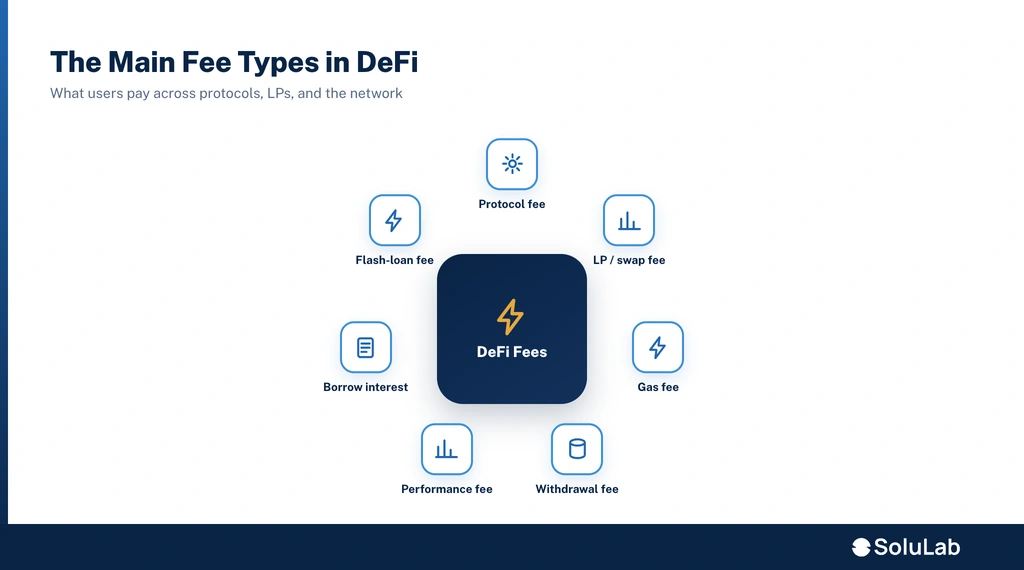
Here is how they compare by who pays, who earns, and where you see them:
| Fee type | Who pays | Who earns | Typical range [VERIFY] | Example protocol |
|---|---|---|---|---|
| Protocol fee | Trader or user | Protocol treasury / token holders | A share of the swap fee, e.g. 1/6 of it | Uniswap, Aave |
| LP / swap fee | Trader | Liquidity providers | 0.01% to 1% per trade | Uniswap, Curve |
| Gas fee | Transaction sender | Validators / network | Varies with network demand | Ethereum, Layer 2s |
| Withdrawal fee | Withdrawing user | Protocol or vault | Protocol-specific [VERIFY] | Various vaults |
| Performance fee | Depositor | Vault / strategy manager | A cut of profit earned [VERIFY] | Yield vaults |
| Borrow interest | Borrower | Lenders / suppliers | Variable, set by utilization | Aave |
| Flash-loan fee | Flash-loan user | Protocol | 0.05% to 0.09% of amount [VERIFY] | Aave |
The percentages above come from protocol documentation cited later in this guide. Live rates change through governance, so confirm current numbers on the protocol’s own docs before you act on them.
What is a protocol fee and who earns it?
A protocol fee is the cut a DeFi protocol keeps for itself, separate from what it pays liquidity providers. It funds the treasury, rewards token holders, or both, depending on how the protocol’s governance has voted.
On Uniswap, the protocol fee is a fraction of the swap fee rather than an extra charge. When it is switched on, the protocol fee is set at one-sixth of the pool’s swap fee, so a 0.30% pool would route 0.05% to the protocol and leave the rest for LPs. Whether that switch is active is a governance decision, which is why “who earns the fee” can change over a protocol’s life. On lending markets like Aave, part of borrower interest and flash-loan premiums flows to the protocol as reserve revenue instead of going entirely to suppliers.
What are liquidity provider (LP) fees and how do they work?
Liquidity provider fees are the trading fees a decentralized exchange charges on each swap and pays to the users who deposited tokens into the pool. LPs take on price risk by supplying both sides of a pair, and the swap fee is their compensation.
Uniswap v3 offers four fee tiers, 0.01%, 0.05%, 0.30%, and 1%, so pools can match the fee to how volatile the pair is Uniswap Labs. Stable pairs sit in the low tiers; volatile or exotic pairs use higher ones. Curve, built for stablecoin and pegged-asset swaps, typically charges a low fee and splits it between LPs and the protocol. Across decentralized exchanges, trading fees usually fall in a roughly 0.01% to 0.30% band, and those fees are either distributed to liquidity providers or shared with the protocol.
How do gas fees work in DeFi?
Gas fees are what you pay the network, not the protocol, to have validators include and execute your transaction. On Ethereum they are the reason a simple swap can cost more than the swap fee itself during busy periods.
Since the EIP-1559 upgrade, an Ethereum transaction fee has two parts: a base fee that the protocol sets per block and burns, plus an optional priority fee (tip) that goes to the validator. The base fee “increases when blocks are above the gas target, and decreases when blocks are below it, so the cost tracks live demand. You pay base fee plus tip, multiplied by the gas your transaction uses. Complex DeFi actions, like a multi-step yield strategy, use more gas than a plain transfer, so they cost more even at the same gas price.
How do DeFi fees differ across chains and Layer 2s?
DeFi fees differ most on the gas side. Protocol and LP fees are usually similar percentages wherever a protocol deploys, but the network cost to transact can differ by orders of magnitude between Ethereum mainnet and a Layer 2.
Layer 2 rollups batch many transactions and settle them together on Ethereum, so each user shares the L1 cost instead of paying it in full. As Ethereum’s documentation puts it, “by combining multiple transactions into a single transaction on layer 1, transaction fees are massively reduced” Ethereum Foundation. The practical result: the same swap that costs several dollars in gas on mainnet during congestion can cost a fraction of that on a rollup. That is why fee-sensitive DeFi activity, small trades, frequent rebalancing, gaming, has migrated to Layer 2s. The protocol and LP fees you pay stay roughly constant; the gas overhead is what collapses.
How can you track and compare DeFi fees?
You can track live DeFi fees and revenue with public analytics dashboards, then confirm exact rates against each protocol’s own documentation. Dashboards show what protocols actually earn; docs tell you how a fee is defined.
DeFiLlama publishes a fees-and-revenue ranking across protocols, and Token Terminal reports fees as trading and flash-loan volumes multiplied by their pool fee tiers Token Terminal. Those two are the standard starting points for comparing protocols on a like-for-like basis. For a specific number you plan to rely on, such as a swap tier or a borrow rate, read the protocol’s developer docs rather than a third-party figure, because governance can change fees at any time.
How do fee structures affect DeFi protocol revenue?
Fee design is the revenue model of a DeFi protocol. The split between what LPs keep and what the treasury takes determines whether the protocol can fund development, reward token holders, and survive a bear market without inflating its token.
Set the LP share too low and liquidity leaves for a competing pool; set the protocol cut too high and traders route around you. Academic work on DeFi adoption finds that “user adoption is significantly influenced by fee structure and network efficiency,” so the numbers you pick are not just accounting, they shape growth in IEEE Xplore. Sustainable protocols tie fees to real usage, revenue that scales with volume rather than emissions that dilute holders, and they keep a reserve from protocol fees to cover audits, insurance, and shortfall events. This is exactly the trade-off a founder faces: what fee model makes a DeFi protocol sustainable and compliant.
How does SoluLab help design DeFi fee models?
SoluLab designs and codes DeFi fee logic into the smart contracts, from swap-fee tiers and LP splits to treasury routing and flash-loan premiums, then audits it before deployment. The goal is a fee model that funds the protocol without pushing liquidity or traders away.
SoluLab has built production blockchain systems since 2014 across Ethereum, Polygon, Solana, Hyperledger Fabric, Avalanche, and Aptos SoluLab and has delivered DeFi development solutions for protocols managing over $3B in total value locked. If your protocol earns yield for depositors, our DeFi yield farming development company team builds the vault and performance-fee logic; for the underlying chain and contract work, our blockchain development company practice handles the base layer. Teams moving from a centralized product into on-chain finance often start with our Web3 development company services to scope the stack first.
FAQs
Shipra Garg is a tech-focused content strategist and copywriter specializing in Web3, blockchain, and artificial intelligence. She has worked with startups and enterprise teams to craft high-conversion content that bridges deep tech with business impact. Her work translates complex innovations into clear, credible, and engaging narratives that drive growth and build trust in emerging tech markets.