Key Takeaways
- A DeFi order-book exchange matches discrete bids and asks instead of pricing trades against a pooled curve, which is why it delivers tighter spreads, limit orders, and real depth signals that AMMs structurally cannot offer.
- The matching engine is not the hard part. Risk is. Perps require an oracle strategy, a funding-rate mechanism, a margin engine, and a liquidation path that survives volatile blocks, and this is where most builds slip their timeline.
- MEV and front-running have to be designed out, not patched later. Batch auctions, encrypted mempools, private sequencing, and priority-fee rules all change your book’s fairness profile and should be decided during architecture, not after launch.
- Liquidity is a cold-start problem, not a marketing problem. Budget for a market-maker program, a FIX or low-latency API tier, maker rebates, and incentive emissions before launch day, because a book with no depth reads as a broken product.
- Compliance shapes the build. Geofencing, front-end access rules, token listing policy, and the degree of sequencer decentralization all affect which jurisdictions and which institutional partners you can serve.
SoluLab designs, builds, and helps pitch order-book DEXs end to end, from matching-engine architecture to trading-interface UX. If you are scoping a build, start with our DeFi development company services, then use the sections below to decide on a model, plan the interface, and structure your investor deck.
A decentralized exchange that matches buyers and sellers through a live list of limit orders — the same model centralized exchanges use, instead of an automated market maker pool.

What is a DeFi order-book exchange and how does it differ from an AMM?
A DeFi order-book exchange is a decentralized exchange that keeps a running list of buy (bid) and sell (ask) orders at set price levels and matches them when prices cross. An automated market maker (AMM), by contrast, prices trades against a liquidity pool using a formula, with no counterparty on the other side. The order book gives traders limit orders, price-time priority, and market depth. The AMM gives instant swaps and passive liquidity, but suffers slippage on large trades and impermanent loss for providers.
The split matters because it changes who provides liquidity and how price is set. An order book DEX replicates the structure of a traditional exchange, maintaining a continuously updated list of orders at different price levels. An AMM replaces that book with a bonding curve, so anyone can add liquidity by depositing token pairs. Uniswap made the AMM the default DeFi trading model. Order-book DEXs like dYdX, Serum, and Hyperliquid brought back the central limit order book for traders who need tighter spreads and advanced order types.
Order book vs AMM: which model should your DEX use?
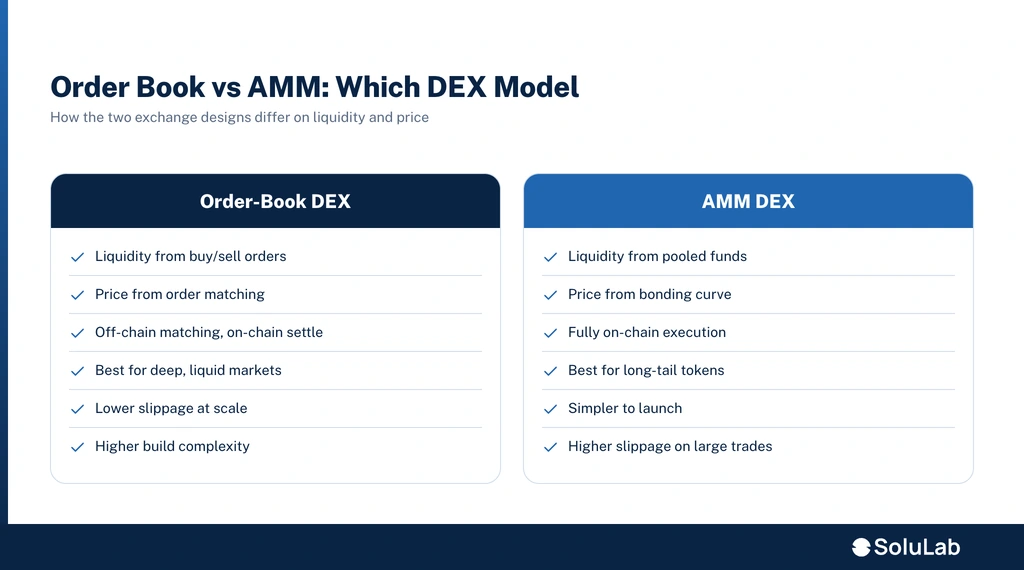
Choose an order book when you need precise pricing, professional order types, and low slippage on size. Choose an AMM when you want fast bootstrapping, passive liquidity, and a simpler build. The table below maps each model against the factors that drive the decision.
| Factor | Order-book DEX | AMM DEX |
|---|---|---|
| Liquidity source | Market makers and traders posting limit orders | Passive liquidity providers depositing token pairs |
| Price discovery | Continuous bid/ask matching at set levels | Formula-driven against pool reserves |
| Slippage on size | Low if the book is deep | Rises with trade size relative to pool |
| Latency needs | High; matching must be fast | Low; a swap is one transaction |
| Gas and infrastructure | Higher; off-chain engine or fast chain often required | Lower; runs directly in smart contracts |
| Best use case | Derivatives, pro trading, deep-liquidity pairs | Long-tail tokens, quick listings, retail swaps |
A central limit order book is a real-time display of all active buy and sell orders for an asset, sorted by price and time. That structure is what lets an order-book DEX offer stop-losses, post-only orders, and tight spreads that an AMM cannot match on liquid pairs. For low-liquidity or brand-new tokens, though, an empty book is useless, and an AMM’s pool gives instant, if imperfect, pricing. Many mature protocols run both, an AMM for the long tail and an order book for the majors.
How does an order-book DEX work under the hood?
Most order-book DEXs split the work: they match orders off-chain for speed and settle the resulting trades on-chain for custody and finality. Putting every order, cancel, and update directly on-chain is possible but expensive, because each fill requires updating the order book state and transferring assets on every transaction. The hybrid approach keeps the matching engine fast while the blockchain still holds the funds.
dYdX is the canonical example of this pattern. It maintains an order book and matching engine off-chain with settlement happening on-chain, running derivatives trading on a Layer 2. Serum took a different route: it was built on Solana as a fully on-chain central limit order book, relying on Solana’s throughput to keep an on-chain book viable. A newer wave, including Hyperliquid and app-chains on Cosmos, pushes the whole book on-chain by using a purpose-built high-throughput chain.
The core components of any order-book DEX build
- Matching engine: Sorts orders by price-time priority and pairs bids with asks. Off-chain engines are faster; on-chain engines are more trust-minimized.
- Settlement layer: The smart contracts that hold funds, verify matches, and execute the token transfer on-chain.
- Order book state: The live record of open orders, kept in memory off-chain, in a state channel, or directly in contract storage.
- Custody and wallet layer: Non-custodial signing so users keep control of funds until a trade settles.
- Oracle and risk layer: Price feeds and liquidation logic, needed for margin or derivatives products.
Throughput and latency figures vary widely by chain and design and should be confirmed against current protocol docs before you publish any number.
What are the core UX and UI presentation patterns for an order-book DEX?
An order-book trading interface has a small set of standard components traders expect to see, and getting them right is most of the UX work. Traders scan the screen for price, depth, and their own position in under a second, so the layout has to be dense but legible.
- Order form: Buy/sell toggle, order type (limit, market, stop), price, amount, and a clear total. Advanced fields like post-only, reduce-only, and time-in-force sit behind a toggle so beginners are not overwhelmed.
- Order book ladder: The live bids and asks stacked around the mid price, usually green for bids and red for asks, with cumulative-size shading so depth reads at a glance.
- Depth chart: A visual of cumulative buy and sell liquidity, showing where large walls sit and how much slippage a size order will cause.
- Price chart: Candlesticks with the standard timeframes and drawing tools, since order-book traders expect TradingView-grade charting.
- Positions and orders panel: Open orders, fills, position size, entry price, unrealized PnL, and one-click cancel or close.
- Balances and wallet state: Connected wallet, available and locked balances, and clear gas or settlement status per action.
How do you present an order-book DEX in a pitch deck?
Structure the deck around the decision an investor is actually making: can this book attract liquidity and defend a niche. Lead with the problem and the model choice, not the technology. A workable slide order:
- Problem. The specific trading pain you solve (thin books, high slippage, custodial risk, missing derivatives on a chain).
- Model choice. Why order book over AMM for your market, in one clear slide with the trade-off named.
- Architecture. The off-chain-match / on-chain-settle diagram, kept to one clean flow, no jargon walls.
- Product and UX. A real screenshot of the trading interface, not a mockup of features.
- Liquidity plan. How you bootstrap the book: market-maker partners, incentives, and the path to organic depth. This is the slide investors probe hardest.
- Traction. Volume, users, TVL, or waitlist. Use only real numbers.
- Team and security. Named builders and audit status.
- The ask. Raise amount, use of funds, and milestones.
The liquidity slide is where order-book DEXs win or lose the room. An AMM can look liquid on day one from a single deposit; an order book needs real makers, so investors want to see the plan before they see the product.
How do you explain on-chain vs off-chain tradeoffs to non-technical stakeholders?
Frame it as three plain questions: who holds the money, how fast is a trade, and what does it cost. On-chain means the blockchain records everything, so nobody can quietly change an order or seize funds, but every action costs gas and waits for a block. Off-chain means a fast server does the matching, so trades feel instant and cheap, but you are trusting that server to be honest until the trade settles on-chain.
The honest summary for a stakeholder: most serious order-book DEXs keep custody on-chain (your funds stay in a smart contract you control) while doing the fast matching off-chain. You get exchange-grade speed without handing your coins to a company. The remaining risk is the matching layer, which good designs mitigate with verifiable proofs, published order flow, or a decentralized sequencer. Skip the acronyms; a founder or marketing lead needs the custody-speed-cost triangle, not a lecture on state channels.
What is a style guide for a DEX front end?
A DEX front-end style guide is a documented set of components, naming rules, and visual conventions that keeps a data-dense trading interface consistent as the team ships. It covers the component library (order form, book ladder, depth chart, positions panel), a spacing and type scale tuned for dense numeric data, and a strict color system where green and red are reserved for direction and PnL only.
Key sections a DEX style guide should define
- Component library: Every trading widget with its states (loading, empty, error, filled), documented so engineers reuse rather than rebuild.
- Terminology: One canonical term per concept (bid/ask, not buy-price/sell-price; maker/taker; fill; slippage), used in UI copy, tooltips, and docs alike.
- Numeric formatting: Fixed decimal precision per market, monospaced figures so columns align, and thousands separators for readability.
- Visual hierarchy: Price and PnL are the loudest elements; secondary data recedes. Dark-mode contrast ratios must stay legible for hours of screen time.
- Motion and feedback: Subtle, fast transitions for order updates; no animation that delays a trader’s read of the book.
What does it cost and how long does it take to build an order-book DEX?
Cost and timeline depend on whether you build off-chain matching or fully on-chain, how many order types and markets you support, whether you add margin or derivatives, and the depth of your security audits. A spot order-book DEX on an existing high-throughput chain is faster and cheaper than a custom app-chain with a bespoke matching engine and liquidation logic.
Rather than quote a number that will not fit your scope, the drivers to price against are:
- Architecture: Hybrid off-chain matching versus fully on-chain changes the engineering load significantly.
- Product scope: Spot only, or margin, perpetuals, and cross-margin; each layer adds contracts and risk logic.
- Chain and infrastructure: Building on an existing chain versus standing up an app-chain or Layer 2.
- Security: Smart-contract audits, formal verification, and bug bounties are non-negotiable and add real time and budget.
- Liquidity tooling: Market-maker APIs, incentive contracts, and monitoring.
For a scoped estimate tied to your model and markets, talk to SoluLab’s DeFi development team.
How does SoluLab build and help present DeFi order-book exchanges?
SoluLab builds order-book and hybrid DEXs across the stack: matching-engine architecture, non-custodial settlement contracts, trading-interface UX, and the liquidity and market-maker tooling that makes a book usable. Because a DEX rarely ships alone, the same team covers the surrounding DeFi work, including DeFi yield farming development for incentive layers and Ethereum blockchain development when your settlement layer runs on EVM chains.
We also help you present the build. That means a clean architecture diagram, an honest liquidity-bootstrapping plan, and a trading-interface demo that stands up in front of investors. If you are still deciding where a DEX fits in a broader on-chain product, our Web3 development company work maps the wider stack. A SoluLab DeFi engineer’s rule of thumb: pick the order book when your market already has makers who want depth and control; pick the AMM when you are opening a new pair and need liquidity from day one.
FAQs
Neha is a curious content writer with a knack for breaking down complex technologies into meaningful, reader-friendly insights. With experience in blockchain, digital assets, and enterprise tech, she focuses on creating content that informs, connects, and supports strategic decision-making.