Key Takeaways
- Decision intelligence platforms combine AI, data, and business logic to enable faster, smarter, and more consistent enterprise decision-making.
- Governed decision systems ensure transparency, compliance, and accountability, which are critical for regulated industries and enterprise-scale operations.
- Real-time data integration improves decision accuracy, allowing businesses to respond quickly to changing conditions and market signals.
- Predictive analytics and ML models enhance decision outcomes, helping organizations forecast risks, optimize processes, and uncover opportunities.
- Enterprises are moving from dashboards to automated decision systems, reducing manual intervention and improving operational efficiency.
- SoluLab delivers enterprise-grade AI solutions, helping businesses build scalable, governed decision intelligence platforms tailored to their needs.
Over the past decade, enterprises have invested aggressively in analytics. Dashboards are richer, predictive models are sharper, and real-time data pipelines are now standard across banks and fintech platforms.
Yet decision latency persists.
Critical business moments approving a loan, flagging a transaction, adjusting a risk threshold, and triggering a compliance review still move more slowly than they should. Not because the data is unavailable, and not because intelligence is lacking, but because there is no unified system that can translate insight into governed action.
This is where Artificial Intelligence Platform Development begins to matter for decision-making.
It shifts the focus from generating insights to engineering execution. Instead of asking how accurate a model is, enterprises begin asking whether decisions can be automated safely, audited completely, and refined continuously.
In regulated environments, that distinction is not subtle. It is structural.
The Enterprise Decision Bottleneck: When Insights Stop at Dashboards
Inside most large organizations, decision-making still flows through fragmented layers.
A predictive analytics model generates a risk score. An analyst reviews supporting data. Compliance adds a control checkpoint. Operations validates documentation. Escalations occur if thresholds are unclear. Meanwhile, time passes, and accountability becomes diffused.
At scale, this pattern creates systemic drag.
Enterprises often assume their problem is model sophistication. In reality, the friction sits between prediction and execution. Analytics platforms surface insights, but without integrated AI decision automation systems, those insights remain advisory rather than operational.
This gap introduces several risks:
- Inconsistent policy interpretation across teams
- Manual override chains that are difficult to audit
- Delayed approvals in high-volume workflows
- Limited visibility into which model version influenced a decision
- Fragmented ownership across departments
As regulatory scrutiny increases, particularly in banking and fintech, the inability to trace how and why a decision was made becomes more than an operational inconvenience. It becomes a compliance exposure.
An effective enterprise decision modeling framework must therefore go beyond prediction. It must encode policies, orchestrate approvals, trigger execution, and record every step in a defensible audit trail.
What Is a Decision Intelligence Platform?
A Decision Intelligence Platform is a governed system designed to model, validate, execute, and audit enterprise decisions in real time.
It occupies the operational space between analytics and action.
Traditional Business Intelligence focuses on historical visibility. Predictive AI introduces probabilistic forecasting. Decision Intelligence extends that continuum by determining what action should be taken and ensuring it can be executed within defined policy and compliance boundaries.
At a technical level, Decision Intelligence Platform Development involves building a custom architecture that integrates several critical components:
- Enterprise decision modeling systems that combine rule engines and machine learning models
- A policy-driven orchestration layer that determines automation versus escalation
- Integrated execution pipelines that connect directly to core systems
- Comprehensive audit trails and explainability frameworks
The result is not simply faster decisions, but controlled automation. Every outcome can be traced back to its data inputs, model versions, and policy configurations.
In industries where accountability matters as much as efficiency, that level of structural clarity transforms decision-making from an ad hoc process into institutional infrastructure.
Core Architecture of a Decision Intelligence Platform
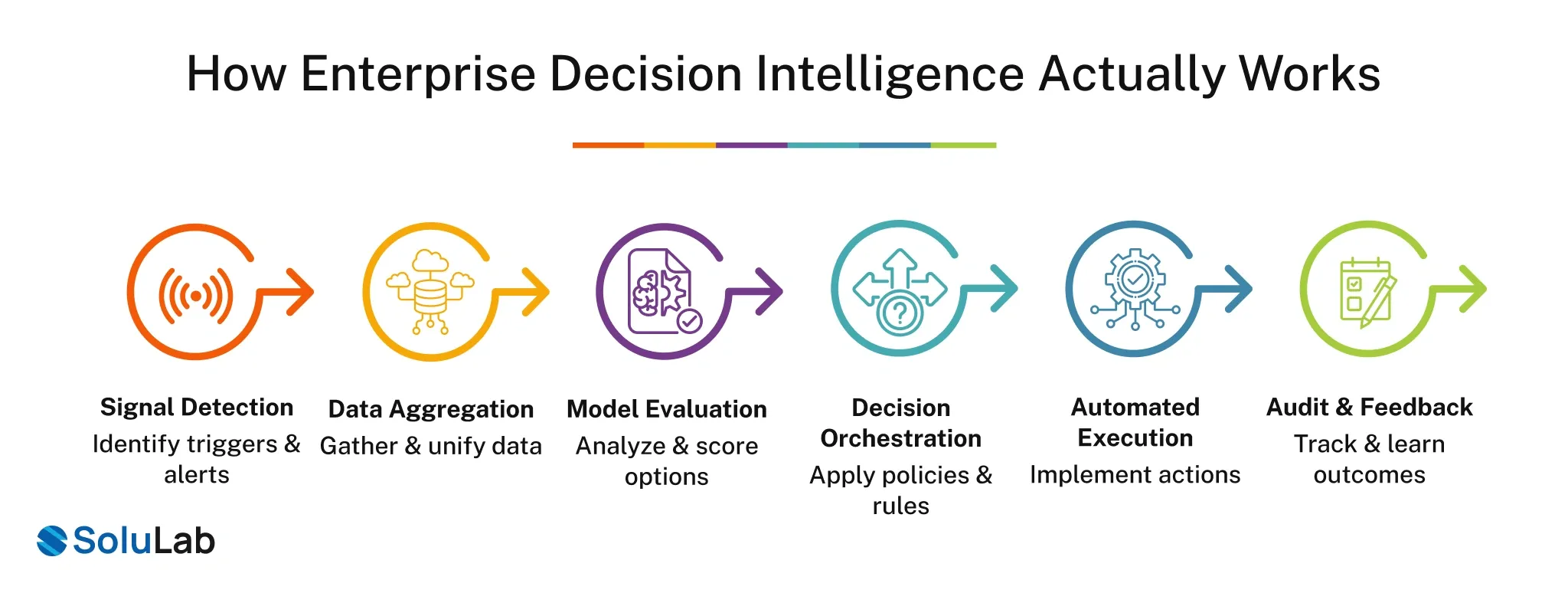
A Decision Intelligence Platform is not a single tool. It is a layered system designed to ensure that enterprise decisions move from signal to execution within controlled boundaries.
When organizations approach Decision Intelligence Platform Development, they are effectively designing a decision infrastructure stack. That stack typically includes five foundational layers.
1. Data and Context Layer
This layer aggregates structured and unstructured inputs from internal systems such as ERP, CRM, core banking platforms, fraud engines, and external data feeds. The objective is not simply to collect data, but to assemble decision-ready context in real time.
Data quality checks, governance controls, and access permissions are enforced here. Without this foundation, downstream automation becomes unreliable.
2. Modeling and Simulation Layer
This is where enterprise decision modeling systems operate. Machine learning models, rule engines, and optimization algorithms evaluate the assembled context.
Mature platforms go a step further by running scenario simulations before execution. Instead of blindly acting on a single model output, the system evaluates possible outcomes under different policy thresholds or risk assumptions.
3. Decision Orchestration Layer
Here, business logic meets governance.
Policies are encoded. Escalation rules are defined. Human-in-the-loop checkpoints are configured. The system determines whether a decision can be automated instantly or must be routed for review.
This orchestration layer is what differentiates governed automation from uncontrolled AI execution.
4. Execution Layer
Once validated, decisions trigger action. APIs initiate downstream processes, workflows update internal systems, notifications are dispatched, and transactional adjustments are executed automatically.
Importantly, this layer integrates directly with operational systems rather than functioning as a detached advisory engine.
5. Governance and Audit Layer
Every decision event is logged. Model versions are tracked. Policy logic is recorded. Overrides are timestamped. Outcomes are monitored.
In regulated sectors, this audit trail becomes essential. It provides defensibility, supports compliance reviews, and enables post-decision analysis without ambiguity.
When these layers function cohesively, decision-making shifts from reactive to engineered.
Enterprise Decision Modeling: Beyond Static Rules
Many enterprises begin their automation journey with static rule engines. While rules are necessary, they rarely remain sufficient.
Markets evolve. Risk patterns shift. Customer behavior changes. Regulatory thresholds tighten. Static logic becomes brittle under dynamic conditions.
This is where advanced enterprise decision modeling plays a critical role.
Modern decision intelligence platforms combine:
- Deterministic business rules for compliance consistency
- Predictive machine learning models for probabilistic insight
- Optimization engines for resource allocation
- Simulation modules to test policy impact before deployment
Instead of treating modeling as a black box, mature systems incorporate version control, performance monitoring, and rollback capabilities. Each model iteration is documented, evaluated, and traceable.
Scenario testing becomes particularly valuable. Before adjusting credit thresholds or fraud sensitivity parameters, institutions can simulate the impact across historical datasets. This reduces unintended consequences while maintaining agility.
In practice, this hybrid AI approach creates resilience. Rules provide guardrails. Machine learning provides adaptability. Simulation provides foresight.
Together, they form the analytical backbone of AI decision automation systems that enterprises can trust.
Automating Decisions Without Losing Control
Automation in regulated environments cannot operate on optimism. It must operate under defined control.
A well-designed Decision Intelligence Platform ensures that automation is conditional, policy-driven, and observable.
At the AI orchestration stage, each decision is evaluated against:
- Risk thresholds
- Regulatory requirements
- Operational capacity
- Escalation criteria
- Historical performance patterns
Some decisions qualify for full automation. Others require tiered review. High-impact or ambiguous cases may route directly to human oversight.
This layered automation framework enables scale without sacrificing accountability.
Integration also matters. AI-driven business automation must connect seamlessly with core banking systems, payment gateways, CRM platforms, underwriting engines, and compliance databases. Without integration, automation becomes fragmented and operationally risky.
Equally important is continuous monitoring. Automated decisions are not static endpoints. Performance metrics, model drift detection, and anomaly tracking ensure that the system adapts responsibly over time.
When designed correctly, automation does not replace governance. It encodes it.
This is the structural shift enterprises seek: moving from manual review loops to policy-aware, auditable, scalable decision execution.
Audit Trails, Explainability, and Compliance Controls
Automation without traceability is simply accelerated risk.
In sectors like banking, insurance, lending, and fintech, the question is not only whether a decision was accurate. It is whether the organization can explain how that decision was made months or even years later.
A mature Decision Intelligence Platform therefore, treats auditability as a core design principle, not an afterthought.
Every decision event should capture:
- Input data snapshots
- Model versions and configuration states
- Applied business rules and policy thresholds
- Human overrides, if any
- Timestamped execution logs
- Final outcome and downstream impact
This structured logging creates a defensible decision record. When regulators request clarity, institutions are not forced to reconstruct logic from memory or scattered documentation. The system already contains the evidence trail.
Explainability is equally important. Even when machine learning models are used, outputs must be interpretable. Feature importance, decision paths, and threshold logic should be transparent to risk and compliance teams. This does not mean exposing proprietary algorithms, but it does mean ensuring that decisions are intelligible within regulatory boundaries.
AI governance frameworks increasingly demand this level of structural visibility. As regulatory bodies formalize AI compliance guidelines, organizations that embed audit trails and explainability into their decision infrastructure gain a long-term advantage.
In practical terms, this is where many in-house automation initiatives struggle. Building predictive models is one challenge. Engineering traceable, version-controlled, compliant execution pipelines is another entirely.
Decision Intelligence Platform Development must therefore account for governance from day one.
Operating Model: How Enterprises Deploy Decision Intelligence at Scale
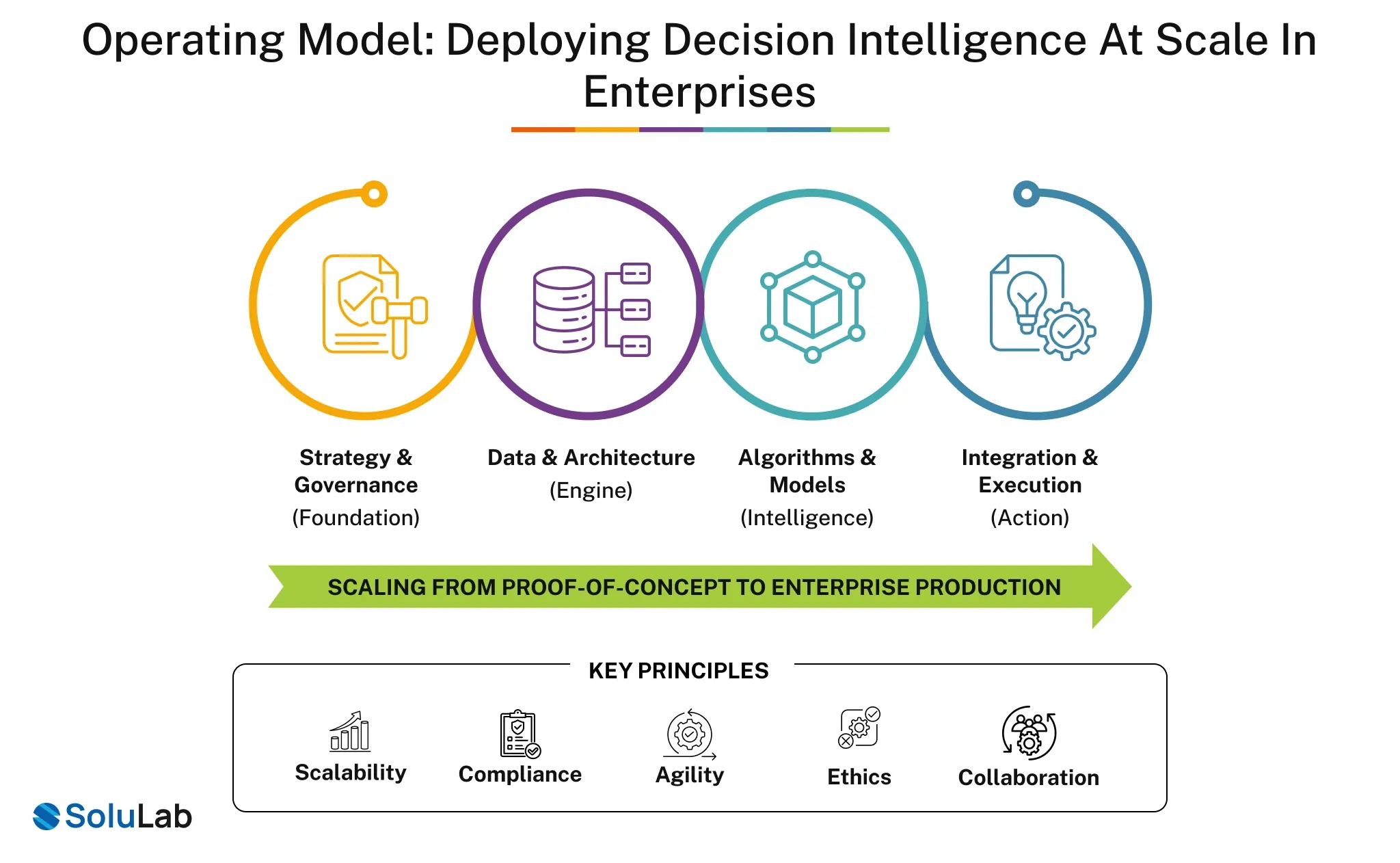
Technology alone does not operationalize decision intelligence. Governance structure and ownership models determine whether the platform sustains long-term value.
Enterprises typically adopt one of two operating approaches.
A centralized model places the decision intelligence platform under a single governance team, often within risk or technology. This ensures consistency, policy alignment, and stronger compliance oversight. However, it may slow experimentation if domain teams feel constrained.
A federated model allows business units to design and manage their own decision workflows while adhering to shared platform standards. This approach encourages agility but requires robust policy enforcement mechanisms.
Most mature institutions eventually move toward a hybrid structure. Core decision infrastructure remains centralized, while domain-specific decision models are managed collaboratively across risk, operations, and business units.
Key operating components include:
- A decision governance committee responsible for policy approvals
- Defined model lifecycle management processes
- Clear ownership of escalation thresholds
- Continuous monitoring dashboards for model performance and drift
- Structured review cycles for policy updates
The objective is not to eliminate human oversight but to formalize it. Human-in-the-loop mechanisms become intentional checkpoints rather than informal workarounds.
When AI-powered operating models align with platform architecture, decision intelligence becomes embedded into enterprise workflows rather than existing as an isolated AI initiative.

Risk Considerations: Where Decision Intelligence Can Fail
No enterprise system is immune to risk, and decision intelligence platforms introduce their own complexities.
One major concern is model drift. Over time, behavioral patterns shift, economic conditions change, and previously accurate models lose calibration. Without continuous monitoring and retraining protocols, automated decisions may degrade silently.
Automation bias presents another challenge. Teams may become overly reliant on system outputs, assuming that algorithmic recommendations are inherently superior. Structured override mechanisms and periodic review processes help counterbalance this tendency.
Data integrity also plays a foundational role. Inaccurate or incomplete data inputs can cascade through the decision pipeline, producing flawed outcomes that appear technically sound but are operationally incorrect.
Regulatory misalignment is perhaps the most critical risk. If policy encoding does not accurately reflect compliance requirements, the organization may unknowingly automate non-compliant behavior at scale.
Mitigation strategies include:
- Real-time performance monitoring
- Drift detection alerts
- Scenario re-simulation before policy adjustments
- Threshold-based escalation controls
- Independent audit reviews of model updates
The purpose of highlighting these risks is not to discourage automation. It is to underscore why structured, infrastructure-first development matters.
When designed carefully, a Decision Intelligence Platform reduces uncertainty rather than amplifying it. But achieving that outcome requires intentional architecture, disciplined governance, and ongoing oversight.
Build vs Partner: Strategic Considerations for Decision Intelligence Platform Development
At some point, every enterprise evaluating Decision Intelligence Platform Development faces the same question: should we build internally, or partner with a specialized architecture team?
On the surface, building in-house appears attractive. Many organizations already have data science teams, DevOps consultants and experts, and internal analytics platforms. However, decision intelligence is not merely a modeling initiative. It is a cross-functional infrastructure program.
Building internally requires:
- Designing a scalable orchestration layer
- Engineering audit-grade logging mechanisms
- Integrating with multiple core systems
- Managing model lifecycle governance
- Encoding regulatory policies into automation logic
- Establishing explainability frameworks
- Implementing real-time monitoring and drift detection
Each of these components introduces complexity. Together, they form a multi-year infrastructure effort.
Partnering with an experienced enterprise AI development firm accelerates this process. Rather than experimenting with disconnected automation pilots, organizations can implement a phased, compliance-ready decision infrastructure aligned with long-term regulatory expectations.
The most effective engagements typically focus on:
- Architecture-first design
- Governance embedding from day one
- Phased rollout of high-impact decision workflows
- Institutional training for sustainable ownership
For institutions operating under strict regulatory oversight, the cost of getting this wrong is significantly higher than the cost of getting it right.
Decision Intelligence Maturity Framework for Enterprise Leaders
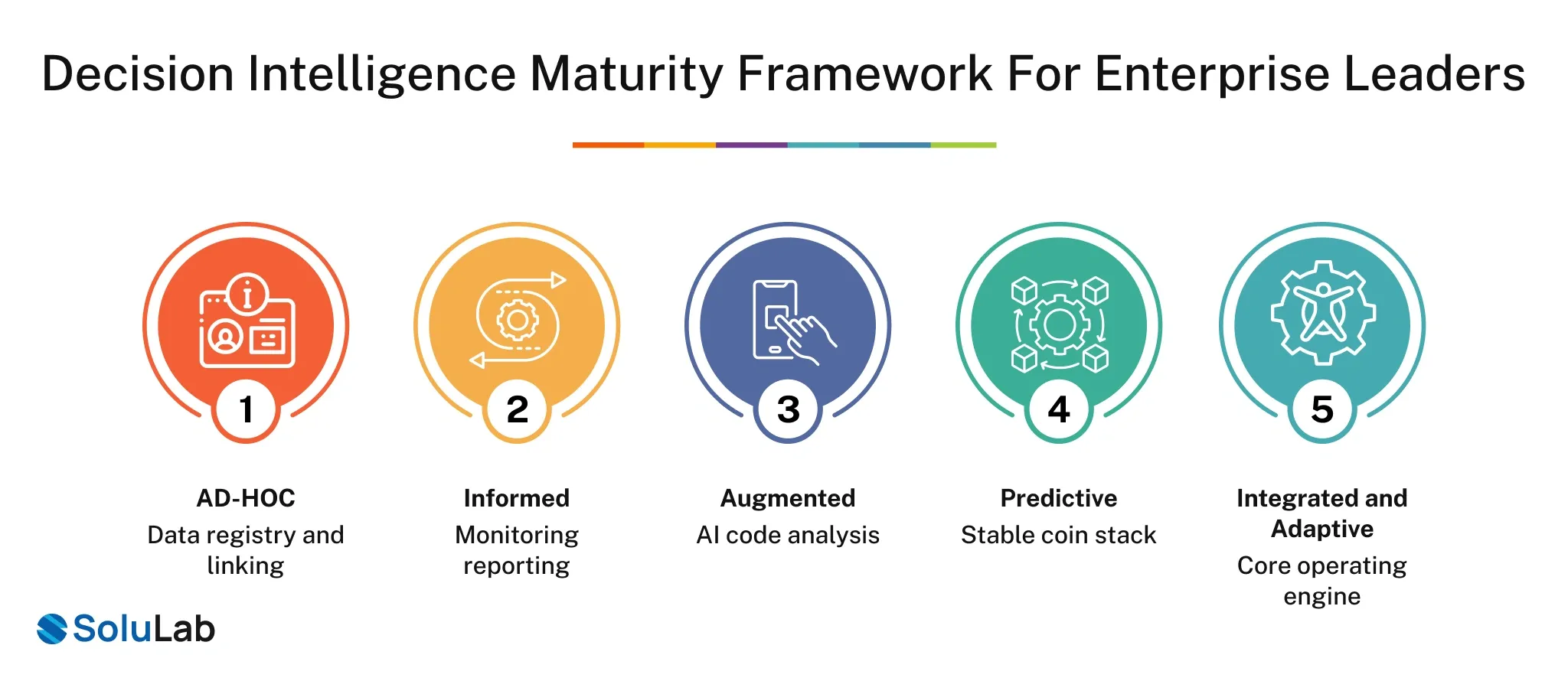
For CXOs evaluating readiness, it helps to view decision intelligence as a maturity progression rather than a binary capability.
Most enterprises move through five stages:
Level 1: Reporting
Data visibility through dashboards and analytics platforms.
Level 2: Predictive Modeling
Machine learning models generate forecasts or risk scores.
Level 3: Prescriptive Analytics
Systems recommend actions based on defined optimization criteria.
Level 4: Automated Decisions
Conditional automation executes predefined workflows.
Level 5: Governed Decision Intelligence
Fully integrated platforms model, validate, execute, and audit decisions within embedded compliance frameworks.
The shift from Level 4 to Level 5 is the most significant. Automation alone does not guarantee institutional control. Governed decision intelligence integrates policy enforcement, explainability, audit trails, and lifecycle management into the automation layer.
Organizations at earlier maturity stages often believe they have “AI-driven automation.” In reality, they may still be operating without structured orchestration and compliance encoding.
Understanding this distinction clarifies where investment should be directed next.

Conclusion: Engineering Decisions as Infrastructure
Enterprises do not scale on data alone. They scale on the quality and speed of their decisions.
As operational complexity grows and regulatory scrutiny intensifies, informal decision workflows become unsustainable. What once worked through manual review chains now demands structured, auditable automation.
AI software development for decision making represents a shift from analytics experimentation to engineered execution. It transforms decisions into controlled, traceable, continuously optimized processes.
For organizations prepared to treat decision-making as infrastructure rather than output, the opportunity is not simply efficiency. It is institutional resilience.
FAQs
Shipra Garg is a tech-focused content strategist and copywriter specializing in Web3, blockchain, and artificial intelligence. She has worked with startups and enterprise teams to craft high-conversion content that bridges deep tech with business impact. Her work translates complex innovations into clear, credible, and engaging narratives that drive growth and build trust in emerging tech markets.