
Key Takeaways
- The GENIUS Act regulates payment stablecoins, not property tokens. It governs the money moving through your platform, not the asset itself.
- Your real estate token is a security. Securities law decides your structure, and the GENIUS Act decides how you can settle, distribute and redeem in dollars.
- The Act bans permitted issuers from paying interest on stablecoins, so rental yield must flow through the security token, never through the settlement coin.
- Compliance lives in the smart contract, not the front end. Eligibility and transfer restrictions enforced at token level survive a user routing around your interface.
- Real estate is the most discussed and least adopted tokenization category, because a token does not change how title transfers.
- Fractional economic exposure is far easier to structure than legal ownership. Most successful platforms sell the first and are honest about it.
- Choose your exemption before your chain. Everything technical is downstream of that decision.
A compliant real estate tokenization platform issues tokens representing property interests, under a securities exemption, with eligibility and transfer rules enforced on-chain.
The GENIUS Act does not regulate those tokens. It regulates the payment stablecoins your platform uses to take subscriptions, pay distributions, and process redemptions, which is a different and equally important part of the stack.
The opportunity is large, and the timeline is long. The Deloitte Center for Financial Services projects tokenized real estate reaching $4 trillion by 2035, up from under $300 billion in 2024, a compound annual growth rate above 27%.
Getting there requires separating two regulatory questions that most guides collapse into one, and that confusion is costing teams real money in rebuilt architecture. This article keeps them apart, then walks the exemptions, the compliance layers, and the build sequence.
What Does the GENIUS Act Actually Regulate?
The GENIUS Act regulates payment stablecoins. It creates a federal licensing, reserve, and redemption framework for digital tokens pegged to a fixed monetary value and used for payment or settlement. It does not govern security tokens, property interests, or real estate offerings.
1. What the Statute Covers
Signed into law on 18 July 2025 as S.1582, the Guiding and Establishing National Innovation for U.S. Stablecoins Act sets enforceable standards for reserve assets, redemption rights, disclosures, and custody, and restricts issuance to permitted payment stablecoin issuers. It explicitly clarifies that compliant payment stablecoins are neither securities nor commodities.
2. What It Explicitly Excludes
The definition of a payment stablecoin carves out central bank money, bank deposits and traditional securities. Read that last exclusion carefully. A token representing an interest in a building is a security. It sits outside the GENIUS framework entirely, and no amount of structuring will bring it inside.
3. Why This Correction Matters Commercially
A surprising amount of published guidance implies the GENIUS Act created a compliance pathway for real estate tokenization. It did not. Building your regulatory strategy on that misreading means arriving at a securities lawyer with an architecture that has to be redone.
The Act matters here for a different reason, covered next, and that reason is genuinely significant.
4. Where the Rulemaking Currently Sits
The OCC published its notice of proposed rulemaking in the Federal Register on 2 March 2026. The FDIC Board approved a parallel proposal on 7 April 2026, with comments due 9 June 2026, addressing reserve deposit insurance and tokenized deposits.
The statute takes effect on the earlier of eighteen months after enactment or 120 days after final implementing regulations. Plan your settlement design against a moving regulatory target, not a finished one.
Why the GENIUS Act Still Matters for Real Estate Tokenization
Because it fixes the money leg. Every tokenized property offering has to take subscriptions, pay rental distributions and process redemptions in something, and until GENIUS that something had no federal framework. Now it does.
1. Compliant Settlement Rails
Accepting investment and paying distributions in a permitted payment stablecoin means using an instrument with defined reserve backing, redemption rights and a named regulator. For institutional capital, that was the blocker. Not the property token. The dollar leg.
2. The Yield Trap Nobody Warns You About
Here is the specific design constraint. The GENIUS Act prohibits permitted issuers from paying interest to stablecoin holders. The CLARITY Act reinforces it by treating yield-bearing tokens that try to reclassify as commodities as securities under SEC jurisdiction.
For a rental property platform this matters enormously. Your rental yield must flow to investors through the security token as a distribution on their property interest. It cannot flow as interest on a stablecoin balance they hold with you. Architecting a product where investors park value in your stablecoin and earn yield on the balance walks straight into the prohibition.
Get this wrong and you have built a compliance problem into the core of the product. Get it right and the separation is clean: the security token carries the economics, the stablecoin carries the dollars.
3. Custody and Segregation Expectations
The reserve, custody and segregation standards GENIUS sets for stablecoin issuers have become the benchmark institutional counterparties apply more broadly. Even where the rules do not bind your platform directly, your investors will ask whether you meet them.
4. A Precedent for Market Structure
The CLARITY Act is the market-structure companion covering how digital assets trade, who supervises spot markets and how custody works around them. Together the two are the closest the US has to what MiCA does in Europe. A compliant tokenization platform built today should be designed to absorb both rather than either alone.
Which Laws Actually Govern a Real Estate Tokenization Platform?
Securities law does. A token representing an economic interest in property is almost always an investment contract under the Howey test, which puts your offering under the Securities Act of 1933 and your platform under SEC jurisdiction.
1. Your Exemption Options
Most platforms register nothing and rely on an exemption. Three dominate.
Regulation D 506(c) permits general solicitation but restricts sales to verified accredited investors, with no offering cap. It is the default for US private real estate offerings.
Regulation S covers offshore sales to non-US persons, frequently run alongside a 506(c) tranche for a dual-track raise.
Regulation A+ allows non-accredited investors up to an annual ceiling, with qualification requirements, ongoing reporting and meaningfully higher cost and timeline.
Our breakdown of what a security token offering involves covers the selection criteria in more depth.
2. Transfer Restrictions Are Not Optional
Reg D securities carry holding period restrictions. Reg S has its own distribution compliance period. These have to be enforced at the token level, because a restriction that only lives in your terms of service fails the moment someone transfers peer-to-peer.
3. Who Else Touches Your Stack
A registered transfer agent maintains the securityholder record. A qualified custodian holds assets where required. An alternative trading system operator is needed if you intend to run secondary trading rather than just issuance. Broker-dealer registration applies if you are effecting transactions. Most platforms partner for these rather than acquiring the licences themselves.
4. Title Still Works the Old Way
The point most guides avoid. In nearly every jurisdiction, legal transfer of real property still requires the traditional recording process. A token does not convey title. What it conveys is an interest in the entity that holds the title, usually a special purpose vehicle, which is why the SPV structure is doing more work in these deals than the blockchain is. Broader patterns are covered in our real estate tokenization overview.
Where Does Real Estate Tokenization Actually Stand Today?
Behind the narrative. Real estate is the most discussed tokenization category and one of the least adopted, and the gap between those two facts should shape your business plan.
Tokenized real-world assets excluding stablecoins reached roughly $29 billion in on-chain value in the first quarter of 2026, up from about $7.9 billion in 2024, a year-over-year increase near 263% according to RWA.xyz data. Within that total, tokenized US Treasuries and private credit dominate. Tokenized real estate only recently crossed the $1 billion threshold.
1. Why Treasuries Scaled and Property Did Not
A Treasury is fungible, liquid, legally simple and already dematerialised. A building is none of those things. Tokenization removed friction from the first category almost immediately. In the second, the legal complexity does not disappear when you add a token on top.
2. Economic Exposure Beats Legal Ownership
The distinction the market is finally absorbing. Selling fractional economic exposure to a property’s cash flows through an SPV interest is structurable today, at reasonable cost, under a familiar exemption. Selling actual fractional legal ownership of the deed is not, in most jurisdictions.
Platforms that lead with the second and quietly deliver the first create a disclosure problem. Lead with what you actually offer.
3. Liquidity Is the Underappreciated Risk
Putting an asset on-chain does not create buyers for it. A secondary market needs an ATS, market makers, and genuine demand. Plenty of tokenized property sits in wallets with no bid. Investors who were promised liquidity and found none are the loudest source of reputational damage in this category.
4. Where It Is Working
Dubai’s Land Department moved its real estate tokenization programme into a second phase in February 2026, enabling secondary resale of tokenized property units. A phased approach, pilot first and secondary market second, is a reasonable model for how a jurisdiction sequences this. Our tokenized real estate investing guide covers the investor side of these structures.
What Does a Compliant Tokenization Platform Architecture Look Like?
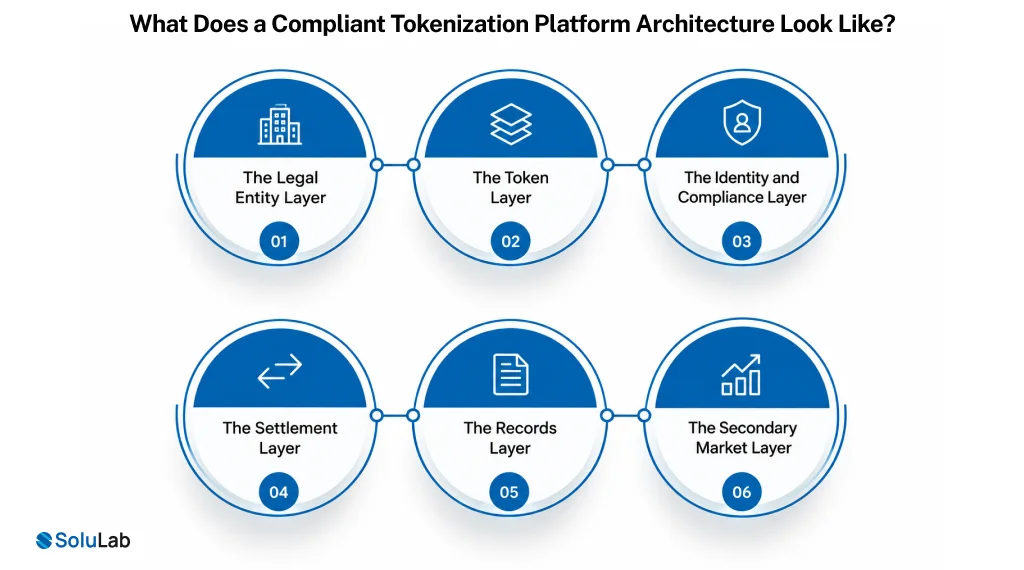
Six layers. Each is a compliance control as much as a technical component, and the ordering reflects dependency rather than build sequence.
1. The Legal Entity Layer
An SPV holding the property, with the token representing an interest in that entity. Jurisdiction, entity type and operating agreement are decided here, and every layer above inherits those choices.
2. The Token Layer
A permissioned standard with identity-aware transfers, so eligibility and holding periods are enforced by the contract itself. This is exactly what ERC-3643 tokenization was designed for, and it is why generic fungible standards fail securities use cases.
3. The Identity and Compliance Layer
KYC, AML, accreditation verification and jurisdiction checks, with results bound to an on-chain identity rather than a database row. The token queries identity before permitting transfer. Careful smart contract development here is what separates a platform that enforces compliance from one that merely documents it.
4. The Settlement Layer
Where GENIUS applies. Subscriptions, distributions and redemptions moving in a permitted payment stablecoin or through traditional banking rails, with the yield separation described earlier respected in the design.
5. The Records Layer
Transfer agent integration, cap table maintenance, tax reporting and investor communications. Unglamorous, mandatory, and the layer most often bolted on late at significant cost.
6. The Secondary Market Layer
An ATS relationship or regulated venue if you intend trading. Optional at launch and worth deciding early, because retrofitting transfer logic to support a venue is harder than designing for it.
How Do You Launch a Compliant Real Estate Tokenization Platform?
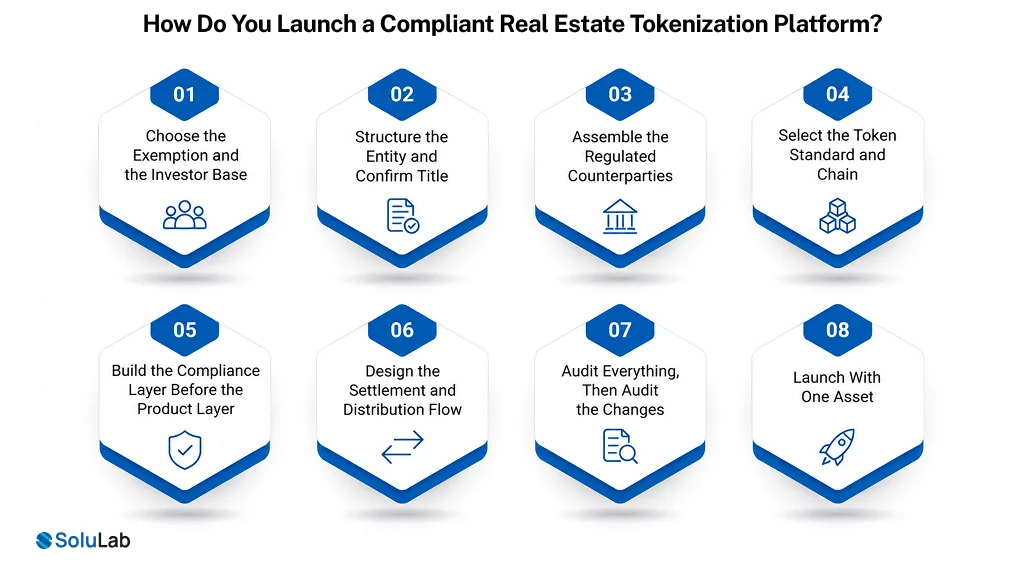
Eight steps. The first three are legal and commercial rather than technical, and teams that invert the order rebuild.
1. Choose the Exemption and the Investor Base
Accredited only under 506(c), offshore under Reg, or retail under Reg A+. This single decision sets your disclosure burden, your marketing rules, your transfer restrictions, and your cost base.
2. Structure the Entity and Confirm Title
Form the SPV, confirm clean title on the underlying property, and document exactly what the token holder receives. Ambiguity here is not resolvable later by better engineering.
3. Assemble the Regulated Counterparties
Transfer agent, custodian, and an ATS if you want secondary trading. These relationships have lead times measured in months and they frequently sit on the critical path.
4. Select the Token Standard and Chain
A permissioned standard with identity-aware transfers, on a chain where your investors and partners already operate. Standard before chain, and legal structure before both.
5. Build the Compliance Layer Before the Product Layer
Identity, eligibility gating and transfer restrictions first. Everything user-facing depends on them, and adding them afterwards means rewriting the contracts.
6. Design the Settlement and Distribution Flow
Decide how dollars enter and leave, whether you use a permitted payment stablecoin or banking rails, and confirm the yield path runs through the security token. Document this before it becomes an architecture.
7. Audit Everything, Then Audit the Changes
An independent smart contract audit before launch, not after, and a re-audit on any change touching transfer or compliance logic. Teams needing delivery capacity often hire blockchain developers with securities experience rather than training generalists mid-build.
8. Launch With One Asset
A single property, a single exemption, a single jurisdiction. Prove the full cycle including a distribution and a transfer before adding a second asset. Platforms that launch a portfolio cannot diagnose which part of the machine is failing.
Why Do Compliant Tokenization Platforms Fail?
Rarely on the smart contracts. Usually on structure, liquidity, or promising something the law does not permit.
1. Building Before the Exemption Is Chosen
Contracts written before the legal structure is final get written twice. The exemption determines transfer restrictions, eligibility logic and holding periods, all of which are contract-level concerns.
2. Promising Legal Ownership You Cannot Deliver
Marketing fractional deed ownership while delivering an SPV interest is a disclosure problem that compounds. Say what the investor actually receives, in plain language, on the offering page.
3. Launching Without a Secondary Market
Liquidity was the pitch. If there is no venue and no market maker, investors discover that only when they try to exit, which is the worst possible moment. Either build the venue relationship or stop promising liquidity.
4. Compliance in the Interface, Not the Contract
Eligibility enforced only in the front end fails at the first peer-to-peer transfer. If a token can move without passing an identity check, your restrictions are decorative. STO development practice exists precisely to avoid this.
5. Treating the GENIUS Act as Securities Cover
Back to where this article started. A permitted payment stablecoin on the settlement leg does not make your offering compliant. Two separate regimes, two separate compliance programmes, and conflating them is the most expensive misunderstanding available in this category. Broader context sits in our RWA tokenization guide.

Conclusion
Launching a compliant real estate tokenization platform means running two compliance programmes at once. Securities law governs the token, the offering and the investor relationship. The GENIUS Act governs the dollars moving through the platform, and it bans paying yield on those dollars, which shapes your product design more than most teams expect.
Resolve the exemption and the entity structure first. Enforce compliance in the contract rather than the interface. Launch with one asset and prove a full cycle including a distribution and a transfer before you scale. And be precise about what investors are buying, because economic exposure through an SPV is a good product that does not need to be described as something it is not.
SoluLab, a tokenization platform development company, can help your business select the right exemption and token standard, build identity and transfer compliance into the contracts, and design settlement rails that hold up as the GENIUS rulemaking finalises. We will also tell you plainly when a white label route beats a custom build for your first offering.
FAQs
Neha is a curious content writer with a knack for breaking down complex technologies into meaningful, reader-friendly insights. With experience in blockchain, digital assets, and enterprise tech, she focuses on creating content that informs, connects, and supports strategic decision-making.