Key Takeaways
- The problem: Many crypto founders in Dubai underestimate VARA crypto regulations Dubai 2026, which leads to stalled approvals, heavy fines, or even license revocation.
- The solution: Partner with a blockchain and legal‑compliance team that understands how to turn VARA‑compliant blockchain solutions into production‑ready systems.
- How SoluLab can help: From VARA license consulting services to VARA‑compliant enterprise blockchain development, we help you design, build, and launch.
If you’re reading this, you’re likely a founder, C‑level, or lead architect weighing whether to go fully regulated in Dubai or stay in the gray zone for a bit longer. That’s a fair question. But here’s the data point that shifts the calculus – the World Economic Forum has flagged 2026 as a pivotal year for digital assets, where policy‑clarity jurisdictions like the UAE will start to pull in the majority of institutional capital, while unregulated or loosely governed crypto platforms lose access to banking, liquidity, and enterprise clients.
In Dubai, that policy clarity is centered on the VARA crypto regulations, Dubai 2026. If you’re planning to invest in crypto development solutions, be it building a crypto exchange, OTC desk, custody, or blockchain‑based financial product, you’re not just “managing risk” by pursuing VARA compliance; you’re positioning your business inside the next iteration of global finance.
Understanding Dubai’s VARA Regime for Building Regulated Crypto Platforms
If you don’t already know this, here’s the simple version – VARA is Dubai’s Virtual Assets Regulatory Authority, created in 2022 under Dubai Law No. 4 of 2022 on Virtual Assets.
What is the VARA license in Dubai?
It is the VARA license that permits you to act as a Virtual Asset Service Provider (VASP) in Dubai (outside DIFC). Think of it like a crypto‑specific license for exchanges, wallets, custody, brokerage, OTC desks, and even token‑issuers, depending on the activity.
Why does this matter for 2026?
- VARA is now the main gateway for institutional crypto adoption in Dubai, and regulators are actively pushing banks and liquidity providers to only work with VARA‑licensed or VARA‑aligned platforms.
- The future of regulated crypto in the UAE is essentially VARA‑first – with federal bodies like CBUAE and SCA aligning frameworks around the VARA‑style model.
For any founder thinking I’ll start unregulated and then get the VARA license later, VARA’s track record so far suggests that it will be slow, expensive, and risky.
Who Needs a VARA License in Dubai to Launch a Regulated Crypto Business?
You need VARA approval if:
- You’re running a crypto exchange, OTC desk, or swap platform in or from Dubai.
- You offer custody, crypto wallet services, staking, yield products, or lending to clients.
- You’re issuing or managing tokenized assets or RWA that touch retail or institutional investors.
Even proprietary trading desks are in scope if they cross certain volume thresholds – VARA can treat you as a Virtual Asset Trading Platform even if you don’t have external clients.
ROI of getting VARA approval early:
- Access to banking and liquidity: VARA‑licensed entities are more likely to get bank onboarding, FX rails, and prime‑broker‑style relationships.
- Institutional trust: Family offices, hedge funds, and corporates are already reallocating capital into VARA‑regulated platforms because of crypto governance requirements in Dubai.
So, not pursuing VARA‑compliance is less about saving money today and more about self‑excluding from the next wave of institutional capital.
Case Studies of VARA-Licensed Crypto Platforms in Dubai
1. Binance FZE in Dubai
- Binance operates a VARA‑licensed entity in Dubai (FZE) and has received backing from Abu Dhabi‑based MGX, which put $2 billion into Binance, one of the largest institutional crypto‑exchange investments globally.
- This signals that institutional crypto adoption Dubai is already flowing into VARA‑licensed platforms, not just “offshore shell” structures.
2. HashKey
- HashKey is among the exchanges that have secured VARA‑style VASP licenses, positioning itself as a regulated, institutional‑grade trading venue in MENA.
- These cases show that VARA‑compliant crypto exchange development is not optional experimentation anymore; it’s how established global players are hardening their operational footprint in Dubai.
Regulatory Requirements Shaping VARA-Compliant Crypto Platforms in 2026
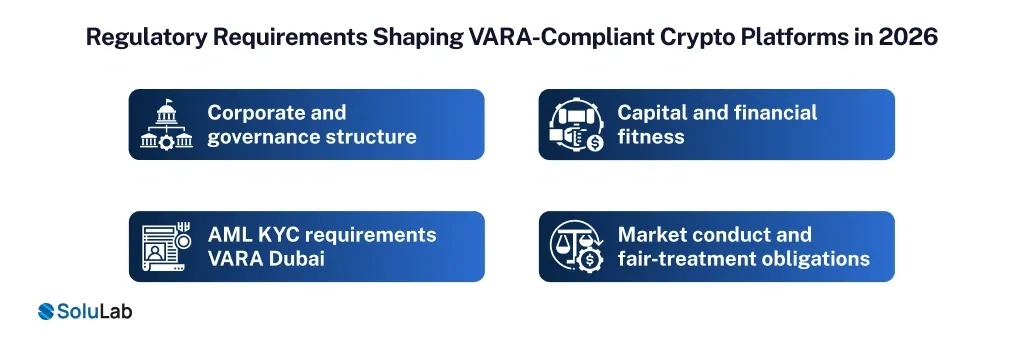
Here’s what your VARA license consulting services and crypto legal compliance services UAE teams will need to translate into your architecture:
1. Corporate and governance structure
- Clear board and senior management, with Responsible Individuals (RIs) who VARA can hold accountable.
- Crypto governance requirements in Dubai mean defined policies on conflict‑of‑interest, related‑party transactions, and risk‑committee oversight.
2. Capital and financial fitness
- Minimum capital requirements vary by activity type (exchange, custody, lending, OTC), but expect capital buffers that are meaningful for a serious operator.
- This is directly linked to the cost to build a VARA‑compliant blockchain platform – you’re not just paying tech and legal; you’re also funding regulatory capital.
3. AML KYC requirements VARA Dubai
- Risk‑based KYC, which means different levels of due‑diligence for retail, corporate, and high‑net‑worth clients.
- Automated AML/KYT workflows on‑chain and off‑chain, with transaction monitoring and sanctions screening integrated into your platform.
4. Market conduct and fair‑treatment obligations
- Transparent fee structures, clear disclosures, and no‑wash‑trading or misleading marketing.
- VARA’s Marketing Regulations (2024) already apply to anyone marketing virtual assets in or into the UAE, even if not yet licensed.
If you’re thinking about VARA‑compliant DeFi crypto exchange development, you need an architecture that embeds compliance into the product, not just an AML module you bolt on later.
That’s the core idea of VARA‑compliant enterprise blockchain development.
Tech Stack for Building VARA-Compliant Crypto Platforms in Dubai
When you’re building a VARA‑compliant crypto platform development, you’re not just choosing a front‑end framework. You’re choosing how compliance, risk, and governance will live in the stack.
Core components:
| Component | What It Covers | Why It Matters for VARA |
| Matching Engine & Order Book | High-performance trade matching with full audit trails, rate-limiting, and circuit breakers | Prevents market manipulation and gives regulators clear, inspectable trade history |
| KYC / AML Layer | Multi-provider KYC, risk-based user tiers, real-time monitoring, and alerts routed to MLRO workflows | Meets VARA expectations around AML, sanctions screening, and ongoing monitoring |
| Custody & Settlement Layer | Asset segregation, hot- and cold-wallet controls, multi-signer approvals, and proof-of-reserves | Allows VARA to verify asset safety and custody governance |
| Market Surveillance Module | Detection of wash trading, pump-and-dump behavior, front-running, and abnormal patterns tied to user IDs and devices | Demonstrates active market oversight, not reactive enforcement |
| Blockchain Infrastructure Layer | Permissioned or hybrid networks (e.g., Hyperledger Fabric, private Ethereum, Corda) with enterprise-grade controls | Supports VARA-compliant enterprise blockchain design and controlled access |
| On-Chain Governance & Audit Logs | Upgradeable smart contracts, on-chain approvals, and immutable, audit-ready logs | Lets you clearly show VARA how tokens, balances, and permissions move end to end |
Blockchain‑infrastructure layer for VARA‑compliant systems:
- Permissioned or hybrid blockchain networks (e.g., Hyperledger Fabric, private Ethereum, Corda) that are VARA‑compliant enterprise blockchain designs.
- Blockchain infrastructure for VARA deployment that supports on‑chain governance, upgradeability, and audit‑ready logs so you can show VARA exactly how tokens, balances, and approvals move.
The ROI VARA-compliant blockchain development solutions argument is simple:
You pay more upfront to build a VARA‑compliant enterprise blockchain, but you avoid the much higher cost of rebuilding once VARA is inside your audit trail.

Architecture Best Practices Under VARA Crypto Regulations in Dubai
As someone who’s helped build several VARA‑compliant decentralized crypto exchange development and VARA‑compliant enterprise blockchain projects, here’s what works in practice:
1. Separate compliance and trading concerns
- Keep your core trading engine lean and fast.
- Push KYC, AML, risk‑scoring, and governance rules into a separate compliance microservice.
2. Make everything auditable
- Every balance change, order rejection, and internal transfer should be logged with a timestamp, user ID, and context.
- Use immutable logs or on‑chain state proofs so you can later reconstruct any snapshot of the platform.
3. Design for VARA‑style audits
VARA tends to ask for:
- Evidence of transaction monitoring and risk‑tiering.
- Proof that Responsible Individuals actually reviewed and approved material changes.
Your VARA‑compliant enterprise blockchain should be able to feed those reports automatically instead of forcing your team to “manually” reconstruct them.
If you’re already thinking about building VARA‑compliant blockchain solutions in Dubai, this is where VARA‑compliant blockchain solutions start to look like a real enterprise architecture project, not a crypto‑hype pitch.
Operational and Organizational Compliance for VARA-Compliant Blockchain and Enterprise Systems
Once you’re live, VARA‑compliance is not just a tech issue; it’s an organizational heartbeat.
People and process layer:
- Dedicated compliance function (MLRO, compliance officer) with VARA‑approved responsibilities.
- Training and awareness for all front‑office and tech teams, so no one is accidentally violating VARA crypto regulations in Dubai 2026 because “no one told them.”
Ongoing monitoring and reporting:
- Monthly/quarterly reports to VARA on volumes, incidents, and risk exposures.
- Incident‑management and BCM processes that can survive outages, hacks, or regulatory visits without losing data or control.
For founders, this is where VARA‑license consulting services and crypto legal compliance services UAE become ongoing partners, not one‑time form‑fillers.
Strategic Roadmap to Launch a Regulated Crypto Business in the UAE in 2026
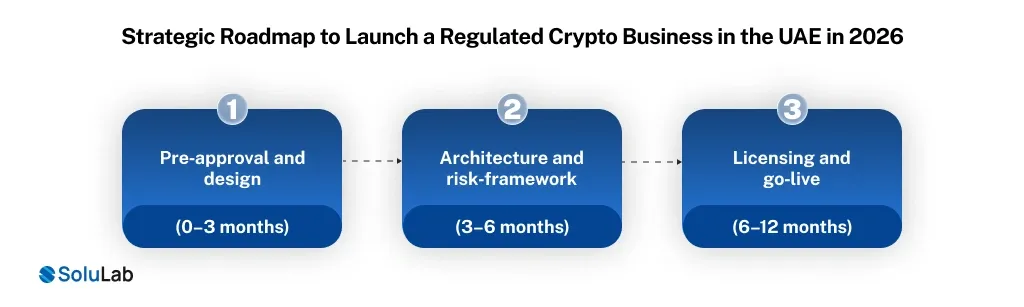
Here’s a practical, operator‑style roadmap for launch regulated crypto business in the UAE in 2026:
Phase 1 – Pre‑approval and design (0–3 months)
- Finalize your crypto licensing process in Dubai structure: onshore vs. free‑zone, ATI‑ready entity.
- Engage VARA license consulting services and crypto legal compliance services UAE to map your product against VARA crypto regulations Dubai 2026 rules.
- Define the tech stack for VARA‑ready platforms, including VARA‑compliant enterprise blockchain and VARA‑compliant blockchain system choices.
Phase 2 – Architecture and risk‑framework (3–6 months)
- Build your VARA‑compliant crypto exchange development or VARA‑compliant blockchain solutions with auditable logs, KYC/AML, and governance hard‑wired.
- Draft your crypto governance requirements in Dubai policies: AML KYC requirements VARA Dubai, risk‑management, incident‑response, and continuity.
Phase 3 – Licensing and go‑live (6–12 months)
- Submit your crypto licensing process in Dubai package to VARA, leveraging your VARA license consulting services to avoid loops and rework.
- Stage your launch regulated crypto business UAE with clear boundaries: e.g., regulated OTC crypto platform Dubai first, then spot exchange, then derivatives.
When you do this right, you’re not just ticking boxes for VARA crypto regulations Dubai 2026; you’re building a VARA‑compliant enterprise blockchain that can later expand into RWA tokenization, custody, and cross‑border settlements without a full re‑platform.
Conclusion
What’s happening in Dubai right now isn’t theoretical anymore. VARA is live, licenses are active, and real operators like Binance FZE and HashKey are already operating inside the framework. At the same time, the UAE crypto market is growing fast, and the signal from regulators is pretty clear: get AML/KYC right, build with transparency, and meet institutional standards or don’t expect to scale.
For builders, this changes how you should think about compliance. VARA isn’t something that slows you down; it actually gives you room to move, and SoluLab as a Blockchain Development company can help you with that. Once you’ve built a VARA-compliant blockchain base in Dubai, you don’t need to rebuild everything every time you launch a new product or enter a new market.
You extend what already works, layer new use cases on top, and keep moving. That ability to reuse infrastructure, while staying on the right side of regulators, is where the real long-term ROI comes from.
FAQs
With over 3 years of experience, I specialize in breaking down complex Web3 and crypto concepts into clear, actionable content. From deep-dive technical explainers to project documentation, I help brands educate and engage their audience through well-researched, developer-friendly writing.