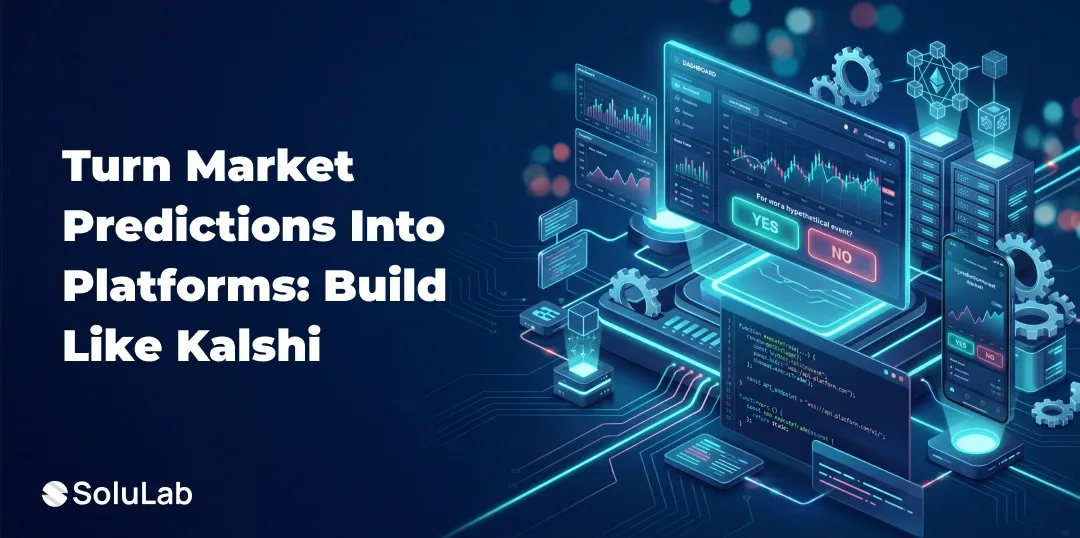
Prediction markets are digital platforms where participants buy and sell contracts tied to the outcomes of future events. These markets translate collective expectations into real-time probabilities. Building a prediction market platform is no longer just about creating a niche product. It’s about designing a next-gen trading ecosystem that combines elements of a crypto exchange solution, real-time data infrastructure, liquidity mechanisms, and compliance frameworks.
Kalshi is a leading example. Founded in 2018 and regulated by the U.S. Commodity Futures Trading Commission, it is positioned as the first federally licensed prediction market exchange in the U.S. Users trade event contracts that settle to $1 if an event happens and $0 if it does not, with prices dynamically reflecting collective sentiment.
These markets are gaining traction for a few big reasons. First, they offer a new form of probabilistic forecasting derived from real money stakes and mass participation. Second, major media outlets and financial players are integrating prediction data into mainstream channels, boosting relevance and reach.
Key Takeaways
- Prediction market platforms turn collective intelligence into tradable insights, allowing users to forecast real-world events through market-driven probabilities and financial incentives.
- Building a platform like Kalshi requires a robust architecture, including a trading engine, order matching system, liquidity mechanisms, and real-time data infrastructure.
- Regulatory compliance is a critical differentiator, especially for centralized prediction markets operating in jurisdictions like the US, where licensing and reporting are essential.
- AI enhances prediction markets by improving pricing models, sentiment analysis, and risk assessment, making platforms more efficient and data-driven.
- Prediction markets are expanding beyond trading into enterprise use cases, including risk forecasting, decision intelligence, and financial modeling.
- SoluLab has delivered 150+ blockchain and AI solutions globally, helping businesses build scalable fintech platforms, including trading systems, AI-driven analytics, and compliant Web3 infrastructure.
What Is a Prediction Market Platform?
A prediction market platform is a digital marketplace where users trade on the outcome of future events using real money or tokens. Instead of simply guessing, participants buy and sell “shares” in outcomes, and prices fluctuate based on collective market sentiment.
In many ways, these platforms function similar to a DeFi crypto exchange solution, where users trade probabilities instead of tokens. The price of each outcome continuously adjusts based on supply, demand, and new information entering the market.
For example, users might trade on questions like:
- Will Bitcoin cross a certain price this month?
- Who will win an election?
- Will a specific event occur by a given date?
Each outcome has a price (often between $0 and $1), representing the probability of that event happening. If the prediction is correct, traders earn payouts based on their positions.
Why Businesses Are Investing in Prediction Market Platforms Like Kalshi?
Prediction markets are not just betting sites. From an enterprise perspective, they offer a blend of forecasting, engagement, and data intelligence that’s hard to replicate with traditional analytics:
1. Real-Time Collective Intelligence
Unlike surveys or static analytics dashboards, prediction markets continuously aggregate thousands of user positions into live probability-driven pricing models.
Just like in a centralized or decentralized exchange (CEX/DEX), prices adjust instantly based on demand, liquidity, and new information. This creates a real-time forecasting engine that is far more dynamic than traditional research methods.
With the integration of AI and data analytics, these platforms can further enhance signal accuracy by combining market behavior with sentiment analysis and historical trends.
2. Expanded Use Cases Beyond Betting
Initially tied to political forecasting, prediction markets like Kalshi have found broader adoption in areas such as:
- Sports forecasting and fan engagement. In late 2025, Kalshi’s monthly contracts on sports reached multi-billion-dollar volumes, with sports betting becoming its largest category.
- Media and financial insights. Partnerships with broadcasters like CNBC and CNN are embedding prediction data into business news, creating new visibility and analytical value.
This evolution shows how prediction markets are moving closer to decentralized exchanges, AI, and real-time data infrastructure.
Large companies such as Google, HP, and Microsoft have experimented with internal prediction markets to forecast product launches, sales performance, and R&D outcomes. These internal markets often outperform traditional forecasting approaches because they harness distributed knowledge across teams.

How Kalshi-Style Prediction Market Platforms Work at Scale?
Building anything similar starts with understanding the essential mechanics behind a prediction market.
1. The core market mechanism
At its simplest, a prediction market platform matches buyers and sellers of contracts tied to a binary outcome (yes/no). If you think an outcome is likely, you buy the “yes” contract. If you think it won’t happen, you buy the “no” contract. The trade price reflects the community’s probability estimate for that event.
This design balances supply and demand for belief in future outcomes. Markets with high liquidity approach efficient pricing faster, which is why attracting participants early is critical for any prediction market.
2. Matching engine and order book
Like other top crypto exchanges, a Kalshi-like marketplace needs a matching engine and order book infrastructure. This system must handle high throughput, maintain fairness, and prevent market manipulation. It supports limit and market orders, cancellation flows, and audit trails for compliance. Startups often adapt traditional financial exchange engines or use variants from open-source matching systems as their base.
3. Event lifecycle and settlement
A contract lifecycle includes creation, trading, settlement, and payout. After an event resolves, the platform must verify the official outcome through reliable oracles or data feeds. Settlement mechanisms should be transparent, with predefined rules and fallback procedures for ambiguous or disputed outcomes.
4. Liquidity considerations
Prediction markets suffer without liquidity. Low liquidity skews prices and reduces signal quality. To address this, platforms use incentive mechanisms such as:
- Rewarding early market makers with fee rebates or token incentives.
- Providing automated liquidity pools backed by capital.
- Partnering with external market participants, such as hedge funds or proprietary traders.
Without these, a nascent marketplace risks low engagement and unreliable pricing.
Kalshi and Polymarket, for instance, have explored ways to support deeper liquidity pools to enable complex offerings like parlays in sports betting, showing how liquidity engineering directly impacts product breadth.
5. Central Limit Order Book (CLOB)
Kalshi uses a CLOB model similar to traditional exchanges.
Advantages include:
- Transparent price discovery driven purely by supply and demand dynamics.
- Tight bid-ask spreads when liquidity is sufficient.
- Familiar mechanics for institutional traders and market makers.
CLOBs work best for regulated, high-volume environments where fairness and auditability matter.
6. Automated Market Makers (AMMs)
AMMs are popular in decentralized prediction markets.
They offer:
- Guaranteed liquidity through mathematical pricing curves.
- Simpler onboarding for retail users.
However, AMMs struggle with capital efficiency, sharp probability shifts, and regulatory clarity at scale.
7. Hybrid models for enterprises
Many enterprise-grade prediction market platforms now explore hybrid architectures:
- CLOBs for primary regulated markets with institutional liquidity.
- AMM-style pools for sandboxed, experimental, or internal markets.
The model choice should follow the compliance and user profile, not ideology.
Step-by-Step: How to Build a Prediction Market Platform Like Kalshi
Building a prediction market platform like Kalshi involves combining trading infrastructure, compliance frameworks, liquidity design, and AI-driven insights. Below is a structured approach followed by most fintech teams:
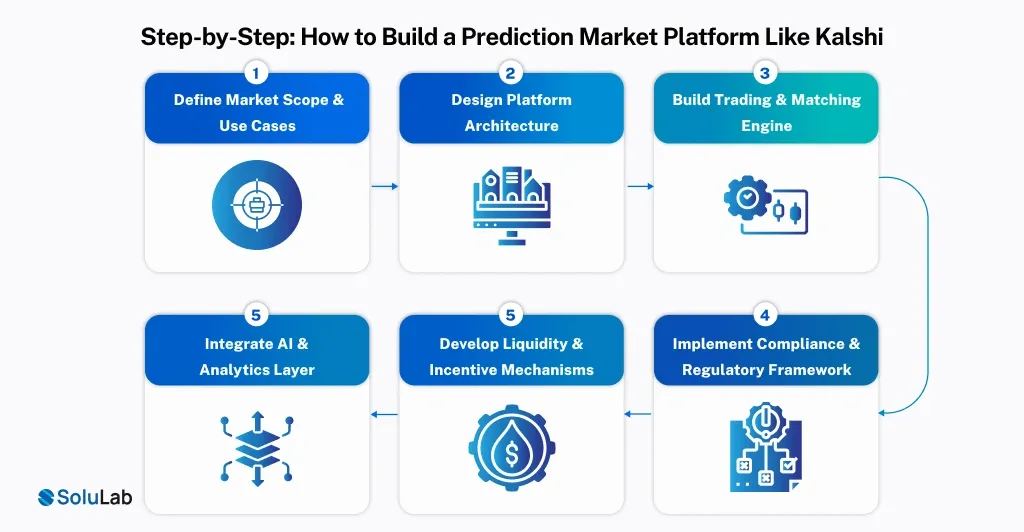
Step 1. Define Market Scope & Use Cases
Start by identifying what users will trade on:
- financial markets (crypto, stocks)
- political or economic events
- sports or entertainment outcomes
Clear use cases help define market structure, user personas, and regulatory requirements early in the process.
Step 2. Design Platform Architecture
Build a scalable architecture that supports:
- order book or AMM-based trading
- real-time pricing engine
- user wallet and fund management
- data ingestion and event resolution systems
This forms the foundation of your prediction market platform development.
Step 3. Build Trading & Matching Engine
The core of the platform is the trading system:
- order matching engine (like exchanges)
- pricing logic based on probabilities
- settlement mechanism for outcomes
This ensures accurate price discovery and seamless trade execution.
Step 4. Implement Compliance & Regulatory Framework
For platforms like Kalshi, compliance is critical:
- licensing (depending on jurisdiction)
- KYC/AML integration
- audit trails and reporting systems
A compliance-first approach builds trust and enables institutional participation.
Step 5. Develop Liquidity & Incentive Mechanisms
Liquidity drives platform success.
Key strategies include:
- market makers or liquidity providers
- token incentives or rewards
- initial liquidity seeding
Strong liquidity ensures tight spreads, better pricing, and higher user engagement.
Step 6. Integrate AI & Analytics Layer
Artificial Intelligence enhances prediction accuracy and user experience:
- sentiment analysis from news and social data
- predictive modeling for pricing insights
- fraud detection and risk management
This transforms the platform into a data-driven forecasting engine.
Step 7. Test, Launch & Scale
Before launch:
- conduct security audits
- stress-test trading systems
- validate compliance workflows
Post-launch, focus on:
- user acquisition
- liquidity growth
- feature expansion
What It Takes to Build a Regulated, Production-Ready Prediction Market Platform?
One of Kalshi’s core differentiators is compliance. It operates under regulatory oversight as an exchange dealing in event contracts.
- Navigating financial regulation
In the U.S., Kalshi secured approval from the CFTC as a designated contract market (DCM). This requires significant legal preparation, capital reserves, surveillance systems, and operational controls similar to those of other regulated exchanges.
Regulated platforms must also implement compliance programs to prevent prohibited conduct like insider trading and market abuse. Kalshi’s leadership has publicly backed legislative efforts to standardize insider trading rules within prediction markets, highlighting how governance aligns with traditional finance practices.
- State and jurisdictional challenges
Even with federal backing, state regulators sometimes assert jurisdiction, especially when outcomes involve sports events. Courts in Nevada, for example, ruled that Kalshi must comply with state gaming laws for sports markets.
This complexity means you must design your platform architecture and legal strategy with multi-jurisdiction compliance in mind. It’s not just about building blockchain technology; it’s about adapting operations to evolving regulatory frameworks.
- Custody, KYC/AML, and trust
Prediction markets handle funds. Platforms must integrate secure custody solutions, KYC/AML screening, and fraud detection to protect users and comply with financial laws. Integrating with established payment providers and bank partners typically forms part of this stack.
How AI, Blockchain, and Data Intelligence Create an Edge in Prediction Market Platforms
Technology is the engine that makes a Kalshi-like platform scalable, reliable, and insightful.
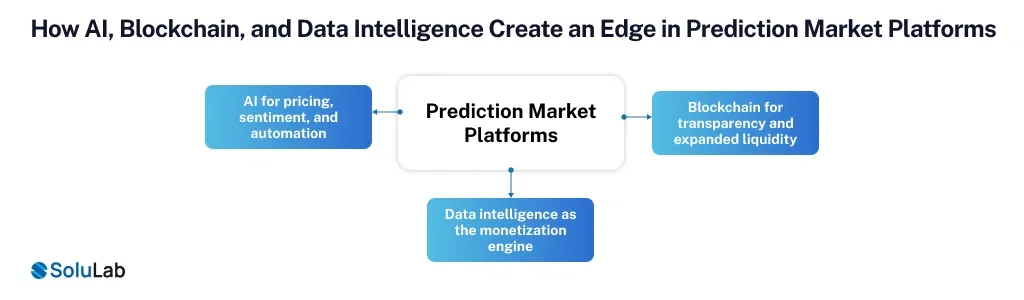
1. AI for pricing, sentiment, and automation
AI integration isn’t just a buzzword here. It serves multiple practical functions:
- Real-time signal filtering: AI can analyze news feeds, social sentiment, and market macro data to flag meaningful catalysts that might impact outcomes.
- Liquidity modeling: Machine learning models predict how changes in spreads or fees may impact order flow and liquidity.
- Semantic clustering: Advanced AI can group correlated markets, uncover hidden relationships, and offer actionable insights to traders. Novel research shows AI can identify topical structures and relationship patterns that human analysis might miss.
2. Data intelligence as the monetization engine
The real value often lies in the data, not transaction fees. Prediction futures platforms increasingly sell:
- Real-time probability feeds via APIs to enterprise systems.
- Historical forecast accuracy datasets for model training.
- Scenario simulations combining market signals with AI forecasts.
This is why enterprises view prediction markets as strategic predictive analytics infrastructure.
These capabilities enhance user experience and help markets stay efficient when information arrives quickly and unpredictably.
3. Blockchain for transparency and expanded liquidity
Blockchain integration can enable on-chain settlement, immutable audit trails, and permissionless participation. Kalshi’s moves with TRON and Solana, for example, show how multichain liquidity and tokenized markets can broaden access and reduce settlement friction.
Smart contract-based event resolution allows decentralized oracle inputs and automates settlements without intermediaries. This model appeals to crypto-native traders and can bring non-traditional liquidity sources into the market. It also sets the stage for global, permissionless participation, bridging centralized regulation with decentralized execution.
Cost, Timeline, and Revenue Potential of Building a Kalshi-Inspired Prediction Market Platform
1. Development scope and timeline
Building an enterprise-grade blockchain platform typically spans:
- Core exchange infrastructure, including matching engine, risk systems, and settlement logic.
- Compliance, identity, and regulatory reporting layers.
- AI analytics, dashboards, and enterprise integration APIs.
Depending on the scope, timelines often range from 6 to 9 weeks for production-ready systems.
2. Cost drivers enterprises should expect
Major cost components include:
- Regulatory consulting and licensing are often underestimated early.
- High-performance backend engineering for low-latency trading.
- Ongoing data sourcing and verification partnerships.
A Build Your Own Kalshi clone script approach may reduce prototyping costs, but serious platforms quickly require custom architecture that can increase exchange development costs.
3. Revenue models that attract investors
Successful platforms diversify revenue beyond trading fees.
Common enterprise-aligned revenue streams include:
- Subscription access to predictive analytics dashboards.
- Data licensing agreements with financial institutions and research firms.
- White-labeled exchange platforms with such features for internal enterprise use.
These models align well with long-term contracts and predictable cash flow.
Companies using similar strategies include:
- Financial institutions are seeking alternative risk indicators beyond traditional derivatives.
- Technology firms are embedding predictive intelligence into strategic planning tools.
- Governments and NGOs are testing policy outcomes before implementation.
Kalshi demonstrated regulatory feasibility. The next generation will demonstrate industry-specific dominance.

Conclusion
From the insights above, it’s clear that prediction market platforms are evolving into serious decision-intelligence systems. With AI driving probability analysis, liquidity optimization, and real-time risk monitoring, these platforms offer faster insights, stronger trust, and scalable forecasting for enterprises. This shift is why more organizations are now exploring AI-powered prediction market platforms to guide high-impact decisions.
If you’re evaluating how AI, data intelligence, and regulated market models can shape a Kalshi-like prediction market platform development, SoluLab is ready to support that vision.
How SoluLab helps you build enterprise-grade prediction market platforms
- With 250+ skilled developers and over 10 years of experience, we help you design and build prediction market platforms that are compliance-ready, scalable, and analytics-driven.
- Our teams enable continuous market monitoring and AI-based risk controls so you can operate with confidence.
- We support custom architectures, including CLOB, hybrid models, and AI analytics layers aligned with your business goals.
As a trusted prediction market and AI platform development partner, we apply the latest AI tools, data frameworks, and secure infrastructure to deliver reliable, production-ready platforms.
Connect with us to explore how your prediction market platform can move from concept to enterprise-ready reality.
FAQs
Deepika is a content writer who blends storytelling with strategic thinking. She explores topics across digital innovation, emerging tech, and the evolving blockchain industry. She enjoys breaking down complex ideas into simple, engaging narratives in the growing global markets.