



Key Takeaways
- Blockchain for small and mid-sized businesses isn’t about running a full node or launching a token. Most practical SMB use cases plug into systems that already exist.
- An SMB doesn’t need to rebuild its business to adopt blockchain. The ten-stage process below starts with one narrow problem, not a company-wide overhaul.
- Cross-border payments, supply-chain tracking, smart contracts, digital identity, document verification, loyalty programs, and asset tokenization cover the bulk of what actually works at SMB scale today.
- Not every business needs blockchain. A short fit test, built around shared data and trust gaps between organizations, usually answers the question honestly in five minutes.
- Getting the scope wrong, either too ambitious or too vague, is the single biggest reason SMB blockchain pilots stall before they ever reach production.
Blockchain got sold to small businesses for years as something that required an engineering team, a crypto strategy, and a leap of faith.
That’s mostly wrong. The SMBs actually getting value from blockchain right now aren’t building a decentralized application from scratch; they’re plugging blockchain functionality into a supply chain system, a payments flow, or a loyalty program that already exists.
This guide walks through the real benefits, a practical way to implement without a company-wide rebuild, the use cases that actually work at SMB scale, what it costs, and a quick test for whether your business needs any of this at all.

What Are the Benefits of Blockchain for Small and Mid-Sized Businesses?
The benefits of blockchain technology aren’t abstract at this scale. They show up directly in fewer disputes and less manual work.
- Better traceability and greater transparency matter most in businesses juggling multiple vendors or partners, where a shared, tamper-resistant record replaces a pile of emails and spreadsheets nobody fully trusts.
- Faster reconciliation and reduced manual work follow from that same shared record: fewer discrepancies between what two companies each think happened means less time spent tracking down who’s right.
- Improved auditability and automated workflows compound the savings, since a timestamped, immutable ledger gives an auditor something concrete to check, and smart contracts can execute routine rules without someone manually approving each step.
- Fraud reduction and better cross-company coordination round out the list, and they’re not small line items. Deloitte’s blockchain survey found 87% of businesses already using the technology plan to keep investing in it, and 91% expect a measurable, quantifiable return within five years.
- That’s not hype talking; that’s businesses reporting results. Gartner separately forecasts blockchain generating more than $3.1 trillion in new business value worldwide by 2030, and a meaningful share of that comes from exactly this kind of operational friction getting removed, not from speculative token projects.
How Can an SMB Implement Blockchain Without Rebuilding Its Entire Business?
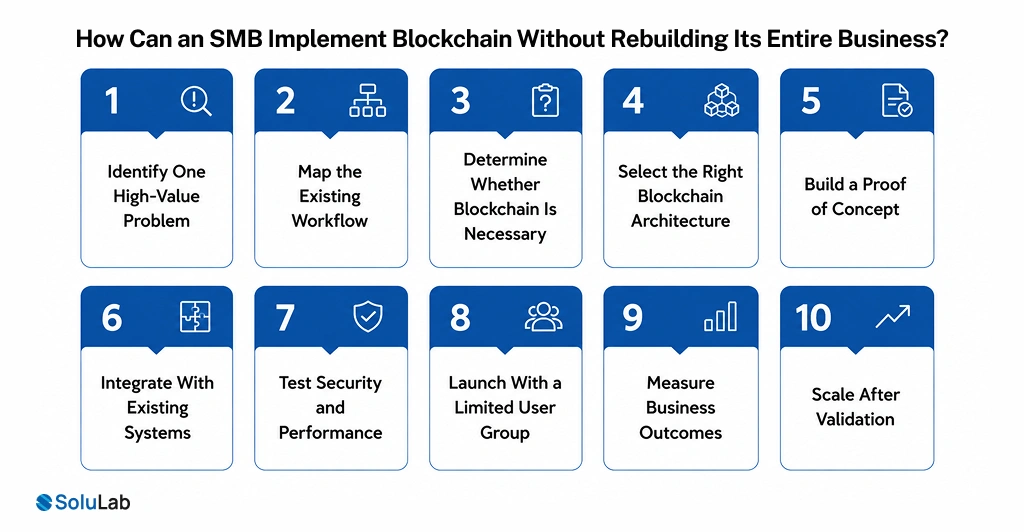
Ten stages take a business from “maybe blockchain” to a working pilot, and skipping the early ones is how projects balloon into something nobody budgeted for.
1. Identify One High-Value Problem
Start narrow. A single, well-defined problem, not “improve our operations with blockchain,” keeps the whole project honest and fundable.
- Define the specific pain point
- Confirm it’s worth solving
2. Map the Existing Workflow
Before touching any technology, get a clear picture of how the process actually works today, warts and all.
- Document the current process fully
- Identify every party involved
- Flag where data currently disagrees
3. Determine Whether Blockchain Is Necessary
Here’s the uncomfortable question most vendors skip: does this actually need a blockchain, or would a shared database solve it just as well?
- Confirm multiple parties need trust
- Check if a database would suffice
- Rule out blockchain if unnecessary
4. Select the Right Blockchain Architecture
Public, private, or consortium chains fit different situations, and an SMB rarely needs the same setup a bank does. Bringing in a partner to hire blockchain developers with SMB-scale experience specifically avoids the common mistake of over-architecting for enterprise scale nobody needs yet.
- Compare public versus permissioned options
- Match architecture to actual scale
- Avoid over-engineering for future growth
5. Build a Proof of Concept
A narrow POC catches problems while they’re still cheap to fix, before real budget and reputation are on the line.
- Scope a small, testable use case
- Set clear, measurable success criteria
6. Integrate With Existing Systems
This is usually the actual hard part, not the blockchain itself. Most SMB systems weren’t built expecting a blockchain layer bolted on.
- Map integration points to existing software
- Build APIs bridging old and new
- Test data flow in both directions
7. Test Security and Performance
Skipping security testing at SMB scale is just as risky as at enterprise scale, arguably more so, since there’s less margin to absorb a mistake.
- Run security testing before launch
- Confirm performance under real load
8. Launch With a Limited User Group
Rolling out to a small group first surfaces problems while the blast radius is still manageable.
- Launch with a small user cohort
- Gather direct, unfiltered feedback
- Monitor closely for unexpected issues
9. Measure Business Outcomes
Vanity metrics don’t justify the investment. Actual time saved, disputes avoided, or costs cut do.
- Track outcomes against original goals
- Compare against pre-blockchain baseline
10. Scale After Validation
Only expand once the pilot has actually proven the case, not before, no matter how much internal pressure there is to move faster.
- Expand to additional use cases
- Train staff on the new process
- Monitor as volume increases
Read more: Blockchain in finance
What Are the Most Practical Blockchain Use Cases for SMBs?
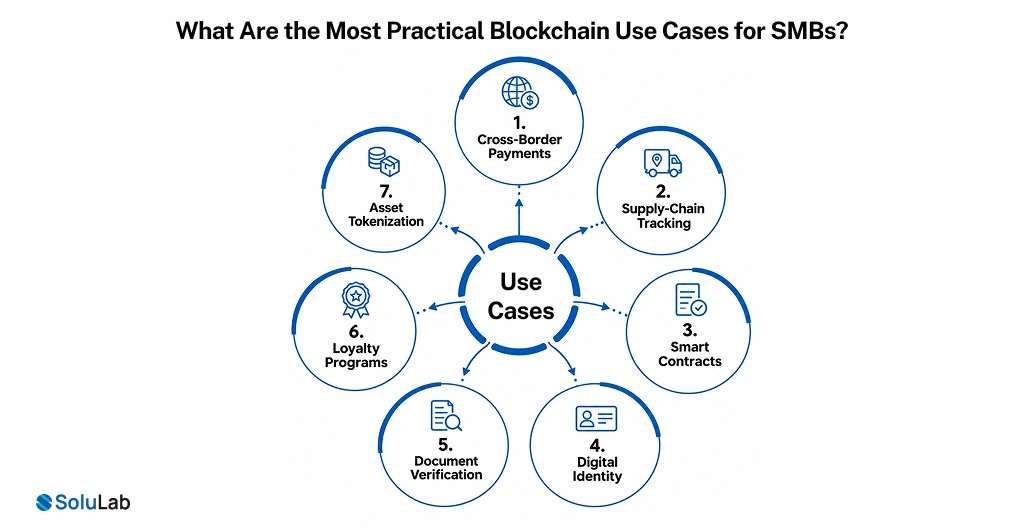
Seven use cases show up again and again at SMB scale, mostly because they solve a specific, recurring friction point rather than chasing something speculative.
1. Cross-Border Payments
Moving money internationally through traditional banking rails is slow and layered with fees. Blockchain rails cut both. That matters disproportionately for a small business that doesn’t have the volume to negotiate better banking terms in the first place.
2. Supply-Chain Tracking
A shared ledger gives every party in a supply chain the same version of the truth. SMBs working with supply chain blockchain solutions tend to start here, and for good reason: the ROI shows up fast, fewer disputes over what shipped and when, and it’s genuinely easy to measure.
3. Smart Contracts
Automating routine agreements cuts the manual approval steps eating time in a small back office. Payment on delivery confirmation is the classic example. Working with a smart contract partner who’s actually done SMB-scale deployments before matters here, since it’s easy to over-build for a problem that never needed enterprise-grade complexity.
4. Digital Identity
Verifying a customer, vendor, or employee without relying on one centralized database cuts fraud risk and onboarding friction at the same time, especially for businesses operating across borders.
5. Document Verification
Certificates, contracts, compliance documents, all verified instantly against a tamper-resistant record. Beats a manual, often slow, paper trail every time.
6. Loyalty Programs
Tokenized points and rewards are one of the lowest-friction entry points into blockchain going, mostly because they don’t touch core operational systems at all. More on this below.
7. Asset Tokenization
Fractional ownership of a physical or financial asset, opened up to more investors than a traditional structure allows, is now accessible even to SMBs. Asset tokenization platforms increasingly serve smaller-scale issuers, not just institutional ones the way they used to.
How Can Blockchain Improve Loyalty and Rewards Programs?
Loyalty programs are one of the more approachable entry points precisely because they don’t require touching a company’s core systems at all.
1. Tokenized Loyalty Points
Points issued as blockchain tokens, not database entries, get tracked transparently. Depending on how the program’s designed, they can even be moved or traded, something a traditional points system was never built to do.
2. Cross-Brand Rewards
Multiple businesses can share one rewards ecosystem built on the same underlying token. A customer earns at one shop and redeems at another. Siloed loyalty platforms simply can’t do that.
3. Transferable Rewards
Points that move between accounts, or even between people, add flexibility standard loyalty programs just don’t offer. Design this carefully, though. Nobody wants to accidentally create a secondary market for points.
4. Digital Collectibles
Limited-edition digital rewards or milestone badges cost little to issue and generate real collector interest, the kind a flat points balance never quite manages.
5. Customer Engagement
Rewards that unlock automatically at milestones, no manual tracking required, drive more repeat engagement than a static punch card ever managed to.
Read more: Blockchain in Healthcare
Common Blockchain Adoption Mistakes SMBs Should Avoid
A handful of avoidable mistakes account for most stalled SMB blockchain projects.
- Trying to solve too many problems at once tops the list. A pilot built around three different use cases at once rarely finishes any of them well.
- Underestimating blockchain integration work is close behind, since connecting blockchain to existing accounting, CRM, or inventory systems is almost always harder than the blockchain component itself.
- Skipping the “do we actually need this” question, covered in the fit test below, wastes budget on a database problem dressed up as a blockchain one.
- And treating a proof of concept as optional, or as a formality to rush through, tends to mean the real problems surface in production instead of in testing, where they’re far more expensive to fix.
How Much Does Blockchain Implementation Cost for an SMB?
Cost depends heavily on scope, and the gap between a narrow pilot and a full custom platform is bigger than most first-time buyers expect.
| Project Scope | What’s Included | Estimated Cost |
| Pilot / Proof of Concept | Single use case, limited integration, small user group | $15,000 – $40,000 |
| Mid-Scale Implementation | Full integration with existing systems, broader rollout | $50,000 – $150,000 |
| Custom Enterprise-Grade Platform | Multiple use cases, advanced security, full-scale deployment | $150,000 – $400,000+ |
| Ongoing Maintenance | Monitoring, updates, support | 10–20% of build cost annually |
For context on why costs vary this much, Statista-tracked global spending on blockchain solutions is projected to reach roughly $19 billion, and a growing share of that is smaller-scope enterprise projects rather than the headline-grabbing institutional builds.
Some SMBs also work with a web3 development services partner on a project basis rather than staffing up internally, which keeps the pilot-tier cost realistic. Most SMBs are better served starting at the pilot tier and expanding only once the numbers justify it, rather than committing to a custom platform on the first attempt.
How Do You Know If Your Business Actually Needs Blockchain?
Run your situation through this quick fit test before committing budget to anything.
- Do multiple organizations share the same data? If it’s just internal teams, a shared database usually solves this more cheaply.
- Do they lack a common trusted database? Blockchain earns its place specifically when no single party is trusted to hold the master record.
- Do participants need independently verifiable records? If nobody actually needs to verify the data themselves, this requirement doesn’t apply.
- Does reconciliation consume significant time? Time spent resolving mismatched records is one of the clearest, most measurable signals blockchain could help.
- Are intermediaries adding cost or delays? Removing a middleman is one of blockchain’s more reliable wins, when the middleman is genuinely unnecessary.
- Do you need an immutable audit trail? Regulated industries and anything requiring long-term proof of authenticity tend to answer yes here.
- Can smart contracts automate meaningful business rules? If the “rules” are actually judgment calls, smart contracts won’t help much.

Conclusion
Blockchain for small and mid-sized businesses works best as a targeted fix for a specific, recurring problem, not a company-wide transformation project. The businesses seeing real results started narrow, proved the case with a small pilot, and expanded only once the numbers backed it up.
SoluLab, a blockchain development company, can help your business figure out exactly where that starting point is for your specific operations and budget.
Talk to a SoluLab blockchain architect about implementation and cost.
FAQs
Neha is a curious content writer with a knack for breaking down complex technologies into meaningful, reader-friendly insights. With experience in blockchain, digital assets, and enterprise tech, she focuses on creating content that informs, connects, and supports strategic decision-making.


![Top 20 Industries Leveraging Blockchain Development Services [2026 Edition]](https://www.solulab.com/wp-content/uploads/2026/04/Powering-20-Industries-with-Blockchain-Solutions.webp)