Key Takeaways
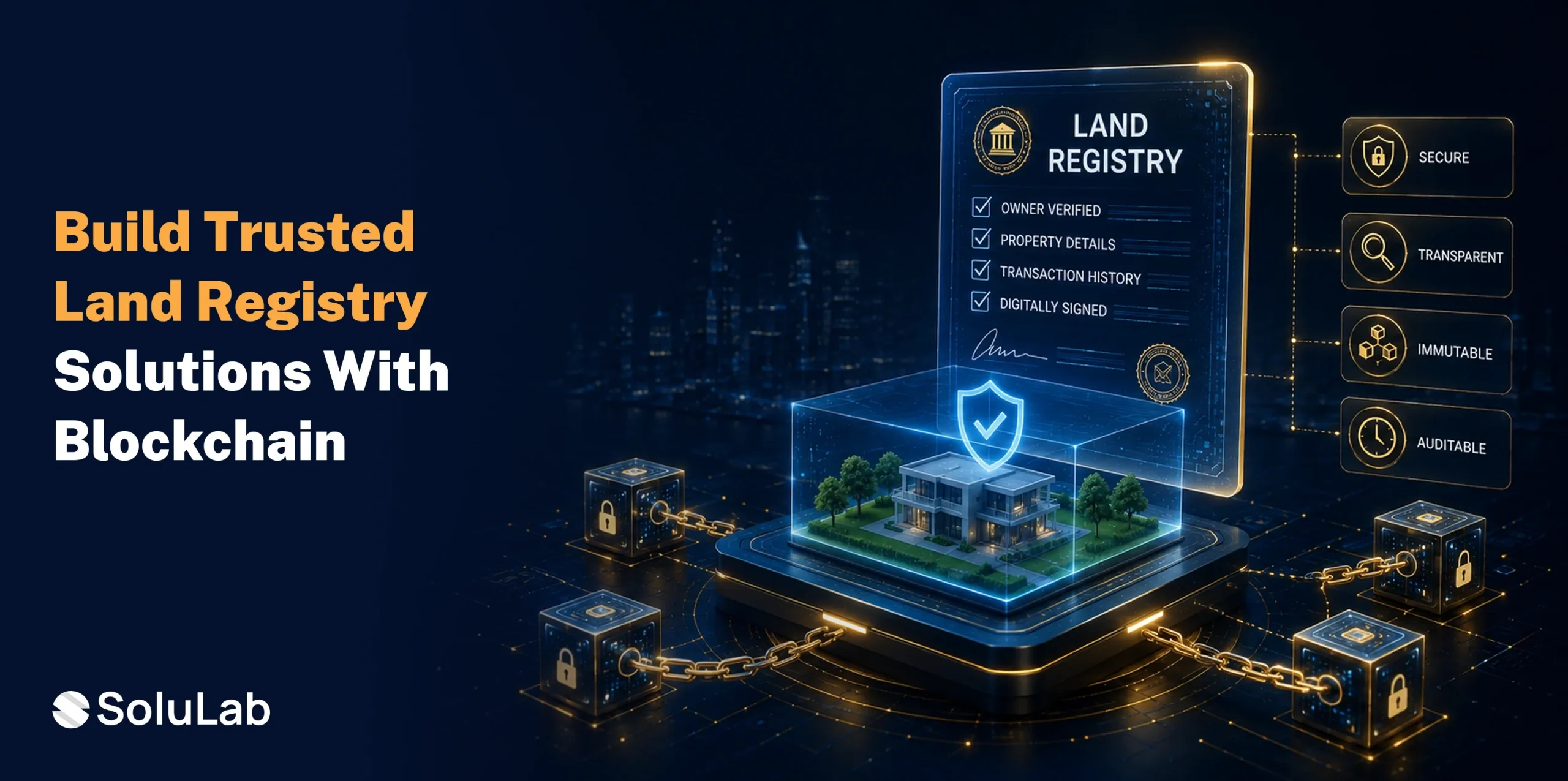
- Blockchain-powered land records create immutable ownership histories that reduce fraud and document tampering.
- Smart contracts automate property transfers, escrow, and title verification.
- Digital land registries improve transparency while reducing paperwork and processing time.
- Countries including Sweden, Georgia, the UAE, and India are actively testing or expanding blockchain land registry initiatives.
- Integration with GIS, digital identity, and government databases is critical for successful implementation.
Picture a farmer waiting 100 days just to prove a field is theirs. No bribes needed, ideally. But reality often says otherwise. Roughly 70% of the world still stores land records on paper. Think stamps and dusty file cabinets. Errors creep in. Fraud creeps in, too, more than most people realize.
Blockchain development solutions for land registry systems flip that script fast. Every title becomes a digital record nobody can quietly edit. This tech is quietly changing how nations track blockchain property records. From Sweden to India, real teams are testing blockchain land records on real land, with real people and real stakes.
What Is A Blockchain Land Registry And Why Does It Matter?
A blockchain land registry is like a shared notebook for property ownership. It resists tampering by design. Instead of one office guarding the master file, thousands of computers hold matching copies. Nobody can sneak in and rewrite history alone.
Old systems ask you to trust a clerk or a government desk. That trust sometimes breaks down. Corruption happens more than anyone admits. Files go missing without warning. Records get “accidentally” changed, too.
Digital land records work differently. Once a deal gets confirmed, it stays locked in place. If someone tries to fake a title, the network simply says no.
This matters most where property rights feel shaky. A blockchain land record management system gives regular people something solid. It gives them proof that holds up, without needing anyone’s favor.
Think of it like a group chat that never lets anyone delete a message. Every edit stays visible. Every transfer stays visible, too. That alone stops a lot of bad behavior.
Generally, a land record management system built this way fixes a few old problems. Here’s what changes once records move on-chain:
- Ownership history becomes traceable from the very first sale.
- Duplicate titles for the same plot become nearly impossible.
- Disputes get resolved faster, since evidence sits on one shared ledger.
- Citizens can verify a title themselves, without waiting for an office.
None of this removes the human side of land ownership. However, it clears out a lot of guesswork. That guesswork used to fuel disputes and slow down every sale.
How Do Blockchain Land Records Actually Work?
The mechanics sound complex. However, the core idea stays simple. Documents get turned into computer code. Then a system checks them, not a person.
Turning Paper Deeds Into Digital Tokens
First, buyers and sellers verify who they are with digital IDs. Then, the actual paperwork, surveys, and deeds get hashed. Hashing turns a document into one unique string of code.
- That string links straight to a digital token for the property. Change even one letter in the file, and the code changes too. This ties the real world to the on-chain record. The link stays tight and lasts.
- Georgia’s national registry used this exact approach. Millions of titles got hashed and locked onto a public ledger. That gave citizens solid, digital proof of ownership.
This step matters more than most people assume. A digital land title is only as good as the paperwork behind it — if the original survey was wrong, the token carries that error too. That’s why identity checks come first, before anything gets minted on-chain. Teams building government blockchain platforms generally build this check layer first. It’s not flashy work, but it’s the backbone that everything else leans on.
Land registration platform development teams generally build this check layer first. It’s not flashy work. However, it’s the backbone that everything else leans on.
Smart Contracts That Handle Escrow On Their Own
Smart contracts are small programs that follow simple rules. No human pushes any buttons. Buyer sends funds. Contract holds them. Seller transfers the title. Funds release on their own.
- No middleman collects a fat fee for weeks of waiting. Additionally, both sides stay protected. The contract won’t release anything unless every rule gets met.
- Oracles play a helper role here too. Smart contracts can’t check the outside world alone. So oracles feed them verified data instead. A contract might wait for proof that a permit exists before it releases funds.
This kind of automation turns a slow, months-long closing into minutes. That alone changes how people think about buying property.
- Connecting different networks matters here too. Government registries often run on private chains.
- Payments, meanwhile, happen on public networks. Bridging tools, like the Chainlink layer, let a title act as backing elsewhere.
Getting that logic right depends entirely on rigorous smart contract development, because a bug in an escrow contract holding real property funds isn’t the kind of mistake you patch after the fact. Moreover, that link stays possible without handing over control of the data.
Can Blockchain Property Records Unlock Real Estate Liquidity?
Land has always held value but stays hard to sell fast. Blockchain land management brings something new: split, tradeable ownership.
Fractional Ownership, One Token At A Time
Imagine a big office building worth millions. Instead of one buyer needing the full amount, the property splits into thousands of digital shares. Each token stands for a small slice of ownership.
- Everyday investors can buy in with small amounts. Owners can sell part of their stake without giving up the whole asset. That’s a real change for a market that usually moves slowly.
- These tokens can also be traded around the clock. Prices adjust in real time, not just once a year. Global buyers gain access without needing to fly anywhere.
However, this only works if the legal system backs the token as real ownership. Otherwise, you’re just trading a picture of a house, not the house itself. This is the same principle behind real estate tokenization more broadly: experts increasingly describe it as borrowing stock market logic for land, the same fractional thinking used in shares, just applied to a plot of dirt.
Asset tokenization for real estate generally opens a few doors at once:
- Smaller investors gain entry into markets once reserved for the rich.
- Owners raise cash without a full sale, keeping most of their stake.
- Buyers from other countries can join in with a couple of clicks.
- Price discovery happens all the time, not once every few years.
None of this works without solid legal backing, though. A token still needs a real deed standing behind it; otherwise, it’s just a picture of an asset, which is exactly why teams building on the broader real-world asset tokenization model treat legal structuring as step one, not an afterthought.
Who Is Already Using Blockchain Land Management Around The World?
This isn’t just theory anymore. Multiple governments have moved from talk to real pilot programs. Some are already growing them further.
| Country / Region | Initiative | What It Achieved |
| Sweden | Lantmäteriet blockchain pilot | Tested property transactions, projected savings of over €100 million a year |
| Republic of Georgia | National blockchain title registry | Registered millions of land titles with cryptographic proof |
| India | State-level blockchain land record pilot | Merged revenue, survey, and registration data into one tamper-resistant system |
| Ghana | Land administration digitization project | Explored blockchain to reduce disputes over customary land |
| UAE | Dubai Land Department blockchain initiative | Moved toward paperless real estate transactions citywide |
One recent example comes from an Indian state government. It launched a blockchain land records pilot. The pilot pulls revenue, survey, and registration offices into one shared system. Each land parcel gets a unique digital ID. Every deal becomes fully traceable, down to the exact time and the official who handled it. The system pauses any deal on its own if errors show up. That’s a small detail with a big impact. Officials say the pilot already covers dozens of villages across seven districts. A wider rollout is planned soon.
These examples share a common thread. Governments aren’t chasing hype here. They’re chasing fewer disputes, faster processing, and records people can actually trust.
Traditional Registries Versus Blockchain Land Records At A Glance
| Factor | Traditional Land Registry | Blockchain Land Registry |
| Record control | Single government office | Distributed network of nodes |
| Fraud risk | Higher, due to manual edits | Lower, records are tamper-resistant |
| Transaction speed | Weeks to months | Minutes to days |
| Cost | Multiple intermediaries and fees | Reduced through automation |
| Transparency | Limited public access | Auditable history, with privacy controls |
| Liquidity | Illiquid, hard to sell partially | Tokenization allows fractional sales |
What Challenges Stand In The Way Of Blockchain Land Title Management?
Nothing this big rolls out without friction. Blockchain land registry development still faces real, practical hurdles.
Legal Recognition Still Lags Behind
In many countries, a smart contract isn’t yet a valid legal deed. Laws written decades ago simply didn’t plan for this. Lawmakers now need to catch up. That process moves slowly.
In case a dispute lands in court, judges need clear rules to follow. Without new laws, even a perfectly recorded blockchain title can sit stuck in limbo.
Balancing Openness With Privacy
Openness sounds great, until it means posting names and addresses in public. That raises real privacy worries, especially under laws like GDPR.
Private, permissioned chains help here. Only approved people see sensitive details on those. Zero-knowledge proofs offer another path, too. They let a system confirm ownership without showing personal data.
Moreover, connecting new blockchain systems with old government databases isn’t simple. Old systems weren’t built to link up this way. Closing that gap takes real engineering, not just good intentions.
Adoption also depends on people, not just code. A few hurdles keep showing up across pilot programs worldwide:
- Rural citizens may lack steady internet access or a smartphone.
- Older generations often trust paper deeds more than a screen.
- Government staff need fresh training on entirely new workflows.
- Budget constraints slow down rollout in smaller municipalities.
If these gaps remain unsolved, even the most reliable land record system will fail to reach the people who need it most. Tech alone can’t close that gap.
Governments won’t drop paper overnight, and that’s fine. Change as this happens in slow, tested steps. Pilot programs, such as those running in Sweden and Georgia, offer real proof. The idea holds up well outside a whitepaper. Parts of India now show the same pattern.
If your country hasn’t started exploring digital land records yet, it likely will soon. The push to cut fraud and speed up deals isn’t going away.
For now, the smart move is watching these pilots closely. Learn from what works. Fix what doesn’t. Then grow it with care. Land is too important to rush.
Conclusion
By combining immutable ledgers, smart contracts, and digital identity verification, blockchain systems reduce fraud, improve transparency, and simplify property transfers while creating a trusted source of ownership data.
However, successful implementation requires more than blockchain technology. Governments need legal frameworks, secure identity verification, integration with existing land databases, and scalable infrastructure to ensure long-term adoption.
At SoluLab, we specialize in blockchain consulting services and developing blockchain land record management solutions for governments, enterprises, and real estate organizations. From blockchain architecture and smart contract development to GIS integration, digital identity, tokenization, and secure land registry platforms, our team delivers end-to-end solutions tailored to your regulatory and operational requirements.
Whether you’re planning a pilot program or a nationwide digital land registry, our blockchain experts can help you build a future-ready platform that is transparent, secure, and built to scale.
FAQs
Deepika is a content writer who blends storytelling with strategic thinking. She explores topics across digital innovation, emerging tech, and the evolving blockchain industry. She enjoys breaking down complex ideas into simple, engaging narratives in the growing global markets.