Key Takeaways
- Blockchain-based digital credentials give universities a tamper-proof way to issue degrees, certificates, and micro-credentials that graduates can share instantly without a manual verification request.
- Adoption is no longer theoretical. Institutions ranging from community colleges to large research universities have already issued blockchain diplomas at scale.
- The real value isn’t just fraud prevention. It’s putting the credential in the graduate’s hands as a portable, employer-verifiable record they control.
- Integration with existing student information systems and registrar workflows is usually the hardest part of a rollout, not the blockchain itself.
- Universities building this in-house without prior blockchain experience tend to underestimate the identity, storage, and compliance work involved.
Remember the last time you had to prove you actually graduated? For most people, that meant calling the registrar and waiting a couple of weeks for someone to dig up a file.
Blockchain-based digital credentials are quietly fixing that. A university can now issue a degree that’s cryptographically signed, instantly checkable, and owned by the graduate rather than filed away in an office somewhere.
According to the 2025 Gartner CIO and Technology Executive Survey, higher education leaders identified improving the customer experience (79%), enhancing the digital workplace (75%), and acquiring new customers (67%) as the primary business outcomes of their organizations’ digital technology investments.
This piece gets into what these credentials actually are, how the architecture behind them works, and where schools are already putting them to use.
What Are Blockchain-Based Digital Credentials?
Picture a degree that can’t be quietly edited after the fact. No white-out, no forged signature, nothing. That’s essentially what a blockchain-based digital credential is: an academic record that’s cryptographically signed and anchored to a blockchain, so anyone can check it’s real without calling the school.
A PDF diploma? Someone with basic image-editing skills and a little patience can alter it. A blockchain credential can’t be touched that way, because tampering breaks the signature the second it happens. That single detail solves something registrars have wrestled with for years. Fake and altered degrees slip past employers constantly, mostly because nobody has the time to verify every line on every resume by hand.
How This Differs From a Standard PDF Certificate
- A PDF gets edited with a bit of software and patience. A blockchain credential’s signature breaks the moment its data changes, so tampering shows up right away.
- Verification takes seconds through a public link or a QR code, not a phone call or an email that sits unread for a week.
- The graduate holds and controls the credential in a digital wallet, instead of hoping the registrar’s office is still around, and still answering emails, twenty years from now.
Blockchain technology is doing the heavy lifting behind all of this, and it’s honestly one of the more useful applications it’s found outside of finance.

How Blockchain Strengthens Digital Credentials
Strip away the jargon, and the mechanics here aren’t nearly as complicated as they sound.
The Core Verification Process
- Credential creation. The university pulls the credential data together- degree type, name, date, whatever metadata matters- into a standard format.
- Cryptographic hashing. That data runs through a hash function and comes out as a unique digital fingerprint. Change one character of the original, and the fingerprint changes completely.
- On-chain anchoring. Only the hash goes on the blockchain, not the full credential. Private student data stays off the public ledger, while the record itself still proves it exists and hasn’t been touched.
- Issuance to the graduate. The graduate receives the full credential, usually through a digital wallet app, along with everything needed to check it against the on-chain hash.
- Verification by a third party. An employer, or another school, compares the hash to the blockchain record. Legitimate or not, they know within seconds.
That’s the piece that makes portable blockchain credentials for universities genuinely different from a PDF sitting on a desktop somewhere. Proof travels with the credential itself. No callbacks, no waiting on an office that might take days to respond.
Why Universities Are Adopting Blockchain Credentials Now
This has already moved well past pilot territory, more than most people realize. Central New Mexico Community College and ECPI University in Virginia have both issued blockchain-based diplomas at real scale, and by most accounts, employers responded well to how quickly verification actually worked.
The bigger numbers back this up. Gartner’s research pointed to roughly a fifth of higher education institutions expecting to adopt blockchain for credential verification within a few years of that 2022 survey, up sharply from around 2% that had actually rolled it out back in 2019. For a sector that typically moves at the pace of a faculty committee, that’s a genuine shift.
A handful of forces are pushing this along, and fraud prevention is only one of them.
- Rising credential fraud. Fake degrees and doctored transcripts remain a real headache for employers, and a university’s name takes the reputational hit whenever one slips through.
- Growing demand for micro-credentials. More schools are issuing certificates and badges alongside traditional degrees, and doing that by hand stops being realistic pretty fast.
- Student mobility. Students transfer schools and study abroad more than they used to, and a portable, instantly checkable record removes a lot of the friction involved.
- Employer expectations. Hiring teams don’t want to sit on a job offer for days waiting on a verification response.
Key Benefits of Blockchain Credentials for Universities
There’s more here than just cutting down on fraud, though that’s a real part of it.
For the Institution
- Less administrative work, since fewer verification requests hit the registrar’s desk once employers can check things themselves.
- A stronger reputation, particularly in places where credential fraud has been an ongoing, well-documented problem.
- A foundation for issuing stackable micro-credentials without building a new system from scratch every time a certificate type gets added.
For Graduates and Employers
Employers care about verified, skills-based records more than a lot of universities give them credit for. Deloitte’s research on skills-based organizations found companies applying this model are 79% more likely to deliver a positive workforce experience, and 63% more likely to hit their intended results, compared to organizations still relying on resume-based evaluation. A blockchain credential feeds directly into that shift. Instead of a claim an employer has to take on faith, they get a verifiable, skills-anchored record. Graduates benefit here too. Their credential doesn’t hinge on some records office staying open or responsive, decades from now.
Blockchain Credential Architecture: Core Components
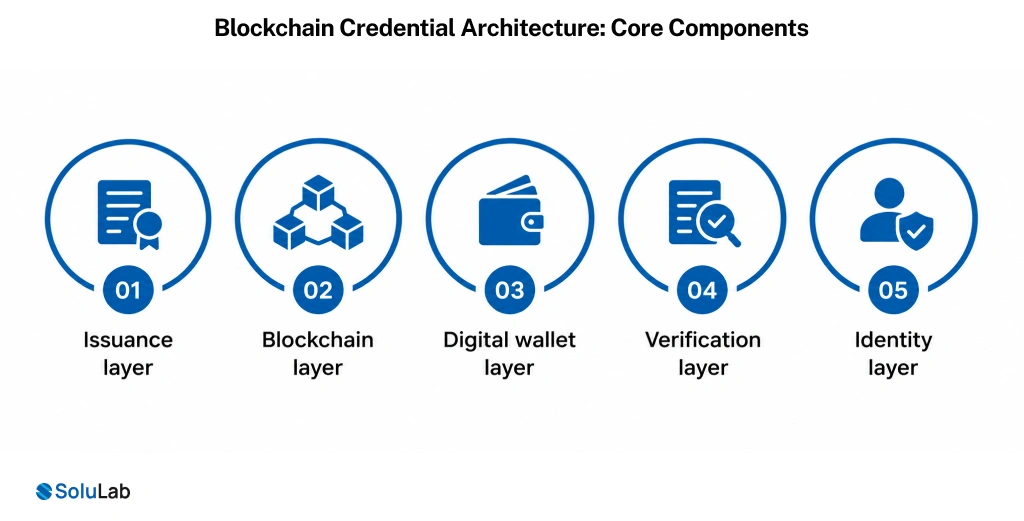
Putting the diploma on a blockchain sounds simple until you actually try to build it. There’s more to a working system than that, and knowing the pieces matters before picking a vendor.
The Technical Stack
- Issuance layer: the system a registrar uses to generate, sign, and issue credentials, usually wired into the existing student information system.
- Blockchain layer: where the credential hashes actually live, whether that’s a public chain, a permissioned network shared across institutions, or something hybrid.
- Digital wallet layer: the app where graduates store and manage credentials, not far off from how a mobile payment wallet works.
- Verification layer: the public-facing tool employers and other schools use to confirm authenticity.
- Identity layer: the piece that ties a credential to the right person, usually built on decentralized identity standards rather than a basic login system.
Plenty of universities go with a Blockchain-as-a-Service model for the infrastructure instead of running their own nodes. That takes a real chunk of ongoing maintenance off an IT department that already has enough on its plate.
Top Use Cases for Blockchain Credentials in Higher Education
A few of these are still catching on, but several have already gone well past the pilot phase.
- Digital diplomas. The most established use case, hands down. Graduates get a verifiable digital diploma, either alongside a paper one or instead of it.
- Transcript verification. Full transcripts, course-level detail included, get issued as verifiable credentials instead of sealed paper documents nobody can check.
- Micro-credentials and digital badges. Short courses and skills-based badges run through the same infrastructure as full degrees.
- Continuing education records. Professional development hours get tracked in a format licensing boards can actually verify, no extra paperwork required.
- Cross-institutional credit transfer. Students moving between schools can share a verifiable record of completed coursework without the usual wait on a manual transcript request.
- Alumni verification for employers. A background check turns into a seconds-long lookup instead of a request that sits in someone’s queue for a week.
Challenges to Address Before Adoption
None of this rolls out smoothly by itself, so it’s worth being upfront about where universities tend to hit a wall.
- Integration with legacy systems. Most student information systems weren’t built with blockchain in mind, and connecting the two takes actual engineering work, not a plugin install.
- Standardization across institutions. Without a shared standard, a credential issued by one university’s system might not play nicely with a verification tool built for another’s.
- Digital identity gaps. Proving a credential belongs to the right person requires an identity layer plenty of institutions haven’t built yet.
- Change management. Registrar staff and IT teams need training, and faculty buy-in ends up mattering more than most people expect going in.
- Cost and vendor selection. The broader blockchain technology market, valued at roughly USD 57.7 billion in 2025 and projected by Grand View Research to grow at a compound annual rate of 88.2% through 2033, has pulled in vendors of wildly uneven quality. Due diligence isn’t optional here.
How Universities Can Get Started
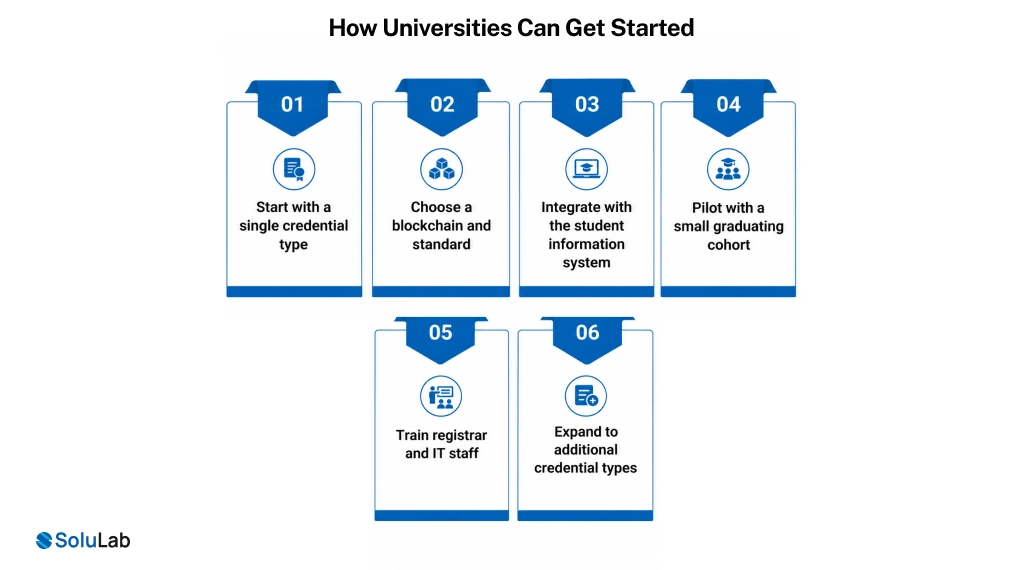
Getting from interest to a working system tends to follow a fairly predictable path.
A Practical Rollout Approach
- Start with a single credential type. Most institutions begin with diplomas, or one specific certificate program, instead of trying to convert everything at once.
- Choose a blockchain and standard. Weigh a public chain against a consortium network shared with peer institutions, or a private permissioned setup, based on cost, privacy needs, and how much interoperability actually matters.
- Integrate with the student information system. This step usually eats up more time than the blockchain part itself, since it means mapping existing data structures onto a new format.
- Pilot with a small graduating cohort. Issue credentials to a limited group, listen to feedback from students and the employers trying to verify them, and fix the rough edges before scaling.
- Train registrar and IT staff. Ongoing issuance and support need to become part of the actual job, not a side project for whoever happened to run the pilot.
- Expand to additional credential types. Once the core system holds up under real use, extend it to micro-credentials, transcripts, and continuing education records.
Institutions without existing blockchain expertise usually bring in outside blockchain development services at the architecture stage. Getting the identity and integration layers wrong early costs a lot more to fix later than it would have to get right from the start.

Conclusion
Blockchain-based digital credentials have gone from an interesting pilot idea to a practical fix for something universities have dealt with for a long time: slow, manual, easily forged verification. The schools actually getting value out of this aren’t chasing the technology for its own sake.
They’re solving for faster verification, less administrative overhead, and graduates who genuinely own their own records instead of borrowing access to them from a registrar’s office.
If your institution is exploring how to issue verifiable, portable credentials, SoluLab, a blockchain development company with hands-on experience across identity, credentialing, and Web3 infrastructure, can help you scope an approach that fits your existing systems instead of forcing a rebuild from scratch.