Blockchain went from a niche hobby to a mass movement fast. By early 2023, something like 420 million people worldwide owned cryptocurrency, according to industry researchers. That kind of growth sounds great until you hit the wall it creates: networks choke under their own popularity. Enter blockchain scalability. Without it, blockchain stays a curiosity, not infrastructure.
Developers didn’t just sit with that problem. They built a whole toolkit around it, and two approaches now dominate the conversation: Layer-1 blockchain scaling and Layer-2 blockchain scaling. Each tackles throughput and performance from a different angle.
This post walks through what separates the two, where each one shines, where it falls short, and how each shows up in production systems today. Stick with it and you’ll come away with a clearer picture of what actually makes a blockchain scale, and stay usable while it does.
Importance of Scalability in Blockchain Technology
Scalability isn’t a nice-to-have in blockchain technology, it decides whether a network can support real users at real volume. Here’s why it matters so much:
- Transaction Throughput: This is simply how many transactions per second (TPS) a network can push through. More throughput means quicker confirmations and a smoother experience, something that matters a lot for real-time apps or anything with heavy transaction volume.
- Cost Efficiency: Solutions that cut fees or energy use make the tech genuinely usable for everyday people and businesses. Cheaper transactions mean more adoption, plus they help blockchain-based applications actually work across different industries instead of staying theoretical.
- Network Stability and Reliability: Scale it right and a network gets steadier: less congestion, fewer delays, fewer transaction backlogs when demand spikes. A scalable chain can absorb more users and rougher traffic spikes without buckling on performance or security.
- Ecosystem Growth and Innovation: Better scalability opens the door to more ambitious projects, complex decentralized applications (DApps), decentralized finance (DeFi) platforms, and things nobody’s built yet. As the ceiling rises, developers get room to try ideas that used to choke the network before they even launched.
Types of Blockchain Layers
1. Layer-1 (On-Chain Scaling)
Layer-1 scaling means changing the protocol itself, not bolting something on top. Think consensus mechanism, block size, data structure: the core machinery. Tune those, and you raise the ceiling on how many transactions the chain handles and how many users it can carry.
2. Layer-2 (Off-Chain Scaling)
Layer-2 takes a different route. It sits on top of the Layer-1 blockchain and pushes transactions off-chain, or through a secondary protocol, instead of touching the base layer at all. The main chain gets breathing room. Throughput goes up. And nobody has to touch the original protocol to make it happen.
What is Layer-1 Blockchain Scaling?
Layer-1 blockchain scaling solutions sit at the center of this whole scalability push. They refine the core protocol itself, aiming to process more transactions and run the network more efficiently overall. Let’s get into what that actually looks like.
At bottom, Layer-1 scaling is about rewriting the rules the protocol runs on: how consensus works, how data gets structured, how blocks get validated. Get those right and you’re not patching a symptom, you’re fixing the actual bottleneck. That’s the difference between a quick fix and a foundation that holds up as the network grows.
- Targeted Protocol Enhancements: Layer-1 solutions zero in on the core protocol itself, tightening how transactions get processed and how far the network can scale.
- Foundational Changes: Layer-2 solutions sit above the base protocol. Layer-1 doesn’t. It rewrites the blockchain’s architecture from the inside.
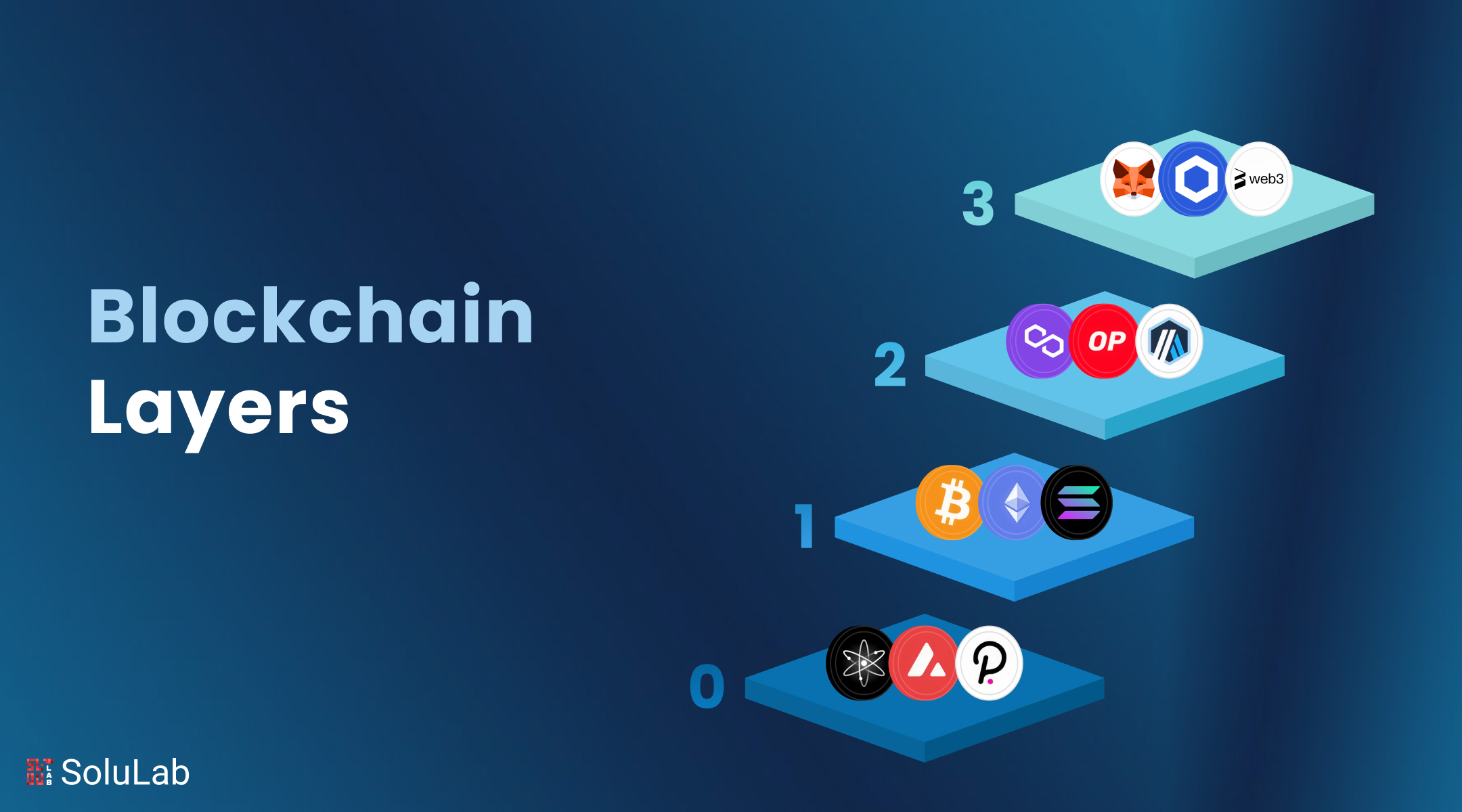
Related: Business Lens on Blockchain Stack: From Layer 0 to Layer 3
Examples of Layer-1 Scaling Solutions
A few strategies dominate this space. Here’s where the real engineering happens:
1. Sharding
Sharding splits the network into smaller pieces called shards. Each one runs independently and handles its own slice of transactions. Run enough of these in parallel and throughput jumps, since the network is no longer processing everything through one bottleneck. Ethereum leaned on this idea to fix its own scalability headaches, with Ethereum 2.0 built around sharding to push transaction capacity higher.
Related: Top Blockchain Development Companies
2. Consensus Algorithm Optimization
How a network reaches consensus matters more than most people give it credit for. Proof of Work (PoW) demands enormous computing power just to validate blocks, and that ceiling caps scalability hard. Switch to Proof of Stake (PoS) or Delegated Proof of Stake (DPoS) and the computational overhead drops, along with the energy bill. Cardano runs PoS. EOS runs DPoS. Both picked their consensus model specifically to buy back scalability and efficiency.
Pros and Cons of Layer-1 Scaling Solutions
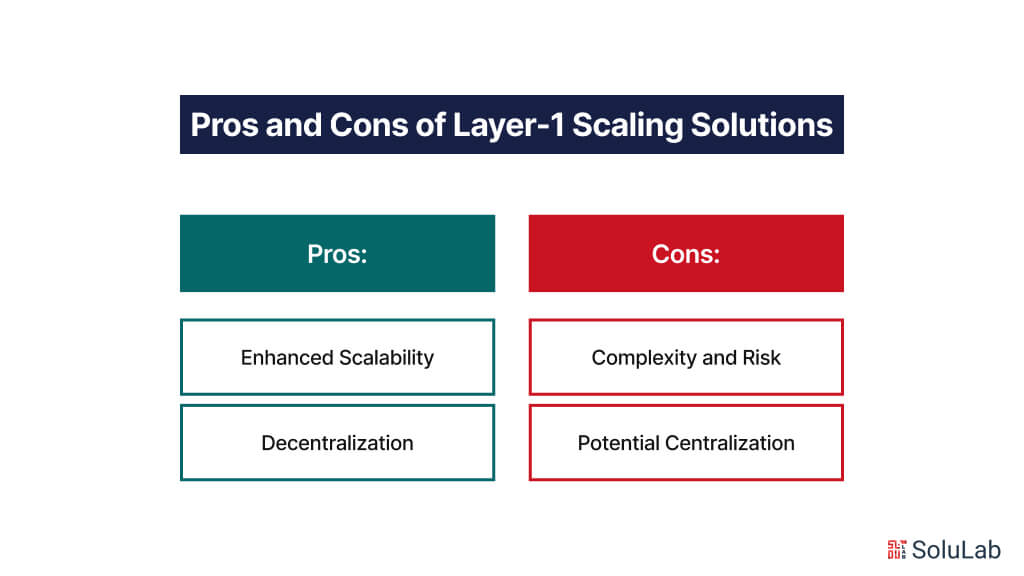
Nothing here is free, of course. Layer-1 scaling brings real upside, and real trade-offs.
Pros:
- Enhanced Scalability: Fix the protocol and you fix scalability at the root, not the symptom. Throughput climbs, performance improves, and the gains hold up over the long run instead of degrading as the network grows.
- Decentralization: Most Layer-1 projects try hard not to sacrifice decentralization while scaling. Keep the network spread across many independent validators and it stays resistant to censorship, transparent, and trustworthy by design, not by promise.
Cons:
- Complexity and Risk: Changing the base protocol is not a small ask. It takes careful planning, extensive testing, and a tolerance for the unexpected, because new consensus mechanisms or features can open attack surfaces nobody anticipated. Skip the risk assessment and you’re gambling with the whole network’s security.
- Potential Centralization: Here’s the irony: some Layer-1 fixes quietly favor certain validators over others. PoS and DPoS both tie voting power to token holdings, which can concentrate control among a handful of large stakeholders. That undercuts the very decentralization the network was built on, and it takes deliberate design choices to keep things fair.
Read Also: Layer 3 Blockchain
What is Layer-2 Blockchain Scaling?
Layer-2 sits above the base Layer-1 protocol and chases blockchain scalability from a different direction: push the work off-chain, or route it through a secondary protocol, and leave the core architecture untouched. Transactions happen off-chain, then settle back on the main chain only when it actually matters. The result? Less congestion, more throughput, better performance overall, all without rewriting a single line of the underlying protocol.
- Scalability Enhancement: Push transactions off-chain, or through a secondary protocol, and blockchain scalability improves almost as a side effect: less pressure on the main chain, more room for throughput.
- Off-Chain Transactions: Off-chain means participants transact faster and for less money, while cryptographic mechanisms still keep everything secure and trustless underneath.
- Main Chain Settlement: Off-chain activity only touches the main chain when settlement actually needs to happen. That alone takes a huge load off the base layer.
Different Types of Layer-2 Scaling Solutions
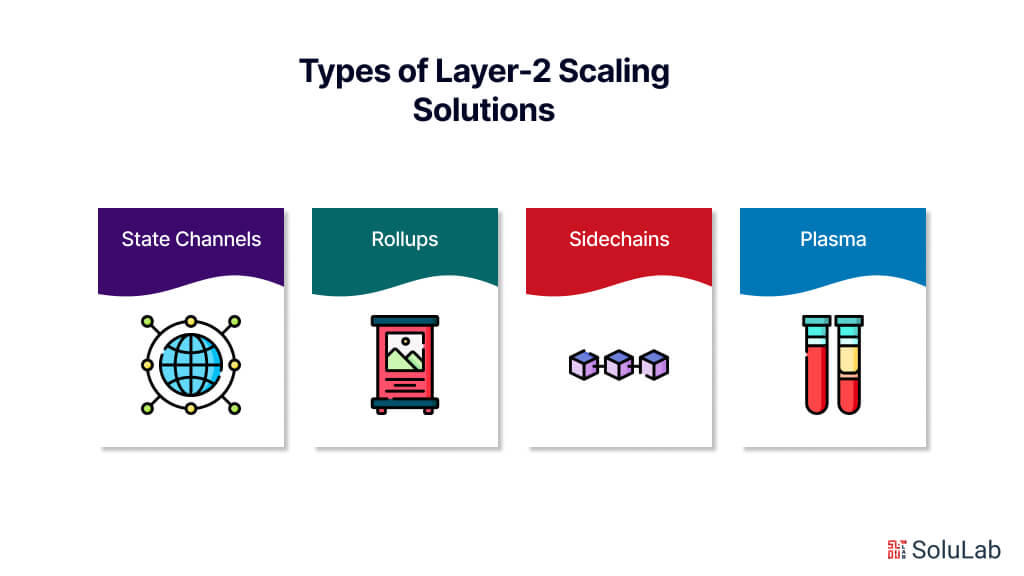
Several distinct techniques fall under the Layer-2 umbrella, each moving transaction processing off-chain in its own way. Here’s the rundown:
1. State Channels
Picture two parties opening a private tab and settling it once at the end, that’s a state channel. Participants swap signed messages off-chain, each one updating the running state, and only the final outcome ever touches the main chain. Cryptography keeps everyone honest along the way. This fits micropayments and gaming especially well, anywhere transactions happen fast and often.
2. Rollups
Rollups bundle a batch of off-chain transactions into one compressed package, then settle that package on the main chain periodically. Two flavors exist. Optimistic rollups assume transactions are valid and only step in when someone disputes one. Zk-rollups take the opposite approach: zero-knowledge proofs verify validity upfront, cryptographically, without exposing the underlying data. Either way, blockchain scalability improves, costs drop, and the network runs more efficiently, all without giving up on security.
3. Sidechains
A sidechain is its own independent blockchain, tethered to the main one. That separation lets teams experiment freely, try new consensus mechanisms, test new features, all without adding congestion to the main chain. Assets move back and forth between the two, so you get scalability gains without losing the ability to interact with the main chain.
4. Plasma
Plasma builds a tree of child chains, each anchored back to a parent chain. Transactions pile up into blocks on the child chain, and the state periodically settles on the main chain above it. High throughput, decent security, that combination makes Plasma a fit for things like decentralized exchanges (DEXs) and tokenized assets.
Read Also: Blockchain Interoperability’s Impact Enterprise Adoption
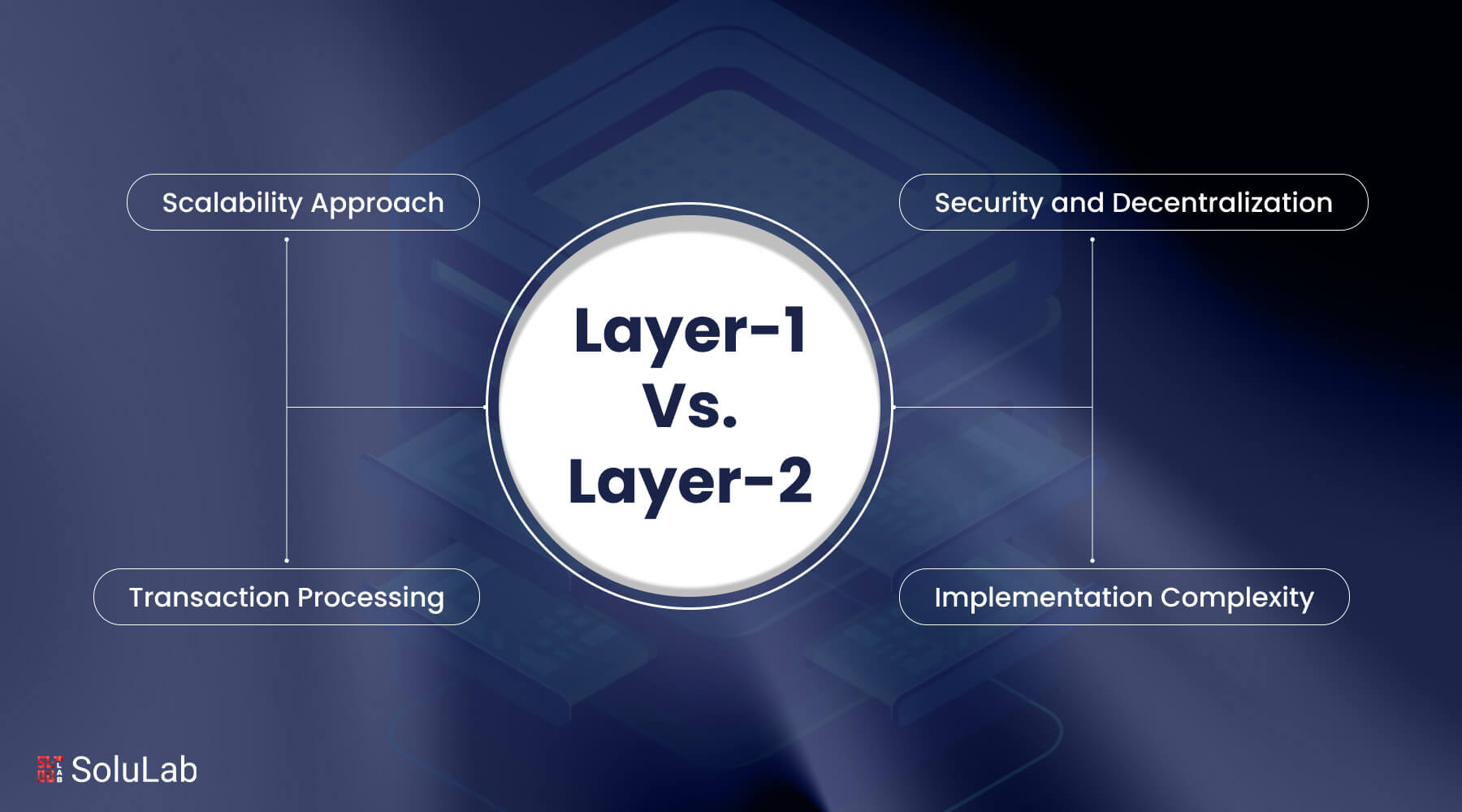
A Comparative Analysis Between Layer-1 Blockchains vs. Layer-2 Blockchains
Put them side by side and the differences get concrete fast. Here’s how they actually compare:
Scalability Approach
- Layer-1: Change the protocol, change the outcome. Layer-1 solutions touch core components directly, consensus mechanisms, block size limits, whatever’s limiting throughput, to raise the ceiling from the inside.
- Layer-2: Layer-2 stays above the base protocol entirely. Off-chain processing and secondary layers absorb the extra load, so the main chain breathes easier and throughput climbs without anyone touching the underlying code.
Transaction Processing
- Layer-1: Every transaction runs straight through the main chain. That’s fine until traffic spikes, then things slow down. Layer-1 fixes work by making that base-level processing more efficient.
- Layer-2: Move transactions off-chain, or through a secondary protocol, and the main chain stops being the bottleneck. Off-chain processing scales better and costs less, particularly for anything that needs frequent, real-time interaction.
Security and Decentralization
- Layer-1: Because changes here hit the core protocol, Layer-1 projects tend to guard security and decentralization closely. Get that wrong and you damage the network’s integrity and the trust users place in it.
- Layer-2: Off-chain activity brings its own headaches: channel disputes, data availability gaps, things that need solving to keep transactions trustworthy. The scalability upside is real, but security and decentralization still have to be earned, not assumed.
Implementation Complexity
- Layer-1: Rewriting the protocol means coordinating across every participant in the network, and that’s rarely simple. Expect extensive testing, expect some risk, expect it to take longer than you’d like.
- Layer-2: Building above the base layer is generally lighter work than rewriting it. Still, compatibility, security, and interoperability with the main chain, and with other Layer-2 systems, all need attention. Nothing here is truly plug and play.
Factors to Consider When Choosing Between Layer-1 and Layer-2 Scaling
Choosing between the two isn’t a coin flip. A few questions tend to settle it:
1. Scalability Requirements: Start with what the network actually needs: throughput targets, acceptable latency, cost tolerance. Those numbers usually point you toward Layer-1 or Layer-2 before anything else does.
2. Security and Trustlessness: Then weigh the security trade-offs. Every choice here trades some mix of scalability, security, and decentralization against another. Figure out which of those three you can least afford to compromise.
3. Implementation Complexity: Be honest about implementation effort too. Coordinating a protocol-level change across a whole network is a different kind of project than shipping an off-chain layer, with different risks attached to each.
4. Use Case and Application Requirements: Finally, look at what the application actually demands, performance, functionality, the experience users expect, and pick whichever layer lines up with those requirements, not whichever sounds more impressive.

Use Cases Where Layer-1 or Layer-2 Scaling Might be More Suitable
There’s no universal winner here, it depends entirely on what you’re building. A few scenarios make the choice clearer:
Layer-1 Scaling Use Cases
1. High-Volume Financial Transactions:
Exchanges and payment platforms live and die by main-chain speed. Sharding or consensus optimizations push throughput up and latency down, and the network absorbs more volume without giving up security or decentralization in the process. For financial applications, that combination, speed plus reliability on the main chain itself, is exactly what Layer-1 scaling delivers.
2. Decentralized Finance (DeFi) Protocols
DeFi protocols, including decentralized exchanges (DEXs), lending platforms, and liquidity pools, all need transactions that are both fast and cheap to support complicated financial interactions. Layer-1 upgrades, protocol optimizations, consensus improvements, push throughput higher and fees lower, which makes these protocols more usable day to day. Give DeFi protocols that kind of headroom and it can carry a bigger user base and far more transaction volume, which in practice drives more adoption and deeper liquidity across decentralized finance.
Layer-2 Scaling Use Cases
1. Microtransactions and Micropayments
Online games, content monetization systems, pay-per-use services, anything running on frequent micropayments needs transactions that are both quick and cheap, or the whole experience feels clunky. State channels or payment channels handle this well: transactions move off-chain, fast and at low cost, sidestepping the fees and delays that come with on-chain processing. That opens up business models built on volume rather than per-transaction margin, without pushing costs or delays onto the user.
2. Privacy-Preserving Applications
Healthcare records, supply chain tracking, identity verification, these all handle sensitive data and need genuine privacy guarantees, not just a promise. Zk-rollups solve this with zero-knowledge proofs: transactions stay valid and verifiable, but the underlying data stays hidden. That’s a real technical trick, not a workaround. Applications built this way can meet regulatory requirements and protect user privacy, and they don’t have to trade away scalability or performance to get there.
Which Blockchain Layer Will Rule the Future?
Given everything above, it’s a reasonable bet that Layer 2 blockchains end up as the more widely used option going forward. Cheaper, faster transactions drive adoption, and they help different chains work together more easily. That said, a Layer 2 chain never stands alone, it still leans on a Layer 1 underneath it. As long as it keeps its efficiency edge and feature set intact, it’ll keep growing.
But it’s not that clean-cut. Things move fast in this space, and the ground keeps shifting under everyone’s feet. Solana and other newer, third-generation blockchains already push hundreds of transactions per second. Cosmos took a different path entirely, building a network design meant for interoperability and scalability from the ground up. And Ethereum itself keeps changing, working through upgrades meant to fix its own speed and scalability limits.
At bottom, Layer 2 blockchains matter because they fill a gap that Layer 1 blockchain development leaves open. If Layer 1s eventually meet user demand on their own, that gap might close, and Layer 2 solutions could matter less. Whether enough people gravitate toward Layer 1 chains with interoperability and scalability built in from the start, that’s still an open question. Time will answer it.
Conclusion
Picking the right option comes down to understanding what each layer actually trades away. Layer 1 blockchains gives you strong decentralization and security, but scalability and transaction speed can suffer for it. Layer 2 blockchains flip that trade: they often sacrifice some decentralization and security to buy speed.
None of this stands still. New developments show up constantly, and right now, Layer 2 blockchains are the go-to method for scaling up and cutting costs. Still, keep an eye on the newer third-generation blockchains. They’re stretching what’s possible directly at Layer 1, and that could shift the balance again.
SoluLab, a leading blockchain development company, works on both sides of this problem, Layer-1 and Layer-2 alike. We build solutions tailored to each network’s actual bottlenecks, drawing on hands-on blockchain experience rather than a one-size-fits-all playbook. Our engineers dig into Layer-1 work like sharding and consensus optimization, and just as comfortably into Layer-2 territory: state channels, zk-rollups, the works. Need to scale your network, or move part of it off-chain? That’s exactly where we come in. Contact us today to hire blockchain developers and get more out of your blockchain project.
FAQs
Shipra Garg is a tech-focused content strategist and copywriter specializing in Web3, blockchain, and artificial intelligence. She has worked with startups and enterprise teams to craft high-conversion content that bridges deep tech with business impact. Her work translates complex innovations into clear, credible, and engaging narratives that drive growth and build trust in emerging tech markets.