By 2026, enterprises have stopped asking whether blockchain is worth a pilot. They want platforms that are smarter and actually connected. And that exposes an awkward problem. Once a company runs three or four decentralized systems, how do those isolated chains talk to each other without someone copying data between them by hand? That question is what blockchain interoperability answers.
Interoperability solutions let separate blockchains pass data and assets back and forth with no central middleman in the loop. When platforms can exchange information that easily, teams get more done, and new kinds of business applications open up in supply chain, finance, and healthcare.
Below, we look at how interoperability is changing enterprise adoption in 2026. Expect practical ground: what happens when data moves between chains without friction, and why that makes cooperation between organizations far easier than it used to be.
What is Blockchain Interoperability?
Put simply, it is the ability of different blockchain networks to talk, share data, and cooperate without breaking. There are a lot of chains out there. Each one has its own protocols, its own consensus method, its own reason to exist. Interoperability keeps them from turning into walled gardens and lets them behave like parts of one larger system.
The blockchain interoperability market is projected to grow 28.30% a year, from USD 0.83 billion in 2026 to USD 7.90 billion by 2034. For reference, the same market was valued at USD 0.65 billion in 2024.
Early blockchains ran alone, on small, closed networks. If a business wanted a multi-chain plan, or wanted to bolt a decentralized system onto the platforms it already had, it hit a wall fast. Compatibility changes that. You can move money, share smart contracts, and manage your identity or assets in one consistent way, even when several networks are involved.
Take Chainlink’s Cross-Chain Interoperability Protocol (CCIP). It gives separate blockchains a secure, scalable way to exchange messages. Tools like this make partnerships between businesses much less painful, and they open the door to services such as multi-chain DeFi platforms, global supply chain tracking, and cross-border payments.

Why Blockchain Interoperability Matters for Enterprises?
For a business, this is not a nice technical extra. It is strategy. Once blockchain technologies spread across departments and regional operations, the only way to stay efficient, keep costs down, and hold a lead over competitors is to get those systems and chains working together. Cross-chain interoperability, then, is the glue that turns scattered systems into one coherent digital backbone.
So what does an enterprise actually get out of it?
- Seamless Data Exchange: Data can travel across many blockchain systems, so every platform works from the same, consistent picture instead of its own version of the truth.
- Multi-Chain Operations: Plenty of companies run different blockchains for different jobs, one for supply chain, one for finance, another for identity, even when those jobs overlap.
- Enhanced Efficiency: Less manual reconciliation. Fewer outside intermediaries. Operations get simpler and decisions get made faster.
- Scalable Innovation: When a new chain or technology shows up, you can adopt it without tearing out what you already built. That is what makes growth over the long haul realistic.
- Improved User Experience: Shared loyalty programs, cross-chain payments, whatever the use case, customers, partners, and stakeholders all get smoother interactions.
- Future-Proofing Investments: Blockchain standards will keep shifting. Interoperable solutions bend with them, which protects the money you have already put into the technology.
How Blockchain Interoperability Works?
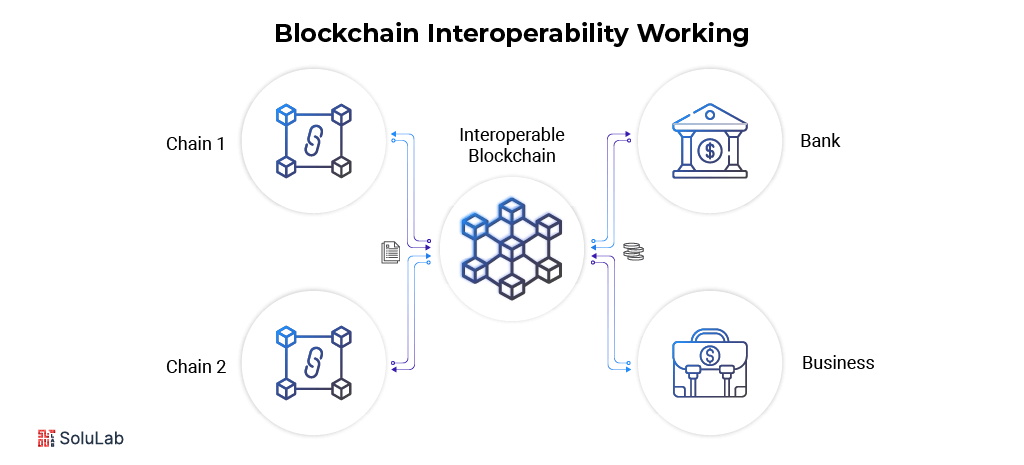
Every blockchain has its own rules, consensus method, and data format. Interoperability lets these very different networks exchange information anyway, and it does so without a central intermediary. Inside a large company, where several chains each handle a separate job, that shared flow of data is what keeps day-to-day operations from grinding.
Underneath it all sits distributed ledger technology (DLT), which records and maintains data securely across a decentralized network. The catch? Each blockchain runs on its own. So you need interoperability layers or protocols to bridge those separate ledgers.
Here is how that usually plays out in practice:
- Relays and Bridges: These rely on interoperable smart contracts so one blockchain can watch and verify data coming from another. A relay sits in the middle and passes transaction proofs between chains, with no need to trust a third party.
- Atomic Swaps: Two parties trade assets directly, as P2P transactions across different blockchains, with no centralized exchange involved. This matters a lot for DeFi interoperability, because it lets users swap assets between decentralized platforms like Ethereum and Binance Smart Chain.
- Middleware Protocols: Polkadot, Cosmos, and Hyperledger interoperability frameworks provide one shared layer that ties several blockchains together. Think of them as a universal translator, moving messages and value between enterprise chains and public ones.
- Inter-Blockchain collaboration (IBC): Cosmos uses IBC to set the rules for how chains message each other, so cooperation between them stays secure and orderly.
- APIs and SDKs: In corporate setups, APIs are the usual way to connect legacy systems with blockchain networks. They give you a standard way to interoperate without deep, protocol-level integration work.
- Oracles: External data feeds such as Chainlink let one blockchain use real-world data, or the output of another chain, to trigger smart contract execution. That extends what an interoperable system can do.
Approaches to Achieve Blockchain Interoperability
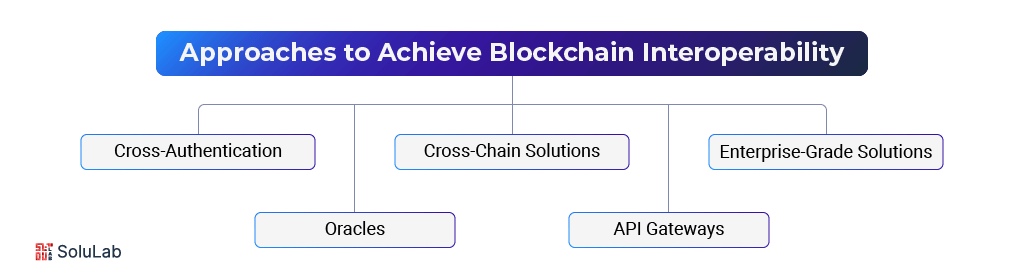
There are plenty of methods and tools for getting blockchains to cooperate, but they fall into two camps. You can go directly and change the chains’ own infrastructure so transactions follow the same business logic on every network. Or you can go indirectly and use external interoperability protocols that link chains securely and carry data, tokens, and messages between them. These are the main methods people have used to make it work.
- Cross-Authentication
Here, a separate network that everyone trusts sits between the chains and checks transactions and shared data. Third-party blockchain tools usually do this job: trust mechanisms, token links, sidechains.
The notary model is a common version. A notary on one chain approves the transaction, then sends proof of that approval to the target chain. Some programs use single-signature notaries, others use multi-signature ones. Either way, the setup gets more trustworthy and harder to knock over.
- Oracles
DeFi interoperability leans heavily on oracles. They hook blockchain systems up to outside data sources, and sometimes to other chains. Think of them as trusted couriers: they carry real-world data into smart contracts, or carry on-chain events over to other blockchain networks.
A simple case. Two people bet on a football match through a smart contract. The contract has no idea who won, because it can’t see anything outside its own chain. An oracle fetches the result from a trusted outside source, delivers it securely, and the contract pays out accordingly. That is why oracles end up as the building blocks linking blockchains to off-chain systems.
- API Gateways
An API gateway is software that makes it easier for blockchain protocols and outside apps to communicate. It works like an interpreter. Requests arrive from outside the network, a transaction instruction here, a data query there, and the gateway reshapes them into a format that network understands.
Each time a request comes in, the gateway works out which blockchain should get the command, then rewrites it to match that network’s protocol. Without these interfaces, getting global ledgers and off-chain business apps to talk in real time would be far harder.
- Cross-Chain Solutions
Cross-chain interoperability solutions give blockchain apps a shared channel, so they can pass data, coins, and contract calls across different blockchain platforms. The idea is one standard interface that works on many networks. Token links and built-in oracle services keep those exchanges safe and dependable.
Cosmos, Polkadot, Chainlink, and Wanchain are a few of the newer messaging and transfer platforms that have made moving assets and information between chains much easier. If you want blockchain collaboration that is efficient and actually useful, these options are where it starts.
Related: What is Cross-Chain Compatibility?
- Enterprise-Grade Solutions
Enterprise blockchains tend to be private and permissioned, unlike public chains such as Ethereum or Bitcoin. That makes connecting them to anything else harder. Interoperability flips the problem around: companies can plug into the blockchain technology that already exists instead of building fresh systems from zero.
Enterprise-level sharing also lets companies exchange data quickly without giving up security. In healthcare and finance, where the data is sensitive, that counts for a lot. With enterprise-grade cross-chain interoperability you keep strong privacy, control over your data, and compliance, and you can still work with partners running completely different environments.
The Future of Blockchain Interoperability in Enterprise Adoption
Through the rest of 2026 and after, interoperability looks set to become a baseline requirement rather than a bonus. More businesses are adopting multi-chain methods to tighten processes across departments, regions, and sectors. Finance, supply chains, healthcare, government: all of them are figuring out that they need blockchain communities that are linked up and can talk to each other without fuss.
Where is this heading? Toward open, secure, widely accepted standards that let organizations work across chains without trading away privacy, compliance, or performance. Companies planning to use blockchain for the long term will need an experienced enterprise blockchain development company in their corner.
Those firms provide blockchain development services as well as advice on setting up scalable, open infrastructure that fits how businesses run today. Early movers will have the edge as interoperability matures. They will already be positioned for real-time automation, cross-platform data access, and new revenue models built on connected blockchain networks.

The Bottom Line
Interoperability is not a someday idea anymore. It is a business requirement. As companies graduate from pilots to full-scale blockchain integration, their ability to connect across networks will decide whether their digital transformation work pays off. Get that right, and you have the base for better, more connected processes in almost any field.
SoluLab, as a leading enterprise blockchain development company, helps businesses handle this shift with custom blockchain solutions built around growth and connectivity. Our work on the OBORTECH Smart Hub project shows it well, since it uses Blockchain-as-a-Service (BaaS) to make operations run more smoothly. The platform lets businesses build decentralized apps on third-party cloud infrastructure.
If your business is exploring blockchain, or wants its current projects to work with other chains, now is a good moment to move. Talk to us about building cross-chain capability and about where blockchain can create real value in your operations.
FAQs
Shipra Garg is a tech-focused content strategist and copywriter specializing in Web3, blockchain, and artificial intelligence. She has worked with startups and enterprise teams to craft high-conversion content that bridges deep tech with business impact. Her work translates complex innovations into clear, credible, and engaging narratives that drive growth and build trust in emerging tech markets.