
Key Takeaways
- Blockchain in travel and tourism gives every booking, payment, and identity record one trustworthy version, so airlines, hotels, and OTAs stop arguing over whose data is right.
- Smart contracts can automate refunds, commissions, and loyalty payouts. That’s less manual reconciliation and fewer angry support tickets.
- Tokenizing real-world travel assets, think fractional vacation ownership or spendable loyalty points, is opening revenue models that didn’t exist five years ago.
- Shared, permissioned identity checks can turn a five-minute check-in into something closer to thirty seconds, without every vendor storing a full copy of your passport.
- This is still early-stage technology in most of the industry. It works. The hard part is picking the one use case that actually pays for the build.
Book a flight on one app, a hotel on another, a rental car through a third, and you’ve just created three separate records of the same trip. None of those systems talk to each other. If the flight gets delayed, good luck getting the hotel or the rental desk to know about it automatically. Someone, usually the traveler, ends up doing the coordination by hand.
That gap is expensive. Chargebacks drag on for weeks. Loyalty points expire before anyone remembers to use them. Support teams spend hours untangling who owes what after a cancellation. Blockchain in travel goes after exactly this problem: instead of five companies keeping five different versions of a trip, everyone with permission sees the same verified record, updated as it happens and hard to quietly change afterward.
It won’t replace your booking engine. It sits underneath it, handling the trust layer that right now gets patched together with phone calls, spreadsheets, and a customer service rep on hold. This article walks through why travel businesses are looking at this now, how the mechanics actually work inside a booking flow, and where travel companies are already using it.
Why Does the Travel Industry Need Blockchain?
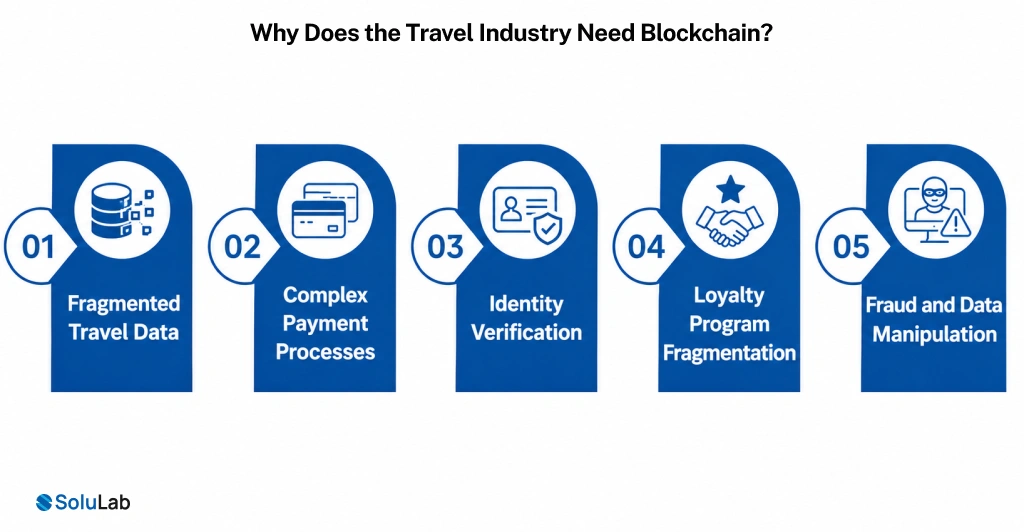
A single trip can pass through an airline’s system, a global distribution system, a hotel’s property management software, a payment processor, and a loyalty platform, often across two or three countries. Every handoff between those systems is a place where data goes stale, gets duplicated, or just breaks.
1. Fragmented Travel Data
Most itineraries live across five or six databases that don’t automatically sync. Flight gets delayed? The hotel has no idea. The airport taxi booking still shows the old pickup time. Deloitte’s research on travel and hospitality operations points to a consistent pattern here: companies that modernize their core data infrastructure recover from disruptions faster, largely because decisions are based on one accurate picture instead of reconciling three conflicting ones after the fact.
2. Complex Payment Processes
Cross-border travel payments route through multiple banks and card networks, and each one takes a cut plus a day or two of settlement time. Refunds are worse. Money has to reverse through the same chain of intermediaries it came through, which is why a cancelled booking sometimes takes ten business days to actually land back in someone’s account.
3. Identity Verification
You show your ID at booking, again at check-in, again at security, again at the hotel desk, and again at the rental counter. Each business stores a fresh copy. That’s not just annoying for the traveler; it multiplies the number of places a data breach can happen.
4. Loyalty Program Fragmentation
Airline miles, hotel points, and card rewards mostly sit in separate silos, each with its own expiry rules and redemption caps. Statista’s data on loyalty programs shows a meaningful share of earned points and miles simply go unused every year and eventually expire, which is a straight loss for the traveler and, longer term, a trust problem for the brand.
5. Fraud and Data Manipulation
Fake reviews, duplicate bookings, manipulated pricing- all of this is easier to pull off when records sit in one centralized database that a single administrator can edit. There’s no independent way for a traveler or a partner business to confirm a record hasn’t been altered after the fact.

How Does Blockchain Work in the Travel Industry?
Strip away the jargon, and a blockchain is a shared record book that only adds new pages, never rewrites old ones. Once an entry gets verified by the network, changing it later isn’t really an option. Here’s what that looks like inside an actual travel transaction. Blockchain is estimated to touch roughly 28% of all travel transactions, representing a market value of $195 billion.
- Transaction Is Created: A traveler books a flight, pays a deposit, redeems a loyalty point. Whatever it is, that action becomes a transaction request.
- Data Is Recorded: The details- who, what, when, and the relevant terms- get written into a block, tied cryptographically to the block that came before it.
- Network Validates the Transaction: Nodes on the network (this could be the airline, the hotel, a payment partner) check the transaction against agreed rules before it’s accepted.
- Transaction Becomes Part of the Ledger: Once validated, the block joins the chain permanently. Editing it after this point would mean rewriting every block that came after, which the network is built to make practically impossible.
- Authorized Parties Access the Data: Airlines, hotels, agencies, even the traveler, can see the parts of the record they’re permissioned to see, without each of them keeping a separate, siloed copy.
Smart contracts layer automation on top of all this. A smart contract is code that runs automatically once agreed conditions are met, no manual approval needed. In travel, that might mean a refund fires the moment a flight shows as officially cancelled, or a travel agent’s commission pays out the instant a booking finalizes. This is usually where smart contract development work actually begins on a project: finding the two or three repetitive, rules-based payment flows a business currently handles with a person staring at a spreadsheet.
How Can Travel Companies Implement Blockchain?
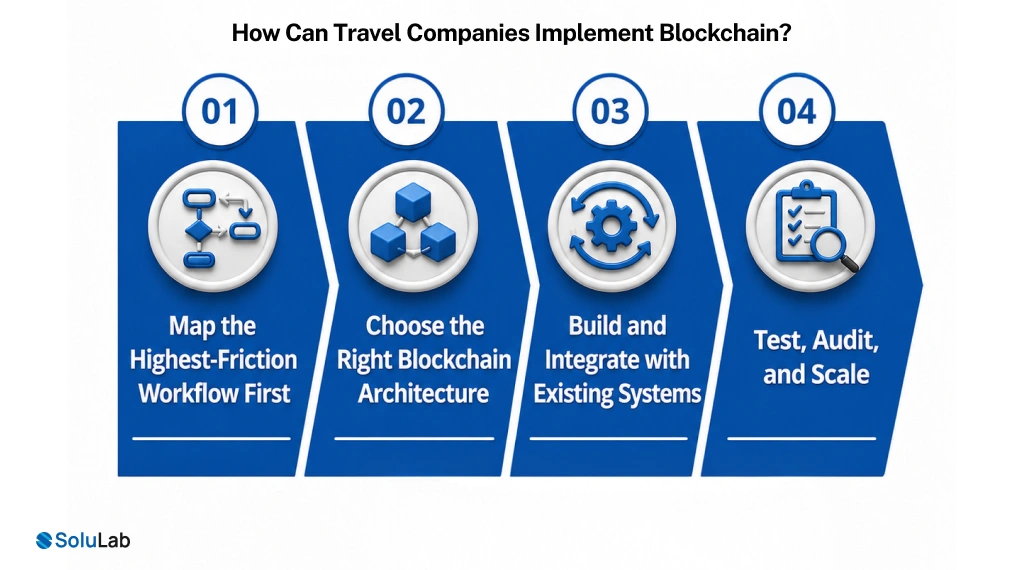
You don’t need to rebuild your entire booking stack to get started. Most projects that actually succeed pick one painful workflow, prove it out, and expand from there.
1. Map the Highest-Friction Workflow First
Start with whatever process already generates the most manual work or the most disputes internally.
- Audit refund and reconciliation delays
- Flag processes with repeated manual checks
- Prioritize by cost saved, not novelty
2. Choose the Right Blockchain Architecture
Not everything needs a public, permissionless chain. A lot of travel applications actually run better on permissioned networks where participants are known and vetted.
- Compare public versus permissioned ledgers
- Match architecture to data sensitivity
- Bring in a blockchain consulting partner early
3. Build and Integrate with Existing Systems
The ledger has to plug into whatever booking engine, PMS, and payment rails are already running in production, not replace them wholesale.
- Connect legacy systems through APIs
- Pilot with one property or one route
- Budget for blockchain integration services up front
4. Test, Audit, and Scale
Before real customer money or identity data touches the system, the smart contracts need someone other than the team that wrote them to check the work.
- Run smart contract audit services before launch
- Start with a limited user group
- Scale once fraud and error rates actually drop
Blockchain vs Traditional Travel Systems
Put the two models side by side, and the differences get pretty obvious pretty fast.
| Factor | Traditional Travel Systems | Blockchain-Based Systems |
| Data storage | Siloed databases per company | Shared, permissioned ledger |
| Record trust | Relies on the operator’s word | Cryptographically verifiable |
| Payment settlement | Days, multiple intermediaries | Near real time via smart contracts |
| Identity checks | Repeated at every touchpoint | Verify once, reuse securely |
| Loyalty points | Locked to one brand’s system | Portable and tokenizable |
| Fraud detection | Manual review, after the fact | Built into the validation process |
| System changes | Renegotiate each integration | Rules encoded once, enforced automatically |
Traditional systems aren’t going anywhere, to be clear. Most blockchain travel deployments today run alongside the existing booking engine and PMS rather than tearing them out. They handle the one slice, usually payments or identity, where a shared source of truth actually pays for itself.
What Are the Main Use Cases of Blockchain in Travel?
Adoption clusters around a handful of areas where the trust problem is biggest and the payoff is easiest to measure.
- Loyalty and Rewards Tokenization: Turning airline miles or hotel points into tokens travelers can combine, transfer, or spend across partner brands, instead of watching them expire unused.
- Smart Contract-Based Booking and Refunds: Automating cancellation policies so refunds trigger the moment conditions are met. Fewer support tickets, faster money back.
- Digital Identity for Faster Check-In: Verify once, reuse that verification across airports, hotels, and rental counters through permissioned access. Some pilot programs report cutting check-in time down significantly.
- Real World Asset Tokenization for Vacation Ownership: Real-world asset tokenization development can fractionalize timeshares or vacation properties, giving multiple owners a verifiable, tradable stake instead of a paper deed nobody can easily sell.
- Supply Chain Transparency for Tour Operators: Proving a “sustainable tour” or “locally sourced” experience is actually what it claims to be, by recording supplier certifications directly on-chain.
- Fraud-Resistant Reviews: Tying a review to a verified booking record, so nobody can post or manipulate a review without proof the trip actually happened.
Travel tokenization platforms show up in a lot of these use cases for a reason. Once loyalty points, ownership stakes, or even room inventory exist as tokens, they get a lot easier to trade, bundle, and automate.
How SoluLab Can Help With Blockchain in the Travel Industry
Most travel companies don’t wake up wanting a blockchain strategy. They want the fraud rate down, the refund cycle shorter, or a loyalty program that actually works across partner brands. Blockchain just happens to be the right tool for those specific jobs, sometimes.
SoluLab walks through that “sometimes” with travel businesses before anyone writes a line of code: which workflow has the clearest reconciliation problem, whether a permissioned or public chain fits the data involved, and whether the timeline and cost actually beat the manual process it would replace.
From there, SoluLab’s blockchain development team handles the architecture, the smart contracts, and the integration with whatever booking and payment systems are already live, backed by independent smart contract audit services before anything touches real customer funds.
For companies exploring tokenized loyalty programs or fractional ownership products specifically, SoluLab also offers tokenization services built to the compliance and custody standards those asset types actually require. A token has to represent something the business can stand behind, not just a marketing gimmick.

Conclusion
Blockchain isn’t going to fix a travel company’s marketing or its customer service. What it does fix, and this is easy to underestimate, is the fact that most travel businesses have quietly accepted having no single trustworthy record of what happened across every partner in a booking.
Fix that, and refunds move faster, loyalty points stop being dead weight, and travelers stop showing the same ID five times on one trip.
The companies actually getting value from this started small: one workflow, one honest pilot, one partner willing to say when a use case wasn’t worth building yet. SoluLab, a blockchain development company, can help your business find that starting point and build toward it.
FAQs
Neha is a curious content writer with a knack for breaking down complex technologies into meaningful, reader-friendly insights. With experience in blockchain, digital assets, and enterprise tech, she focuses on creating content that informs, connects, and supports strategic decision-making.