Key Takeaways
- TRON-based stablecoin infrastructure enables near real-time cross-border settlement, reducing payment delays from multiple days to minutes in many enterprise corridors.
- Stablecoin-powered payment rails can lower intermediary fees and FX overhead by up to 40–70% compared with traditional correspondent banking routes.
- Modern blockchain payment infrastructure improves transaction visibility and automated reconciliation, helping enterprises streamline treasury operations and reduce settlement friction.
Every delayed international payment locks up working capital that could otherwise fuel growth. For global enterprises, cross-border payment friction is not just an operational issue. It directly affects liquidity, compliance risk, customer trust, and profitability.
Despite digital banking advancements, many international transfers still take two to five business days to settle. Studies from global financial institutions continue to show that intermediary-heavy correspondent banking models remain the primary bottleneck.
Two realities define the problem:
- Up to 70% of cross-border payment delays occur at intermediary or last-mile banking layers.
- Global average transaction fees still exceed 6% in many corridors.
For enterprises operating across regions, reducing cross-border payment delays requires structural modernization. This is where enterprise payment infrastructure redesign becomes critical, and stablecoin payment solutions are giving an edge.
This article explores five key infrastructure decisions that define successful enterprise payment modernization, including the role of stablecoin payments for enterprises and TRON-based blockchain payment infrastructure for enterprises.
Why Do 70% of Cross-Border Payment Delays Originate from Legacy Settlement Infrastructure?
Traditional cross-border payment infrastructure was never designed for real-time global commerce. It evolved around correspondent banking networks, batch processing cycles, and manual compliance checkpoints.
1. Intermediary-Heavy Routing
International payments often pass through three to five correspondent banks. Each layer adds:
- Processing delays
- FX markups
- Reconciliation overhead
This structure increases both cost and uncertainty.
2. Limited Operating Windows
Many banking systems operate only during business hours and weekdays. This creates liquidity dead zones during weekends and holidays, slowing enterprise treasury operations.
3. Fragmented Compliance Checks
AML, KYC, and regulatory screening differ across jurisdictions. Without unified systems, manual reviews delay settlements and increase error rates.
For enterprises managing high transaction volumes, these inefficiencies impact:
- Cash flow predictability
- Supplier relationships
- Customer retention
- Treasury cost of capital
Reducing global payment friction requires moving beyond patchwork upgrades. It requires infrastructure redesign.
How Can a TRON-Based Stablecoin Payment Platform Reduce Cross-Border Costs?
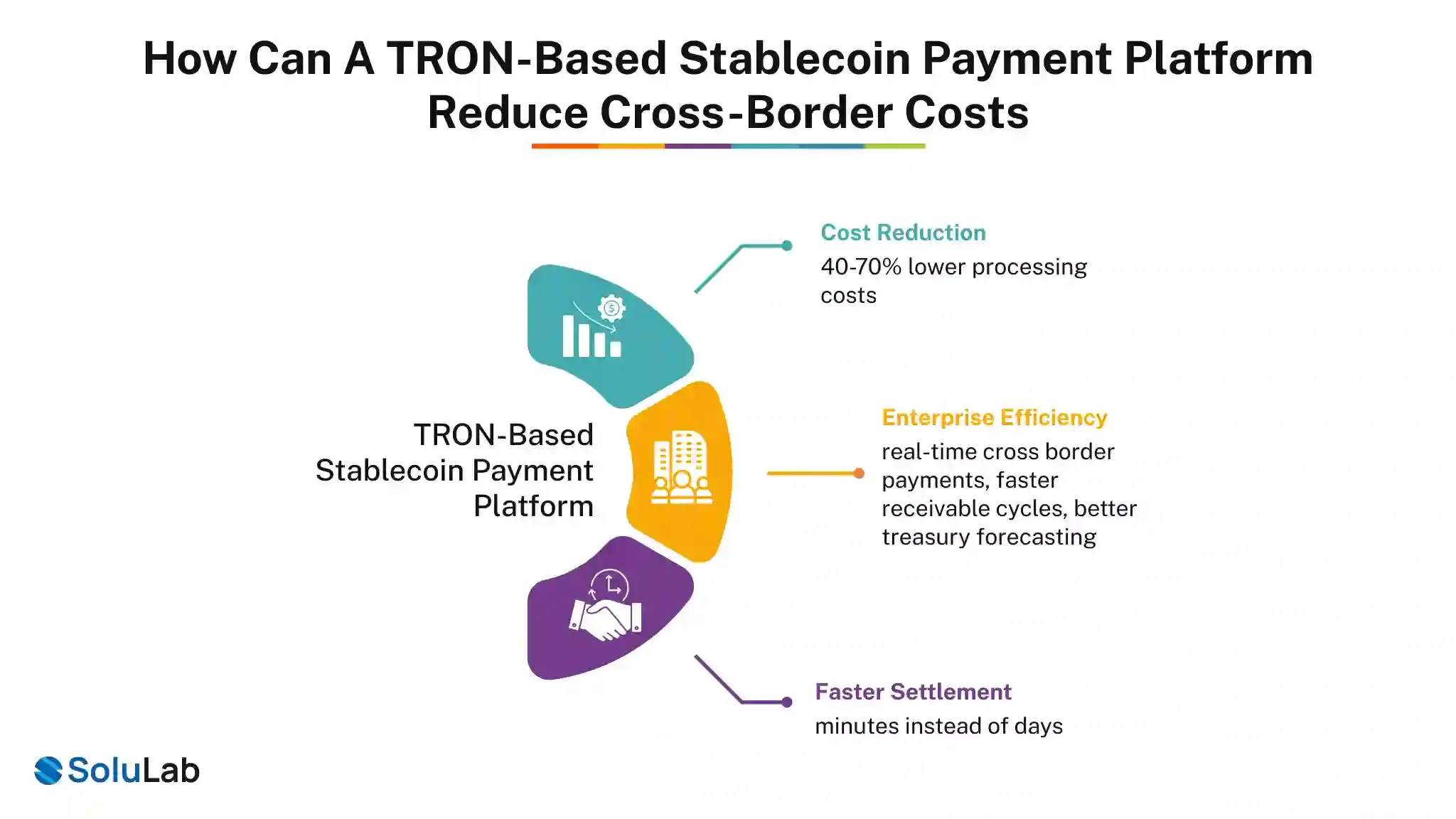
A TRON-enabled stablecoin payment system changes the settlement layer itself. Instead of routing funds through multiple correspondent banks, transactions are executed directly on blockchain rails.
1. Why TRON Matters for Enterprise Use Cases
TRON has become one of the most widely used networks for stablecoin transfers globally due to:
- High transaction throughput
- Low network fees
- Strong adoption for USDT settlement
- Fast confirmation times
For enterprise payment infrastructure, this translates into measurable advantages.
a. Cost Reduction
By eliminating several intermediary layers, enterprises can reduce processing expenses by 40–70%, depending on the corridor and transaction size.
Lower network fees make stablecoin payments for enterprises commercially viable at scale.
b. Faster Settlement
Transactions settle in minutes rather than days. This supports:
- Real-time cross-border payments for enterprises
- Faster receivables cycles
- Improved treasury forecasting
When integrated properly, blockchain payment infrastructure for enterprises becomes a performance driver rather than an experimental upgrade.

What 5 Core Infrastructure Components Are Required for Enterprise-Grade Stablecoin Payment Platform Development?
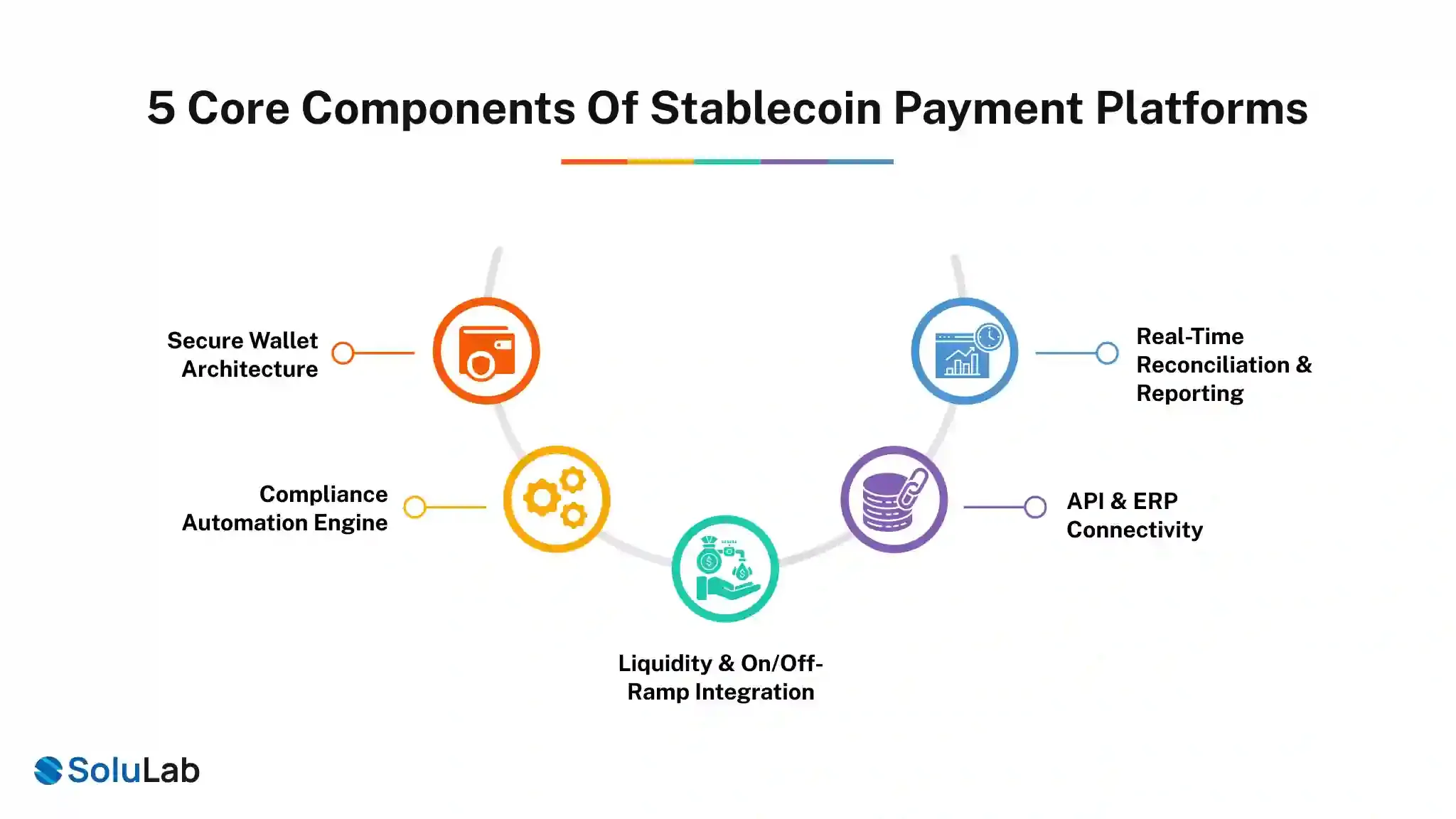
Enterprise adoption depends on more than blockchain access. It requires a structured global payments architecture for enterprises.
Below are the five essential components for scalable stablecoin payment platform development.
1. Secure Wallet Architecture
Enterprise systems must include:
- Multi-signature authorization
- Role-based access controls
- Cold storage integration
Security is foundational for institutional trust.
2. Compliance Automation Engine
To align with regulatory frameworks, platforms must embed:
- Automated KYC workflows
- AML screening
- Transaction monitoring
- Regulatory reporting modules
Compliance cannot be an afterthought in enterprise payment modernization.
3. Liquidity & On/Off-Ramp Integration
Enterprises require seamless fiat-to-stablecoin conversion for:
- Supplier payouts
- Treasury rebalancing
- Local currency disbursements
Integrated exchange and custody solutions ensure operational continuity.
4. API & ERP Connectivity
Enterprise payment infrastructure must connect with:
- Accounting platforms
- ERP systems
- Banking dashboards
- Merchant gateways
API-first design enables scalability and integration flexibility.
5. Real-Time Reconciliation & Reporting
On-chain transparency allows automated reconciliation, reducing back-office workload by up to 30–40%.
For institutions, this improves audit readiness and governance reporting.
Working with a specialized stablecoin development company ensures these elements are designed into the architecture from day one.
Can Near-Real-Time Settlement Improve Working Capital Efficiency by 30% for Global Enterprises?
For CFOs and treasury leaders, settlement speed directly influences liquidity.
When funds settle in minutes instead of days:
- Working capital cycles shorten
- Dependency on short-term credit decreases
- Cash visibility improves
1. Reduced Float Time
Shorter settlement cycles reduce trapped capital. Even a two-day improvement in receivables turnover can free millions in operational liquidity for high-volume enterprises.
2. Improved Supplier Relationships
Faster settlement strengthens vendor trust and may unlock early-payment discounts.
3. Lower Credit Exposure
Reduced reliance on bridge financing lowers interest costs and risk exposure.
In many enterprise scenarios, near real-time cross-border payments for enterprises can improve working capital efficiency by 20–30%, depending on transaction volume and geographic spread.
Stablecoin payment systems create this acceleration by removing correspondent banking latency from the settlement layer.
How Should Enterprises Structure a Compliant TRON-Enabled Stablecoin Payment System?
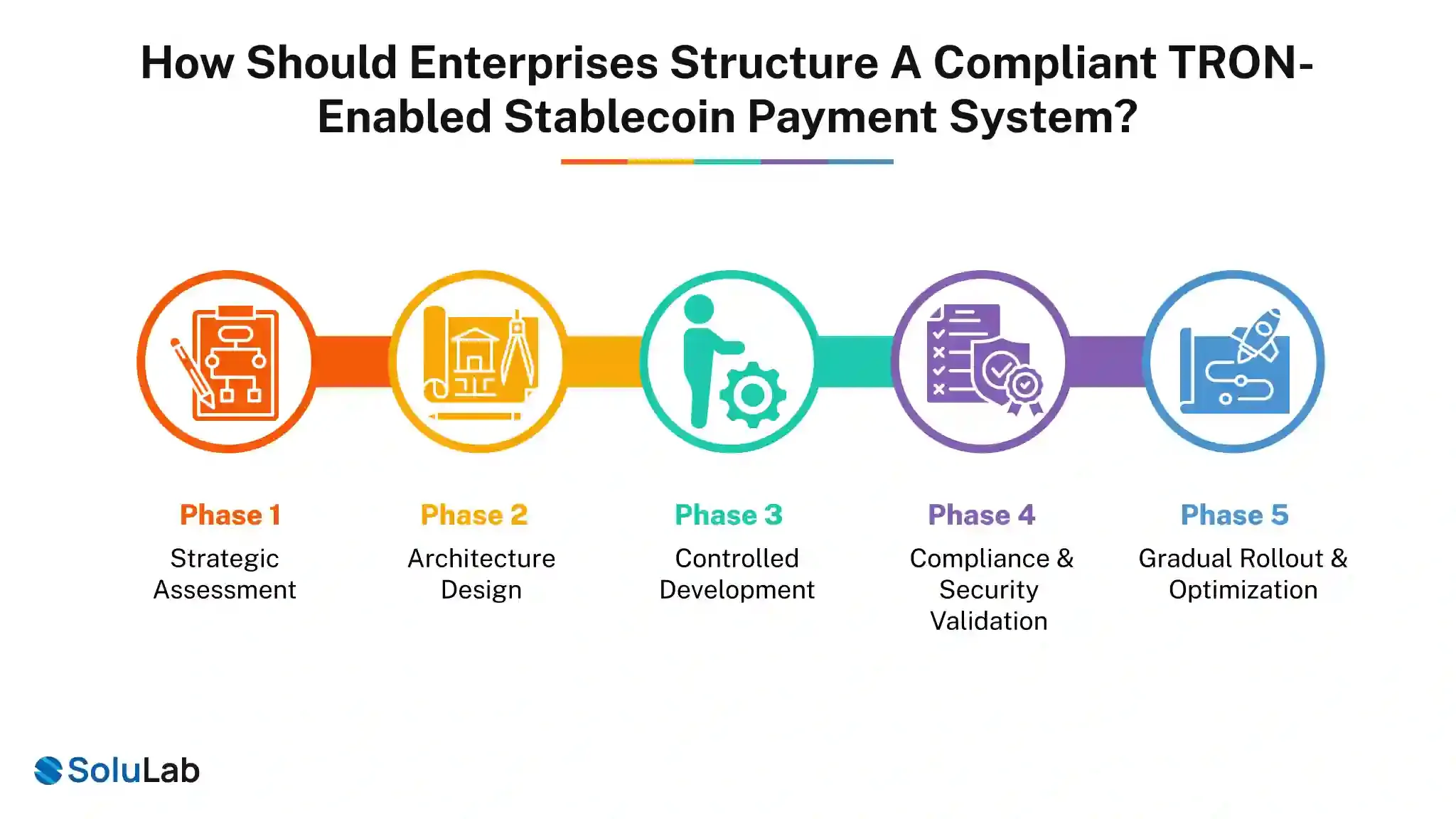
Technology alone does not guarantee success. Structured implementation is essential. A practical roadmap ensures risk control and scalability.
Phase 1: Strategic Assessment
Define:
- Target markets
- Regulatory exposure
- Transaction volumes
- Currency corridors
Clear scope prevents compliance surprises.
Phase 2: Architecture Design
Design:
- Wallet structures
- Compliance workflows
- Settlement logic
- Access governance
This stage defines the global payments architecture for enterprises.
Phase 3: Controlled Development
Develop modules for:
- Payment routing
- Monitoring dashboards
- Treasury management
- Reporting automation
Testing under realistic transaction loads ensures resilience.
Phase 4: Compliance & Security Validation
Conduct:
- External audits
- Penetration testing
- Regulatory review
Enterprise clients expect institutional-grade safeguards.
Phase 5: Gradual Rollout & Optimization
Launch in controlled corridors. Monitor performance metrics such as:
- Settlement time
- Cost per transaction
- Failure rates
- Liquidity utilization
Continuous optimization transforms reducing cross-border payment delays into a long-term competitive advantage.

Conclusion
As discussed above, modernizing cross-border payment infrastructure is essential for enterprises operating in global markets. TRON-enabled stablecoin payment platforms help reduce settlement delays, lower transaction costs, and improve liquidity visibility across international transactions.
For enterprises looking to build a TRON-powered stablecoin payment platform, SoluLab provides the technical expertise and enterprise-grade blockchain solutions required to support scalable global payment systems.
- Develop secure stablecoin payment platforms for enterprise cross-border settlements
- Build scalable blockchain payment infrastructure integrated with enterprise financial systems
With a team of 250+ experienced developers, SoluLab helps enterprises design and deploy reliable blockchain payment solutions. Connect with us today to explore our stablecoin payment platform development services.
FAQs
Deepika is a content writer who blends storytelling with strategic thinking. She explores topics across digital innovation, emerging tech, and the evolving blockchain industry. She enjoys breaking down complex ideas into simple, engaging narratives in the growing global markets.