Key Takeaways
- Asset-backed stablecoins sit between old-school finance and crypto. They peg a digital token to something you can actually point to.
- Reserves do the heavy lifting here: USD, gold, other commodities. That gives you a “price floor” Bitcoin simply doesn’t have.
- Circle (USDC) and Tether (USDT) run the show. Deep liquidity, fast cross-border movement, and it shows in the numbers.
- Because they touch real-world assets, these coins keep landing in the middle of every crypto regulation fight.
There are now more than 25,000 digital assets floating around the crypto market. Most of them move on mood. Bitcoin swings with sentiment; stablecoins do not. A stablecoin holds a set value because it’s tied to something outside the token itself.
Here’s a number worth sitting with. Recent reports suggest close to 90% of all decentralized finance (DeFi) liquidity lives in tokens backed by fiat, gold, or government bonds.
That combination is the whole point. You get the speed of blockchain development with the price certainty people expect from traditional finance, and it works for payments that cross borders.
So this guide walks through how asset-backed stablecoins actually work, where they stand with regulators, and who is issuing the ones that matter right now.
What are Stablecoins and Their Pros?
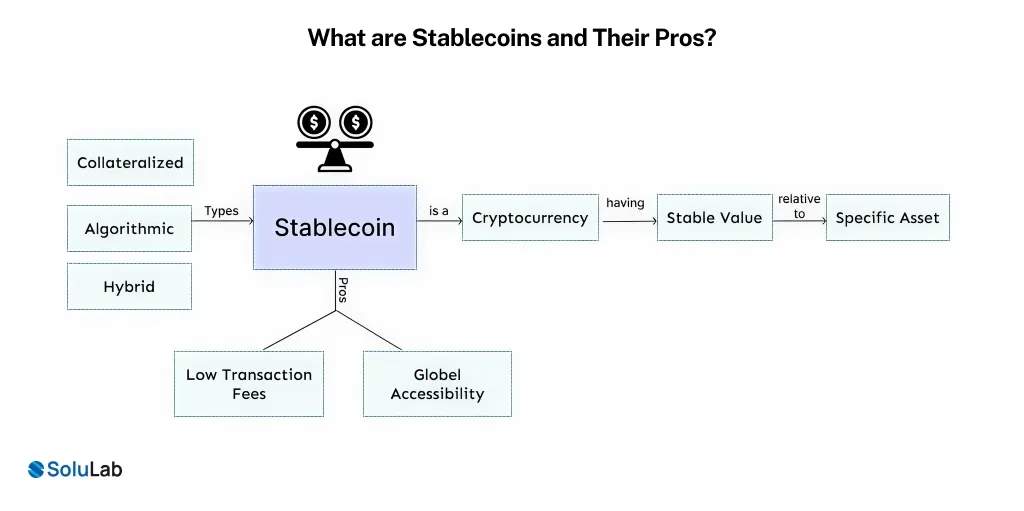
Stablecoins hold their value against some reference asset. Regular crypto bounces around. Stablecoins don’t, which is exactly why people use them to pay for things and park savings. And the backing takes different shapes: sometimes it’s a real-world asset like fiat currency, sometimes a commodity.
Then there are the code-driven ones. Algorithmic and smart contract versions juggle supply and demand with nothing physical behind them, while hybrids try to split the difference, some stability, some flexibility.
Pros of Using Stablecoins:
1. Low Transaction Fees: Send money across the world and stablecoins usually cost you less than the payment rails you’re used to.
2. Global Accessibility: Anyone with an internet connection gets a working digital payment option, which pulls more people into the financial system.
Put those together, crypto’s flexibility plus the steadiness of a traditional asset, and you can see why stablecoins keep showing up as a serious financial tool.
What Does Asset-Backed Stablecoins Mean?
In plain terms, asset-backed stablecoins are digital currencies backed 100% by high-quality liquid assets (HQLA): cash, US Treasuries, or physical commodities.
Compare that to “synthetic” or algorithmic tokens, which lean on code to hold their peg. Asset-backed coins behave more like programmable cash, and there’s a real legal claim to a reserve sitting underneath.
That’s what kills the “thin air” problem that dogs ordinary crypto. It gives you the price certainty institutions need before they’ll trade at scale.
The 2026 Market Shift
This isn’t a crypto-native toy anymore. It has become plumbing for global finance. The recent data tells a fairly clear story:
- Explosive Market Growth: By April 2026 the total stablecoin market cap hit an all-time high of $318.6 billion, up 34% from 2025.
- Dominance of Backed Assets: Two asset-backed giants, Tether (USDT) and Circle (USDC), hold over 93% of the market between them. The message is blunt: people want physical collateral, not algorithmic experiments.
- Transaction Volume: In 2025, stablecoins pushed $33 trillion in transactions. That is past Visa’s annual volume, and it happened doing real B2B payments.
- The Yield Revolution: The big 2026 storyline is the rise of yield-bearing stablecoins. This corner grew 15 times faster than the rest of the market last year, with $22.7 billion moving into tokens that pass Treasury interest straight to whoever holds them.
2026 Regulatory Changes
In 2026 you don’t get to pick whether you’re asset-backed. The law picks for you. Regulators wrote strict frameworks to keep the wider economy safe:
- The US GENIUS Act: This 2026 landmark law formally labels compliant stablecoins as “regulated payment instruments.” Issuers have to hold 1:1 reserves in liquid assets and pass bank-grade audits.
- MiCA in Europe: The EU’s Markets in Crypto-Assets (MiCA) rules are fully live now. Unbacked algorithmic tokens are out, and every stablecoin (EMT) has to be 100% collateralized and EU-authorized.
- Real-Time Transparency: Monthly reports are done. The top issuers run On-Chain Proof of Reserve in 2026, so any user can check the bank balances behind their tokens as it happens.

Different Types of Stablecoins

Before we get into the mechanics, it helps to know the main flavors:
- Centralized StableCoins
Centralized stablecoins usually sit on fiat cash parked in an off-chain bank account, and that reserve backs the tokens on-chain. Some peg to something else instead, a commodity or an index. The catch is you’re trusting a custodian. Chainlink proof of reserve softens that worry by verifying the backing automatically, which is a real transparency win.
- Digital Bank Currencies
Central bank digital currencies (CBDC) are a close cousin of centralized stablecoins. The difference is who issues them. A central bank does, so there’s no need for fiat sitting in an off-chain account as backing. The issuing government treats a CBDC as legal money, and it moves payments between people and institutions.
- Decentralized StableCoins
Decentralized stablecoins run over-collateralized, and that means they need an on-chain price feed to trigger liquidations and keep the protocol solvent. Take LUSD. It’s an immutable DeFi protocol where you lock ETH at a 110% ratio to mint LUSD. Chainlink price feeds keep the smart contracts fed with accurate, high-quality pricing data.
Key Characteristics of Asset-Based Stablecoins
Bitcoin and Ethereum run on blockchain technology. Asset-backed stablecoins work differently. There’s an actual asset behind each one, and that alone changes how people use digital money. A few traits set the good ones apart:
1. Easy to Understand and Available
Clarity is where asset-backed coins beat standard tokens. As noted, they lean on real assets, so a third party can actually verify what’s there. Good news for users and investors alike: the value of those holdings is anchored to fixed assets you can check.
2. Getting Rid of Risks
Real backing takes some of the sting out of the risks that come with ordinary crypto, and it supports asset-backed cryptocurrencies at a lower cost. There’s something tangible underneath, so these coins have a bit of a cushion when the market drops.
3. Tangible Assets That Support
Here’s the real dividing line. Asset-backed stablecoins have actual assets under them; most crypto doesn’t. They aren’t purely digital the way freely traded Bitcoin is. Their value comes partly from real-world asset stablecoins, metals, fiat currency, and goods. Those reserves are what give the coins their stability, since the token is tied to what the underlying asset is worth.
4. Better Following of the Rules
Regulators tend to look on asset-backed coins more kindly, precisely because there’s a real asset involved. Genuine reserves make it easier to slot into existing rules; they add legitimacy and someone to hold accountable.
Related: How to Create A Stablecoin?
5. Prices Staying the Same
Volatility is the classic knock against ordinary crypto. Prices never sit still. A freely floating coin can get shoved around by outside events, investor mood, and whatever the market expects next. Asset-backed stablecoins stay calmer because low-volatility assets sit at their base.
Top Global Stablecoin Issuers with 80% Market
More than five hundred stablecoins are in use, yet two names, Tether and Circle, issue the bulk of them. Here’s who’s behind the asset-backed ones:
- Tether (USDT)
Tether holds the biggest slice of the stablecoin market and connects across a lot of blockchains, which is a big part of why so many stablecoins trace back to it. Tether’s reserves and financial reporting have drawn plenty of criticism over the years. The company says it has been audited and that it stress-tests against live market data.
Think of Tether as a reserve heavyweight, on par with sizable nations. It holds close to $100 billion in US Treasury notes, most of it through Cantor Fitzgerald.
- Circle (USDC)
Circle comes in second by circulation. What USDC is known for is its weekly attestations. Reserves are held in cash and short-term U.S. government securities, and that openness is why users trust it.
- The Paxos
Beyond Pax Dollar (USDP), Paxos also runs the infrastructure behind PayPal USD (PYUSD) and other stablecoins issued globally. Paxos leans hard on openness, careful portfolio management plus monthly attestation reports on its reserves, and that’s how it builds client confidence.
- PayPal (USD)
PYUSD, PayPal’s own PayPal’s stablecoin, launched with Paxos. It’s backed by reserves, meant to work as everyday currency, and Paxos handles the management. The public gets regular transparency reports too.
Top Asset-Backed Stablecoins to Watch in 2026
Ten asset-backed stablecoins worth keeping an eye on:
- Tether
- USD Coin
- Dai
- Tether Gold
- Ethena
- PayPal USD
- BSDX
- FRAX
- EURX
- DOLA
Use Cases of Asset-Backed Stablecoins
By the close of 2026 the global stablecoin market cap will have cleared $250 billion. Institutions piled in, and regulatory clarity (MiCA in Europe, the GENIUS Act in the US) gave them cover. The experiments are over. Companies now wire stablecoins in as a core financial rail.
1. Institutional Treasury & Risk Mitigation
- Liquidity Management: Corporations keep liquidity running around the clock with asset-backed stablecoins. A bank account sleeps on weekends; a stablecoin reserve doesn’t. Treasury teams shift capital between subsidiaries in the moment, no waiting on holidays.
- De-risking Volatility: When unbacked assets got choppy in 2026, firms rotated the excess into stablecoins pegged 1:1 to US Treasuries or cash. Capital value holds, and the money stays on-chain, ready to redeploy the instant it’s needed.
2. Global B2B & Supply Chain Payments
- Instant Cross-Border Settlement: Companies are dropping SWIFT for stablecoin rails. Settlement drops from 3 to 5 days down to under 30 seconds, and the intermediary bank fees vanish. For high-volume trade, that math matters.
- Transparent Vendor Payouts: Big platforms run supply chain payouts on stablecoins now. Payment fires automatically through smart contracts once a delivery milestone is confirmed on-chain, which cuts down on fraud and the arguments that follow it.
3. Automated Corporate Services
- Programmable Payroll: Companies pay global teams in stablecoins, remote staff especially. In 2026 more than 60% of crypto-based salary payments go out in USDC or EUR-backed tokens, which keeps taxes clean and gives employees a predictable amount.
- Smart Subscription Models: Providers set up automated “pull” payments. A smart contract handles the recurring monthly bill for SaaS or utilities and leaves a verifiable trail, which makes accounting and reconciliation far less painful.
4. Emerging AI Economy
- Machine-to-Machine Payments: By 2026, autonomous AI agents pay for API credits, compute, and data sets with asset-backed stablecoins. These agents can’t open a normal bank account, so a stablecoin becomes the default currency of the automated economy.
What is the Future of Asset-Backed Stablecoins?
Early 2026, and asset-backed stablecoins have grown up. They went from niche crypto instruments to the base layer of a whole new digital financial setup.
Market cap is now north of $300 billion. Mostly it’s enterprises using these assets to link the traditional banking world to a blockchain economy that never closes.
1. Expected Market Change: Regulatory Mainstreaming
The single biggest change in 2026 is enforcement. The US GENIUS Act and the EU’s MiCA framework for stablecoins are actually being applied now.
Those laws basically took the risk off the table for institutions. They demand 1:1 reserve backing in liquid assets, like short-term Treasury bills, and monthly independent audits on top.
The label changed with it: from “unregulated crypto” to “regulated payment instruments.”
2. Growth in “Asset-Referenced” Variants
USD-pegged tokens are no longer the only game. In 2026 there’s a jump in tokens backed by commodities (gold, copper) and Real-World Assets (RWAs).
For a global business that’s a hedge against fiat inflation, and you keep the liquidity of a digital token while you’re at it.
3. On-Chain Yield & ROI
For enterprises and holders, what counts as “return” has moved.
Plain payment stablecoins mostly pay nothing, thanks to the rules. But yield-bearing synthetic dollars and tokenized money market funds have shown up to fill that space.
Typical yields in 2026 land somewhere around 3 to 7% APY, coming straight off the interest on the underlying Treasury reserves or from over-collateralized DeFi lending.
4. 24/7 Institutional Liquidity
Big banks now reach for asset-backed stablecoins to handle intra-day liquidity management.
No more waiting on weekend clearing cycles. They shift billions on-chain in an instant to cover margin calls or fund a subsidiary abroad, and capital efficiency jumps as a result.
5. Interoperability & Cross-Border Utility
Mint a stablecoin on the Ethereum blockchain and it can settle a supply chain payment in South Korea or run payroll in London, moving across chains through bridges.
That trims settlement costs by as much as 80% next to legacy banking.

How is SoluLab Making Use of Digital Money Easier?
As blockchain-based financial systems get adopted, the asset-and-cryptocurrency model is going to reshape the world economy and open a path toward a safer financial future. ABSCs do more than store value and move money around. They push accountability and help settle a jumpy crypto market. And that’s exactly why the whole process needs a fresh, inventive approach.
SoluLab, a Stablecoin Development Company, can help you build the kind of considered, well-developed solutions that fit your actual needs, and turn what you’re picturing into something real.
We know how to stand up secure, modern, scalable blockchain platforms, and that’s what lets firms create custom asset-backed stablecoins with us.
Contact us right away and step into the future of finance.
FAQs
Shipra Garg is a tech-focused content strategist and copywriter specializing in Web3, blockchain, and artificial intelligence. She has worked with startups and enterprise teams to craft high-conversion content that bridges deep tech with business impact. Her work translates complex innovations into clear, credible, and engaging narratives that drive growth and build trust in emerging tech markets.