Money keeps pouring into asset-backed securities. The recent report put the market at roughly $2510.83 billion in 2023, with a projected climb to $3757.14 billion by 2030. That works out to a 5.7% compound annual growth rate.
Growth brings new ways to slice and measure the assets underneath. So what actually sits under an ABS? It is a debt product, and a pool of assets backs it.
Think student loans. Or credit card receivables. Mortgage-backed securities (MBS) are one branch of that family, except the pool behind them is made of mortgages. This blog walks through how asset-backed securities vs mortgage-backed securities actually differ, and where the line between them blurs.
What are Asset-Backed Securities?
An asset-backed security is a financial investment secured by a pool of underlying assets. Usually those assets throw off cash from debt: loans, leases, credit card balances, receivables. The security itself often looks like a bond or a note. It pays interest at a set rate for a set stretch of time, right up to maturity. For income investors, ABS can beat plain corporate bonds or bond funds.
Why bother issuing them? Money. ABS let issuers raise funds for lending or fresh investments. The catch is that the underlying assets tend to be illiquid, and you cannot really sell them one by one. Pool them together, though, build a single financial instrument out of the pile, and suddenly those assets have value to investors. That pooling is what people mean by securitization. It also lets a company push shakier assets off its books, which trims credit risk.
The investor gets something out of it too: a stream of income. And ABS open a door to income-generating assets you would never touch otherwise, some of them fairly exotic, none of them available through any other investment.
The U.S. side has been running hot. Issuance hit $202.5 billion as of June 2024, a 45% year-over-year increase . Zoom out globally and the ABS market is expected to move from $2276.03 billion in 2023 to $3112.45 billion by 2028, at a CAGR of 6.3%.
Types of Asset-Backed Securities

ABS come in several flavors. Each one has its own quirks, its own cash flow pattern, its own value. Here are the ones you will run into most.
Home Equity ABS
Home equity loans behave a lot like mortgages, so home equity ABS end up looking like their mortgage cousins. There is one real difference. Borrowers behind home equity loans often have weaker credit, which is precisely why they could not land a mortgage in the first place. That is the thing to watch. When you size up home equity loan-backed ABS, the borrowers’ credit ratings tell you most of the story.
Auto Loan ABS
Cars lose value. Auto loans are depreciating assets, so their cash flows come in as monthly interest, principal, and the odd prepayment. Compared to a home equity loan ABS or an MBS, prepayment risk here is much lower. Someone prepays only when they actually have the cash to clear the loan.
And refinancing? Rare, even when rates drop. A car depreciates faster than the loan gets paid down, which means the collateral is often worth less than what is still owed. On top of that, these balances are usually small. Refinance at a lower rate and you barely save anything, so most borrowers just do not bother.
Credit Card Receivable ABS
Credit card receivables are the classic non-amortizing ABS. No fixed payment schedule. Instead, new loans and adjustments keep reshaping what sits in the pool. The cash flows are made up of interest, principal payments, and yearly fees.
There is usually a lock-up stretch where no principal gets paid out. Pay principal during that window and it does not go to investors. It gets recycled into fresh loans added to the ABS, so the pool of receivables stays roughly level. Once the lock-up ends, principal starts flowing through to ABS investors.
Student Loan ABS
Student Loan ABS bundle up loans taken out to pay for higher education. Some come from private lenders, others carry a government guarantee. The cash flows show up once borrowers start repaying after they graduate. One wrinkle worth remembering: the borrowers in a single pool may finish school at different times, or with different degrees entirely.
Elaborate Lease ABS
Here the pool is made of leases on machinery or equipment. Businesses lease the gear, and the lease payments feed the cash flows that keep the ABS running. The collateral is the equipment itself: big office furniture, heavy machinery, factory-floor manufacturing kit, whatever is on lease.
Small Business Loan ABS
These are pools of loans built specifically for small firms. The security rests on the cash the small businesses are expected to generate, and that makes them riskier. Whether the ABS performs comes down to one question: can those businesses keep up with repayment? So the broader economy and the financial health of each borrower end up being the variables that really drive the risk here.
What are Mortgage-Backed Securities?
MBS work a lot like bonds. Each one is a slice of a bundle of mortgages and other real estate debt, which investors buy from the banks or government agencies that wrote the original loans. And like bond coupons, the payouts arrive monthly.
Buy an MBS and you are, in effect, lending to homebuyers. A broker handles the buying and selling. Minimum investment varies from issuer to issuer, so there is no single number. To trade on the market today, an MBS has to go through a GSE or a private financial firm, and it needs one of the top two ratings from an approved credit rating agency. Non-agency MBS come from private financial shops and carry no guarantee at all. They get sorted by seniority and sold to investors depending on how much risk each one can stomach.
Types of Mortgage-Backed Securities
MBS are financial instruments backed by a pool of mortgages. A bank bundles the mortgages together, then sells the bundle to investors. From there, MBS split into a few types depending on how they are structured and what mortgages sit underneath. Knowing which type you are holding matters, because it shapes the decisions you make and how you read mortgage-backed securities rates.
Pass-Through Securities
This is the simplest MBS there is. Principal and interest from the mortgage pool pass straight through to investors, minus servicing and guarantor fees. Government-sponsored enterprises usually issue them, names like Fannie Mae, Freddie Mac, or Ginnie Mae. Two things move the mortgage-backed securities rates on pass-throughs: the interest rates on the underlying mortgages, and how creditworthy the borrowers are.
Collateralized Mortgage Obligations (CMOs)
CMOs are the complicated ones. They get carved into tranches, slices really, and every slice carries a different maturity, risk level, and interest payment. That lets an investor pick the tranche that fits their appetite and time horizon. Mortgage-backed securities rates shift from tranche to tranche here. The riskier slices dangle higher returns to make up for the extra risk you are taking on.
Strip Securities
Strip securities pull the interest and principal apart into two separate instruments: Interest-Only (IO) strips and Principal-Only (PO) strips. IO strips pay you the interest income. PO strips pay back the principal. Different investors want different things, and strips let them pick a side. What drives mortgage-backed securities rates on IO and PO strips is prepayment behavior and wherever interest rates happen to sit.

Commercial Mortgage-Backed Securities (CMBS)
CMBS swap out home loans for commercial real estate: office buildings, shopping centers, apartment complexes. Because those properties are bigger and messier than a house, CMBS usually carry higher mortgage-backed securities rates than residential MBS. Like CMOs, they are structured in tranches, so you get a spread of risk and return to choose from.
Agency vs. Non-Agency MBS
Agency MBS come from GSEs, again Fannie Mae, Freddie Mac, and Ginnie Mae, and they carry an implied government guarantee. That makes them safer. Non-agency MBS come from private institutions with no such guarantee behind them. The extra credit risk pushes their mortgage-backed securities rates higher.
Advantages of Asset-Backed Securities (ABS)
A few segments dominate the ABS market: residential mortgage-backed securities (RMBS), auto loan ABS, and credit card ABS. RMBS alone make up about 25% of all ABS issuances. Collateralized loan obligations (CLOs) are another heavyweight, accounting for 40% of the global structured finance market.
So what does the ABS market actually give you? Plenty, and it cuts across investors, issuers, and the wider financial system. Here are the ones that matter most.
1. Diversification
ABS give investors a way to spread their bets. Buy into a pool of mixed underlying assets, whether loans, leases, or receivables, and your risk gets scattered across different asset types and issuers. When one asset in the pool goes sour, it stings less, because it is not carrying the whole investment on its own.
2. Enhanced Liquidity
Securitization takes assets that were stuck and turns them into securities you can trade. That extra liquidity means investors can move in and out of ABS in the secondary market without much friction, which makes it far easier to rebalance a portfolio or react when the market shifts under you.
3. Yield Enhancement
ABS often pay more than other fixed-income securities of the same credit quality. That extra yield is not free money. It is your compensation for the added complexity and risk baked into the underlying asset pools and the securitization process itself.
4. Customization
ABS can be built to fit. By splitting them into tranches with different risk-and-return profiles, securitizers can shape a deal for almost anyone: the investor chasing high returns, and the one who mostly wants to sleep at night. Same pool, different slices, different buyers.
Related: A Guide to Asset Tokenization
5. Risk Distribution
For the issuer, securitization spreads the risk of the underlying assets across a wide base of investors. That does a few good things at once. It cleans up the balance sheet, frees up capital, and stops risk from piling up in one place. The result is a more stable issuer, one with room to extend more credit or fund the next project.
6. Access to Capital
ABS plug issuers straight into the capital markets, so they can raise money faster than old-school financing would allow. For a financial institution, that is a real edge. It means more room to write new loans, which in turn feeds economic growth.
Advantages of Mortgage-Backed Securities
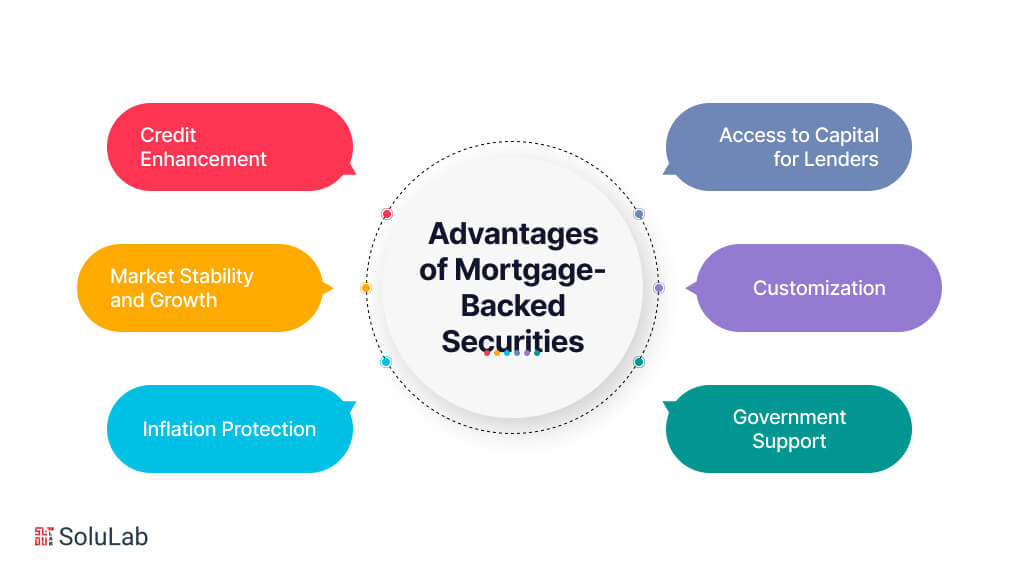
MBS bring their own set of upsides for investors, issuers, and the market at large. Here are the ones worth knowing.
Credit Enhancement
A lot of MBS ship with credit enhancements, often a guarantee from a government-sponsored entity like Fannie Mae, Freddie Mac, or Ginnie Mae. That guarantee lifts the credit quality of the security. Investors like them more, and issuers may end up borrowing at a lower cost.
Access to Capital for Lenders
Issuing MBS is how lenders reach the capital markets without a lot of drag. Sell the mortgage loans to be securitized, and the capital that was tied up gets freed to write new loans. That keeps the housing market moving and feeds broader economic growth.
Market Stability and Growth
MBS keep capital flowing into the housing market, and that steady flow does real work. It holds liquidity in place, which makes it easier for borrowers to get loans. That, in turn, props up the wider economy.
Customization
MBS bend to fit the buyer. Split them into tranches with different risk-and-return levels and you can serve the whole spectrum, from the conservative investor to the one hunting yield.
Inflation Protection
Some MBS, the ones backed by adjustable-rate mortgages (ARMs), offer a bit of a shield against inflation. When rates climb, the interest on ARMs climbs with them. Investor income can rise too, which acts as a hedge.
Government Support
GSE-backed MBS carry an implicit or explicit government guarantee. That backing does two things: it boosts investor confidence and it adds a layer of security. Set against other securities, that support can make MBS the steadier, more appealing choice.
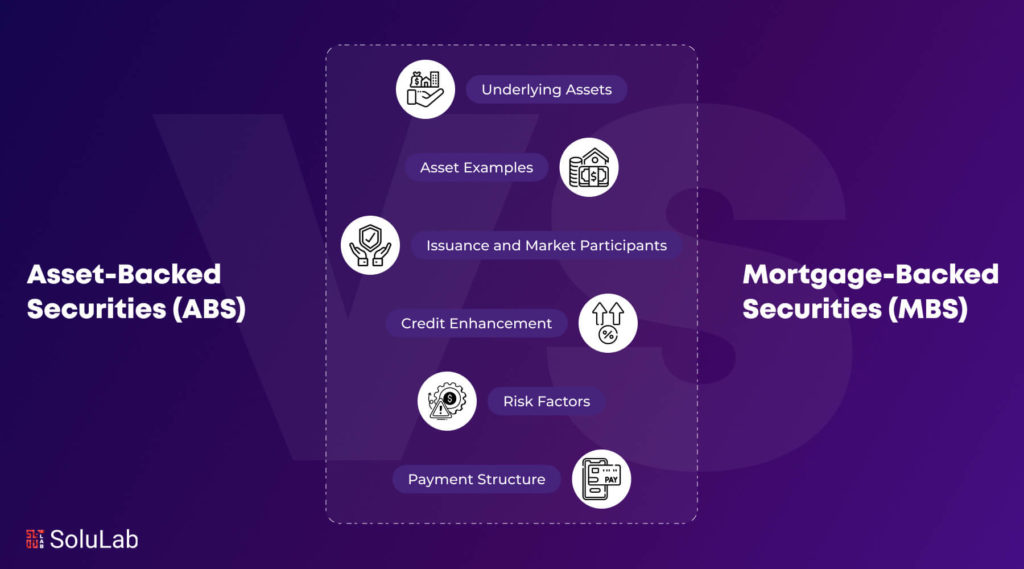
Difference Between Asset-Backed Securities and Mortgage-Backed Securities
ABS and MBS are both structured financial instruments, but they are not interchangeable. Each has its own makeup and its own job to do. Here is where they part ways.
1. Underlying Assets
- ABS: An ABS is backed by a pool of financial assets that are anything but mortgages. Think auto loans, credit card receivables, student loans, equipment leases, and other receivables.
- MBS: An MBS is backed by mortgage loans, full stop, whether residential (RMBS) or commercial (CMBS).
2. Asset Examples
- ABS: Asset-backed securities examples run from auto loans and credit card debt to home equity loans, student loans, and equipment leases. That range shows just how many non-mortgage assets can be securitized into ABS.
- MBS: MBS have one kind of underlying asset and one only: mortgage loans, whether home mortgages or commercial real estate mortgages.
3. Issuance and Market Participants
- ABS: The issuers tend to be financial institutions, auto finance companies, credit card companies, and other outfits sitting on a lot of receivables. On the buying side, you get institutional investors who want exposure to consumer credit or other non-mortgage assets.
- MBS: Issuers here are usually GSEs like Fannie Mae, Freddie Mac, and Ginnie Mae, plus private financial institutions. The MBS market draws in a wide crowd, pension funds, insurance companies, mutual funds, all of them after exposure to real estate.
4. Credit Enhancement
- ABS: ABS lean on tools like over-collateralization, reserve accounts, subordination, and third-party guarantees. Each one bumps up the credit quality of the security and shields investors when borrowers in the pool default.
- MBS: MBS often get their enhancement from GSEs or from private mortgage insurance. GSE-backed MBS in particular carry an implicit or explicit government guarantee, which lifts their credit quality and their appeal to investors.
5. Risk Factors
- ABS: Three risks dominate ABS: credit risk (borrowers default), prepayment risk (loans get paid off early), and interest rate risk. How the ABS holds up depends on how good and how diversified the underlying assets are.
- MBS: MBS face the same trio: credit risk, prepayment risk, interest rate risk. The difference is where the pressure comes from. ABS mortgage risks tie straight back to the housing market and real estate values, so they move with the housing sector and with anything that hits homeowners.
6. Payment Structure
- ABS:Payment structure on ABS is all over the map. It hinges on the type of underlying asset and how the deal is built. Generally, ABS payments are principal and interest coming out of the underlying asset pool.
- MBS: MBS usually pay principal and interest monthly, straight from the mortgage loans in the pool. Those payments go out to investors on a set schedule, and specific tranches get paid in a fixed order of priority.
Both ABS and MBS belong to the asset-backed family, yet they diverge in real ways: the assets underneath, who plays in the market, the credit enhancements, the risk factors, the payment structures, and even the size of the market itself. Get those differences straight before you weigh ABS vs MBS in your own investment strategy.

Conclusion
ABS and MBS share a spine, both are backed by pools of assets, but the differences run deep. ABS pull from a mix of financial assets: auto loans, credit card receivables, student loans, giving investors a window into several corners of the economy at once. MBS stay pinned to mortgages, which ties them directly to real estate. Both hand you liquidity, diversification, and decent yields. Both also carry their own risk profiles and their own market rhythms. Sort out those differences and you are in a far better spot to build a portfolio around structured finance.
There is a catch, though. Securitizing and running ABS and MBS is hard work: intricate structuring, regulatory compliance, and the constant need to track assets in a way that is transparent and secure. That is the gap SoluLab fills, as a leading tokenization development company. SoluLab puts blockchain technology to work on the securitization process, building solid asset tokenization that keeps things transparent, secure, and efficient. Tokenize the assets and managing them gets simpler, costs come down, and investors find it easier to get in. Want to see how SoluLab can help you tackle the hard parts of the ABS and MBS markets? contact us today.
FAQs
Shipra Garg is a tech-focused content strategist and copywriter specializing in Web3, blockchain, and artificial intelligence. She has worked with startups and enterprise teams to craft high-conversion content that bridges deep tech with business impact. Her work translates complex innovations into clear, credible, and engaging narratives that drive growth and build trust in emerging tech markets.