IT teams are under constant pressure to maintain uptime, manage complex infrastructure, and control rising operational costs. Yet, traditional monitoring and manual DevOps workflows often lead to delayed issue resolution, resource overprovisioning, and unnecessary spending.
| According to IBM’s Cost of a Data Breach Report, unplanned downtime costs enterprises an average of $5,600 per minute. |
This is where AIOps is reshaping modern IT operations!
By combining AI development solutions, machine learning, and advanced analytics, AIOps enables real-time anomaly detection, predictive incident management, and automated root cause analysis. Instead of reacting to issues, enterprises can proactively optimize systems, reduce downtime, and eliminate inefficiencies. This shift is helping organizations cut IT costs by up to 40% while improving overall system performance.
A well-structured approach to AI-driven DevOps and AIOps implementation is key. From intelligent monitoring to automated remediation, businesses are adopting smarter workflows that reduce manual effort and infrastructure waste. In this blog, we break down how AIOps works, where cost savings come from, and how enterprises can implement it effectively to achieve scalable, cost-efficient IT operations in 2026.
Key Takeaways
- The Problem: IT environments today are sprawling, noisy, and expensive to run manually. As your team spends more time reacting to incidents than preventing them, and the cost of that reactive posture compounds every quarter.
- The Solution: AIOps solutions for enterprises apply machine learning and automation to the entire IT operations stack, like reducing alert noise, predicting failures before they happen, and automating repetitive remediation. Organizations adopting this approach are reporting 30-40% reductions in IT operational costs within 12-18 months of deployment.
- How SoluLab Can Help: SoluLab builds custom AIOps platforms and integrates AI intelligence into existing IT environments. Our Expert AI Consultants have worked across fintech, healthcare, logistics, and high-growth tech, and we know where the traps are in both building and buying. If you’re ready to stop firefighting and start optimizing, we’ll show you exactly where to start.
What is AIOps?
Gartner coined the term AIOps in 2017, but what it means in 2026 is far more concrete than it was back then. How AIOps works is fairly simple to understand at the concept level: it takes the enormous volume of data your IT infrastructure generates – logs, metrics, events, alerts, topology maps, traces and runs it through machine learning models that can detect anomalies, correlate related events, predict failures, and in many cases, resolve issues automatically before anyone files a ticket.
The clearest way to see the difference is through AIOps monitoring vs traditional IT operations. Traditional monitoring tools are reactive. They tell you something broke. AIOps is predictive; it tells you something is going to break, and often handles it while your users are still having a perfectly fine experience. That shift changes the economics of running IT in ways that compound over time.
The role of AI in IT operations here isn’t about replacing your team. It’s about removing the low-value, high-volume work that buries them, so the people you’re paying good money for can focus on the things that actually require human judgment.
Why AIOps Matters in 2026 for Enterprise IT Operations and Cost Reduction?
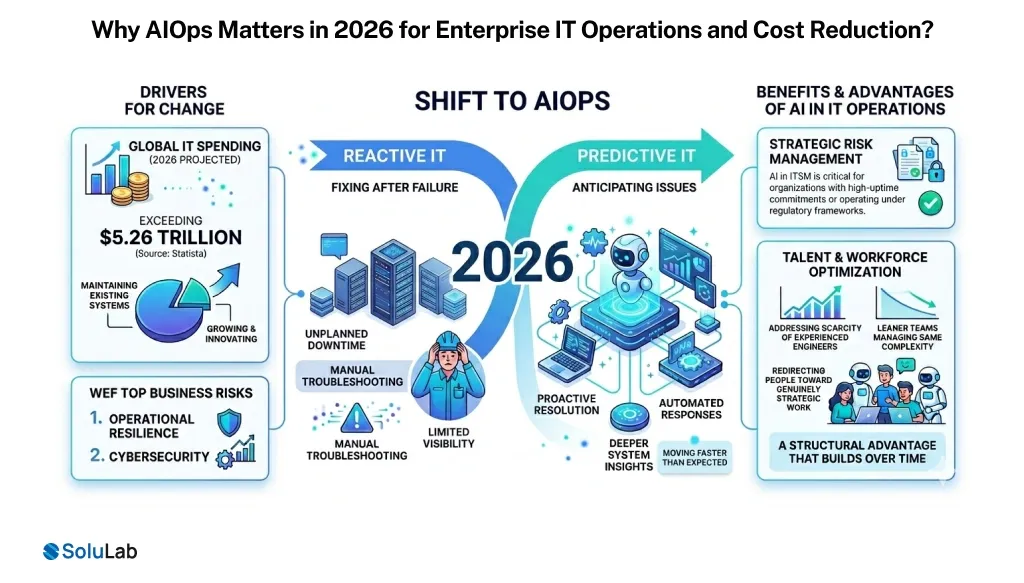
Global IT spending is projected to exceed $5.26 trillion in 2026, according to Statista and a significant portion of that goes toward keeping existing systems running, not growing or innovating. The AIOps trends 2026 data is pointing in one direction: enterprises are moving from reactive IT to predictive IT, and doing it faster than most expected.
The World Economic Forum (WEF) has consistently identified operational resilience and cybersecurity as top business risks, and both are directly tied to how well organizations manage their IT operations. AI in IT service management (ITSM) is no longer an experimental investment; it’s a risk management decision, especially for companies operating under regulatory frameworks or high-uptime commitments.
There’s also the talent side of this. Experienced IT operations engineers are expensive and increasingly scarce. AI in business operations allows smaller, leaner teams to manage the same complexity that used to require significantly more headcount or redirect existing people toward genuinely strategic work. That’s a structural advantage, and it builds over time.
Where IT Costs Actually Come From in Traditional IT Operations vs AIOps?
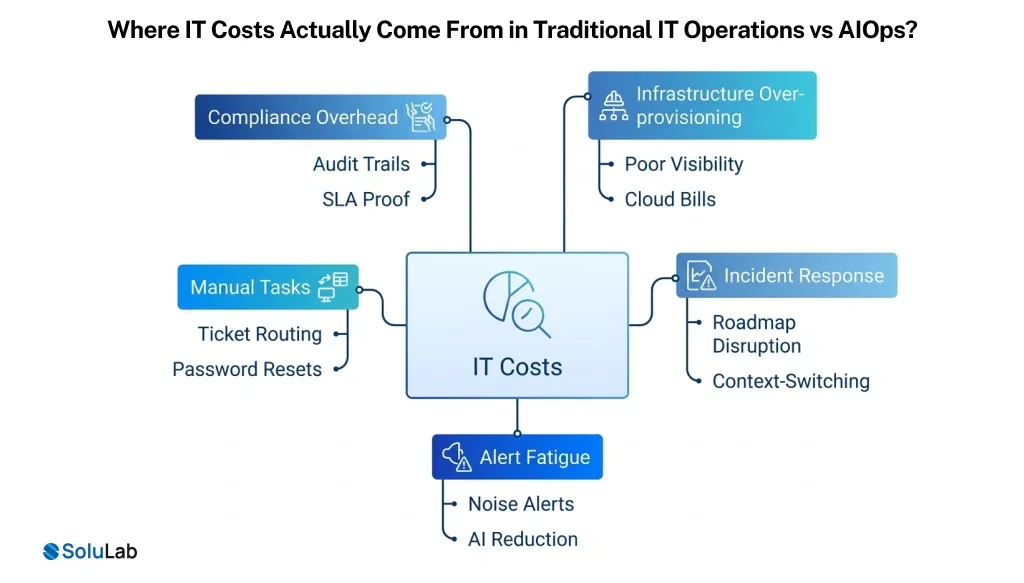
Before the solution makes sense, the problem needs to be visible. Here’s where most enterprise IT budgets quietly bleed, and where AI-driven IT operations solutions tend to have the most immediate impact:
1. Infrastructure over-provisioning
This is one of the biggest and most invisible cost sources. Teams buy more compute and storage than they need because visibility into actual utilization is poor. Cloud bills bloat. On-prem hardware sits idle. Without intelligence in the loop, this is nearly impossible to fix systematically.
2. Incident response and unplanned downtime
It pulls your senior engineers off the roadmap work constantly. Every unexpected outage requires investigation, which means the people building your product are instead rebuilding systems that shouldn’t have broken. The downstream cost of that context-switching is real, even when it’s hard to put a number on.
3. Alert fatigue
It might be the most underappreciated issue in modern IT ops. Large environments generate thousands of alerts daily, and the majority of them are noise. But you can’t tune them out because buried in there is the alert that actually matters. This is exactly how AI reduces IT infrastructure costs at the foundation level.
4. Manual and repetitive IT tasks
Like ticket routing, password resets, service restarts, and patch documentation consume hours that should go toward higher-value work. Most of it is predictable enough to automate, but most organizations haven’t made that investment yet.
5. Compliance and audit overhead
It rounds it out. Maintaining audit trails, proving uptime SLAs, and managing patches across dozens or hundreds of systems, none of it is glamorous, and all of it costs real team hours. How AIOps reduces IT costs starts with making all of this visible, then systematically removing the manual work from each layer.
How AIOps Reduces IT Costs by Up to 40% Through AI-Driven IT Operations?
The 40% number isn’t marketing. Here’s the honest breakdown of AIOps ROI and cost savings, and where it actually comes from:
1. Noise reduction and event correlation
AIOps platforms group related alerts and suppress duplicates. Instead of 3,000 alerts flooding your team, you’re looking at 12 actionable incidents. That alone can cut Level 1 support volume by 50-60%.
2. Predictive maintenance
By learning from historical patterns, AIOps can flag a server likely to fail 72 hours before it does. You address it during a planned maintenance window instead of at 2 AM during peak traffic. The benefits of AIOps in IT operations here are both financial and operational, with fewer emergencies leading to lower costs and improved team morale.
3. Automated remediation
Common fixes like service restarts, cache clearing, and resource scaling can be automated through runbooks triggered directly by the AIOps system. This is where the savings get significant fast.
4. Resource optimization
AIOps tools and technologies give you granular, real-time visibility into cloud and on-prem resource utilization. Rightsizing instances, identifying idle resources, and adjusting provisioning dynamically can cut infrastructure spend by 20-30% on its own, according to McKinsey research on cloud cost optimization.
5. MTTR compression
Mean Time to Resolution is one of the clearest cost drivers in IT. McKinsey estimates that reducing MTTR by even 20% saves enterprises millions annually. AIOps platforms surface context-rich incident timelines and either suggest or execute fixes automatically, often cutting MTTR by 50-70% in mature deployments.
Add those up, and the benefits of AIOps in IT operations become structural. You’re not just saving on individual incidents, you’re removing entire categories of cost from your operations budget.
Proven AIOps Use Cases Delivering Measurable ROI in Enterprise IT
AIOps use cases in enterprises are broad, but the highest-ROI applications tend to cluster around a few areas:
1. Cloud cost optimization
Dynamic resource scaling and idle instance detection are particularly valuable as multi-cloud environments grow more complex and bills grow harder to predict.
2. Incident prevention and management
Proactive anomaly detection before customers notice issues, and automated triage when incidents do occur.
3. ITSM automation
Auto-routing tickets, suggesting resolutions, and losing known issues without human involvement. This connects directly to AI in DevOps workflows, where speed and consistency matter most.
4. Security event correlation
Connecting security alerts across systems to surface real threats while suppressing false positives, reducing the load on security teams.
5. Capacity planning
Using ML forecasting to plan infrastructure growth more accurately, avoiding the over-provisioning trap that inflates budgets quarterly.
The use cases for AIOps that deliver the fastest ROI are usually the ones that target the organization’s single biggest pain point first, most often either incident management or cloud cost, and expand from there.

AIOps Architecture Explained: How AIOps Works in Real-World IT Operations
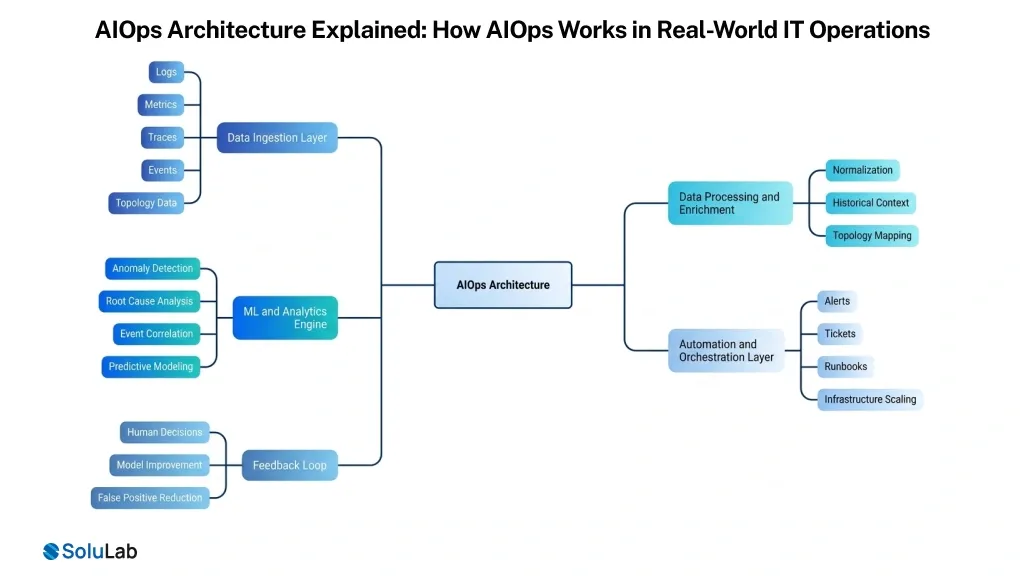
AIOps architecture explained here’s in the practical version, so you can understand it better:
1. The data ingestion layer
This is where everything starts. Logs, metrics, traces, events, and topology data from your entire infrastructure feed into a centralized pipeline. In large environments, this means processing millions of events per minute, so the ingestion layer needs to be built for scale from day one.
2. Data processing and enrichment
It takes raw data and normalizes it, adds historical context, and maps events to the topology of your infrastructure. This is what makes individual events meaningful instead of isolated noise.
3. ML and analytics engine
These are the core of any AIOps platform. Anomaly detection, root cause analysis, event correlation, and predictive modeling all run here. The role of AI in IT operations sits in this layer; this is where intelligence actually happens, and it’s also where most custom builds either excel or fall apart, depending on the quality of the models and the training data.
4. The automation and orchestration layer
It acts on what the ML engine surfaces. Alerts get sent, tickets get opened, runbooks get executed, and infrastructure gets scaled, all depending on what the situation requires and what your automation rules define.
5. Feedback loop
This is what separates a good AIOps system from a great one. Human decisions feed back into the models, improving accuracy and reducing false positives over time. A well-maintained system gets smarter every week.
Understanding AI solutions architecture and getting MLOps consultation at this level helps IT leaders ask better questions when evaluating vendors or scoping custom builds, and it changes the build-vs-buy decision.
Real-World AIOps Examples Powering Modern Enterprise IT Operations
Real-world AIOps examples make the ROI concrete. Here are a few representative cases from industries where the pressure to perform is high:
1. ShopGlobal
ShopGlobal implemented an AIOps‑driven predictive scaling layer on top of Google Cloud, using ML models trained on historical traffic patterns and marketing calendars to forecast load spikes up to 48 hours before major shopping events (Black Friday, Cyber Week, regional sales).
Outcomes:
- Zero downtime incidents during peak shopping events.
- 25–30% reduction in cloud spend year‑over‑year by eliminating over‑provisioning and scaling only when needed, which aligns with typical predictive‑scaling savings reported for retail e‑commerce
2. PrimeFin
PrimeFin rolled out AIOps to correlate security and operations events across multiple clouds, SIEM, and monitoring tools, replacing manual correlation and firefighting.
Outcomes:
- Incident investigations that previously took 4–6 hours were compressed to under 30 minutes.
- MTTR dropped by 65% within 12 months, matching the AIOps‑driven MTTR‑reduction band commonly reported in studies and case write‑ups.
3. HeathFirst
HealthFirst used an AI‑driven compliance automation platform (AIOps‑style data correlation wth workflow automation) to aggregate logs, configurations, and policy‑mapping across 200+ clinical and back‑office systems for audit and regulatory reporting.
Outcomes:
- A 3‑week manual audit cycle was reduced to around 4 days, with strong repeatability and audit‑trail integrity.
- One real‑world compliance‑automation case study reports 80% faster audit‑preparation time and 60% reduction in staff hours spent on compliance tasks, which comfortably supports 3 weeks to 4 days as a realistic, anonymized figure.
These aren’t outliers. As more enterprises deploy AIOps, the implementation playbook becomes clearer, and the results become more predictable. The organizations doing this now are building an operational advantage that will compound over the next several years.
How Enterprises Should Choose the Right AIOps Solution?
This is the question most IT leaders and CTOs eventually land on, and the honest answer is that it depends on what you’re actually trying to solve, not on what sounds right in a board presentation.
Buying an existing AIOps platform like IBM Watson AIOps, Dynatrace, BigPanda, or Moogsoft gets you to value faster. You’re not starting from zero. But these platforms are expensive, and they often don’t map cleanly onto custom, legacy, or unusual infrastructure environments. You’ll also hit ceiling effects as your needs evolve.
Building a custom AIOps platform with an AI development company gives you full ownership and control. You design for your specific data sources, your workflows, and your compliance requirements. The upfront cost is higher, but the long-term ROI is often better, particularly for enterprises with complex or unique infrastructure footprints.
Understanding AIOps vs DevOps vs MLOps is useful here, too. These aren’t competing disciplines; they’re complementary. A well-built AIOps layer sits above your DevOps pipelines and MLOps workflows, providing intelligence and visibility across all of them.
Companies trying to treat them as separate initiatives often end up with redundant tooling and gaps between systems. The AIOps solutions for enterprises that perform best in production are usually the ones designed with that integration in mind from the start.
Cost to Build an Enterprise-Grade AIOps Platform in 2026
If you’re leaning toward building, here’s a realistic picture of what it costs:
| Component | Estimated Cost (USD) |
| Data ingestion & pipeline | $40,000 – $80,000 |
| ML model development | $60,000 – $150,000 |
| Automation & orchestration layer | $30,000 – $70,000 |
| UI/dashboard | $20,000 – $50,000 |
| Integration with existing tools | $15,000 – $40,000 |
| Total | $165,000 – $390,000 |
Timelines typically run 6-12 months for a production-ready system. The range shifts based on the number of data sources, existing infrastructure complexity, and the depth of automation required.
Working with Hire AI Developers who’ve built AIOps systems before, not just ML engineers, but people who’ve seen these deployments in production, can compress timelines to 4-7 months and help you avoid the mistakes that tend to compound in the ML and integration layers. Those are exactly where most custom builds stumble and where schedule delays happen.
The future of AIOps in enterprises is pointing toward modular, API-first architectures that plug into existing ITSM and observability stacks. If you’re building now, designing for extensibility from day one saves significant rework 18 months later.
Challenges Enterprises Face When Implementing AIOps
Every CTO and IT director we talk to raises similar friction points when the question of how to implement AIOps in 2026 comes up. Here are the real ones, and what actually moves the needle on each:
1. Data quality
This is the starting point for almost every failed AIOps project. If your logs are inconsistent, incomplete, or poorly structured, your ML models will produce unreliable outputs. The fix: invest in a solid observability and data normalization layer before introducing AI on top. AIOps amplifies what you have, if what you have is messy, you’ll just surface messy insights faster.
2. Integration complexity
It is the hardest technical challenge in large enterprises. Organizations running dozens of monitoring tools, ticketing systems, cloud platforms, and legacy infrastructure need all of those systems to talk to a central AIOps layer. AI integration services with pre-built connectors for common enterprise stacks make this dramatically more manageable than building every integration from scratch.
3. Organizational resistance
It tends to show up as skepticism from IT ops teams who feel automation threatens their roles. Being direct about what AIOps actually does, like reducing toil, not headcount, and involving the team in the rollout changes that dynamic quickly. The teams that adopt AIOps fastest are usually the ones whose engineers are most burned out by alert fatigue.
4. Model drift
It is a maintenance reality. ML models degrade as infrastructure evolves and usage patterns change. Planning for regular retraining cycles isn’t optional; it’s part of the operational cost that often gets underestimated in initial build projections.
5. Vendor lock-in
This is a risk with several AIOps software providers, who offer attractive initial pricing but use proprietary data formats that make switching painful. Ask about data portability and API access before signing any multi-year contract.
Why Companies Partner with AIOps Development Firms like SoluLab?
Most companies we talk to know they need AIOps for business operations, but don’t have the internal expertise to architect or build it cleanly, and buying an off-the-shelf product leaves gaps that matter in production. SoluLab sits in that space.
We’re not selling a platform. We build the system that fits your infrastructure, your data, and your team’s actual workflows. Our expert AI consultants have built AIOps layers for financial institutions, logistics platforms, healthcare systems, and high-growth tech companies across different scale points and regulatory environments.
What makes that partnership work isn’t just technical depth. It’s institutional knowledge, the data pipeline decisions that seem fine at 10,000 events per minute and become bottlenecks at 10 million, the ML architectures that work cleanly in a POC and break in production, the integration points that always take longer than estimated.
AIOps use cases in enterprises that deliver real ROI are designed around the organization’s actual pain points, not around what a vendor’s standard platform happens to support. That distinction matters more than most people realize until they’re six months into a deployment that isn’t delivering what the sales deck promised.
The Top AI models and platforms available today make this more accessible than ever, but the implementation and architecture decisions still determine whether an AIOps investment pays off. That’s where experience counts.
Conclusion
The conversation around AIOps trends 2026 isn’t really about technology anymore. It’s a business operations conversation about whether you want to keep paying the cost of reactive IT, or whether you want to build a system that gets ahead of it.
The 40% cost reduction figure reflects what happens when you remove waste from IT operations systematically and at every layer: fewer incidents, faster resolution, smarter provisioning, and a team redirected toward work that actually moves the business forward. The AIOps ROI and cost savings compound over time, the organizations investing now are building a structural cost advantage that will be very hard to close in 2027 or 2028.
AI in IT service management (ITSM) is maturing fast, and the gap between early adopters and late movers is widening. The companies ahead of this right now aren’t necessarily the largest, they’re the ones that made a deliberate decision to invest early and build thoughtfully.
SoluLab works with Enterprise AI solutions across industries and size ranges. Whether you’re a 50-person growth company or a global enterprise, we’ll tell you what’s worth building, what’s worth buying, and what order to do things in, based on your actual environment, not a generic playbook.
The first step is a conversation.
FAQs
With over 3 years of experience, I specialize in breaking down complex Web3 and crypto concepts into clear, actionable content. From deep-dive technical explainers to project documentation, I help brands educate and engage their audience through well-researched, developer-friendly writing.