Key Takeaways
- The Problem: Hospitality businesses struggle with rising guest expectations, fragmented systems, staff shortages, and inefficient operations, leading to inconsistent experiences.
- The Solution: AI enables personalized guest experiences, real-time decision-making, pricing, and operational automation, helping hospitality businesses improve efficiency, reduce costs.
- How SoluLab Helps: SoluLab is an AI-native company that embeds AI into its workflows, enabling faster delivery, lower costs, and scalable AI integration tailored to hospitality businesses for smarter operations and enhanced guest experiences.
Guests today expect hotel experiences as personalized and seamless as their favorite digital platforms, yet many hospitality businesses still rely on fragmented systems and manual processes.
This gap creates operational inefficiencies, from delayed service responses to poor resource allocation during peak demand. For hospitality leaders, this is no longer just a service challenge; it’s a growth and survival issue.
However, AI development enables real-time decision-making, intelligent automation, and personalized guest engagement. In fact, Over 40% of large hotel chains are already using or piloting AI solutions across operations and guest experience.
Businesses that adopt AI are not just improving operations; they are redefining how hospitality is delivered at scale.
What Is AI in Hospitality?
AI in the hospitality industry means using smart technology to improve how hotels, resorts, and restaurants work. It helps businesses understand guest needs, automate tasks like bookings and support, and make better decisions. This leads to faster service, personalized experiences, and smoother daily operations for both staff and guests.
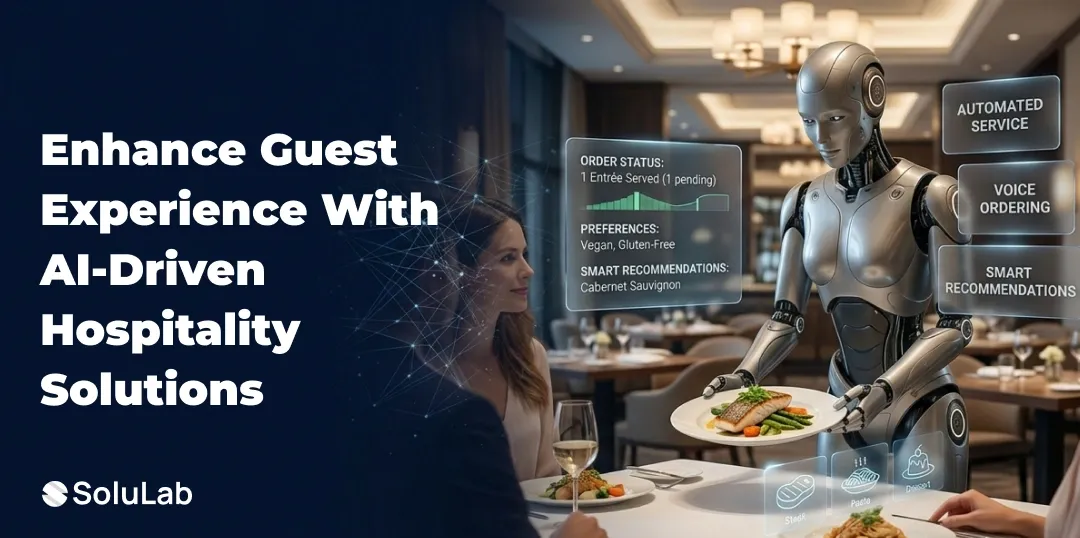
Today, AI is transforming the industry by enabling smarter guest interactions, predictive analytics, and 24/7 service through intelligent systems like chatbots and AI agents. Businesses are increasingly adopting solutions such as AI agents in hospitality to automate bookings, handle guest queries, and deliver personalized experiences at scale.
The Impact of AI in the Hospitality Industry
Artificial intelligence in the hotel industry is improving guest experiences, improving operations, and enabling smarter decision-making. Hotels and resorts are using AI to personalize services, automate routine tasks, and respond faster to changing customer needs. As expectations rise, AI is becoming essential for delivering speed, convenience, and consistency across every touchpoint in the hospitality journey.
- Enhanced guest personalization
- Faster customer support with chatbots
- Real-time demand forecasting
- Dynamic pricing and revenue optimization
- Improved staff and resource management
- Predictive maintenance for facilities
- Better data-driven decision-making
Moreover, the global AI in tourism market size was is projected to reach USD 13,868.8 million by 2030, growing at a CAGR of 26.7% from 2025 to 2030.
Why Hospitality Businesses Need AI Now?
Hospitality businesses must adopt AI integration solutions now to meet rising guest expectations, optimize operations, and stay competitive in a fast-changing market where personalization, speed, and real-time decision-making define success.
- Lack of real-time processing: Legacy systems rely on delayed data updates, limiting instant insights and slowing decisions in environments where guest satisfaction depends on immediate responses and operational agility.
- Limited personalization capabilities: Traditional systems fail to analyze guest preferences effectively, resulting in generic experiences that reduce engagement, loyalty, and repeat bookings in highly competitive hospitality.
- Inefficient resource allocation: Manual scheduling and static planning lead to overstaffing or shortages, increasing operational costs and impacting service quality during peak and off-peak demand periods.
- Revenue optimization challenges: Without AI-driven pricing, businesses miss opportunities to adjust rates based on demand fluctuations, competitor pricing, and seasonal trends, directly affecting profitability.
- Fragmented data systems: Disconnected platforms across booking, CRM, and operations create data silos, making it difficult to gain a unified view of guest behavior and operational performance.
- Slow response to disruptions: Hospitality businesses struggle to adapt quickly to demand changes, cancellations, or external disruptions without predictive analytics and automated decision-making systems in place.
Benefits of AI Development in the Hospitality Industry
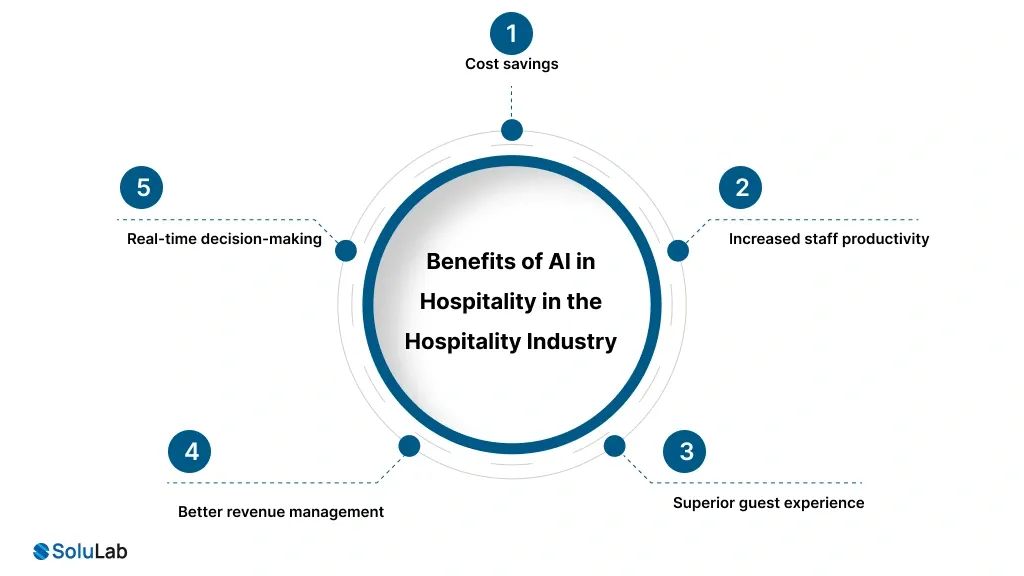
AI empowers businesses to cut costs, enhance guest experiences, improve staff efficiency, and enable smarter decisions through real-time insights, making operations more agile, personalized, and revenue-focused. Some of the main advantages are-
- Cost savings: AI automates repetitive tasks, optimizes energy usage, and reduces operational inefficiencies, helping hospitality businesses lower costs while maintaining service quality and improving overall profitability across operations.
- Increased staff productivity: AI handles routine processes like bookings, queries, and scheduling, allowing staff to focus on high-value guest interactions, improving efficiency and reducing workload without increasing workforce requirements.
- Superior guest experience: AI enables personalized recommendations, faster service, and seamless interactions, helping businesses deliver tailored experiences that increase guest satisfaction, loyalty, and positive reviews.
- Better revenue management: AI analyzes demand patterns, competitor pricing, and booking trends to optimize pricing strategies, maximizing occupancy rates and revenue while adapting dynamically to market changes.
- Real-time decision-making: AI provides instant insights from live data, enabling hospitality businesses to make quick, informed decisions, respond to guest needs promptly, and manage operations efficiently during peak demand or disruptions.
How to Implement AI into Hospitality: Step-by-Step Guide
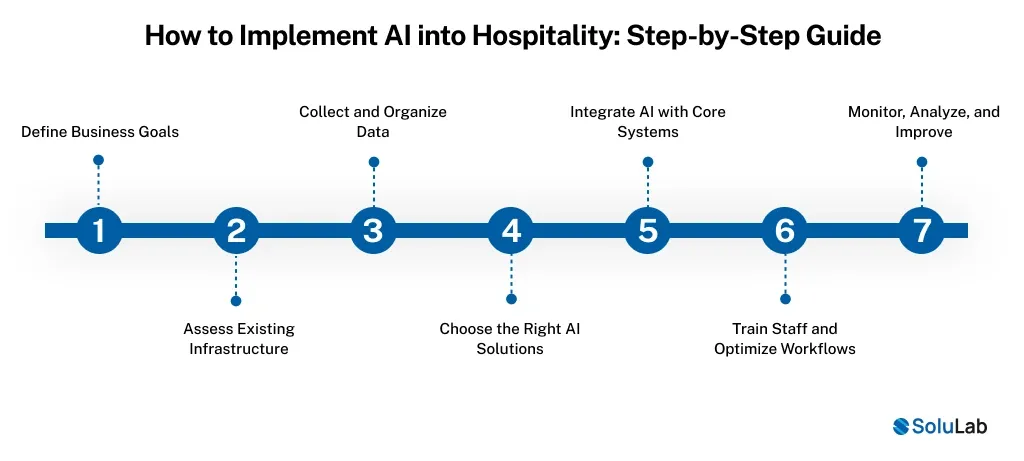
Implementing AI in hospitality helps businesses automate operations, personalize guest experiences, and improve efficiency, enabling hotels to deliver smarter, faster, and more responsive services in a highly competitive and evolving industry landscape.
1. Define Business Goals
Start by identifying clear objectives with expert AI consultants, such as improving guest experience, reducing costs, or increasing revenue. Align AI adoption with specific operational challenges to ensure measurable outcomes and a focused implementation strategy.
2. Assess Existing Infrastructure
Evaluate current systems like PMS, CRM, and booking engines to understand integration capabilities. Identifying gaps early helps ensure smoother AI deployment without disrupting ongoing hospitality operations.
3. Collect and Organize Data
AI relies on high-quality data. Gather guest preferences, booking patterns, and operational data, then structure it properly to enable accurate insights, predictions, and personalized service delivery.
4. Choose the Right AI Solutions
Select AI tools based on your needs, such as chatbots, demand forecasting, or AI-powered room service. Focus on scalable solutions that integrate seamlessly with your existing hospitality ecosystem.
5. Integrate AI with Core Systems
Connect AI models with hotel management systems to enable real-time decision-making. This ensures automation across workflows like bookings, customer service, and resource allocation.
6. Train Staff and Optimize Workflows
Educate staff on using AI tools effectively and adapt workflows accordingly. Human-AI collaboration improves service quality while ensuring smooth adoption across departments.
7. Monitor, Analyze, and Improve
Continuously track AI performance, gather feedback, and refine models. Regular optimization ensures accuracy, better guest experiences, and long-term value from AI implementation.
Top Use Cases of AI in Hospitality
AI in hospitality is transforming how hotels operate and serve guests by enabling real-time personalization, automation, and smarter decision-making, helping businesses improve efficiency, enhance experiences, and increase revenue.
- AI-powered guest personalization: AI analyzes guest preferences, booking history, and behavior patterns to deliver tailored recommendations, customized room settings, and personalized offers, improving guest satisfaction, loyalty, and overall experience across hospitality touchpoints.
- AI chatbots and virtual assistants: AI chatbots provide 24/7 assistance for bookings, queries, and service requests, reducing response time, lowering operational workload, and ensuring consistent, instant communication with guests across multiple digital channels.
- Enhanced revenue management: AI-driven pricing models analyze demand trends, competitor pricing, and seasonal patterns to adjust room rates, helping hotels maximize occupancy, optimize revenue, and make data-driven pricing decisions in real time.
- Robotic process automation (RPA): RPA automates repetitive back-office tasks such as bookings, invoicing, and data entry, reducing human errors, improving operational efficiency, and allowing staff to focus more on delivering high-value guest services.
- Multilingual customer support: AI-powered language processing enables seamless communication with international guests by providing real-time translation and multilingual support, enhancing guest experience and expanding global reach for hospitality businesses.
- Voice-activated services: Voice-enabled AI systems allow guests to control room features, request services, and access information hands-free, improving convenience, accessibility, and overall in-room experience while reducing dependency on manual interactions.
- Security and fraud detection: AI monitors transactions and user behavior to detect anomalies, prevent fraud, and enhance security across bookings and payments, ensuring a safer environment for both guests and hospitality service providers.
- Smart room technologies: AI-driven smart rooms adjust lighting, temperature, and entertainment settings based on guest preferences, creating a personalized and energy-efficient environment that enhances comfort while optimizing operational costs.
Real World Examples of AI in the Hospitality Industry
AI native strategy in hospitality is no longer experimental; leading hotel brands are using it to personalize guest experiences, automate operations, and improve efficiency through real-time data-driven decision-making across their properties.
1. Marriott International – AI-powered personalization:
Marriott uses AI to analyze guest preferences, booking history, and behavior patterns, enabling personalized recommendations, room settings, and targeted offers, enhancing guest satisfaction while increasing repeat bookings and overall customer lifetime value.
2. Hilton Worldwide – AI concierge (Connie):
Hilton introduced an AI-powered concierge that assists guests with local recommendations, hotel services, and queries, reducing staff workload while delivering instant, consistent, and personalized customer service experiences across multiple properties.
3. Hyatt Hotels Corporation – AI-driven demand forecasting:
Hyatt leverages AI to predict booking trends, optimize pricing strategies, and manage inventory efficiently, helping maximize revenue while ensuring better occupancy rates and improved operational planning across seasonal demand fluctuations.
4. Accor – AI for operational efficiency:
Accor uses AI to streamline housekeeping schedules, energy management, and maintenance operations, improving resource utilization, reducing operational costs, and ensuring a more sustainable and efficient hotel management system.
Future Trends of AI in Hospitality
AI in hospitality is shifting from basic automation to intelligent, predictive, and personalized systems that enhance guest experiences, streamline operations, and enable real-time decision-making across modern hospitality businesses.
- Hyper-personalized guest experiences: AI will analyze guest preferences, behaviors, and past interactions to deliver tailored recommendations, room settings, and services, creating highly customized stays that improve satisfaction, loyalty, and long-term customer retention.
- AI-powered autonomous operations: Hotels will adopt AI-driven systems to automate check-ins, housekeeping schedules, and service requests, reducing manual workload while improving efficiency, accuracy, and operational consistency across multiple properties.
- Voice and conversational AI adoption: AI Voice assistants and AI chatbots will become standard across hotels, allowing guests to interact naturally for bookings, service requests, and information, improving convenience and reducing dependency on staff.
- Predictive maintenance and asset management: AI will monitor equipment and infrastructure in real time, predicting failures before they occur, reducing downtime, lowering maintenance costs, and ensuring uninterrupted guest experiences.
- AI-driven revenue optimization: Pricing models powered by AI will continuously adjust room rates based on demand, competitor pricing, and market trends, helping businesses maximize revenue and occupancy rates.

Conclusion
AI is changing the hospitality industry by enabling smarter operations, personalized guest experiences, and data-driven decision-making. From pricing and AI chatbots to predictive maintenance and demand forecasting, businesses can improve efficiency while enhancing customer satisfaction.
As competition grows, adopting AI is no longer optional but essential for staying relevant and scalable. The real advantage lies in integrating AI seamlessly into existing systems to unlock long-term value.
Businesses that act early will lead the next wave of innovation in hospitality. SoluLab, an AI app development company, can help your business design and implement tailored AI solutions for sustainable growth.
FAQs
Neha is a curious content writer with a knack for breaking down complex technologies into meaningful, reader-friendly insights. With experience in blockchain, digital assets, and enterprise tech, she focuses on creating content that informs, connects, and supports strategic decision-making.