For decades, property ownership has operated on a quiet assumption: value moves slowly. Appraisals happen quarterly. NAVs are updated periodically. Equity structures remain fixed long after market realities shift.
But capital markets no longer tolerate delay.
Investors expect live dashboards. Credit desks demand dynamic collateral visibility. Regulators require transparent audit trails. And digital-native investors increasingly question why property one of the world’s largest asset classes, still behaves like a paper-era instrument.
The integration of AI Agents with RWA tokenization introduces something fundamentally different: equity that recalibrates itself.
Not speculative automation. Not hype-driven tokenization.
But programmable ownership is powered by intelligent agents continuously interpreting rental flows, market signals, risk exposure, and compliance constraints and reflecting those insights in tokenized equity structures in real time.
Static ownership is becoming structurally obsolete.
Key Takeaways
- Dynamic equity combines Agentic AI and RWA tokenization to enable real-time property valuations and more responsive real estate investment models.
- AI-driven valuation models analyze live market data, trends, and signals, delivering faster and more accurate pricing compared to traditional appraisal methods.
- RWA tokenization unlocks fractional ownership and liquidity, making real estate investments more accessible and tradable on-chain.
- The convergence of AI + tokenization is reshaping real estate into a data-driven asset class, enabling smarter portfolio management and yield optimization.
- SoluLab has delivered 150+ blockchain and AI solutions globally, helping enterprises build tokenized asset platforms, AI-powered valuation systems, and scalable Web3 infrastructure.
The Core Problem: Property Markets Run on Delayed Intelligence
Real estate remains one of the least synchronized asset classes in modern finance.
Valuations Are Periodic, Not Continuous
Traditional valuation processes depend on:
- External appraisers
- Comparable sales analysis
- Lagging market indicators
- Manual review cycles
By the time a valuation report is published, the underlying market conditions may already have shifted.
This delay creates:
- Pricing inefficiencies
- Misaligned equity distribution
- Distorted lending ratios
- Reduced investor confidence
Equity Structures Are Rigid
Even when property is fractionalized through a real estate tokenization, most implementations mirror traditional structures:
- Fixed cap tables
- Static dividend logic
- Periodic reporting
- Manual NAV updates
In other words, tokenization without intelligence still produces static equity.
Information Asymmetry Persists
Investors rarely have real-time visibility into:
- Occupancy shifts
- Rental delinquency trends
- Local regulatory changes
- Macroeconomic exposure
Without a continuous intelligence layer, tokenized real estate remains a digital wrapper around analog processes. This is precisely where agentic AI frameworks for real estate begin to change the architecture.
From Tokenized Property to Dynamic Equity
Real estate tokenization development was initially about access. Lower entry barriers. Fractional participation. Broader liquidity. Dynamic equity is about synchronization.
What Dynamic Equity Actually Means?
Dynamic equity refers to ownership structures that:
- Adjust valuation logic continuously
- Recalculate token pricing based on live inputs
- Reflect operational performance in near real time
- Maintain compliance constraints automatically
It is the structural integration of agentic AI with RWA tokenization, not as an add-on analytics layer, but as a core system component.
Why Tokenization Alone Is Not Enough?
A real estate tokenization development platform can:
- Digitize ownership
- Automate transfers
- Enable fractionalization
- Embed compliance rules
But without AI agents for real estate valuation, pricing still depends on periodic manual intervention.
Tokenization creates programmable rails. Agentic AI creates autonomous valuation logic.
Only when both are integrated does equity become dynamic.
The Evolution Toward AI-Native Property Ownership
We are now seeing the emergence of:
- Agentic AI in real estate asset monitoring
- AI agents in property investment risk modeling
- Continuous NAV recalibration systems
- Smart contracts that reference live valuation feeds
This shift marks the transition from tokenized property to intelligent property capital.
Agentic AI Explained in a Real Estate Context
Before discussing architecture, it is important to clarify what makes agentic AI different from traditional analytics.
Predictive AI forecasts outcomes.
Agentic AI takes action within defined constraints.
In the context of agentic AI in real estate, this means intelligent systems that do not merely estimate property values — they continuously interpret signals, update valuation logic, trigger recalibrations, and document every decision within auditable frameworks.
From Predictive Models to Autonomous Valuation Agents
Traditional AI models for property valuation typically:
- Train on historical sales data
- Generate periodic valuation estimates
- Operate as advisory tools
By contrast, AI agents for real estate valuation:
- Ingest live rental income streams
- Monitor vacancy and occupancy shifts
- Track comparable sales in real time
- Adjust risk weightings based on macro indicators
- Trigger smart contract updates when thresholds are crossed
These agents operate within guardrails defined by governance policies and compliance rules.
They do not “override” human authority.
They execute within structured mandates.
Agentic AI Real Estate Use Cases
Some emerging AI real estate use cases include:
- Continuous NAV recalculation for tokenized portfolios
- Automated LTV adjustments for property-backed lending
- Dynamic rental yield redistribution
- Liquidity window optimization
- Real-time risk exposure scoring
When integrated correctly, agentic AI development for real estate becomes an infrastructure discipline, not a data science experiment.
The Role of AI Agents in Property Investment
AI agents in property investment act as:
- Valuation interpreters
- Risk monitors
- Compliance validators
- Market signal translators
Crucially, their decisions must be explainable.
Every valuation adjustment must produce:
- A reasoning log
- Data source traceability
- Timestamped audit records
- Policy reference mapping
Without explainability, institutional adoption stalls.
Which brings us to architecture.
Architectural Blueprint: Agentic AI + Tokenization Stack
Dynamic equity requires a tightly integrated system. Not layered improvisation.
The AI integration solutions with RWA tokenization depend on four foundational layers.
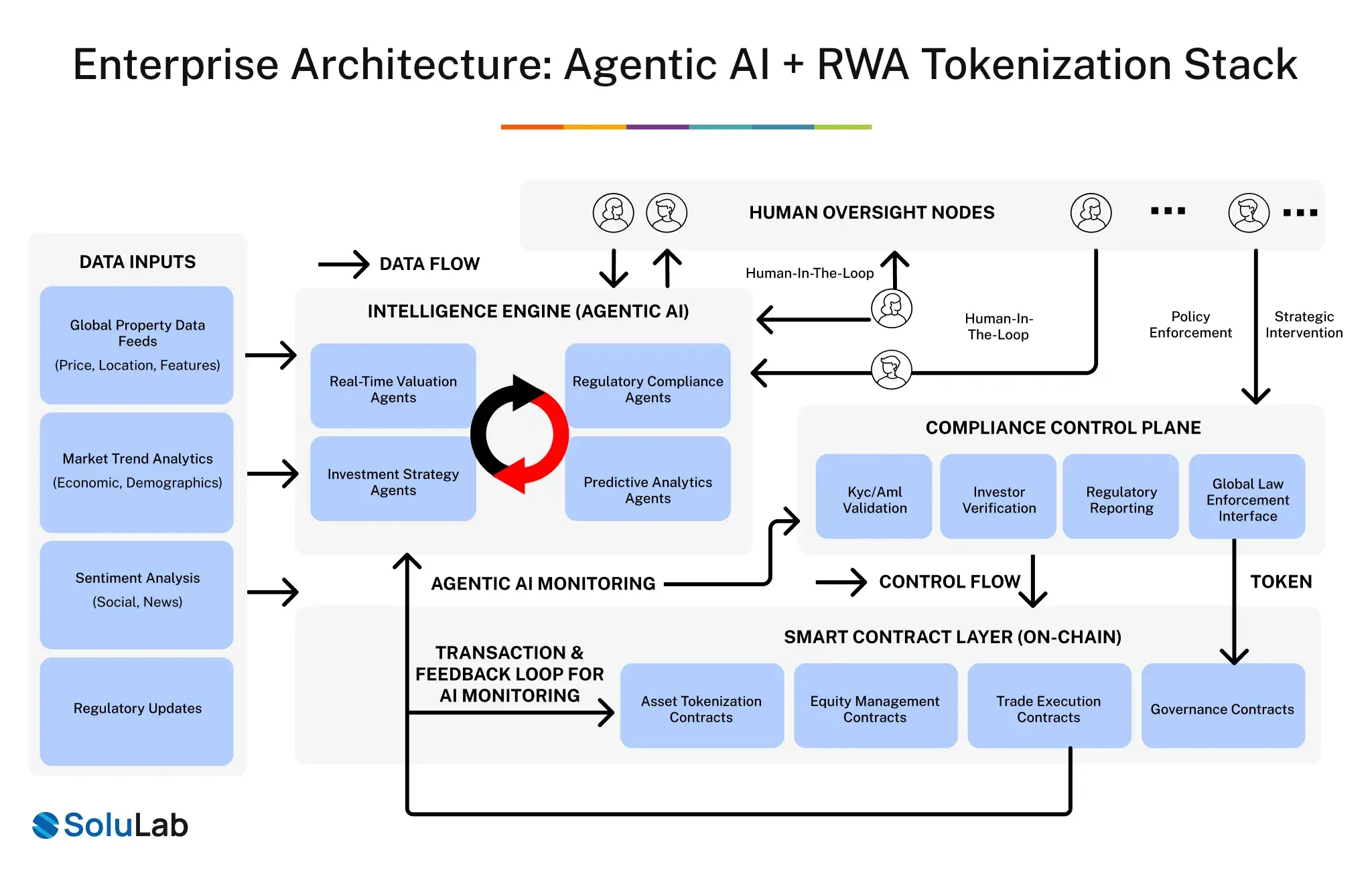
Data Layer: The Real-Time Property Signal Engine
This layer ingests:
- Rental payment streams
- Lease agreements
- Occupancy data
- Local market sales feeds
- Interest rate benchmarks
- Zoning and regulatory updates
- Macroeconomic indicators
Data validation pipelines must include:
- Oracle verification
- Multi-source cross-referencing
- Tamper detection
- Latency monitoring
Garbage data corrupts valuation intelligence.
Institutional-grade inputs are non-negotiable.
Intelligence Layer: Agentic Valuation Engine
This is where AI development solutions for property valuation operate.
Components include:
- Autonomous valuation agents
- Risk-adjusted pricing algorithms
- Scenario modeling engines
- Stress testing modules
- Liquidity sensitivity models
These agents continuously evaluate:
- Income volatility
- Market comparables
- Risk exposure
- Debt structure changes
- Macroeconomic shifts
Outputs are not static reports.
They are executable pricing signals.
Tokenization Layer: Programmable Equity Infrastructure
This is where real estate tokenization development becomes critical.
A mature real estate tokenization platform must include:
- Smart contracts with valuation hooks
- Dynamic equity adjustment logic
- On-chain ownership registry
- Transfer restriction modules
- Jurisdiction-aware compliance controls
Whether built by an internal team or a real estate tokenization development company, this layer must be designed for integration, not isolation.
Smart contracts should reference AI-validated valuation feeds via secure oracle systems.
Equity becomes programmable capital.
Compliance & Governance Layer: The Institutional Guardrail
Dynamic systems introduce dynamic risk.
Therefore, integrating AI agents with tokenization requires:
- On-chain KYC enforcement
- AML monitoring
- Explainable AI audit logs
- Regulator-ready reporting dashboards
- Override and human-in-the-loop controls
Agentic AI implementation services must prioritize:
- Accountability mapping
- Model governance
- Incident escalation protocols
- Version-controlled smart contracts
Without governance architecture, intelligence becomes a liability.
Legal & Regulatory Foundation of Dynamic Equity
Technology may enable dynamic equity. Regulation determines whether it survives.
The integration of Agentic AI with Real-World Asset (RWA) tokenization must begin with legal classification, not code deployment.
Securities Classification Comes First
Tokenized real estate typically falls under securities law in most jurisdictions. Whether structured as:
- Fractional equity in an SPV
- Revenue participation tokens
- Debt-backed instruments
- Hybrid yield tokens
The legal wrapper dictates:
- Investor eligibility
- Disclosure obligations
- Transfer restrictions
- Secondary trading permissions
Dynamic valuation does not remove these constraints. It intensifies scrutiny.
If AI agents are influencing valuation adjustments, regulators will ask:
- What is the decision logic?
- Who is accountable?
- Can adjustments be audited?
- Are investors treated equitably?
Agentic AI in real estate must operate within a legally defensible governance framework.
Jurisdictional Considerations
Implementation models differ across regions:
- United States: SEC oversight, Reg D, Reg A+, Reg S structures
- European Union: MiCA implications for tokenized assets and AI transparency standards
- Middle East: ADGM and DIFC digital asset regulatory frameworks
- APAC: Licensing requirements for digital asset exchanges and custodians
A tokenization platform development company serving institutional clients must embed jurisdiction-aware transfer controls directly into smart contracts.
Compliance cannot remain off-chain.
AI Governance and Explainability Requirements
When integrating AI agents with tokenization, model governance becomes part of regulatory compliance.
Institutions must address:
- Model validation standards
- Data provenance tracking
- Bias testing
- Version control documentation
- Override authority structures
Agentic AI solutions for property valuation must produce:
- Clear reasoning logs
- Parameter change history
- Data source references
- Human review checkpoints
Without explainability, institutional real estate tokenization development will struggle to pass regulatory review.
Governance Models for Autonomous Valuation Systems
A legally resilient dynamic equity platform typically includes:
- Human-in-the-loop oversight committees
- AI audit subcommittees
- Risk escalation protocols
- Smart contract pause mechanisms
- Mandatory disclosure triggers
Dynamic equity is not about removing governance.
It is about embedding governance into system architecture.
Workflow: How Real-Time Property Valuation Actually Works
Architecture explains components. Workflow explains behavior. Below is a simplified lifecycle of agentic AI with RWA tokenization in action.
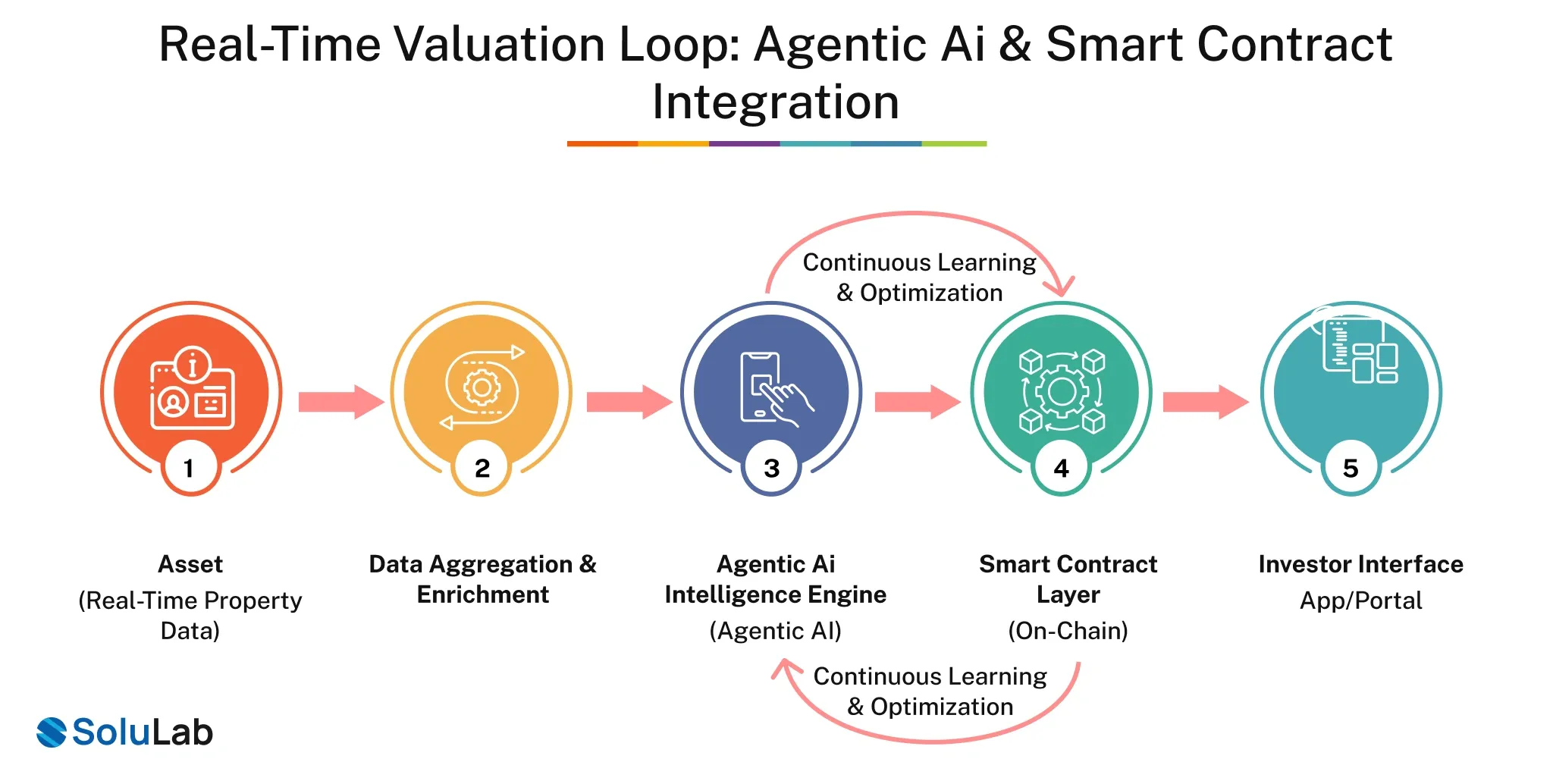
Step 1: Asset Onboarding
- Legal SPV formation
- Property title verification
- Initial independent valuation
- Regulatory classification
- Smart contract deployment
The asset is tokenized through a real estate tokenization development platform with embedded compliance logic.
Step 2: Initial Token Issuance
- Fractional equity minted
- Investor onboarding with KYC
- Cap table initialization
- Base NAV defined
At this stage, the system resembles traditional tokenized real estate.
Dynamic behavior begins next.
Step 3: Continuous Data Ingestion
AI agents begin monitoring:
- Rental income performance
- Occupancy rates
- Market comparables
- Regional economic indicators
Data pipelines feed directly into the intelligence layer.
Step 4: Autonomous Valuation Adjustment
When defined thresholds are met:
- Valuation algorithms recalibrate NAV
- Risk coefficients adjust
- Smart contract valuation variables update
All changes generate:
- Audit logs
- Timestamped records
- Compliance notifications
This is agentic AI in real estate operating within guardrails.
Step 5: Dynamic Equity Reflection
Token pricing reflects updated valuation logic.
Depending on regulatory design:
- Secondary market price bands adjust
- Liquidity windows update
- Collateral ratios recalibrate
Equity now mirrors operational performance in near real time.
Step 6: Continuous Compliance Monitoring
Every adjustment is validated against:
- Jurisdictional restrictions
- Securities law constraints
- Investor eligibility rules
- Reporting obligations
Dynamic equity never operates outside legal boundaries.
Risk Considerations in AI-Driven Tokenized Real Estate
Dynamic systems amplify both efficiency and risk.
Before deploying AI for real estate, institutions must map risk categories carefully.
Model Risk
AI agents for real estate valuation may:
- Overfit to historical data
- Misinterpret anomalous market behavior
- Amplify volatility during stress events
Mitigation requires:
- Periodic retraining validation
- Independent model audits
- Stress scenario simulations
- Conservative adjustment thresholds
Dynamic equity should not mean hyper-reactive equity.
Data Integrity and Oracle Risk
Tokenized systems depend on external data feeds.
Risks include:
- Manipulated market inputs
- Delayed rental reporting
- Oracle compromise
- Single-source dependency
Institutional-grade architecture must implement:
- Multi-oracle validation
- Cross-feed reconciliation
- Anomaly detection algorithms
- Latency monitoring alerts
Without secure data infrastructure, agentic AI in real estate becomes vulnerable to manipulation.
Smart Contract Risk
Asset tokenization development platforms must ensure:
- Formal verification of smart contracts
- Upgradeability safeguards
- Controlled administrative permissions
- Multi-signature governance
Dynamic valuation variables embedded in smart contracts introduce additional complexity. Every valuation hook becomes a potential vulnerability.
Security audits are non-negotiable.
Liquidity Illusion Risk
Real-time valuation does not guarantee real-time liquidity.
If token pricing updates dynamically but secondary market depth is limited, platforms may create an illusion of liquidity.
Institutions must carefully design:
- Liquidity windows
- Market-making structures
- Redemption buffers
- Treasury reserves
Agentic AI real estate use cases must align valuation dynamics with actual capital availability.
Governance Failure Scenarios
Autonomous systems fail when:
- No clear accountability exists
- Overrides are ambiguous
- Escalation paths are undefined
- Compliance monitoring lags behind system changes
Integrating AI agents with tokenization demands defined responsibility matrices.
Technology cannot replace institutional accountability.
Operating Model: Running a Dynamic Equity Platform
Architecture enables functionality. Operating models sustain trust.
The success of agentic AI for real estate depends on how institutions run the platform day to day.
Clear Accountability Mapping
Who is responsible for:
- AI model updates?
- Valuation threshold adjustments?
- Data feed validation?
- Regulatory reporting?
- Incident response?
Dynamic equity platforms must assign explicit ownership across:
- Technology teams
- Risk committees
- Compliance officers
- Investment managers
Autonomy does not eliminate accountability.
Human-in-the-Loop Oversight
Even the most advanced AI agents in property investment require human supervision.
Best practices include:
- Scheduled valuation review cycles
- Override authority controls
- Manual confirmation for large adjustments
- Escalation triggers for abnormal volatility
AI integration services for businesses should prioritize supervised autonomy rather than fully unsupervised systems.
Treasury and Liquidity Management
Dynamic valuation affects:
- Redemption pricing
- Collateral ratios
- Lending capacity
- Yield distribution
Operating models must include:
- Liquidity buffer frameworks
- Capital reserve planning
- Stress-tested redemption models
- Transparent investor communication policies
Real-time property intelligence without treasury discipline creates systemic instability.
Continuous Infrastructure Monitoring
A production-grade real estate tokenization development platform must monitor:
- Node uptime
- Oracle latency
- AI model performance drift
- Smart contract event logs
- Compliance trigger execution
Institutions entering this space increasingly rely on phased implementation approaches — building tokenization foundations first, then layering agentic intelligence gradually.
Infrastructure-first thinking reduces systemic risk.
Build vs Partner: Strategic Infrastructure Decisions
Dynamic equity is not a feature. It is a system’s commitment.
The integration of Agentic AI with RWA tokenization requires decisions across AI engineering, smart contract architecture, compliance frameworks, and operational governance. Few institutions are structurally prepared to build all layers internally.
Building In-House
Building internally offers:
- Full architectural control
- Custom AI model ownership
- Tailored compliance logic
- Proprietary valuation intelligence
However, it also requires:
- AI research and engineering teams
- Blockchain protocol specialists
- Smart contract security expertise
- Regulatory advisory alignment
- Ongoing DevSecOps infrastructure
For institutions without prior real estate tokenization development experience, the learning curve is steep and regulatory exposure is significant.
Partnering with Specialized Infrastructure Providers
Working with a real estate tokenization development company can accelerate:
- Regulatory-aligned smart contract deployment
- Explainable AI framework design
- Multi-jurisdiction compliance modeling
- Phased rollout architecture
The key is not outsourcing responsibility but collaborating with infrastructure builders who understand both capital markets and intelligent systems.
Institutions increasingly adopt hybrid models:
- Core investment logic retained internally
- Tokenization platform deployment is supported externally
- Agentic AI development for real estate co-designed
- Compliance architecture co-governed
Firms such as SoluLab often operate in this architecture-first capacity focusing on compliance readiness, modular infrastructure, and phased implementation rather than speculative experimentation.
Phased Adoption Model
A practical approach to integrating AI agents with tokenization includes:
Phase 1: Deploy real estate tokenization development platform with static valuation.
Phase 2: Introduce AI-driven analytics dashboards (non-executing).
Phase 3: Enable supervised agentic AI for valuation recommendations.
Phase 4: Allow threshold-based automated valuation adjustments.
Phase 5: Implement controlled dynamic equity mechanisms.
This staged model reduces regulatory friction and institutional risk.
Institutional Use Cases for Dynamic Equity
Dynamic equity is not limited to speculative digital asset markets. Its most compelling applications are institutional.
Private Equity Real Estate Funds
Traditional PE real estate funds rely on:
- Quarterly NAV updates
- Limited liquidity
- Manual performance reconciliation
By integrating agentic AI in real estate valuation with tokenized fund units, managers can:
- Offer more transparent performance visibility
- Improve capital allocation timing
- Reduce pricing inefficiencies
- Enhance investor confidence
Property Developers Raising Phased Capital
Developers often raise capital in construction stages.
With AI agents in property investment monitoring:
- Milestone progress feeds into valuation updates
- Risk exposure adjusts dynamically
- Investor tranches reflect real-time project status
Dynamic equity aligns capital structure with execution progress.
Tokenized REIT 2.0 Structures
Traditional REITs operate within rigid frameworks.
A white label real estate tokenization platform combined with agentic AI solutions for property valuation enables:
- Continuous NAV recalibration
- Dynamic yield distribution
- Real-time portfolio risk scoring
- Transparent compliance reporting
This creates a more responsive public-private hybrid model.
Real-Time Collateralized Lending
Lenders using tokenized property as collateral benefit from:
- Live LTV recalculations
- Automated covenant monitoring
- AI-based risk stress testing
- Smart contract-triggered margin adjustments
Here, agentic AI real estate use cases directly enhance credit stability.
Cross-Border Property Syndication
For global investors:
- Jurisdiction-aware compliance modules
- AI-adjusted currency exposure modeling
- Dynamic transfer restrictions
The integration of Agentic AI with RWA tokenization simplifies otherwise complex multi-market participation.
Decision Framework for CXOs
Adopting dynamic equity requires executive clarity.
Before initiating agentic AI development for real estate, leadership teams should assess readiness across five dimensions.
Capital Structure Readiness
- Are assets legally structured for fractionalization?
- Is investor onboarding digitally compliant?
- Does governance support dynamic pricing?
Data Infrastructure Maturity
- Are rental streams digitized?
- Is property performance data structured?
- Are third-party market feeds accessible?
Agentic AI is only as reliable as the data foundation.
Regulatory Environment
- Is tokenized equity permitted in operating jurisdictions?
- Are AI-driven valuation adjustments legally defensible?
- Do reporting systems meet regulatory standards?
Organizational Capability
- Is there internal AI literacy?
- Are risk teams trained for model governance?
- Is compliance embedded in technology strategy?
Investor Appetite
- Do target investors demand real-time transparency?
- Is there tolerance for dynamic valuation mechanisms?
- Are liquidity expectations aligned with infrastructure?
Dynamic equity is strategic. Not experimental.
Read more- tokenization checklist
Implementation Roadmap
Institutions serious about integrating AI agents with tokenization typically follow a layered roadmap.
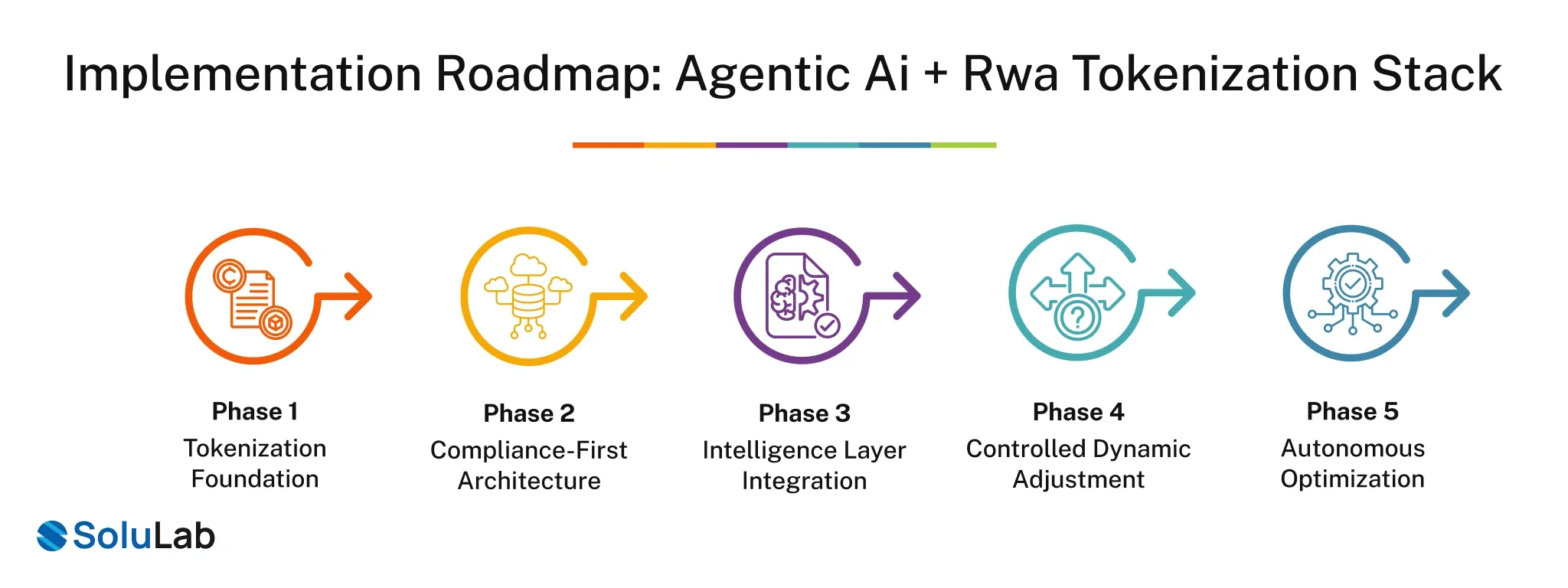
Phase 1: Tokenization Foundation
- Legal SPV structuring
- Real estate tokenization development platform deployment
- Static valuation logic
- Investor onboarding framework
Phase 2: Compliance-First Architecture
- On-chain KYC enforcement
- AML integration
- Regulatory reporting dashboards
- Audit trail mechanisms
Phase 3: Intelligence Layer Integration
- Deployment of AI agents for real estate valuation
- Scenario modeling engines
- Supervised valuation monitoring
- Explainability modules
Phase 4: Controlled Dynamic Adjustment
- Threshold-based automated updates
- Smart contract valuation hooks
- Governance oversight workflows
Phase 5: Autonomous Optimization
- Adaptive yield distribution
- Risk-weighted liquidity management
- Continuous portfolio rebalancing signals
Each stage should be stress-tested before moving forward.
Conclusion:
Real estate has long been treated as static wealth, slow to price, slow to trade, slow to adapt.
The AI powered RWA tokenization development changes that structural reality.
When intelligent agents continuously interpret property performance and tokenized infrastructure reflects those insights within compliance guardrails, ownership evolves from fixed equity to living capital.
Dynamic equity is not about speed for its own sake.
It is about synchronization aligning property value, investor visibility, regulatory transparency, and capital allocation in real time.
For institutions willing to think infrastructure-first, the shift is not incremental.
It is architectural.
Frequently Asked Questions
Shipra Garg is a tech-focused content strategist and copywriter specializing in Web3, blockchain, and artificial intelligence. She has worked with startups and enterprise teams to craft high-conversion content that bridges deep tech with business impact. Her work translates complex innovations into clear, credible, and engaging narratives that drive growth and build trust in emerging tech markets.