Key Takeaways
- An AI phone ordering system for takeaways is a voice agent that answers your line, understands natural speech, takes the full order, and writes it straight into your POS — no phone tree, no hold music.
- It runs 24/7 and takes calls in parallel, so the orders your counter drops during a Friday rush stop walking down the street to a competitor.
- The loop is four parts: telephony (SIP/IVR) → speech-to-text (Whisper, Deepgram) → LLM-based NLU that maps speech to items and modifiers → POS write-back plus a spoken confirmation.
- Integration has two ends: your existing number routed to the agent, and a POS order API such as Square Orders or Lightspeed, with live menu sync so the AI never quotes a sold-out item or an old price.
- Treat advertised order-accuracy and ROI percentages as marketing claims until they are proven on your menu.
An AI phone ordering system for takeaways is a voice agent that answers your phone line, understands the caller in natural speech, takes the full order, and writes it straight into your POS. It runs 24/7, captures calls staff miss during a rush, confirms items back to the caller, and hands off to a person when a request falls outside its scope.
SoluLab builds custom voice ordering systems on the same speech and NLU stack the vendors use, tuned to your menu and phone setup. If you are weighing a packaged tool against a build, our AI development company team can scope either path for a single site or a franchise group.
What is an AI phone ordering system for takeaways, and why are Australian operators adopting it?
An AI phone ordering system is software that answers the takeaway phone, listens to the caller, and turns spoken requests into a structured order in your POS. It replaces the queued hold music and the “can you hold” that loses hungry callers. Adoption is rising in Australia because phone orders still convert well, but a busy Friday counter cannot answer every ring.
The pull for operators is simple. Every unanswered call at peak is a lost basket that often goes to a competitor down the strip. A voice agent answers on the first ring, takes orders in parallel, and never puts a caller on hold to cut vegetables. For a single-site fish-and-chip shop or a multi-site pizza group, the value sits in recovered calls and freed-up counter staff.
What it does, in plain terms:
- Answers inbound calls instantly, day or night.
- Takes the order in natural language, not a rigid phone-tree menu.
- Reads back the order and total to confirm.
- Pushes the order to the POS and kitchen display.
- Escalates to a human for anything it cannot handle.
Who are the AI phone ordering competitors serving Australian takeaway?
The market splits into three groups: voice-first receptionist tools built for restaurants, broader ordering platforms that added a voice channel, and custom builds. Below is a category map. Specific vendor claims (AU presence, exact POS support) change often, so confirm each against the vendor before you decide.
| Category player | Focus | POS integration | AU presence | Build or buy |
|---|---|---|---|---|
| Voice-first receptionist tools | Takeaway and fast-food call answering | Varies; check per vendor | [VERIFY per vendor] | Buy |
| Ordering platforms with voice add-on | Online + phone ordering in one dashboard | Own POS or connectors | [VERIFY per vendor] | Buy |
| Drive-thru voice AI | Quick-service drive-thru lanes | Enterprise POS | [VERIFY per vendor] | Buy |
| Custom voice agent (e.g. SoluLab) | Your menu, your phone, your POS | Any POS with an API | Delivered globally | Build |
Named AU-facing vendors in this query’s search results include Alayic, MyFoodFast, and platforms such as Flipdish and Foodhub for online ordering.
How does an AI phone ordering system actually work?
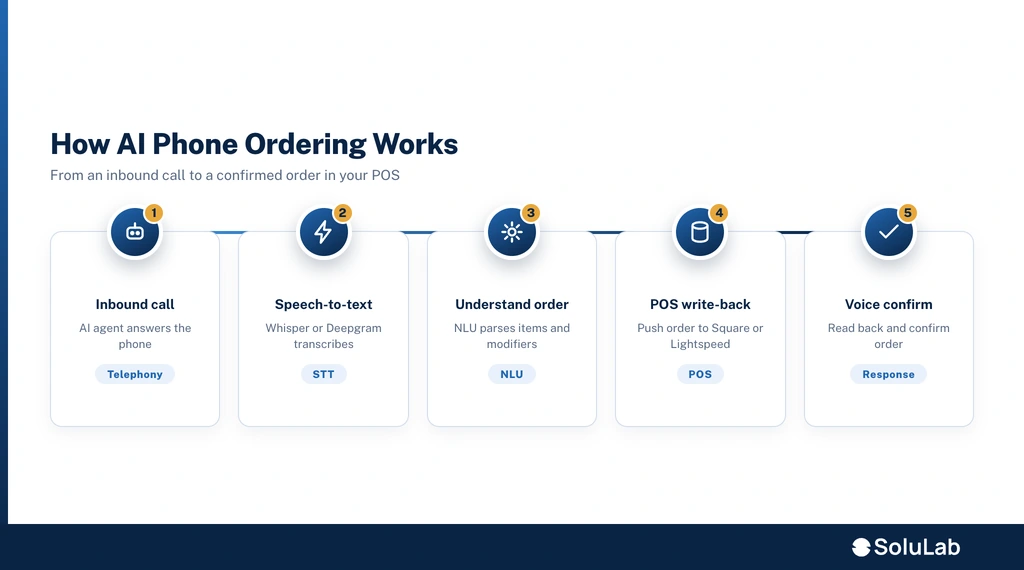
An AI phone ordering system chains four steps: telephony brings the call in, speech-to-text turns audio into words, natural language understanding turns words into an order, and the system writes that order back to your POS and speaks a confirmation.
- Telephony. The call arrives over a phone number routed through a SIP or IVR layer, so the AI answers instead of ringing the counter.
- Speech-to-text. The caller’s audio is transcribed in real time. Whisper is an automatic speech recognition system OpenAI trained on 680,000 hours of multilingual audio, and its open-source model is a common choice for accuracy. For low-latency streaming, engines like Deepgram’s real-time speech-to-text API transcribe audio as the caller speaks.
- Natural language understanding. An NLU layer, usually an LLM, maps the transcript to menu items, sizes, modifiers, and quantities, and asks a clarifying question when something is ambiguous.
- POS write-back and voice response. The structured order is sent to the POS, and a text-to-speech voice reads the order and total back for confirmation before the kitchen sees it.
The whole loop runs in seconds so the caller experiences a normal conversation, not a lag-filled robot exchange.
How does an AI phone ordering system integrate with your POS and phone system?
Integration happens over two connections: the phone system that delivers the call and the POS API that receives the order. On the telephony side, a SIP trunk or IVR routes your existing number to the voice agent, so customers keep dialing the same number.
On the POS side, the agent uses the vendor’s order API. Square exposes an Orders API that records line items, calculates totals, and tracks fulfillment, which lets a voice agent create a real order rather than an email to the counter. Lightspeed publishes a restaurant POS API for the same purpose. Both are common in Australian venues.
What the integration has to handle:
- Menu sync: pull the live menu so the AI never quotes a sold-out item or an old price.
- Modifiers: “no onion,” “extra cheese,” “gluten-free base” map to the correct POS modifiers.
- Upsells: offer a drink or side at the right moment, if you want that behavior.
- Order routing: send the order to the kitchen display or ticket printer, not just a screen.
If your POS lacks a clean API, a custom build can bridge it, which is one reason some operators build rather than buy.
What does an AI phone ordering system cost, and what is the ROI for a takeaway?
Pricing models split into monthly subscription, per-order or per-minute usage, and one-time build cost for a custom system.
The ROI case for a takeaway rests on three levers rather than the sticker price:
- Recovered calls. Every missed peak-hour call is a lost order. If the agent answers calls staff would have dropped, it pays for itself on volume alone.
- Labor. Staff stop stopping to answer the phone mid-service, so counter and kitchen throughput improves.
- Accuracy. A confirmed, structured order reduces wrong tickets and remakes.
Some vendors advertise very high order-accuracy figures. Treat any specific accuracy or ROI percentage as a marketing claim until proven on your menu.
Should an Australian takeaway operator build or buy?
Buy if you run a single site, want to launch in days, and your POS is on Square or Lightspeed with a supported connector. A packaged tool is cheaper to start and needs no engineering. Build if you run multiple sites or a franchise, have an unusual POS, or want full control over the voice, upsell logic, and data.
| Decision factor | Lean buy | Lean build |
|---|---|---|
| Sites | Single location | Multi-site or franchise |
| POS | Square, Lightspeed, common connector | Legacy or bespoke POS |
| Menu | Standard, stable | Complex, frequent changes, custom logic |
| Data control | Fine with vendor’s platform | Need to own the data and model |
| Timeline | Launch this week | Can invest in a tailored rollout |
| Budget shape | Monthly opex | Upfront build, lower per-order cost at scale |
At higher order volume, a per-order fee can outrun the cost of owning the system. That crossover, plus the need to fit an unusual stack, is where a custom build like SoluLab’s makes sense. Bring your real numbers and we will size both options honestly.
What are the main challenges (accents, noise, menu complexity) and how are they solved?
The hard parts of phone ordering are accents, background noise, ambiguous menu items, and knowing when to hand off to a human. Each has a practical fix.
- Accents. Australian speech, plus the many accents of AU customers, can trip a generic model. The fix is choosing a speech engine with strong multilingual training and tuning it on real call recordings from your venue.
- Background noise. A kitchen fryer and a queue are loud. Noise-resistant ASR and confirmation read-backs catch errors before the order reaches the kitchen.
- Menu complexity. “The usual,” half-and-half pizzas, and combo swaps confuse rigid systems. An LLM-based NLU handles free-form phrasing and asks a targeted clarifying question instead of guessing.
- Fallback. When confidence drops, the agent escalates the call to a staff member or takes a callback number, so no order is lost to a confused bot.
SoluLab’s voice engineering practice tunes ASR and NLU on venue-specific recordings for accent and menu accuracy. Our approach to voice AI agent development covers this architecture end to end.
How would you build a custom AI phone ordering system?
Building a custom system follows a clear path: connect the phone, transcribe, understand, write to POS, then harden. It is the same loop the vendors use, built to your menu.
- Route the number. Point your existing line to a SIP or IVR endpoint the agent controls.
- Add speech-to-text. Wire in an ASR engine such as Whisper or Deepgram, tuned for your accents and noise.
- Build the NLU. Use an LLM to map speech to menu items, modifiers, and quantities, with clarifying prompts.
- Integrate the POS. Create real orders through the Square, Lightspeed, or your POS API, with live menu sync.
- Add confirmation and fallback. Read the order back, and escalate to a human on low confidence.
- Test on real calls. Measure answered-call rate and order accuracy against live traffic, then tune.
This is standard conversational AI engineering applied to the phone channel. For teams that want an autonomous agent rather than a scripted flow, SoluLab’s AI agent development company practice and our conversational AI consulting services cover design, build, and rollout. The underlying speech and NLP models draw on the same machine learning development work behind our other AI systems.
FAQs
Chintan leads SoluLab's highest-level AI consulting conversations, assessing whether a client's business problem actually justifies an AI investment before any solutioning begins.