A lot of businesses struggle to turn online visitors into paying customers, and text search is a big part of why. When someone can’t put into words what they’re actually looking for, they get stuck typing guesses into a search box and hoping something matches.
That friction costs real money: lost sales, abandoned carts, fewer completed interactions. Shoppers give up fast when they can’t see the product they have in mind, or can’t describe it well enough in words to find it.
AI development solutions for Visual Search flip that experience around, letting users search with an image instead of a sentence. Visual search drives up to ~27% higher conversion rates on e-commerce platforms, according to aggregated Statista data.
With accurate recognition of objects, styles, and features, businesses can surface results that actually match what someone’s looking for, cut friction out of the search process, and see real gains in conversions, satisfaction, and sales.
Key Takeaways
- The Problem: When customers don’t know the exact name of what they want, they struggle to find it, and that means less engagement, more abandoned carts, fewer sales.
- The Solution: AI-powered visual search lets customers upload or snap a photo and find matching or similar products instantly, which boosts discovery, engagement, and sales.
- How SoluLab Helps: For Visual Search, SoluLab builds custom image recognition models, integrates them with e-commerce systems, and fine-tunes search algorithms, work that’s pushed conversion up by 50% in practice.
What is AI in Visual Search?
AI in Visual Search means using artificial intelligence, specifically computer vision and deep learning, so systems can search, recognize, and retrieve information from images instead of text.
The user doesn’t type keywords. They upload or snap a picture, and the AI reads the visual details, shapes, colors, patterns, objects, context, to find similar or related results.
How AI in Visual Search Technology Works?
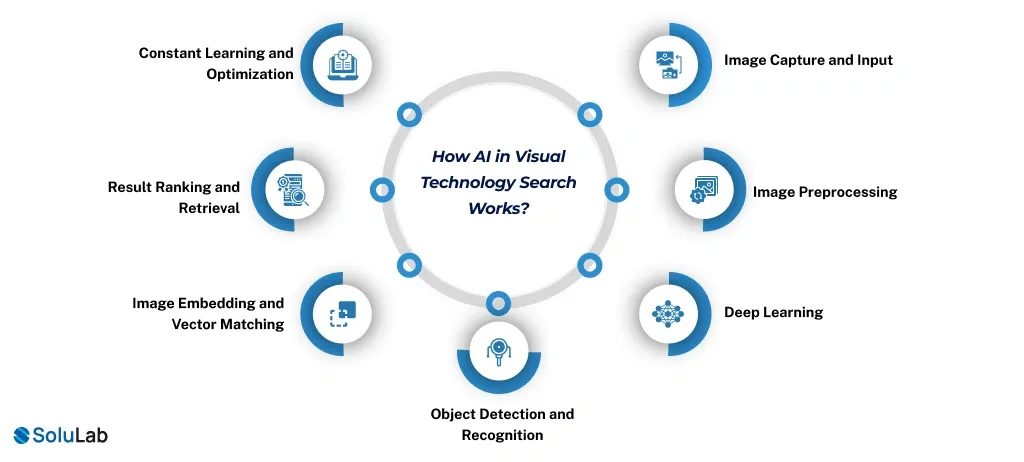
Visual search powered by AI integration services lets computers read images the way people do, analyzing visual patterns and objects to give accurate answers to a query without needing typed text at all.
- Image Capture and Input: It starts when a user uploads or captures an image. The system accepts pretty much any format and pre-processes it, resizing and normalizing before analysis begins.
- Image Preprocessing: The AI cleans up the image, adjusting brightness, cutting noise, normalizing sizes. That consistency is what lets deep learning models extract accurate, meaningful visual features.
- Deep Learning Feature Extraction: Convolutional Neural Networks pull out the shapes, colors, and textures in the image and convert that visual data into mathematical form, what’s called feature vectors.
- Object Detection and Recognition: The AI identifies specific objects or parts of the image, clothes, furniture, animals, landmarks, to understand what’s actually in the picture and what it means.
- Image Embedding and Vector Matching: The system turns those extracted features into numeric embeddings and compares them against known image vectors in a database to judge similarity and relevance.
- Result Ranking and Retrieval: Matching images or related products get ranked by similarity score, context, and user intent, so the most useful matches surface first.
- Constant Learning and Optimization: The model keeps improving over time, getting more accurate as it learns from user interactions, clicks, and feedback.

How to Implement AI for Visual Search?
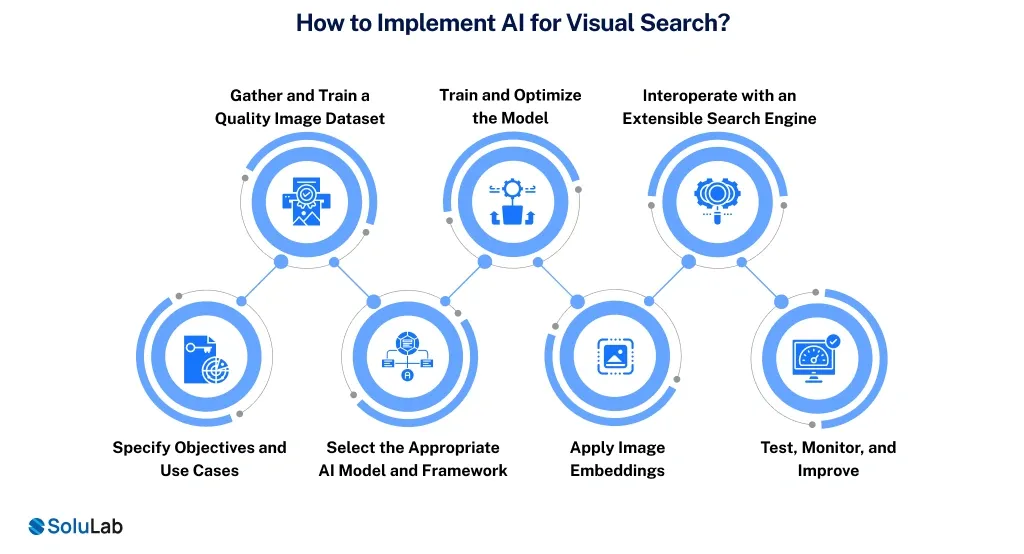
AI-powered visual search is changing how people see and decide. Here’s how you can actually implement it in your business:
Step 1. Specify Objectives and Use Cases
Nail down the main goal first, product discovery, object recognition, or similarity matching. AI Use cases spell out what you need from the dataset, how complex the model should be, performance targets, and the integration plan.
Step 2. Gather and Train a Quality Image Dataset
Collect a well-labeled mix of images that reflect real-world scenarios. Normalize, scale, and clean the data to boost precision, cut bias, and help the model generalize.
Step 3. Select the Appropriate AI Model and Framework
Train deep learning models like Convolutional Neural Networks using frameworks such as TensorFlow or PyTorch. Working off existing model instances cuts development time and boosts performance.
Step 4. Train and Optimize the Model
Train the model on labeled images, test how it performs, and tune the hyperparameters. Data augmentation and transfer learning help push accuracy up and overfitting down.
Step 5. Apply Image Embeddings
Turn images into numeric vectors of visual features. Store those embeddings in a search index so they can be compared for similarity and retrieved quickly.
Step 6. Interoperate with an Extensible Search Engine
Use a search engine or vector database to match query images against stored embeddings. Real-time performance matters here: low latency, room to scale, efficient indexing.
Step 7. Test, Monitor, and Improve
Measure performance on precision and recall. Watch how users actually behave, retrain the model periodically, and keep the datasets updated so results stay accurate and relevant.
Top Brands Winning with AI-Powered Visual Search
1. Myntra: With Myntra’s visual search, shoppers upload a photo of clothing or accessories they like, and the AI instantly finds comparable products from Myntra’s catalog. Its “My Stylist” tool goes further, suggesting whole outfits so customers can put together a complete look without hunting piece by piece.
2. H&M: The H&M app’s visual search lets customers snap a photo of clothing they spot in-store, online, or in their own gallery, then find related products. No written description needed, the AI matches the photo against H&M’s catalog in seconds.
3. Google Lens: Launched in 2017, it’s a widely used visual search tool built into various Android apps. It handles advanced visual search well, and users can move between apps without friction. A 2019 study found Google Lens had more accurate image recognition than other major visual search platforms at the time.
4. Snapchat Camera Search: Introduced in 2018, it lets users search for Amazon products by scanning barcodes. Once it detects a barcode, users get an Amazon card linking to that product or similar ones. The Snapchat-Amazon partnership makes the shopping loop that much shorter.
5. Amazon StyleSnap: Launched in 2019, this visual search tool integrates with Instagram. Users photograph a product they want within Amazon’s app, and StyleSnap surfaces relevant info and similar products. For sellers, it’s another channel to reach shoppers in a crowded market.
AI In Visual Search: Real-Life Use-Cases
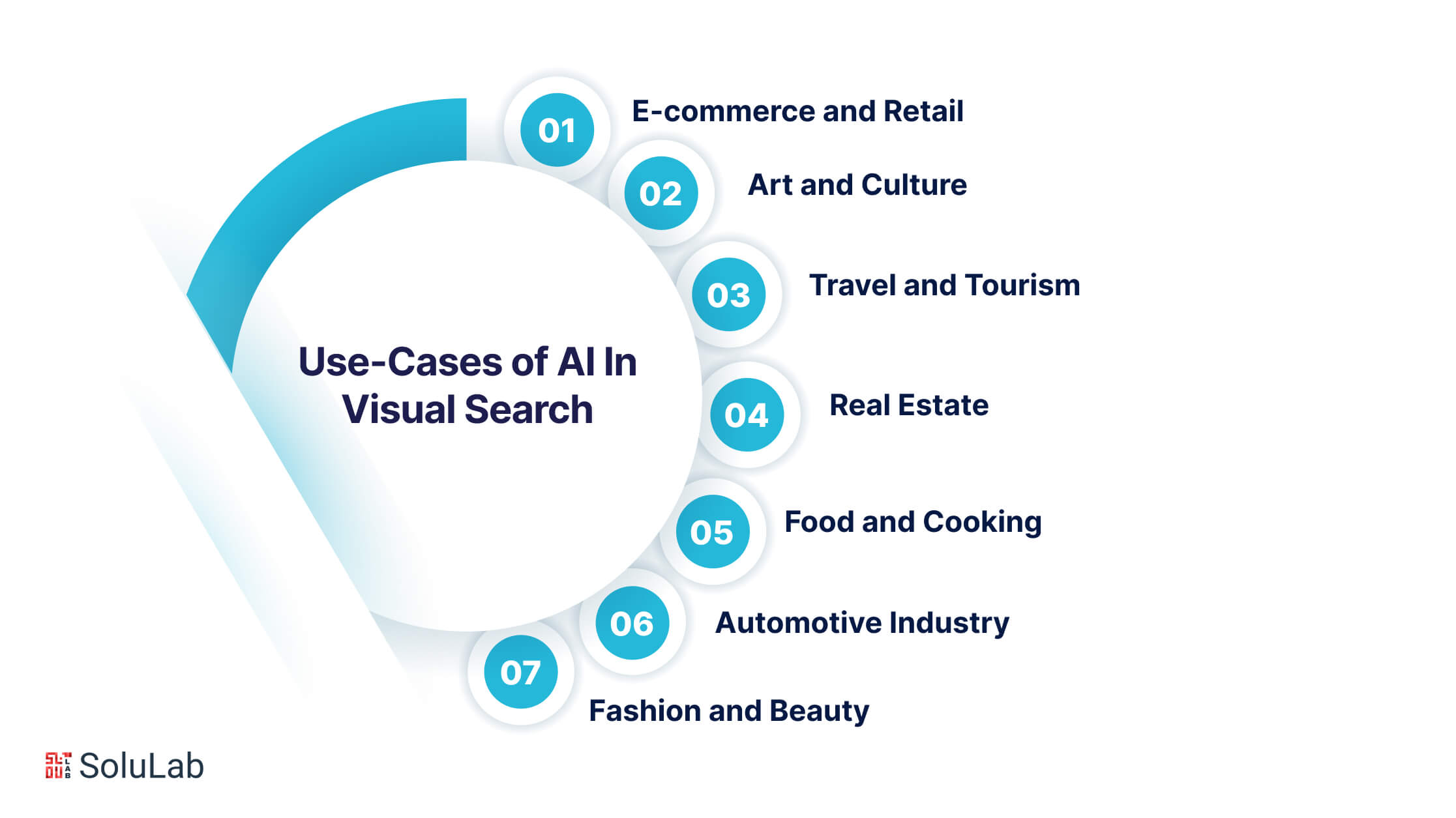
1. E-commerce and Retail
- Product Discovery: Shoppers snap a photo and the system finds similar products from a huge catalog almost instantly. No more guessing at search terms, just point and find.
- Outfit Matching: Upload a photo of an outfit and get suggestions for similar clothing and accessories. Recreating a look you saw somewhere stops being guesswork.
- Home Decor: Snap a photo of furniture or decor you want, and the system finds matching items online, a fast path from “I like this” to “I can buy this.”
2. Art and Culture
- Artwork Identification: Snap a photo of a painting or sculpture and the system pulls up the artist’s name and historical context right away, no plaque required.
- Museum Tours: Visitors photograph artworks or artifacts and get relevant information instantly, adding real depth to how they understand what they’re looking at.
3. Travel and Tourism
- Landmark Recognition: Travelers photograph a landmark and get details and historical context on the spot. AI in travel and tourism industry deepens the trip itself, connecting people to the history and culture around them.
- Translation and Localization: Visual search helps with translation too. Photograph a foreign sign or document and get an accurate translation back, which makes navigating unfamiliar places a lot less stressful.
4. Real Estate
- Property Search: Visual search changes how people hunt for homes. Buyers photograph houses or neighborhoods and get property listings back fast, cutting a lot of the search time out.
- Interior Design: Visual search helps people furnish a space by offering tailored furniture and decor suggestions, turning “what would work here” into an actual answer.
5. Food and Cooking
- Nutritional Analysis: Photograph a meal and visual search estimates its nutritional content, giving people something concrete to work with when they’re tracking what they eat.
- Grocery Shopping Assistance: Build a visual shopping list by photographing items, and the system identifies each one, making the actual store trip faster.
6. Automotive Industry
- Car Recognition: Visual search makes car shopping faster. Photograph a vehicle and get make, model, features, and pricing back, enough to make a real decision.
- Parts Identification: For automotive maintenance, visual search identifies car parts accurately, which speeds up sourcing replacement parts for mechanics and enthusiasts alike.
7. Fashion and Beauty
- Cosmetic Recommendations: Take a selfie and get product recommendations tailored to complexion, style, and preferences, personalized beauty shopping without the guesswork.
- Hairstyle Ideas: Upload a photo and get style suggestions based on your hair type and face shape, a genuinely useful way to explore new looks before committing.
Future Of AI In Visual Search
AI-powered visual search is changing how we interact with images, and how we discover, shop, and recognize things is getting faster, smarter, and more intuitive across every industry it touches.
1. Smarter Object Recognition: AI will recognize objects, scenes, and patterns at a near-human level, enabling more accurate searches, sharper personalized recommendations, and faster access to them in real time.
2. E-commerce Integration: AI visual search will let users find a product instantly from an image, improving the shopping experience, cutting search friction, and lifting conversion rates for retailers.
3. Increased Contextual Knowledge: Advanced AI models will understand not just objects but context, relationships, and aesthetics too, opening doors in design, education, and AR experiences.

Conclusion
AI in Visual Search is changing how companies connect with customers, and it delivers a more engaging experience that translates directly into more conversions.
Letting people search with images instead of text closes the gap between what someone wants and what they can actually find, cutting friction out of the buying process.
AI in e-commerce, fashion stores, and consumer brands are already putting this to work, personalizing recommendations, speeding up product discovery, and lifting user satisfaction.
As the technology keeps advancing, AI-powered visual search isn’t just improving sales, it’s building brand loyalty too, and that combination is what puts businesses ahead of their competition.
SoluLab, an AI development company, can help you put AI to work in your business to grow sales. Book a free consultation call today!
FAQs
Neha is a curious content writer with a knack for breaking down complex technologies into meaningful, reader-friendly insights. With experience in blockchain, digital assets, and enterprise tech, she focuses on creating content that informs, connects, and supports strategic decision-making.