Key Takeaways
- Three sourcing models exist for an AI engineering team—in-house, a dedicated remote team, or a project-based partner—and each trades cost against speed and control differently.
- HealthTech, PropTech, and InsurTech share the same core AI stack: a data pipeline, a model or LLM, retrieval over private documents, and production monitoring. Only the compliance load changes by vertical.
- A working AI team needs six roles: machine learning engineer, LLM/GenAI engineer, MLOps engineer, data engineer, AI solution architect, and product plus QA.
- Cost and timeline depend on seniority, model complexity, integrations, and compliance work—treat any single figure as project-specific, not a quote.
- Australian builds must plan for the Privacy Act 1988 nationally, APRA CPS 234 for regulated financial and insurance entities, and extra health-data duties for HealthTech.
- Match the model to the company stage: a partner for a first build, a dedicated remote team for an ongoing roadmap, and in-house once the roadmap is mature and durable.
Australian health tech, prop tech, and InsurTech companies build AI engineering teams in three ways: hire an in-house team, engage a dedicated remote AI team, or use a project-based development partner. In-house gives the most control at the highest cost and slowest ramp. A dedicated remote team balances speed and control. A partner is fastest for a first build.
Most searches for the top AI development companies in Australia end at a directory of agency names. The harder question sits underneath: who actually builds and staffs the AI work once you pick someone. SoluLab is an AI development company that supplies dedicated AI engineers and full delivery pods for regulated Australian builds. If you want an outcome rather than a ranked list, our AI development company team scopes the build and staffs it.
What Do HealthTech, PropTech, and InsurTech Companies in Australia Actually Build With AI?
Across the three verticals, the common AI builds clusters into four groups: document and claims processing, risk and pricing models, valuation and search, and support copilots grounded in private data. The vertical changes the data and the compliance load, not the underlying engineering.
1. HealthTech
Clinical document extraction, patient triage and intake assistants, appointment and referral automation, and predictive models for readmission or no-show risk. Any patient-data build carries heavy privacy obligations.
2. PropTech
Automated property valuation models, listing and search ranking, document parsing for contracts and leases, and lead scoring for agents.
3. InsurTech
Claims triage and fraud detection, underwriting and pricing models, policy-document question answering, and support copilots for brokers.
The specifics differ by client, but the pattern doesn’t: a healthtech intake bot and an insurtech claims classifier share most of their stack—a data pipeline, a model or an LLM, retrieval over private documents, and monitoring in production.
Why Group HealthTech, PropTech, and InsurTech Together?
All three are data-heavy, regulated, and buy the same core AI roles, so the hiring playbook is largely shared. A PropTech valuation model and an InsurTech pricing model are both supervised learning problems on tabular and document data. A HealthTech intake assistant and an InsurTech policy copilot are both retrieval-augmented LLM systems. The engineer who ships one can ship the other with domain context.
What differs is the risk surface. HealthTech touches health information. InsurTech and any APRA-regulated entity carry sector security duties. PropTech handles financial and identity data in transactions. So the team composition stays constant while the compliance and data-governance work scales up. That shared core is exactly why a single hiring model works across the three and why you do not need three separate AI teams to cover them.
What Are the Three Ways to Build an AI Engineering Team?
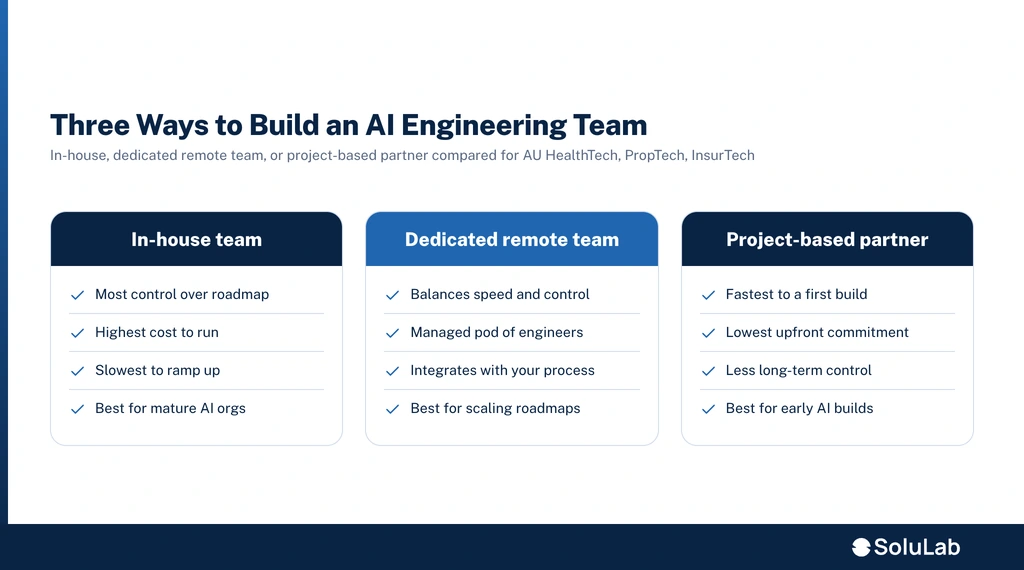
There are three sourcing models: an in-house team you recruit and employ, a dedicated remote AI team that works as a managed pod on your roadmap, or a project-based partner who delivers a defined build. Each trade costs against speed and control differently.
1. In-House Team
You recruit, hire, and manage every engineer directly. Maximum control, at the highest cost and the slowest ramp.
2. Dedicated Remote AI Team
A managed pod works your roadmap and joins your process. This is where most scaling companies land, because you keep the backlog and the process while someone else carries recruiting and bench.
3. Project-Based Partner
A vendor delivers a defined build end-to-end. Fastest route to a working first system, with less ongoing control since the partner owns delivery.
The honest trade-off: in-house maximizes control, but you carry the recruiting risk and the ramp time. A partner ships fastest, but you depend on their process and a clean handover. A dedicated remote team sits in the middle, balancing both.
based partner—showing cost, speed, and control trade-offs
What Roles Does an AI Engineering Team Need?
A working AI team is not one “AI engineer.” It is a small cross-functional group. For most HealthTech, PropTech, and InsurTech builds, you need six roles, though one senior person often covers two early on.
1. Machine Learning Engineer
Builds and trains models (risk, pricing, valuation, classification) and ships them to production.
2. LLM / GenAI Engineer
Builds retrieval-augmented assistants and copilots, and handles prompting, grounding, and hallucination control.
3. MLOps Engineer
Owns the deployment pipeline, monitoring, retraining, and infrastructure. An MLOps engineer merges software engineering, data engineering, and AI operations so models keep running after launch, per Boston University’s engineering school. IBM defines MLOps as the practices that turn model building into a repeatable assembly line.
4. Data Engineer
Builds the pipelines that feed models and enforces data quality and access controls.
5. AI Solution Architect
Designs the system, picks the model and vendor stack, and owns non-functional needs like security and cost.
6. Product and QA
A product owner sets priorities and a QA engineer tests model outputs, not just code paths.
If you engage a dedicated team, you get these roles as a pod. Our machine learning development and generative AI development practices map directly onto the ML-engineer and LLM-engineer roles above.
How Much Does Each Option Cost, and How Fast Can It Ship?
Cost and timeline vary widely by seniority, scope, and vertical, so treat any single figure as project-specific rather than a quote. The drivers that move the number most are team seniority, model complexity (a tabular risk model is cheaper than a multi-agent copilot), the number of integrations, and the compliance work a regulated build demands.
1. In-House
Highest total cost once you count salaries, benefits, recruiting, and management, plus the slowest start, since hiring senior AI engineers in Australia takes time and the market for MLOps and LLM specialists is tight.
2. Dedicated Remote Team
A managed monthly cost per pod, faster to stand up because the people already exist and are matched to the role before day one.
3. Project Partner
A scoped fee for a defined deliverable—the fastest route to a working first build.
| Model | Typical Cost | Speed to Start | Control | Main Risk | Best For |
| In-house team | Highest (salaries, benefits, ramp) | Slowest (hiring takes months) | Highest | Hiring miss, key-person dependency | Mature AI orgs with a long roadmap |
| Dedicated remote AI team | Middle (managed monthly pod) | Fast (weeks) | High (your process, your backlog) | Vendor fit, data-residency setup | Scaling teams with ongoing AI work |
| Project-based partner | Variable, scoped fee | Fastest for a first build | Lower (partner owns delivery) | Scope drift, handover gaps | First AI build or a bounded project |
For a grounded view of what drives the total, our AI development cost guide breaks down the hidden line items most teams miss. To get an accurate figure, talk to SoluLab with your use case and vertical.
What Australian Data and Regulatory Rules Should You Plan For?
Plan for two things: general privacy obligations and sector-specific rules. Confirm the specifics with legal counsel, because the detail changes by entity type and by what data you touch.
1. Privacy Act 1988
The federal law governing how organizations handle personal information in Australia. It sets out the Australian Privacy Principles that cover collection, use, storage, and disclosure of personal data, as described in the overview of the Privacy Act 1988. Any AI system that processes personal or health information falls under it, so confirm the current obligations with legal counsel before you design the data flow.
2. APRA CPS 234
For regulated financial and insurance entities: the Australian Prudential Regulation Authority’s information security standard. It requires regulated institutions to define information-security roles and responsibilities and to maintain security capability, per Microsoft’s APRA compliance summary. InsurTech companies that are APRA-regulated should design their AI data handling around it—confirm applicability with your compliance team early, since it shapes the architecture.
3. Sector and Health Data Rules
HealthTech builds carry additional health-information duties on top of the Privacy Act. The specific state and federal rules vary by data type and entity, so this is worth confirming with counsel before scoping the build.
The practical takeaway: a regulated AU build adds data residency, access control, and audit work on top of the model. That work is real engineering time, and it is one reason the “just hire one AI engineer” plan tends to stall.
How Do You Choose the Right Model for Your Stage?
Match the sourcing model to your company stage and your AI roadmap. The decision tree is short.
1. Early or First AI Build
Favor a project-based partner. You get a working system fast without committing to headcount before you know the roadmap.
2. Scaling With an Ongoing Roadmap
Favor a dedicated remote AI team. You keep the backlog and process, get a stable pod, and avoid the recruiting drag.
3. Mature AI Org With Continuous, Deep Work
In-house starts to justify its cost, often alongside a remote team for surge capacity.
A useful test: if you cannot yet write a twelve-month AI roadmap, you are not ready to hire in-house, because you will be paying senior salaries during discovery. Start with a partner or a dedicated pod, learn what you actually need, then bring the durable roles in-house once the work is steady.
How Does a Dedicated Remote AI Team Work in Practice?
A dedicated remote AI team is a managed pod of AI engineers integrated with your process, blending the speed of staff augmentation with the ownership of a product team. You bring the roadmap and priorities. The vendor brings a matched, pre-vetted pod and runs the day-to-day.
In practice it looks like this: you define the build and the roles, the vendor assembles a pod (for example, an ML engineer, an LLM engineer, and an MLOps engineer), the pod joins your standups and tools, and they ship against your backlog. You keep product control. The vendor carries recruiting, bench, and replacement risk. For regulated data, the pod works inside your access controls and data-residency setup rather than pulling data out.
This is the model most scaling Australian companies use, because it avoids both the slow ramp of in-house and the handover gaps of a one-off project. You can hire a high-performance remote team or hire dedicated AI developers as a pod, and scale it up or down as the roadmap changes.
Where Does an Enterprise Build Differ?
Enterprise AI programs add governance, integration depth, and scale that a single-team build does not. You are wiring models into core systems, meeting internal risk and audit standards, and often running several models across business units at once.
At that size the sourcing question shifts from “one team or one partner” to “how do we run a portfolio.” Many enterprises keep an in-house core for strategy and governance, then use a dedicated remote team for delivery capacity. Our enterprise AI development company practice is built for that pattern: governed delivery at scale, integrated with existing systems and controls.
What Does the Australian AI Adoption Picture Look like?
Adoption is real but uneven, which is why the hiring decision matters now. Deloitte’s Australian survey found that 65% of Australian respondents intended to raise AI investment in the year ahead, below the 84% figure globally, per Deloitte’s State of AI report for Australia. That gap says two things: interest is high, and Australian companies are being more deliberate about where AI investment goes.
For HealthTech, PropTech, and InsurTech specifically, the practical read is that the teams who move first on a focused, compliant build get a lead while competitors are still scoping. You do not need a large program to start. You need one well-staffed team on one high-value use case.
Frequently Asked Questions
Chintan leads SoluLab's highest-level AI consulting conversations, assessing whether a client's business problem actually justifies an AI investment before any solutioning begins.