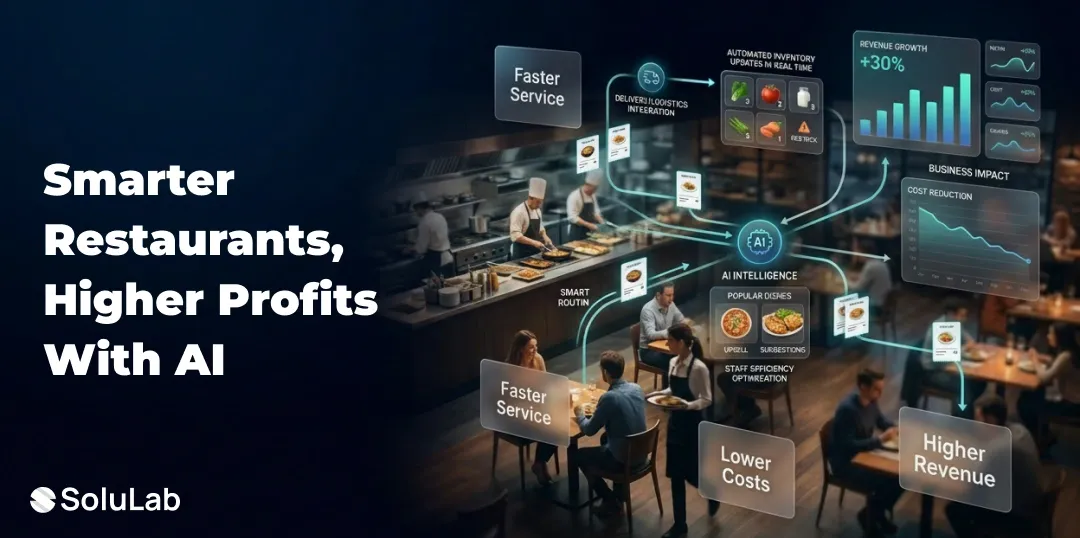
Running a restaurant today is not just about food. It is about speed, accuracy, and consistency across every order and interaction. Many restaurant businesses struggle with order errors, rising costs, wasted inventory, and missed revenue opportunities during peak hours.
These issues quietly impact margins and customer experience. Artificial intelligence is changing this by bringing real-time insights, automation, and smarter decision-making into daily operations.
From predicting demand to improving order accuracy and personalizing customer interactions, AI development solutions help restaurants operate more efficiently while increasing revenue. For restaurant owners and operators, this is not about replacing people but about building a system that works smarter, faster, and more profitably at scale.
Key Takeaways
- The problem: Restaurants struggle with slow service, food wastage, wrong demand planning, and high operational costs, making it harder to deliver consistent customer experiences and maintain healthy profit margins.
- The solution: AI helps predict demand, automate ordering, personalize menus, and optimize kitchen workflows, allowing restaurants to serve faster, reduce waste, and make smarter daily decisions without guesswork.
- How SoluLab helps: SoluLab is an AI-native company use AI in our own workflows to build solutions faster and at lower cost, helping restaurants adopt practical AI tools without heavy complexity or long timelines.
Why Should Restaurants Use Artificial Intelligence?
Restaurants operate in environments where speed, accuracy, and personalization directly impact revenue, making AI a practical tool for improving operations, customer experience, and consistent business growth. 69% of restaurants are already adopting AI technologies to improve operations and customer engagement.
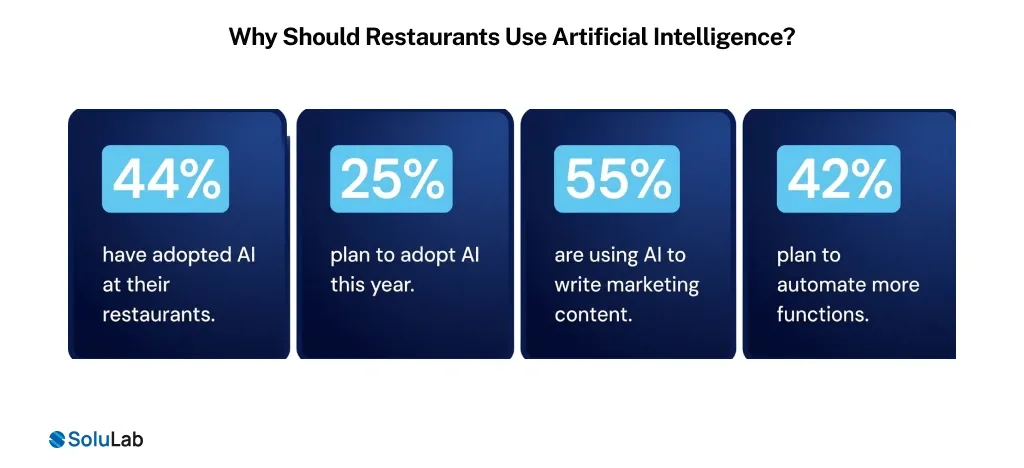
- Order inaccuracies and revenue loss: Manual order handling and communication gaps lead to frequent errors, missed items, and refunds, directly impacting customer satisfaction and reducing overall revenue potential across dine-in, takeaway, and delivery channels.
- Lack of real-time demand forecasting: Traditional systems fail to predict customer demand accurately, causing over-preparation or stockouts, resulting in food wastage, lost sales opportunities, and inefficient kitchen and staff utilization during peak and off-peak hours.
- Inefficient inventory management: Without AI-driven tracking, restaurants struggle with ingredient-level visibility, leading to spoilage, overstocking, and inconsistent supply planning that directly affects cost control and operational efficiency.
- Limited personalization in customer experience: Generic menus and offers fail to engage customers effectively, reducing repeat visits and order value, as businesses miss opportunities to recommend relevant items based on individual preferences and behavior.
- Static pricing strategies: Fixed pricing models ignore demand fluctuations, location factors, and customer behavior, preventing restaurants from optimizing margins and maximizing revenue during high-demand periods or promotional campaigns.
- Manual marketing with low ROI: Traditional marketing lacks data-driven targeting, leading to ineffective campaigns, poor customer engagement, and wasted spend without measurable impact on conversions or retention.
- Limited visibility into business performance: Disconnected systems make it difficult to track real-time sales, customer trends, and operational metrics, limiting informed decision-making and slowing down business growth strategies.
Steps to Implementing AI in Your Restaurant
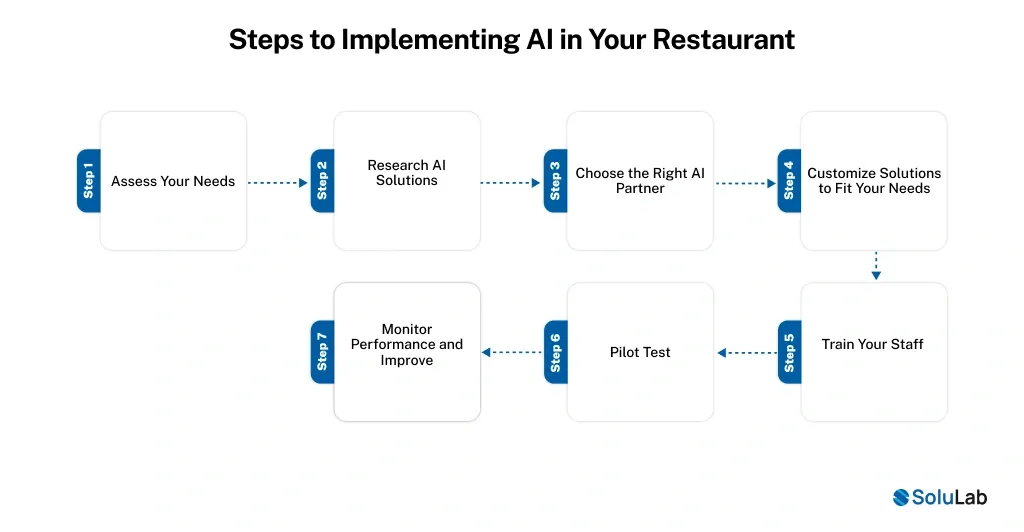
AI adoption in restaurants works best with a structured, step-by-step approach, ensuring technology aligns with operations, improves efficiency, and directly contributes to revenue growth and customer experience.
1. Assess Your Needs
Start by identifying operational gaps such as order inaccuracies, slow service, or inventory inefficiencies. Define clear business goals like improving turnaround time, increasing order value, or enhancing customer experience before implementing AI-driven systems.
2. Research AI Solutions
Explore available tools like artificial intelligence food ordering, predictive analytics, and automation platforms. Compare features, scalability, and integration capabilities to ensure the solution aligns with your restaurant’s size, service model, and long-term growth plans.
3. Choose the Right AI Partner
Select a technology partner experienced in AI integration services in the restaurant industry with proven deployment capabilities. Evaluate their expertise in integrations, customization, and ongoing support to ensure smooth implementation and long-term reliability.

4. Customize Solutions to Fit Your Needs
Adapt AI systems to your workflows, menu structure, and customer behavior. Whether implementing a recommendation engine or an AI phone ordering system, customization ensures better adoption, accuracy, and measurable business impact.
5. Train Your Staff
Equip your team with proper training to use AI tools effectively in daily operations. This includes understanding dashboards, handling automated systems, and resolving exceptions to ensure collaboration between human staff and AI systems.
6. Pilot Test
Run a controlled pilot in a single location or service channel to evaluate performance. Track key metrics like order accuracy, preparation time, and customer satisfaction before scaling AI implementation across the entire restaurant operation.
7. Monitor Performance and Improve
Continuously track system performance using real-time data and analytics. Optimize models, refine workflows, and update AI systems regularly to improve accuracy, efficiency, and overall impact on revenue and customer experience.
Read more: AI in Hospitality
8 Ways Artificial Intelligence Can Help Your Restaurant
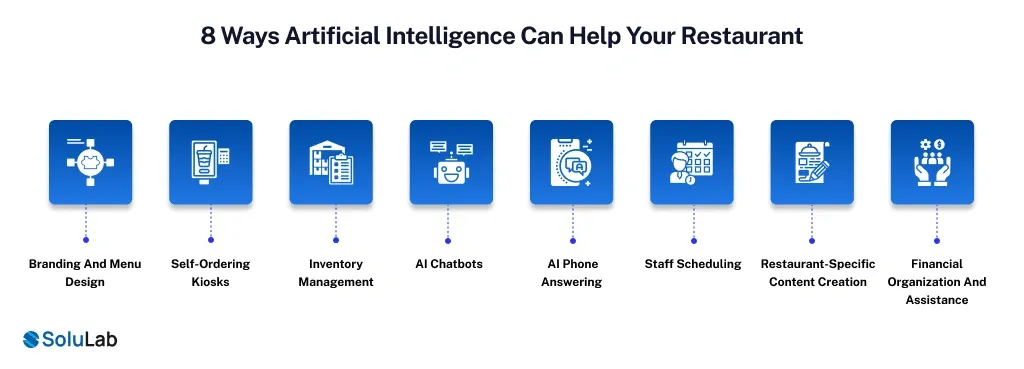
Artificial Intelligence is helping restaurants move faster, serve smarter, and operate with precision by combining automation, data insights, and personalization to improve customer experience while driving consistent revenue growth.
1. Branding and Menu Design
AI analyzes customer preferences, purchase history, and market trends to design high-performing menus and branding elements. It identifies best-selling items, suggests pricing strategies, and optimizes layout to influence buying decisions and improve overall conversion rates.
2. Self-ordering Kiosks
Self-ordering kiosks powered by AI food ordering streamline the ordering process, reduce queues, and minimize human errors. They also use AI to recommend add-ons and combos, increasing average order value while improving customer convenience and speed.
3. Inventory Management
AI-driven inventory systems track ingredient usage in real time and predict demand based on trends, seasonality, and sales data. This reduces food waste, prevents stockouts, and ensures efficient supply chain management for consistent restaurant operations.
4. AI Chatbots
AI chatbots integrated with artificial intelligence food ordering handle customer queries, take orders, and provide recommendations instantly. They operate 24/7, improving response time, enhancing customer engagement, and reducing dependency on manual support teams.
5. AI Phone Answering
An AI phone ordering system automates call handling, takes accurate food orders, and manages reservations without human intervention. It reduces missed calls, improves order accuracy, and ensures seamless customer interaction during peak hours.
6. Staff Scheduling
AI optimizes staff schedules by analyzing foot traffic patterns, peak hours, and historical demand. It ensures the right number of employees are available at the right time, reducing labor costs while maintaining service quality and operational efficiency.
7. Restaurant-specific Content Creation
AI tools generate personalized marketing content, including emails, social media posts, and promotions based on customer behavior. This helps restaurants run targeted campaigns, improve engagement, and maintain consistent brand communication without manual effort.
8. Financial Organization and Assistance
AI automates financial tracking, expense categorization, and revenue forecasting. It provides real-time insights into profitability, identifies cost-saving opportunities, and helps restaurant owners make data-driven decisions for long-term financial stability and growth.
Read More: AI Agents in the Hospitality Industry
What Role Does AI Play in Pricing for Restaurants?
AI enables restaurants to move beyond static pricing by adjusting menu prices dynamically based on demand, location, and behavior, helping maximize revenue while maintaining customer satisfaction and operational efficiency.
- Time-based pricing (peak vs non-peak): AI analyzes historical order volumes and peak-hour trends to adjust pricing dynamically, increasing margins during high demand while offering competitive pricing during off-peak hours to drive consistent sales.
- Location-based pricing strategies: AI evaluates location-specific demand, customer demographics, and purchasing behavior to tailor pricing across outlets or delivery zones, ensuring optimal pricing strategies aligned with local market conditions.
- Event-driven pricing adjustments: AI for demand forecasting identifies demand spikes during festivals, weekends, or local events and automatically adjusts pricing in real time, helping restaurants capitalize on high-demand periods without manual intervention.
- Margin optimization using data: AI processes cost inputs, ingredient pricing, and demand patterns to recommend optimal pricing that balances profitability and competitiveness, ensuring consistent margins across menu items and business cycles.
Conclusion
AI is reshaping how restaurants operate by turning everyday decisions into data-driven actions. From smarter ordering systems to predictive inventory and personalized customer experiences, it helps businesses improve efficiency while increasing revenue.
Restaurants that adopt AI are not just automating tasks; they are building scalable systems that adapt to changing customer behavior and demand patterns.
This shift creates a clear competitive advantage in a crowded market where speed, accuracy, and experience matter most.
If you are looking to implement these capabilities effectively, SoluLab, an AI development company can help your business design, build, and scale AI-driven restaurant solutions.
FAQs
Neha is a curious content writer with a knack for breaking down complex technologies into meaningful, reader-friendly insights. With experience in blockchain, digital assets, and enterprise tech, she focuses on creating content that informs, connects, and supports strategic decision-making.