Elections are becoming more complex every year. Voters are exposed to an overwhelming flow of information, misinformation spreads within minutes, and traditional campaign strategies struggle to keep pace with digital-first audiences. At the same time, governments must secure increasingly digital voting infrastructure while maintaining transparency and public trust.
This is where artificial intelligence is starting to reshape the electoral landscape. AI technologies can analyze massive datasets—from voter demographics to social media sentiment—helping campaigns understand public opinion faster and design more targeted outreach strategies.
Political analysis shows AI algorithms are being used to process massive voter datasets, including demographics and social media activity, to tailor messaging and improve targeting strategies. For election authorities, AI is also becoming a powerful tool to detect fraud, strengthen cybersecurity, and improve the efficiency of modern voting systems.
Key Takeaways
- The Problem: With increased challenges, elections are experiencing misinformation, excessive voter data, low participation, and cybersecurity threats. The request for massive real-time data streams is not easily understood through the traditional campaign methods.
- The Solution: Voting systems with AI enhance fraud detection, authentication, and reinforce cybersecurity. In elections, artificial intelligence allows an immediate analysis of the mood of voters and predicts their turnout.
- How SoluLab Helps: Architects win, grow, and mature AI-powered election and civic tech systems. Develops superior data analytics infrastructure on voter behavior and engagement insights. Creates a privacy-first, designed, and compliance-oriented framework for AI campaign intelligence tools.
How is AI being used to analyze voter behavior in elections?
The use of artificial intelligence is altering the perception and conduct of elections. Through the processing of large volumes of both public and digital data, analysts and campaigns are able to identify patterns in voter activity as quickly as possible, customize communications, and forecast the results more accurately than ever before.
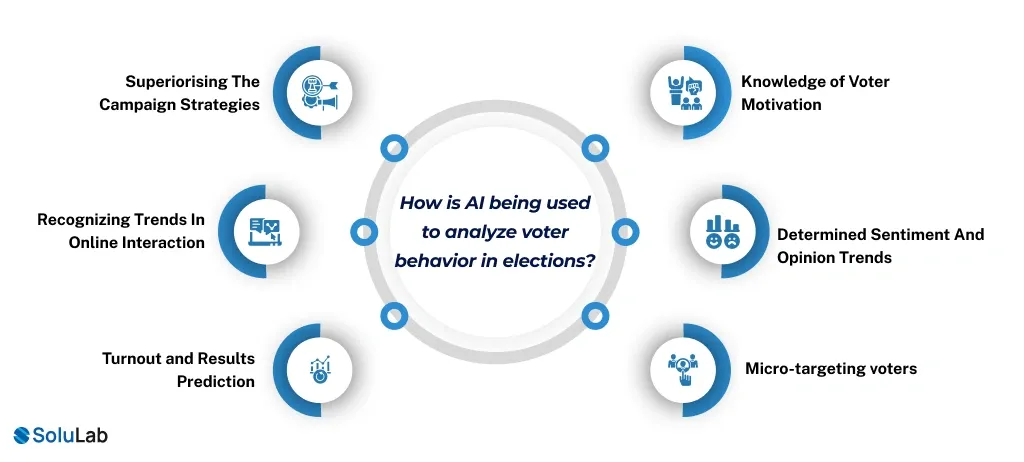
1. Knowledge of Voter Motivation
AI interprets demographic, social media, and online behavioral trends in order to find out why various categories of voters think in a given manner. This assists campaigns to target messages to issues that are most important to each of the audience segments.
2. Determined Sentiment And Opinion Trends
Machine learning technology is used to scan the literature in social sites and news to quantify a positive or negative emotion towards candidates, issues, and policies. This sentiment tracker in real time provides information on the way the opinion of the people is changing at a particular period in a campaign cycle.
3. Micro-targeting voters
Through the application of artificial intelligence in elections, the analysts divide large groups of people into smaller groups in terms of preferences and behavior. This will enable groups to target specific voter groups with custom messages, increasing their engagement and impacting their decision.
4. Turnout and Results Prediction
Intelligence models take into consideration historical turnout statistics, polling statistics, and current behavior to predict who is going to vote and the kind of vote they are likely to cast. Such forecasts aid in the distribution of resources in which they will be most effective.
5. Recognizing Trends In Online Interaction
The tools that are identified under AI in voting systems will be able to monitor the interaction of the voters with digital ads and posters of the campaign. The trends of this engagement data can be used to understand what motivates clicks, shares, or support, making further contact easier.
6. Superiorising The Campaign Strategies
Behavior analysis helps campaign teams to make on-the-fly refinements to messaging and strategy. This may involve modifying matters raised, tone, or delivery platforms to appeal to undecided or swing voters.

Global Regulations on AI in Electoral Processes
- US AI Governance Framework: The United States is currently undergoing a combination of executive measures, industry-specific regulations, and state-based legislation that seeks to provide a balance in the innovation and responsibility in technology that impacts essential processes, such as campaign communications.
- EU AI Act and Political Advertising Rules: The holistic AI Act by the European Union categorizes the systems according to the level of risks and seeks to regulate critical technologies and automating political information, establishing a precedent of safety and openness worldwide.
- New AI Election Policies in Asia and the Middle East: Several Asian and Middle Eastern countries are starting to consider AI governance, which integrates national interests, innovation objectives, and regulation, to handle the social and political impacts of AI.
Benefits of AI in Elections
AI integration solutions are transforming the manner in which elections are conducted, tracked, and planned quietly, assisting governments and political campaigns to become more efficient, secure, and engaging to voters in quantifiable aspects.
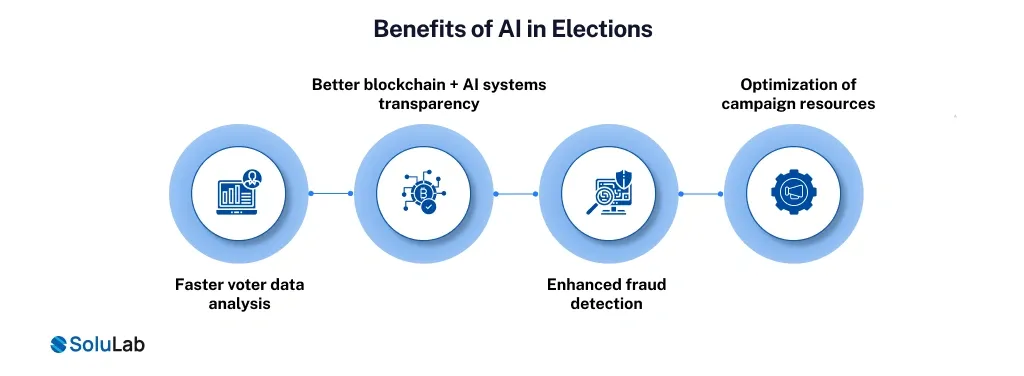
- Faster voter data analysis: The tools of AI election technology are advanced analytics devices that process voter data (in large numbers) in real-time, revealing patterns of turnout, demographic trends, and sentiment indicators (previously requiring weeks to reveal manually).
- Better blockchain + AI systems transparency: Having the AI and the voting systems connected to the blockchain ledgers will make the election records resistant to tampering, auditable, and more verifiable, making institutions more accountable and improving the trust the citizens have in the digital voting.
- Enhanced fraud detection: Machine learning systems identify abnormal voter behaviors, duplicates, robots, and suspicious ballots in real time, enabling the government to act proactively rather than react to the damage to the results.
- Optimization of campaign resources: By analyzing behavior and making predictions, the AI can be used in political campaigns to allocate funds and engage more people, with targeted outreach, volunteer organization, and message personalization, and not to spend the money in vain.
AI in Election Security and Fraud Detection
With the digitalization of democracies, the process of election security has become complicated. The use of AI in voting systems and AI in political campaigns is transforming the modern framework of election integrity by turning cyber threat monitoring into identifying suspicious voting patterns.
- AI Election Security Solutions Threat Monitoring: High-tech AI-based security systems constantly monitor the network, equipment, and data databases in search of suspicious activity. They detect malware and phishing attacks, insider threats, and organized cyberattacks on electoral infrastructure before harm is inflicted.
- Machine Learning to Find Anomalies in Voting Patterns: The machine learning models examine historical and real-time voting data so that suspicious turnout spikes, duplicate records, or statistical anomalies are identified. Such systems enhance transparency because it allows quicker investigations into possible indicators of fraud.
- Online measurement of online interference: Intelligent surveillance systems identify fake news and bot armies, and organized digital meddling using social media, among other aspects. Timely alerts are useful in ensuring that the election authorities are in a better position to address influence activities that may either affect the way voters perceive and or engage in the election.

Conclusion
In 2026, AI will not be experimental in elections anymore. It is proactively defining the strategy of campaigns, voter contact, sentiment measurement, and efficiency in the operations of the voting systems.
Alternatively, artificial intelligence is enabling the stakeholders to make more data-driven decisions quickly, whether it is predicting the turnout patterns or refining the political messaging in real time.
Meanwhile, it brings up key debates of transparency, privacy, and ethical governance. It will be a matter of trying to balance between innovation and accountability in the future of elections.
In case your company is considering the more advanced AI options, SoluLab, the top AI development firm, can assist your company in designing secure, scalable, and responsible AI solutions based on your business.
FAQs
Neha is a curious content writer with a knack for breaking down complex technologies into meaningful, reader-friendly insights. With experience in blockchain, digital assets, and enterprise tech, she focuses on creating content that informs, connects, and supports strategic decision-making.