Key Takeaways
- An AI governance framework isn’t a compliance document sitting in a shared drive nobody opens. It’s the actual operational structure that decides how AI gets built, monitored, and held accountable inside a business.
- The EU AI Act sorts every AI system into one of four risk tiers. Misclassifying a high-risk system as limited-risk is, hands down, the most expensive mistake a company can make here.
- ISO/IEC 42001 is the world’s first international standard for AI management systems. Regulators increasingly point to it as the benchmark when they’re trying to figure out whether a company’s governance is real or just paperwork.
- Building a framework runs through eight stages. It starts with assigning roles and ends with post-deployment monitoring — this isn’t a one-time policy rollout you finish and forget.
- Waiting until an audit or a regulator comes knocking is the single most common way frameworks fail. The businesses getting this right started long before they had to.
Most businesses adopted AI faster than they built anything to govern it, and that gap is now catching up with a lot of them at once.
The market for AI technologies is vast, amounting to around 255 billion U.S. dollars in 2025 and is expected to grow well beyond that to over 1,218 billion U.S. dollars by 2030.
Two reference points keep coming up when businesses actually get asked about this, whether it’s a regulator, an enterprise customer, or their own board: the EU AI Act and ISO/IEC 42001.
This guide walks through what an AI governance framework actually is, why it matters right now specifically, how the EU AI Act’s risk categories work, where ISO 42001 fits into the picture, how to build a framework across eight stages, the core policies it needs, and why governance ends up speeding AI adoption up rather than slowing it down.
What Is an AI Governance Framework?
An AI governance framework is the structured set of policies, roles, and controls that decide how a business builds, deploys, monitors, and takes responsibility for its AI systems. Think of it as operational infrastructure, not something you write once and file away.
Why Do Businesses Need AI Governance?
Regulation moved from theoretical to enforceable fast, and most businesses simply aren’t structured to keep up with it on the fly.
- Regulatory Exposure Is Real and Growing
Gartner projects that by 2027, fragmented AI regulation will cover half the world’s economies, driving $5 billion in compliance investment globally. That’s not some distant risk on a five-year roadmap. It’s already a line item businesses are budgeting for.
- Governance Failures Are Expensive
Fines under the EU AI Act can reach €35 million or 7% of global turnover for the most serious violations, whichever number is higher.
- Trust Is Now a Business Requirement
Enterprise customers increasingly ask vendors to prove their AI maturity before they’ll even sign a contract. What used to be a legal checkbox has quietly turned into a genuine sales requirement.
- Internal Adoption Depends on It
Employees adopt AI faster when there’s an actual framework telling them what’s allowed, monitored, and accountable, as opposed to a vague “use good judgment” policy that nobody really trusts.
Key Components of an AI Governance Framework
A framework that actually works covers five distinct areas. Skip any one of them, and it tends to show up later, usually as a gap nobody planned for.
- Scalable AI Infrastructure
The technical foundation needs to support governance controls at scale, not just at pilot size. A policy that works fine for three AI systems falls apart fast once you’re running thirty.
- Responsible AI Policies
Written, specific rules covering acceptable use, bias mitigation, and data handling give employees and vendors something concrete to build and operate against, not vague principles that sound good in a slide deck.
- AI Monitoring and Explainability
Ongoing visibility into how AI systems make decisions, paired with the ability to actually explain those decisions to a regulator, an auditor, or an affected customer. That combination is what separates real governance from paperwork.
- Risk and Compliance Management
A structured process for identifying, assessing, and tracking AI-related risk keeps the framework tied to real regulatory and business exposure, rather than a generic checklist someone copied from a template online.
- Infrastructure and Cost Optimization
Governance carries real infrastructure and tooling costs. Building this into the budget from the start avoids the scramble that happens when compliance gets treated as somehow free.
What Is the EU AI Act?
The EU AI Act (Regulation (EU) 2024/1689) is the world’s first comprehensive AI law. It entered into force in August 2024, with obligations phasing in over several years, and it applies extraterritorially, meaning any business offering AI systems to EU users falls under it, no matter where the company is headquartered.
Understanding the EU AI Act Risk Categories
The Act sorts every in-scope AI system into one of four tiers, and that tier determines the entire compliance burden that follows.
Unacceptable risk systems are banned outright under Article 5. There’s no compliance pathway around this one, and the prohibition has been enforceable since February 2025.
High-risk systems think employment, credit scoring, education, law enforcement- the areas covered under Annex III require conformity assessments, technical documentation, and ongoing monitoring. Following the 2026 Digital Omnibus agreement, these obligations now phase in from December 2027 for Annex III systems and August 2028 for Annex I systems.
Limited-risk systems, chatbots and similar tools, just need to disclose that users are talking to AI. And minimal-risk systems, which cover the majority of everyday applications, carry no mandatory obligations at all.
Deloitte’s research found only 13% of financial-services institutions felt genuinely ready to implement trustworthy AI. That number is worth sitting with for a second; it’s one of the most heavily regulated industries there is, and even there, readiness lags well behind the regulation itself.
What Is ISO/IEC 42001 and How Does It Fit Into AI Governance?
Published in December 2023, ISO/IEC 42001 is the first international standard built specifically for AI management systems. It gives organizations a structured, certifiable framework for governing AI across its full lifecycle. Certification is voluntary, unlike the EU AI Act, but it’s fast becoming the credibility benchmark that regulators and enterprise customers actually look for.
The standard runs on ten harmonized clauses covering leadership, planning, risk assessment, and continual improvement; the structure will feel familiar to anyone who’s worked with ISO 27001 for information security. Building AI governance around ISO 42001 from the design stage, rather than retrofitting it after deployment, tends to line up naturally with EU AI Act conformity assessment expectations too. Regulators are increasingly citing ISO 42001 as evidence that a company’s governance is mature, not just claimed.
How to Build an AI Governance Framework for Your Business?
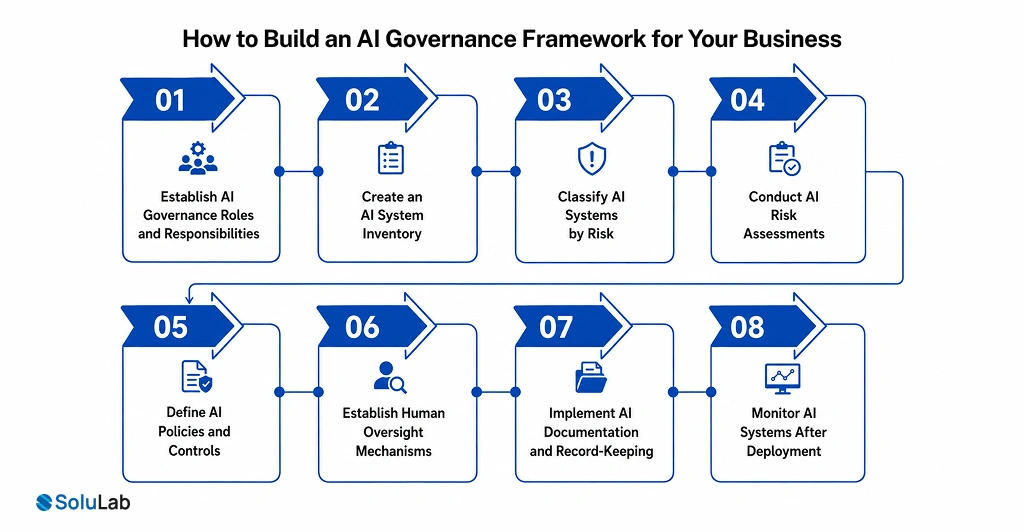
Eight stages take a business from no formal governance to a working, auditable framework. Skip the early ones, and that gap tends to surface during an actual audit, which is the worst possible time to find it.
- Establish AI Governance Roles and Responsibilities
Someone specific needs to own this. Spread ownership across “everyone,” and what you really have is no one, and that’s exactly the pattern regulators flag first. Working with an AI governance risk and compliance partner at this stage helps get the roles right the first time around.
- Assign a governance owner directly
- Define escalation paths clearly
- Set decision-making authority upfront
- Create an AI System Inventory
You can’t govern what you can’t see. A surprising number of businesses stumble onto shadow AI tools during this step, ones nobody in leadership ever formally approved.
- Catalog every AI system in use
- Include vendor and internally built tools
- Update the inventory continuously
- Classify AI Systems by Risk
Map every system in the inventory against the EU AI Act’s four tiers, or an equivalent internal risk scale where the Act doesn’t directly apply.
- Assess each system against risk tiers
- Document the classification rationale
- Flag ambiguous cases for legal review
- Conduct AI Risk Assessments
Beyond the regulatory classification, this step looks at actual operational and reputational risk tied to how each system gets used day to day.
- Assess bias and fairness risk
- Evaluate data privacy exposure
- Score business impact of failure
- Define AI Policies and Controls
This is where the risk assessment turns into concrete rules: what’s allowed, what needs sign-off, what’s off the table entirely.
- Draft acceptable use guidelines
- Define approval workflows by risk tier
- Set enforcement and review mechanisms
- Establish Human Oversight Mechanisms
High-risk systems need a human who can actually intervene, override, or halt the system, not just review outputs after the fact once the damage is done. This matters even more with autonomous AI agent deployments, where the system takes action without a human triggering each individual step.
- Define human-in-the-loop checkpoints
- Assign override authority clearly
- Test intervention mechanisms regularly
- Implement AI Documentation and Record-Keeping
Regulators and auditors want a paper trail showing how a system was built, tested, and monitored; proof it works isn’t enough on its own.
- Document model training and data sources
- Maintain audit-ready compliance records
- Version-control policy and system changes
- Monitor AI Systems After Deployment
Governance doesn’t stop at launch. Systems drift over time, and a framework that quits watching after deployment misses exactly the failures regulators care about most.
- Track performance and drift continuously
- Log incidents and near-misses
- Review classifications as systems evolve
Key AI Governance Policies Businesses Should Have
Seven policies form the practical backbone most frameworks are built around. Miss one and it tends to leave a visible gap the moment someone reviews the program closely.
- AI Acceptable Use Policy
Defines what employees and systems can and can’t do with AI tools. It’s usually the single most-referenced document when something goes wrong internally.
- AI Risk Management Policy
Lays out how AI-related risk gets identified, scored, and escalated, so the organization has one shared process instead of everyone making ad hoc judgment calls.
- Data Governance Policy
Covers how the data feeding AI systems gets sourced, stored, and protected. Most AI governance failures, if you trace them back far enough, turn out to be data problems wearing an AI costume.
- AI Transparency and Explainability Policy
Sets the standard for how much a business can explain about a given AI decision, and that standard shifts quite a bit depending on the system’s risk tier.
- Human Oversight Policy
Formalizes who actually holds override authority over which systems. This is what closes the gap between “we have oversight” as a claim on a slide and oversight as something enforceable.
- AI Incident Management Policy
Defines what counts as an AI incident and how the response works, largely mirroring how most businesses already handle security incidents, just adapted for AI-specific failure modes.
- Third-Party AI Vendor Policy
Extends governance requirements to vendors and tools the business doesn’t build itself, an area a lot of frameworks overlook right up until a vendor’s failure becomes the business’s problem to clean up. Pairing this with a formal, blockchain-security-style checklist adapted for AI vendors catches gaps a generic contract review tends to miss.
How AI Governance Supports Responsible AI Adoption?
Governance often gets framed as a brake on AI adoption. In practice, it tends to do the opposite.
- Improve AI Risk Management
A structured framework catches problems during design and testing, before they turn into expensive production incidents nobody saw coming.
- Strengthen Transparency and Accountability
Clear ownership and documentation mean issues trace back to a specific decision and a specific owner, instead of getting diffused across a team nobody can actually hold accountable.
- Improve Data and Model Governance
Governance forces better data practices almost as a side effect; AI-specific data controls tend to tighten data hygiene across the whole business, not just the AI side of it.
- Build Trust in AI Systems
Employees and customers adopt AI faster when they can see how it’s actually governed, rather than just being told it’s “safe” with nothing concrete behind the claim.
- Support Regulatory Readiness
A working framework turns an audit into a documentation exercise instead of a scramble — the difference between weeks of prep and an afternoon spent pulling records that already exist.
Conclusion
AI governance stopped being optional the moment the EU AI Act’s penalties became real, and ISO 42001 became the credibility benchmark regulators point to.
A working framework doesn’t slow AI adoption down it’s what lets a business scale AI with confidence instead of exposure. Getting the risk classification, policies, and oversight mechanisms right from the start beats rebuilding all of it later, under audit pressure, when there’s a lot less room to get it right.
SoluLab, an AI development company, can help your business build a governance framework designed around your specific regulatory exposure and AI systems.
Talk to a SoluLab AI architect about EU AI Act and ISO 42001 alignment!
FAQs
Neha is a curious content writer with a knack for breaking down complex technologies into meaningful, reader-friendly insights. With experience in blockchain, digital assets, and enterprise tech, she focuses on creating content that informs, connects, and supports strategic decision-making.