Every technological breakthrough creates its counterbalance. When generative AI models began writing essays, drafting contracts, generating code, and simulating human conversation at scale, a parallel question surfaced almost immediately.
If AI can generate anything, how do we verify what is real?
This is where AI detectors enter the picture. Not as reactive tools, but as structural safeguards in an AI-saturated ecosystem. GPT detection technology is not about policing creativity. It is about preserving trust, accountability, and operational control in environments where authenticity carries legal, financial, and reputational consequences.
For founders, CXOs, banks, and regulated enterprises, AI detection systems are quickly becoming part of the broader AI development stack.
They sit at the intersection of compliance, risk management, and responsible innovation.
Key Takeaways
- AI-generated content is scaling faster than verification methods. GPT detection tools emerge to identify synthetic text, helping maintain authenticity across education, media, and enterprise use cases.
- Traditional detection methods fail against advanced LLM outputs. Modern AI detectors use linguistic patterns, probability scoring, and model-based analysis to differentiate human vs AI-generated content
- Accuracy and reliability remain key challenges. False positives and evolving AI models make it essential to combine detection with human review and contextual validation
- SoluLab enables intelligent AI detection and moderation systems. By integrating advanced NLP models and custom AI pipelines, we help businesses build reliable, scalable content verification solutions
What Are AI Detectors?
AI detectors are systems designed to determine whether text, images, audio, or code was generated by artificial intelligence models.
In the context of GPT detection technology, the focus is primarily on text-based large language models. These systems estimate the probability that a piece of content was produced by a model such as GPT rather than a human author.
Importantly, AI detection systems do not “recognize” AI in a simplistic way. They operate on statistical inference.
They analyze measurable properties such as:
• Token probability distributions
• Predictability patterns
• Perplexity scores
• Burstiness behavior
• Linguistic entropy
• Stylometric consistency
The output is typically a probability score, not a definitive verdict.
This probabilistic nature is central to understanding both the power and limitations of modern AI detection systems.
How Do AI Detectors Work?
To understand GPT detection technology, we need to look at how large language models generate text in the first place.
Generative models predict the next token based on probability distributions learned from vast datasets. The output may appear human, but underneath, it follows mathematically optimized likelihood patterns.
AI detection systems reverse engineer that predictability.
At a high level, here is how AI detectors work:
- The input text is tokenized into smaller units.
- Statistical features are extracted.
- Perplexity scores are calculated.
- Burstiness and entropy patterns are analyzed.
- A classification model assigns a probability of AI generation.
Human writing tends to be uneven. We pause. We change tone. We vary the structure inconsistently.
AI-generated content often displays smoother probability curves and more uniform entropy behavior. That statistical smoothness is one of the core signals that detection systems analyze.
However, as generative models improve, these differences become subtler. This is why modern AI detection systems rely on layered model ensembles rather than single signal heuristics.
Detection today is probabilistic modeling, not keyword spotting.
How Does an AI Detection System Work at the Model Level?
At the infrastructure level, an enterprise AI system includes multiple layers working together.
A simplified architecture typically includes:
- Data ingestion pipeline
- Preprocessing and normalization engine
- Feature extraction layer
- Statistical scoring engine
- Machine learning classification model
- Confidence calibration module
- Human review interface
- Audit logging and reporting layer
The feature extraction layer may compute hundreds or thousands of signals, including token-level probabilities, sentence length distributions, syntactic structures, and stylometric fingerprints.
The classification layer then evaluates these features against trained datasets containing both human-authored and AI-generated samples.
In regulated sectors, explainability becomes critical. The system must not only provide a probability score but also justify the decision path.
This is particularly important in banking, legal, and compliance environments where detection outcomes may influence disciplinary or regulatory action.
So when we ask, how does an AI detection system work, the answer is not simply “it analyzes text.”
It operates as a structured inference engine embedded into enterprise workflows.
Core Components of Modern AI Detection Systems
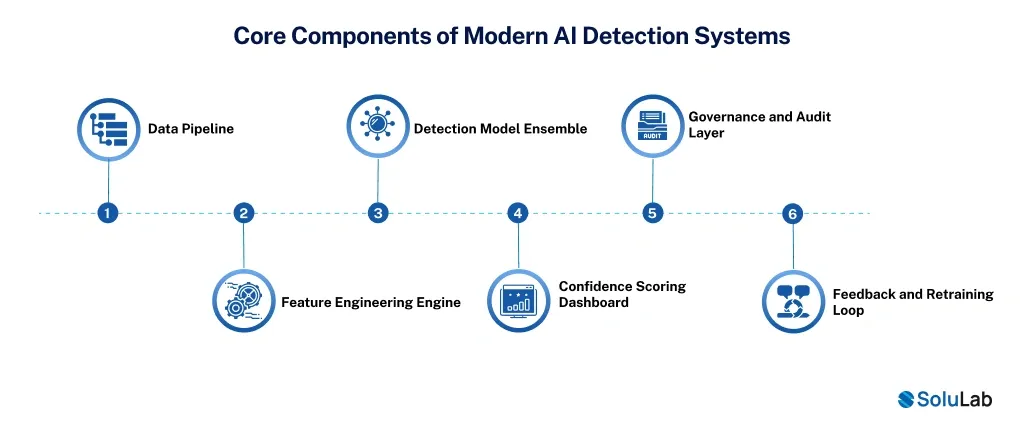
Modern AI detection systems are no longer standalone web tools. In enterprise environments, they function as modular infrastructure components.
Key components include:
- Data Pipeline
Responsible for ingesting text from documents, APIs, communication systems, or content platforms. - Feature Engineering Engine
Extracts statistical and linguistic markers aligned with GPT detection technology. - Detection Model Ensemble
Multiple models trained on different datasets to improve robustness and reduce bias. - Confidence Scoring Dashboard
Provides probabilistic outputs and risk categorization. - Governance and Audit Layer
Logs detection decisions for compliance tracking and regulatory audits. - Feedback and Retraining Loop
Continuously updates models as generative AI systems evolve.
In financial institutions, this system often integrates with:
- Fraud monitoring platforms
- Document verification systems
- Identity management infrastructure
- Risk scoring engines
The architecture must be scalable, explainable, and secure.
Detection cannot operate in isolation. It must sit inside a broader AI governance and risk management framework.
Read More: AI in Risk Management for Enterprises
Statistical Signals Behind GPT Detection Technology
At its core, GPT detection technology is a statistical discipline.
Large language models generate text by selecting the most probable next token based on learned patterns. That probability-driven mechanism leaves measurable fingerprints. AI detection systems analyze those fingerprints.
Some of the most important statistical signals include:
- Perplexity
Perplexity measures how predictable a piece of text is under a given language model. AI-generated text often exhibits lower perplexity because it follows smoother probability paths. Human writing tends to introduce irregularity and surprise. - Burstiness
Humans write in uneven bursts. Sentence lengths fluctuate. Vocabulary intensity varies. AI systems often maintain a more uniform rhythm unless specifically tuned to avoid detection. - Entropy Variance
Entropy reflects unpredictability. Human-authored content usually shows greater entropy variance across paragraphs. Machine-generated content may appear statistically balanced. - Token Distribution Patterns
Language models may over-optimize certain transition patterns or syntactic flows. Detection systems evaluate these distribution curves against known baselines. - Stylometric Consistency
AI-generated text may maintain consistent tone and structure over long spans, while human writing naturally drifts.
None of these signals alone are definitive. GPT detection technology works by combining them into multidimensional classification frameworks.
This layered statistical modeling is what makes modern AI detection systems more resilient than earlier heuristic tools.

Rule Based vs Machine Learning Based AI Detection Systems
Not all AI detection systems are built the same way.
Early tools relied heavily on rule-based logic. They looked for predictable markers such as:
- Repetitive phrasing
- Overly formal transitions
- Structured paragraph symmetry
- Common AI stylistic templates
These approaches were simple but fragile. As generative models improved, rule-based systems quickly became outdated.
Modern AI detection systems rely primarily on machine learning classifiers. These models are trained on large labeled datasets containing both human-written and AI-generated samples.
They evaluate thousands of features simultaneously and produce probabilistic outputs rather than binary judgments.
Many enterprise deployments now use hybrid approaches.
Rule based filters may flag obvious signals, while machine learning layers perform deeper statistical evaluation.
This layered architecture improves robustness and reduces over-reliance on any single detection mechanism.
As generative AI continues to evolve, machine learning driven detection systems are better positioned to adapt through continuous retraining.
The Benefits of AI Detectors for Enterprises
The benefits of AI detectors extend far beyond academic use cases. For enterprises, they directly impact governance, risk, and trust.
Risk Mitigation
AI detection systems can identify synthetic documents, AI-generated phishing scripts, or manipulated communications. In financial institutions, this reduces exposure to fraud and compliance violations.
Policy Enforcement
Organizations implementing responsible AI policies need monitoring mechanisms. Detection systems provide oversight into internal AI usage.
Brand Protection
Media companies and large enterprises must ensure the authenticity of public content. AI detectors help safeguard reputational integrity.
Regulatory Preparedness
With AI regulations evolving globally, enterprises need demonstrable governance frameworks. AI detection systems form part of that accountability infrastructure.
Operational Transparency
Detection outputs can feed into broader AI governance dashboards, supporting audit trails and board-level reporting.
When implemented thoughtfully, AI detection systems become a structural control layer rather than a surveillance mechanism. For decision makers evaluating GPT detection technology, the real question is not simply whether detection works.
It is how detection integrates into a larger compliance-first AI operating model.
The Best AI Detector Is Not a Tool but a System
Many decision makers begin with a simple question:
What is the best AI detector?
The reality is more nuanced. There is no universally best AI detector in isolation. Detection performance depends on context, regulatory exposure, data sensitivity, and integration requirements.
A standalone web tool may be sufficient for low-risk academic screening. It is rarely sufficient for banks, fintech platforms, legal firms, or enterprise environments handling sensitive information.
The best AI detector in enterprise settings is not a single model. It is a layered system that includes:
- Domain-specific model training
- Continuous retraining pipelines
- Confidence threshold calibration
- Human review workflows
- Audit and compliance logging
- API integration with core systems
Detection must align with risk appetite.
For regulated institutions, the standard is not just accuracy. It is explainability, defensibility, and governance readiness.
When leaders evaluate GPT detection technology, the focus should shift from tool comparison to system architecture.
Use Cases of AI Detectors Across Various Sectors
The use cases of AI across various sectors reveal how deeply embedded generative AI has become in operational workflows.
AI detection systems are no longer confined to education. They are increasingly part of enterprise risk stacks.
1. Education
Institutions use AI detection systems to protect academic integrity and support fair assessment processes.
2. Media and Publishing
Editorial teams deploy detection tools to verify contributor authenticity and mitigate misinformation risks.
3. Legal Sector
Law firms use detection systems to validate authorship, ensure AI disclosure compliance, and maintain professional accountability.
4. Enterprise Security
Security teams monitor internal and external communications for AI-generated phishing or social engineering scripts.
5. Government and Public Sector
Detection systems help validate public submissions and reduce manipulation risks in digital governance platforms.
These use cases demonstrate that AI detection systems function as trust infrastructure rather than simple screening tools.

AI Detection Systems in Banking and Financial Services
In banking and financial services, AI detection systems take on heightened importance.
The sector operates under strict regulatory scrutiny and high fraud exposure. AI-generated documents can be used to fabricate loan applications, KYC information, investment proposals, or internal communications. Here, GPT detection technology becomes part of a broader compliance and fraud mitigation strategy.
Common implementations include:
- Document Verification Pipelines
Incoming loan or onboarding documents are analyzed for AI-generated manipulation. - Internal Policy Monitoring
Financial institutions monitor the usage of generative AI tools in sensitive departments such as risk, trading, or legal. - Fraud Detection Integration
Detection scores can be incorporated into fraud risk engines to enhance decision-making. - Regulatory Reporting Support
AI detection systems provide audit logs and explainable outputs aligned with governance requirements.
In such environments, off-the-shelf tools often fall short. Institutions may require custom AI development companies that integrate directly with core banking systems, fraud engines, and compliance dashboards.
This is where working with an experienced AI development company becomes critical. The focus shifts from detection accuracy alone to infrastructure resilience, data security, and regulatory defensibility.
For firms like SoluLab that approach AI from an architecture-first and compliance-ready perspective, AI detection systems are designed as part of an enterprise-wide governance framework rather than as isolated utilities.
Architecture Blueprint for Enterprise AI Detection Systems
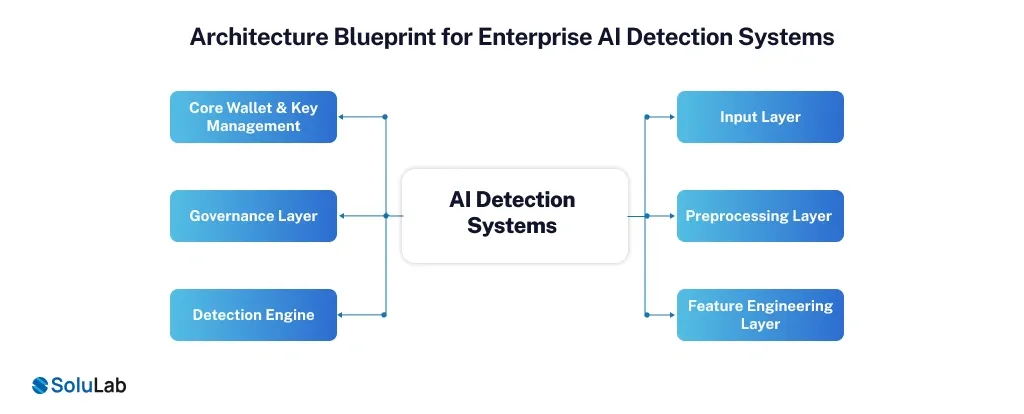
To move from concept to implementation, enterprises need a clear architectural blueprint.
A scalable AI detection system is typically designed as a modular layer within the broader AI governance stack. It should not sit as a standalone dashboard disconnected from operational workflows.
A reference enterprise architecture includes:
Input Layer
- Document ingestion APIs
- Email and communication feeds
- Content management integrations
Preprocessing Layer
- Text normalization
- Tokenization
- Language standardization
Feature Engineering Layer
- Perplexity calculation
- Entropy and burstiness analysis
- Stylometric signal extraction
Detection Engine
- Machine learning classifier ensemble
- Rule based heuristics layer
- Confidence scoring mechanism
Governance Layer
- Audit logs
- Decision traceability
- Compliance reporting dashboards
Integration Layer
- Fraud detection systems
- Risk scoring engines
- Identity and access management
- Regulatory reporting platforms
The design principle is simple. Detection must be infrastructure-first, compliance-ready, and explainable by design.
For regulated institutions, architecture decisions determine not only performance, but defensibility.
Governance and Risk Considerations
Deploying AI systems introduces its own governance challenges.
False positives
A misclassification can affect academic standing, employment status, or legal outcomes.
Model bias
Detection systems trained on narrow datasets may unfairly flag certain writing styles or linguistic patterns.
Over reliance
Organizations may treat detection scores as the absolute truth rather than probabilistic guidance.
To manage these risks, enterprises should establish:
- Clear confidence thresholds for action
- Mandatory human review loops
- Transparent policy documentation
- Periodic model audits
- Bias testing frameworks
AI detection systems should be embedded into formal AI governance policies.
This includes defining who reviews flagged content, how disputes are handled, and how model performance is monitored over time.
Governance is not an afterthought. It must be designed alongside GPT detection technology from day one.
Ethical Considerations in AI Detection
Beyond compliance and risk, AI detection raises deeper ethical questions.
- Transparency
Should individuals be informed when their content is being analyzed by AI detection systems? - Consent
Is explicit consent required in certain jurisdictions? - Fairness
Are non native writers or highly structured thinkers disproportionately flagged? - Accountability
Who is responsible when a detection system makes an incorrect classification?
Ethical AI detection requires a balanced approach.
Detection systems should:
- Provide probabilistic outputs rather than binary labels
- Offer explainable reasoning where feasible
- Include appeal or review mechanisms
- Avoid punitive automation without human oversight
The purpose of AI detection is not surveillance. It is responsible governance.
As generative AI integration continues to expand, organizations must ensure that the systems designed to monitor AI remain aligned with fairness, transparency, and accountability principles.
False Positives, Bias, and Accountability
No AI detection system is perfectly accurate. And in high-stakes environments, even a small error margin can carry serious consequences.
False positives remain one of the biggest challenges in GPT detection technology. A human author may be flagged as AI-generated because their writing style is structured, concise, or statistically predictable.
This risk increases for:
- Non native English writers
- Technical authors
- Policy and compliance professionals
- Highly standardized documentation environments
Bias can also emerge from training data. If AI detection systems are trained predominantly on specific linguistic patterns or regional datasets, the model may underperform across diverse writing styles.
This is why accountability frameworks matter. Enterprises deploying AI detection systems should:
- Treat outputs as probability scores, not verdicts
- Mandate secondary human review for high-impact decisions
- Regularly audit false positive rates
- Continuously retrain detection models with diverse datasets
The strength of AI detection systems lies in structured support for decision-making, not automated enforcement without oversight. Accountability must sit with human governance teams, not the model alone.
Build vs Buy Decision Framework
As interest in AI detection grows, enterprise leaders face a strategic choice. Should they buy an existing detection tool or build a custom solution aligned with their infrastructure?
The answer depends on risk profile and operational complexity.
Buy may make sense when:
- The organization operates in a low regulatory exposure environment
- Use cases are limited to general content screening
- Integration requirements are minimal
- On-premises deployment is not required
Build or customize becomes necessary when:
- The organization operates in banking, fintech, legal, or regulated sectors
- Detection must integrate with fraud engines or core platforms
- Explainability standards are strict
- Data residency constraints apply
- Domain specific tuning is required
A hybrid approach is increasingly common. Enterprises license baseline GPT detection technology and then extend it through custom AI development solutions to fit internal governance and risk models.
This approach balances speed to deployment with infrastructure control.
When Custom AI Development Solutions Become Necessary?
Off-the-shelf AI detection systems often provide generic probabilistic outputs. For many institutions, that is not enough.
Custom AI app development solutions become critical when detection must operate as part of a broader enterprise architecture.
For example:
- In banking, detection may need to feed into fraud scoring engines and transaction monitoring systems.
- In legal environments, explainability modules may need to generate structured reasoning logs suitable for compliance audits.
- In enterprise environments, detection systems may require private deployment within secure cloud or on premise infrastructure.
- This is where partnering with a specialized AI consulting company becomes strategically important.
An experienced partner does more than train a classifier. They design detection as part of a governed AI operating model that includes:
- Architecture planning
- Compliance alignment
- Risk modeling integration
- Phased deployment strategy
- Continuous monitoring and retraining
AI integration firms like SoluLab approach AI detection systems as infrastructure components embedded within enterprise workflows, rather than isolated utilities. The emphasis is on compliance readiness, scalable architecture, and long-term model governance.

Conclusion
AI detectors are not about limiting innovation. They are about preserving accountability in an environment where generative AI can scale faster than oversight.
GPT detection technology has evolved from academic screening tools into enterprise-grade infrastructure. The benefits of AI detectors now extend across banking, legal, media, and compliance-driven sectors.
The organizations that will navigate this shift most effectively are those that treat AI detection systems as structured governance layers rather than standalone utilities.
In the end, the goal is not to police creativity. It is to maintain trust in a world where machine-generated content is becoming indistinguishable from human expression.
Frequently Asked Questions
Shipra Garg is a tech-focused content strategist and copywriter specializing in Web3, blockchain, and artificial intelligence. She has worked with startups and enterprise teams to craft high-conversion content that bridges deep tech with business impact. Her work translates complex innovations into clear, credible, and engaging narratives that drive growth and build trust in emerging tech markets.