
Buyers today want fast replies, personalized attention, and transactions that don’t feel like an obstacle course. Meanwhile, agents are buried in scheduling, follow-ups, and paperwork before they’ve even had a real conversation with a client.
AI tools change that math. They handle scheduling, virtual property tours, transaction tracking, and lead qualification so agents can spend time on the work that actually closes deals.
According to a recent McKinsey analysis, real estate can generate up to $180 billion value for the industry. As professionals adopt generative tools and rethink how they work, their roles will shift. Here’s a look at what those shifts actually look like.
This piece covers how AI is reshaping real estate, from how properties get priced to how deals get closed. Worth reading if you’re trying to figure out where these tools fit in your workflow.
What are AI agents in Real Estate?
Digital assistants that use artificial intelligence to work alongside clients and real estate professionals are known as AI agents in the industry. They handle appointment scheduling, listing management, market data analysis, and generating recommendations automatically.
These systems learn client preferences, surface properties that match their criteria, and provide context to keep transactions moving. The result is a process that’s more data-driven and less dependent on manual back-and-forth.
How Virtual Assistants Transform Real Estate Workflows?
Here’s how virtual assistants transform real estate workflows:
1. Property Visit Scheduling: Real estate agents’ virtual assistants handle the back-and-forth of coordinating site visits without the usual scheduling headaches.
2. Follow-Ups Made Simple: AI-powered virtual assistants tailor follow-up messages to each client’s property interests and preferences, not a generic template.
3. 24/7 Client Support: AI virtual assistants respond to client questions around the clock, so no lead sits unanswered because it came in at 11pm.
When routine admin gets handled automatically, agents get their time back for building relationships and closing. Convin’s AI Phone Calls takes this further by improving follow-up and client communication workflows directly.
Key Features and Impact of AI Agents in Real Estate
Here are the key features and impact of AI in real estate:
1. Efficiency Gain: AI virtual assistants speed up responses and cut down on the need for human touchpoints on routine tasks.
2. Personalization: Tailored interactions raise client satisfaction and drive more conversions, because people respond differently when a recommendation actually fits.
3. Cost Reduction: Recent studies have shown that AI solutions, such as virtual assistants for real estate brokers, can cut operating expenses by as much as 60%.
With virtual assistants covering the repetitive work, brokers can point their energy at the deals that actually need human judgment.
Benefits of AI Agents in Real Estate
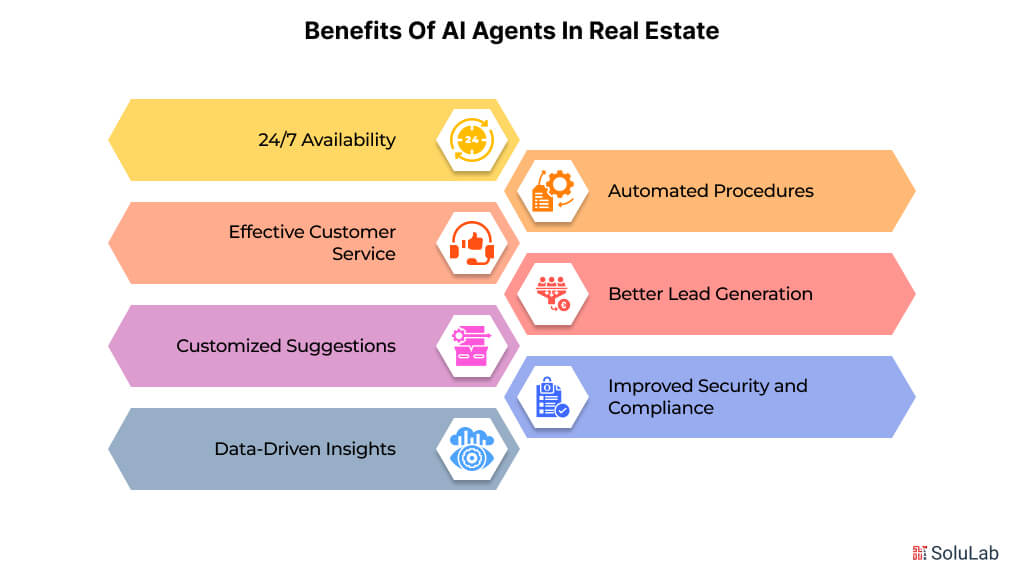
AI agents are systems that perceive their environment, act on it, and learn as they go. In real estate, that translates to several practical advantages:
1. 24/7 Availability: AI agents respond immediately, regardless of time zone or business hours. A prospective buyer at midnight in a different city gets an answer. That matters for conversion.
2. Effective Customer Service: AI agents handle multiple inquiries at once, without errors or wait times. They cover the common questions about availability, pricing, and property details, freeing human agents for the conversations that require real judgment.
3. Customized Suggestions: Machine learning lets these agents study user preferences and behavior, then surface property recommendations that actually fit. Buyers spend less time scrolling through irrelevant listings.
4. Data-Driven Insights: Artificial intelligence (AI) agents can work through large volumes of data to surface patterns in market trends, pricing, and investment opportunities. Agents get sharper context for decisions without having to pull the data themselves.
5. Automated Procedures: Scheduling property tours, sending reminders, tracking paperwork, all of it can run automatically. Less administrative overhead, better operational flow.
6. Better Lead Generation: AI systems qualify leads against parameters like budget, location preference, and purchase intent. Agents focus on prospects who are actually ready to move, not everyone who clicked a listing.
7. Improved Security and Compliance: By handling sensitive data carefully and Security Token Offerings, AI agents help meet legal requirements and data protection rules. That reduces the chance of human error and builds client confidence in the transaction process.
Taken together, these capabilities improve client experience, reduce friction in operations, and give teams better data to act on.
Applications and Use Cases of AI Agents in Real Estate
AI is changing how people buy, sell, and manage properties. It can think through data, predict shifts, and flag problems before they become expensive. Here’s where it’s making a real difference.
1. Property Valuation and Pricing
Automated Valuation Models (AVMs)
AVMs use AI to estimate property value by pulling together house size, nearby sales, and local market trends. They update faster and more consistently than older appraisal methods, which matters in a market where conditions shift week to week.
Predicting Future Trends
AI studies historical data alongside current market signals to project what might come next. Are prices in a specific neighborhood likely to rise? Is rental demand building or softening? That kind of forward-looking context helps investors and agents plan rather than react.
2. Enhanced Customer Service
Virtual Assistants and Chatbots
Someone asks a question about a listing at 2am. AI-powered chatbot development answers it, books a tour if they want one, and keeps the conversation going. No one waits until morning.
Personalized Property
AI learns what you actually want: your budget, preferred neighborhoods, deal-breakers. Then it surfaces homes that fit, not just homes that are available. The shortlist gets shorter and better.
3. Efficient Property Management
Fixing Things Before They Break
AI reads sensor data from building systems and flags when something is likely to fail before it does. That’s cheaper than emergency repairs and less disruptive to tenants.
Picking the Best Tenant
AI reviews rental history and credit scores to identify strong candidates quickly. Landlords get a clearer picture, faster, with fewer gut-feel decisions.
Easy Lease Management
Rent changes, renewals, compliance rules, AI keeps track of all of it. Landlords spend less time chasing details and more time on the work that matters.
4. Marketing and Sales Optimization
Smarter Ads
AI identifies buyers and renters who are actually in the market and shows them relevant listings. It draws on website behavior, social signals, and search patterns to target the right people, which cuts wasted ad spend.
Amazing Content Creation
Property descriptions and virtual tour content can be drafted by AI, quickly and at scale. Good listings get created without bogging down the team.
Read Also: Voice AI Agents In Conversions and Sales
5. Risk Assessment and Fraud Detection
Smart Risk Checks
AI studies market trends and property specifics to flag potential risks in real estate investments. Investors get a clearer view of downside before committing capital.
Catching Fraud
AI can spot patterns that point to fake listings or fraudulent mortgage applications. It adds a layer of protection that manual review simply can’t match at scale.
6. Smart Contract Management
AI combined with blockchain handles contract enforcement automatically. Conditions get verified before money changes hands, which makes transactions faster and reduces the risk of errors creeping in.
7. Environmental and Sustainability Analysis
Saving Energy
AI monitors electricity and heating usage patterns, then identifies where buildings are wasting energy. Suggestions are specific: unused lighting zones, HVAC inefficiencies, that kind of thing.
Planning Green Buildings
For new construction, AI can evaluate materials for environmental impact and optimize designs for passive solar gain. Builders get better options upfront rather than retrofitting later.

How to Build an AI Agent for Real Estate?
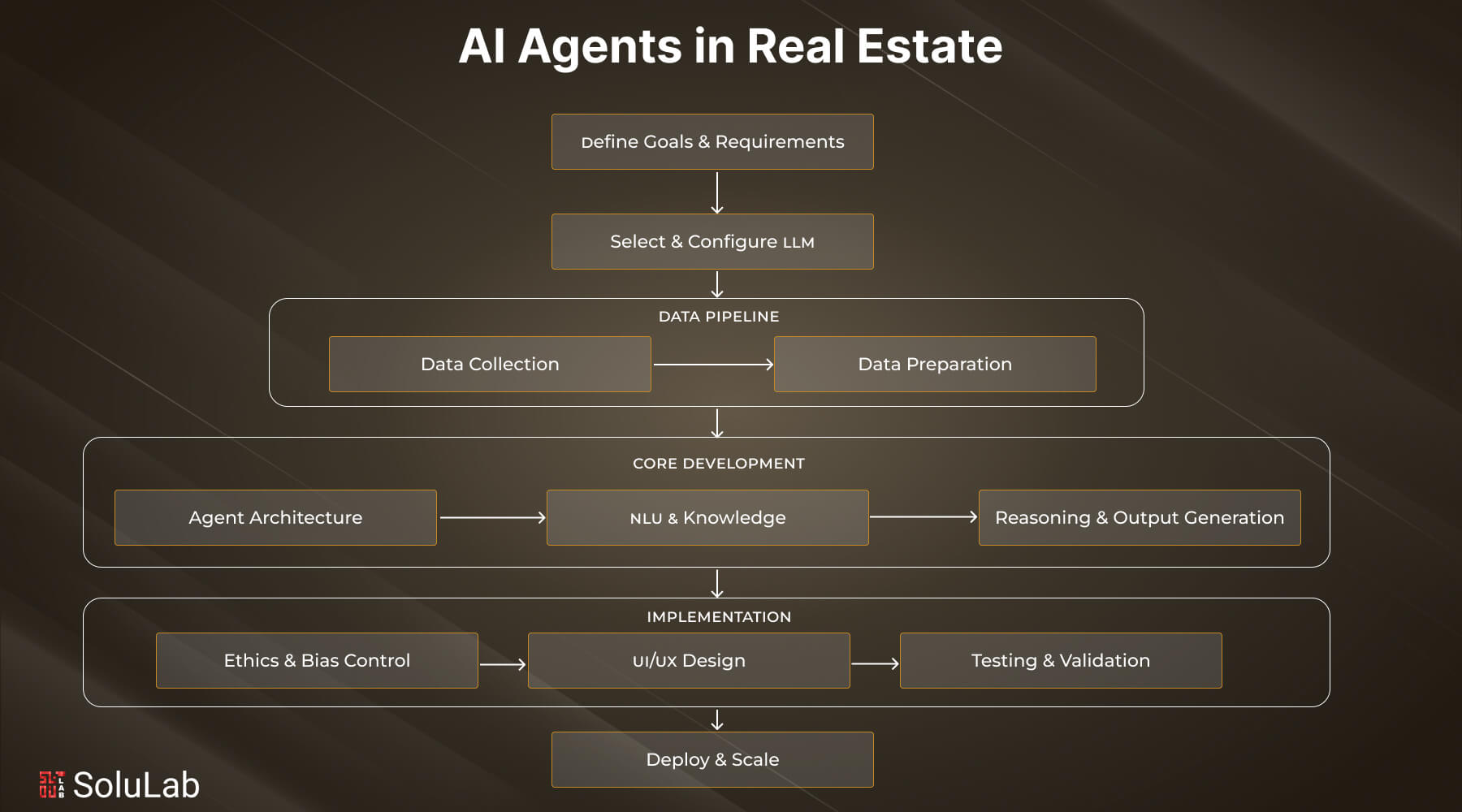
Large language models like Large Language Models (LLMs) are changing what’s possible in real estate. Pair them with the right architecture, and you get an AI assistant that saves time, handles complexity, and gets better with use. Here’s how to actually build one.
1. Define your Real Estate Goals
Start by deciding what you want the AI to do for your business. Be specific. Vague goals produce vague agents.
- Pick your Focus: Is it helping with property management, talking to clients, or keeping track of market trends?
Choose tasks for the AI:
- Market Trends: Teach the AI to study house prices and the best places to invest.
- Talking to Clients: Let it answer common questions and book meetings.
- Property Lists: Help manage and update homes for sale.
- Paperwork: Make contracts easier to prepare and check.
2. Choose the Right LLM
The model you pick shapes what your agent can do. There are real tradeoffs.
- Some Smart Choices:
- OpenAI (GPT): Great for talking to clients and writing reports.
- Google’s PaLM 2: smart for tricky tasks and different languages.
- Meta’s LLaMA: Flexible and good for custom jobs.
- Hugging Face Transformers: There are lots of options to test and choose from.
What to check before picking:
- Size: Bigger models are more capable but cost more to run.
- Skills: Make sure it’s good at real estate tasks.
- Cost: Some are free, and others charge money.
3. Data Collection and Preparation
The quality of your data determines the quality of your agent. Here’s what you need:
- Market Data: This is information about how much houses cost and how the market changes.
- Client Data: Details about what people like, what they’ve asked about, and the deals they’ve made.
- Property Listings: A full database of properties with descriptions, prices, and locations.
Then clean it before you feed it in.
- Cleaning: Remove duplicate or irrelevant records and fix inconsistencies.
- Formatting: Standardize how dates, numbers, and categories are stored so the model can actually learn from them.
4. Train the LLM (for the specific domain/task)
General models don’t know real estate. You have to teach them.
- Domain Adaptation: Fine-tune the model on real estate data so it understands the terminology and context.
- Prompt Engineering: Experiment with how you frame questions to the model. Small changes in phrasing can produce noticeably different results.
5. Develop the AI Agent Architecture
This is where you wire everything together. Think of it as building the agent’s brain and its connection to the outside world.
- Input Processing: This part listens to what you ask or type.
- LLM Interaction: Here, the AI uses what it learned to develop smart answers.
- Output Generation: The AI shares its answers in a way that’s easy to understand.
- Memory and Context: This helps the AI remember what you discussed before, so it doesn’t lose the thread mid-conversation.
6. Implement Natural Language Understanding (NLU)
The agent needs to understand what people actually mean, not just what they literally typed.
- Interpreting Queries: Teach it to figure out exactly what you’re asking.
- Intent Recognition: It learns what you want, like finding a house or comparing prices.
- Entity Extraction: The AI picks out key details, like property type, location, or budget range.
7. Create Knowledge Integration Systems
- Add Outside Knowledge: Give your AI agent access to current data sources so its answers reflect the real world, not just its training data.
- Check Facts: Build in verification against trusted sources. An agent that confidently gives wrong information is worse than no agent at all.
- Keep Learning: Let the AI keep getting smarter by updating what it knows constantly.
8. Develop Reasoning and Analysis Capabilities
- Understand Markets: Teach the AI to study property prices and what’s trending in real estate.
- Spot Deals: Help the AI find strong opportunities in the market, not just surface-level listings.
- Think Logically: The agent needs to reason through problems, not just retrieve answers.
9. Design Output Generation And Summarization
- Write Like A Human: Outputs should be readable, not technical dumps.
- Summarize Info: Let the AI distill large data sets into concise, actionable summaries.
- Show Graphs And Charts: Help the AI make pretty pictures like charts to explain things clearly.
10. Implement Ethical And Bias Mitigation Measures
- Find and Fix Biases: Audit outputs regularly to catch and correct skewed recommendations.
- Be clear: Show how the AI makes decisions so people can trust it.
- Follow the rules: Teach the AI to stick to rules about privacy and fairness.
11. Create User Interface And Interaction Design
- Make It Easy To Use: If the interface is confusing, people won’t use it. Keep it simple.
- Help Users Refine Questions: Add features so users can adjust their questions to get better answers.
- Work As A Team: The best implementations keep humans in the loop rather than replacing their judgment entirely.
12. Testing and validation
- Test a lot: Run the agent through varied real estate scenarios before you go live.
- Compare results: Match the AI’s outputs against expert opinions to check accuracy.
- Keep An Eye On It: Monitor performance regularly. Models drift, and markets change.
13. Deployment and Scaling
- Build A Strong Setup: Get the infrastructure in place before you need it, not after things start breaking.
- Protect Data: Keep sensitive information safe with strong security measures.
- Be Ready To Grow: Plan so the AI can handle more tasks and users as it gets popular.
Challenges and Limitations of AI Agents in Real Estate
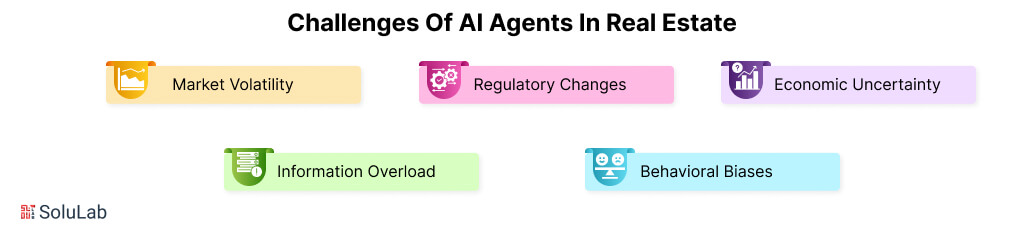
These AI agents in insurance enable real-time data analysis and sharper market intelligence. But real estate investing still comes with challenges that AI can’t fully absorb. Here are five you need to plan for.
1. Market Volatility
Prices move fast, and sometimes in ways that catch everyone off guard. Having a clear risk plan before volatility hits is more useful than trying to react mid-swing.
2. Regulatory Changes
New laws and updated rules can shift how investments perform without warning. Staying current on the regulatory environment is part of the job, not an optional extra.
3. Economic Uncertainty
Interest rate changes, inflation, and global events all feed into real estate conditions. Flexibility matters here: strategies that worked in a low-rate environment need rethinking when rates shift.
4. Information Overload
There is no shortage of data. The challenge is identifying what actually matters for your decision and filtering out the noise. More information doesn’t automatically mean better decisions.
5. Behavioral Biases
Emotional decisions are common in real estate, especially when markets are moving quickly. Recognizing your own patterns, and building processes that slow down reactive choices, helps a lot.
Components of AI Agents for Real Estate
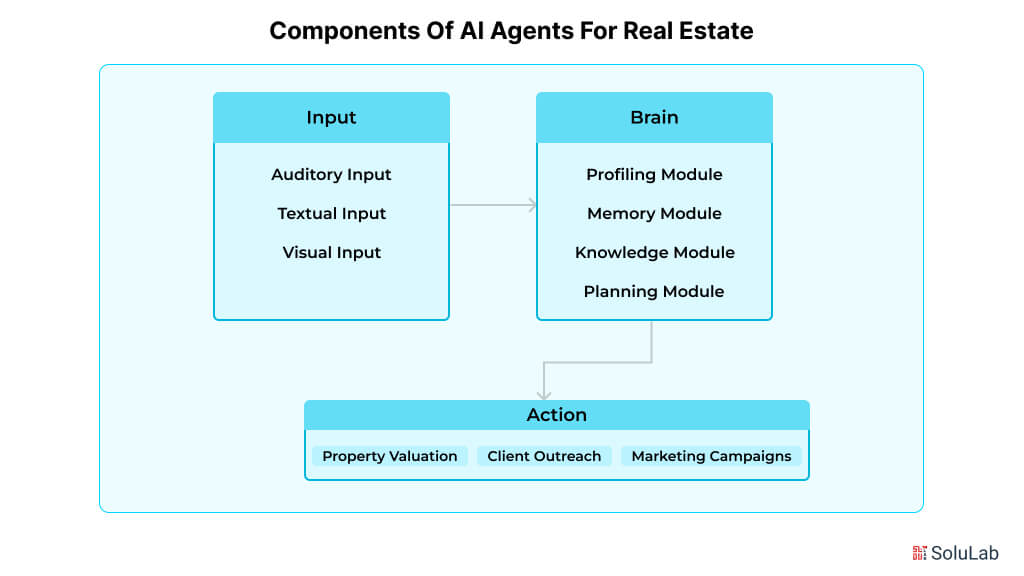
Several core elements go into the architecture of AI agents built for real estate. Each handles a specific part of the process: taking in information, reasoning through it, planning a response, and acting on it. Think of it as a team where every role has a defined job.
1. Input
This is how the agent perceives the world. In real estate, it pulls from three main types of input:
- Auditory Input: It listens to voice commands, such as “Find houses near the park!” or questions from agents or clients.
- Textual Input: It reads emails, messages, property details, and even customer reviews.
- Visual Input: It processes photos, floor plans, and virtual tour content.
Together, these inputs give the agent enough context to make useful decisions.
2. Brain
This is where reasoning happens. The brain has several modules, each covering a different function:
- Profiling Module: Defines the agent’s role. Buyer matching, market analysis, client support, it depends on what you configured.
- Memory Module: Stores past conversations and tasks so the agent doesn’t start from scratch every time.
- Knowledge Module: Holds structured facts: pricing data, neighborhood details, legal requirements.
- Planning Module: It makes a step-by-step plan to do tasks like pricing a home or organizing a marketing campaign.
3. Action
This is where plans become outputs. The agent takes what the brain decided and executes it:
- Property Valuation: It looks at market data and house details to determine the right home price.
- Client Outreach: It sends personalized messages to buyers and sellers to keep them engaged.
- Marketing Campaigns: It helps create ads and listing content that attract the right buyers.
Ethical Considerations of AI Agents in Real Estate
Ethics aren’t a compliance checkbox. In a domain where AI is making recommendations that affect where people live and how money moves, getting this right matters. Credibility depends on it.
1. Define Ethical Standards: Clear ethical guidelines give teams a reference point when ambiguous situations come up. They should reflect the organization’s actual values, not just what looks good in a policy document.
2. Encourage Openness: When stakeholders understand how decisions get made, including how AI algorithms and blockchain transactions work, trust builds. Opacity creates suspicion, even when the underlying logic is sound.
3. Promote Moral Behavior: Training on ethical decision-making helps teams build the habit of asking hard questions before acting. Regular discussions about real cases, not hypotheticals, reinforce a culture where integrity is expected.
The Future of AI Agents In Real Estate
AI agents are moving quickly from useful tools to core infrastructure. Here’s where the next wave is headed:
- Negotiation Agents: These would analyze what both sides actually want, pull in market data, and surface options that move a deal forward without the usual back-and-forth.
- Property Management Agents: Handling repair scheduling, utility tracking, and tenant communication automatically, while adapting as conditions change.
- Virtual Staging Agents: AI that shows buyers how a property looks with different furniture or layout options, using 3D visualization tools.
- Legal and Compliance Agents: Reviewing contracts, flagging risk, and checking regulatory compliance without requiring a lawyer for every transaction.
- Smart Building Agents: Managing energy use, security, and maintenance schedules within a building, learning occupant preferences over time.
- Investment Advisory Agents: Pulling together market trends, property data, and investor priorities to generate specific, reasoned recommendations rather than generic guidance.
- Virtual Tour Agents: Guiding buyers through online walkthroughs, answering questions in real time, and focusing on what each buyer cares most about.
- Tenant Screening Agents: Running credit and rental history checks systematically, so landlords spend less time on manual review and make faster, more consistent decisions.

Conclusion
AI agents handle real work in real estate: pricing properties, predicting when maintenance is needed, qualifying leads, managing leases, and reducing energy waste. These aren’t speculative capabilities. They’re deployed today.
The question for most teams isn’t whether to use AI, it’s where to start. Virtual assistants, transaction coordinators, and AI-powered sales tools all fit into existing workflows without requiring a complete overhaul.
SoluLab helped AI-Build, a construction tech company, use generative AI and machine learning for advanced product development in the CAD space. The goal was to automate design processes, improve productivity, and improve accuracy. The challenge: building a system that generates optimized designs while cutting manual tasks and staying scalable. SoluLab’s AI Agent Development Company expertise made the AI integration work, improving both efficiency and performance. If you have a specific business problem you’re trying to solve, SoluLab’s team is ready to talk through it.
FAQs
Shipra Garg is a tech-focused content strategist and copywriter specializing in Web3, blockchain, and artificial intelligence. She has worked with startups and enterprise teams to craft high-conversion content that bridges deep tech with business impact. Her work translates complex innovations into clear, credible, and engaging narratives that drive growth and build trust in emerging tech markets.