Billions of dollars were lost on exploits, flash loan attacks, oracle manipulation, and smart contract vulnerabilities, and most of the breaches occurred in a few seconds.
Conventional audits and physical surveillance are not able to identify threats in real time or attackers that use AI to investigate vulnerabilities 24/7. In fact, Between 2024 and 2025, DeFi hacks and exploits resulted in over $3.1 billion in losses across protocols.
More protocols expand attack surfaces, threatening user funds, your reputation, and long-term viability. A single breach can drain liquidity and destroy community trust.
AI agents in DeFi security provide perpetual surveillance, anomaly detection, predictive threat data, and automated reaction structures – the development of dynamic, ever-present security systems, which allow DeFi protocols to remain robust to novel threats.
Key Takeaways
- The Problem: DeFi faces rising smart contract exploits, flash loans, front-running-unsecured AI agents amplifying risks like bad trades and leaks.
- The Solution: AI in security strategies can be applied to identify irregularities, identify possible exploits, and automatically eliminate threats.
- How SoluLab Can Help: SoluLab offers custom DeFi security; Custom audits + AI monitoring; blends predictive agents with protocols for resilience, compliance, and smaller attack surfaces.
Why Do AI Agents Introduce New Security Risks?
With their high potential and autonomy, the AI agents will potentially deliver unprecedented convenience to digital systems and, at the same time, pose new security risks to challenge the established defenses and introduce vulnerabilities in unforeseen ways.
- Expanded Threat Surface: The AI agents can connect with various systems, networks, and APIs, increasing the number of potential attack points. Integration exposes the system to more vulnerabilities and predisposes the system to attacks by enemies.
- Autonomous Decisioning: Having the capability to do autonomous actions, AI agents can take unintended actions or pursue the manipulated inputs, which makes them useful to attackers to take advantage of the trust in automated processes and avoid human supervision.
Major Attack Vectors Targeting AI Agents and DeFi Security
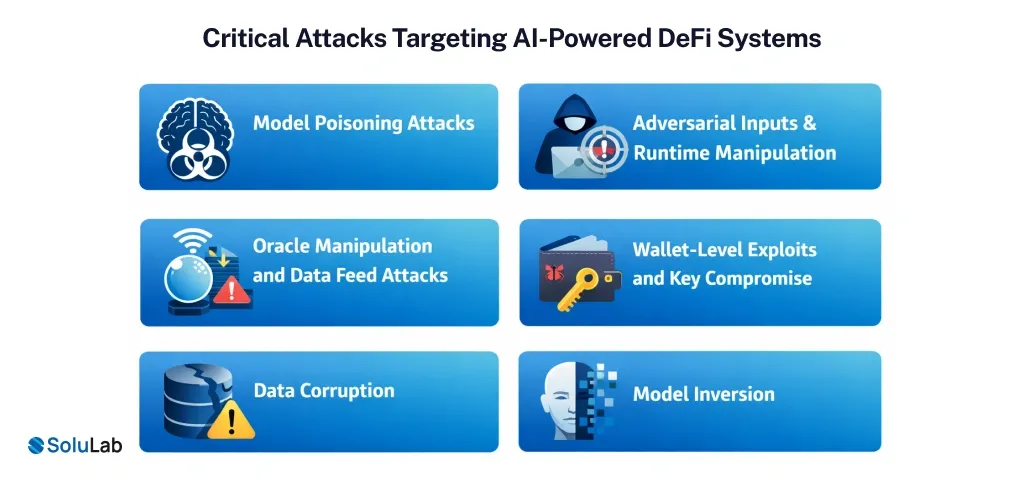
The increasing number of advanced security threats to AI systems and autonomous agents can be described by the attacks being introduced by hackers who take advantage of the model behavior, data streams, input, credentials, and run-time access to undermine the integrity of data, privacy, and operations.
1. Model Poisoning Attacks: In this type of attack, attackers poison training or fine-tuning data to introduce concealed behaviors or backdoors so that the model will behave normally until a particular trigger is triggered, which will trigger malicious outputs.
2. Adversarial Inputs & Runtime Manipulation: To induce misclassification, dangerous behavior, or insecure outputs, engineered inputs at inference time (e.g., adversarial text, images) are manipulated.
3. Oracle Manipulation and Data Feed Attacks: Data feeds (oracles) that are false or not true, which are used to influence AI decision-making, bias predictions, recommendations, or automated actions, will be based on distorted ground truth.
4. Wallet-Level Exploits and Key Compromise: The attacker gets hold of credentials, API keys, or cryptographic wallets associated with the agents and uses them to take unauthorized actions, steal money, or gain control of the agent’s privileges.
5. Data Corruption: This is persistent poisoning, which introduces example poisoning during training or retrieval of data, and prompt injection, which attempts to trick the model during usage to disable protections or to reveal sensitive information.
6. Model Inversion: Model inversion attacks can be used to reconstruct information about sensitive training data or intellectual property used by the model, potentially exposing sensitive data to privacy attacks and intellectual property to leakage.
Strategies to Protect AI-Enabled Protocols
Authenticated AI-based protocols are important to protect against reliability, integrity, and safety. Strategic actions in data management, model stability, execution, validation, and decision-making can help the AI systems withstand new threats.
- Secure Training & Data Provenance: Have datasets that can be proven, are traceable, and tamper-resistant. A safe training environment eliminates unauthorized changes and ensures model integrity, and reduces the risk of poisoned or biased data sources.
- Adversarial Thresholds: Constructs models that are robust to adversarial examples and have confidence-based decision thresholds. These will minimize incorrect outputs, curb the efforts of exploitation, and enhance the general reliability of AI.
- Oracle Diversification & Validation: Predictions and cross-check output should be made using a variety of independent sources or models. Bias and avoidance. Diversification and strict validation can help avoid manipulation and increase the credibility of AI-based decision-making.
- Execution: Secure AI environments through attacks, such as code injection or runtime exploitation. Secure implementation is the stability in the system and compromise in the operations of the models.
- Hybrid Decision Frameworks: AI outputs are combined with human supervision or rule checks. Hybrid structures are safer, more accountable, and transparent, and less reliant on a single source of automated decisions.
Read More: Enterprise AI Security & Governance
Comprehensive Security Framework for AI Agents
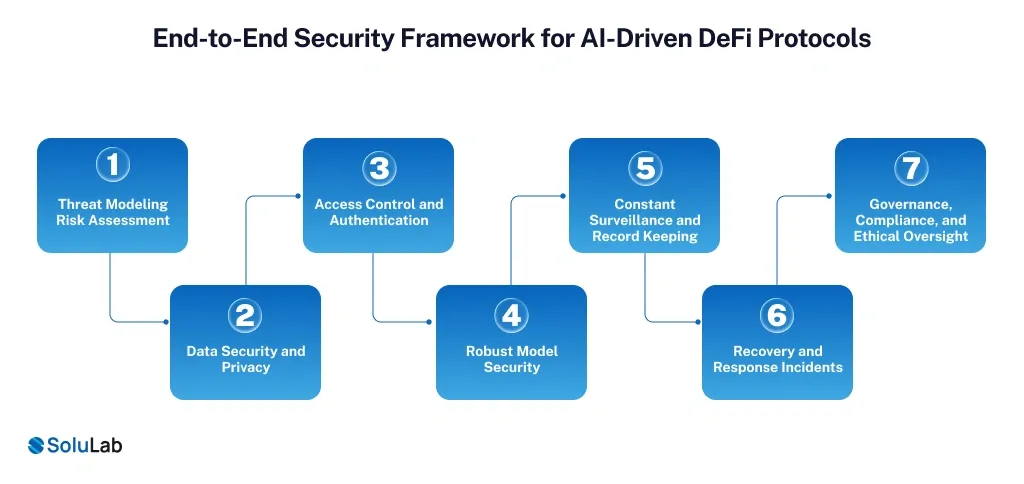
The application of AI agents in critical systems is becoming a commonplace requirement, which demands high-quality security. Planned security infrastructure will guarantee confidentiality, integrity, availability, and resistance to the changing cyber threats and encourage ethical and safe AI implementation.
1. Threat Modeling Risk Assessment
Determine the possible weaknesses of the AI systems through the assessment of information, algorithms, and environments of deployment. Identify map threats and rank risk to create specific security controls to avoid breaches.
2. Data Security and Privacy
Encrypt, anonymize, and secure the training and operational data. Make sure that the privacy rules are adhered to and minimize the possibilities of information leakage or unauthorized access.
3. Access Control and Authentication
Establish tough role-based access and multi-factor authentication. To avoid insider threats, restrict access to sensitive AI components and track user activities.
4. Robust Model Security
Secure an AI model against adversarial attacks, model theft, or compromise. Proactively defend using approaches such as model watermarking, input validation, and anomaly detection.
5. Constant Surveillance and Record Keeping
Implement real-time performance monitoring capabilities to monitor the performance of AI systems, identify anomalies, and record security incidents. With continuous monitoring, upcoming threats are immediately responded to.
6. Recovery and Response Incidents
Provide incident detection, containment, and recovery processes. Test backup system and response plans on a regular basis to ensure that there is minimal disruption in the event of attacks.
7. Governance, Compliance, and Ethical Oversight
Ensure that policies, documentation, and audits are consistent with regulatory standards. Consider ethical, transparency, and accountability in order to create trust towards AI systems.
Future of AI Agents in DeFi Security
Securities are being transformed by the introduction of AI into decentralized finance (DeFi). Anomaly detection provided by AI will increase protection, and new standards will prevent unsafe and irresponsible autonomous operations.
- Proactive security scanning and detection of anomalies: AI models can scan DeFi networks in real time, detect vulnerabilities and unusual transactions before they can be exploited, and minimize financial and systemic risk.
- Practices related to agent safety: The creation of universal safety measures of AI agents can guarantee reliability and ethical functioning, as well as cross-ready work, and prevent the risks of autonomous decision-making in a financial system.
- Striking the balance between autonomy and accountability: Although AI agents can be utilized to facilitate efficient automated functions, it is critical to have human control and clear accountability models that would help avoid the unintended effects or malicious intent.

Conclusion
AI agents have a dual role in the fast-moving DeFi ecosystem, as they both increase efficiency and create new security issues. The emerging threats, such as smart contract exploits, flash loan attacks, and AI-driven market manipulations, require forward-looking protection strategies.
The protocols can be made more resilient by incorporating AI-based monitoring, anomaly detection, and automated risk assessment. Furthermore, the use of high-quality encryption, privileged access, and organizational regulations will guarantee the security of operations and the trust of users.
With the growth of DeFi protocols, the emergence of new threats, the responsible application of AI, and joint security will be crucial to protecting decentralized financial systems against more adversarial attacks.
SoluLab, an AI agent development company, can help in identifying suspicious activity and protect your smart contracts. Book a free discovery call today to discuss further!
FAQs
Neha is a curious content writer with a knack for breaking down complex technologies into meaningful, reader-friendly insights. With experience in blockchain, digital assets, and enterprise tech, she focuses on creating content that informs, connects, and supports strategic decision-making.