Key Takeaways
- AI agents for cybersecurity help businesses detect threats, investigate alerts, support SOC teams, and improve response workflows.
- AI Agents in Modern Security Operations can reduce alert fatigue by enriching, grouping, and prioritizing security events.
- Agentic AI Security is essential because agents may access sensitive systems, call tools, and influence security actions.
- A strong AI agent security framework should include least-privilege access, secure tool use, human oversight, monitoring, testing, and incident controls.
- Businesses need experienced AI Agent development services when building secure, scalable, enterprise-grade cybersecurity AI agents.
- SoluLab helps businesses build custom AI-powered cybersecurity solutions with practical architecture, secure integrations, and product-ready AI agent workflows.
For cybersecurity product development in 2026, businesses need systems that can understand risk, investigate events, support analysts, and respond faster. AI agent development for cybersecurity help to do that! These intelligent agent systems observe the data, reason through incidents, and support threat detection. These agents can reduce manual work, improve investigation speed, and turn large security datasets into practical decisions.
This guide explains how Agentic AI in cybersecurity works, where businesses can use it, what risks they must manage, and how to build secure AI-powered cybersecurity solutions.
Understanding The Role Of AI Agents In Cybersecurity
AI agents for cybersecurity help businesses move from slow, manual investigation to faster, context-driven security operations. They not only detect threats; they connect signals across SIEM, EDR, IAM, cloud platforms, email tools, and ticketing systems.
A cybersecurity AI agent can review alerts, check related activity, assess risk, and suggest the next action. This matters because modern security teams handle too much data with limited time. With proper guardrails, AI Agents in Modern Security Operations support analysts, reduce noise, and help businesses respond to threats before they turn into larger incidents.
Benefits Of AI Agents For Cybersecurity
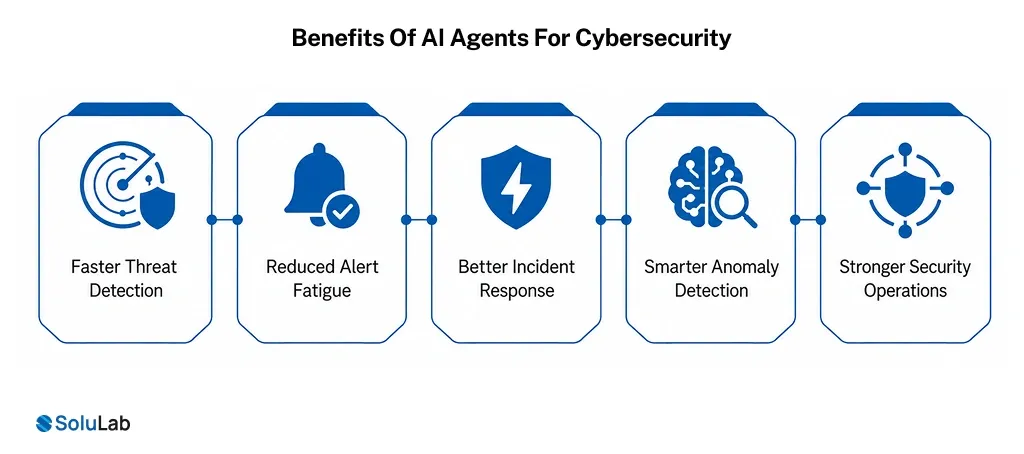
1. Faster Threat Detection
AI agents for cyber defense help security teams detect threats faster by reviewing large volumes of logs, alerts, and user activity in real time. Instead of waiting for analysts to check every dashboard, agents connect patterns quickly and highlight risks that need immediate attention.
2. Reduced Alert Fatigue
Security teams often waste time on duplicate or low-priority alerts. AI agents for security operations can group similar alerts, remove noise, and rank incidents based on real business risk. This helps analysts focus on serious threats instead of spending hours on repetitive checks.
3. Better Incident Response
A cybersecurity AI agent can collect evidence, create timelines, summarize findings, and recommend response steps. This makes incident handling more structured and less stressful. With human approval for sensitive actions, businesses can respond faster while still keeping control over critical security decisions.
4. Smarter Anomaly Detection
AI-powered anomaly detection helps businesses spot unusual behavior across users, devices, applications, and cloud systems. An AI agent adds context by checking whether the activity matches normal patterns or signals a real threat. This improves accuracy and reduces unnecessary panic.
5. Stronger Security Operations
Agentic AI in Cybersecurity helps teams work with better visibility and speed. They support phishing analysis, vulnerability prioritization, threat intelligence, and compliance monitoring. For businesses building AI-powered cybersecurity solutions, agents create more value because they turn security data into practical action.
AI in Cybersecurity vs AI Agents in Cybersecurity
AI in cybersecurity and AI agents for cybersecurity help businesses improve cyber defense, but they work in different ways. Traditional AI usually supports one specific task, while AI agents can manage a complete security workflow with controlled autonomy.
| Area | AI in Cybersecurity | AI Agents in Cybersecurity |
| Core Function | Detects, predicts, or classifies security events. | Observes, reasons, plans, and acts within approved workflows. |
| Scope | Usually handles one narrow task, such as malware detection or spam classification. | Handles multi-step security tasks such as alert investigation, evidence collection, and response guidance. |
| Decision Support | Provides scores, labels, alerts, or predictions. | Reviews context, connects signals, and suggests the next best action. |
| Workflow Ability | Supports a single part of the security process. | Supports the full security workflow from detection to investigation and response. |
| Example | Flags a suspicious file, risky login, or cloud misconfiguration. | Checks whether the asset is public, reviews data exposure, identifies who made the change, verifies policy impact, and recommends remediation. |
| Human Role | Analysts interpret the AI output and decide what to do next. | Analysts review agent findings, approve sensitive actions, and guide final decisions. |
| Business Value | Improves accuracy and speed for specific security functions. | Improves operational efficiency, response speed, and decision quality across security operations. |
| Best Fit | Detection engines, spam filters, malware scanners, and anomaly scoring tools. | SOC automation, phishing investigation, vulnerability prioritization, threat intelligence, and incident response. |
AI Agent Use Cases in Cyber Security
The best AI Agent use cases in cyber security focus on high-volume, context-heavy, repetitive security work. These are areas where analysts spend time collecting information, comparing signals, and writing summaries.
1. SOC Alert Triage
SOC teams receive alerts from many systems. Some alerts are urgent. Many are noise. AI agents can group related alerts, remove duplicates, enrich indicators, and rank incidents based on risk. A SOC triage agent can review user behavior, asset importance, threat intelligence, and historical activity. It can then create a short case summary for the analyst. This helps teams save time and focus on real threats.
2. AI-Powered Anomaly Detection
AI-powered anomaly detection helps identify behavior that looks unusual compared with normal activity. This may include strange login times, unusual device use, abnormal API calls, unexpected data exports, or rare admin actions. An AI agent can add context to these anomalies. It can check whether the user is traveling, whether the device is trusted, whether the account has sensitive access, and whether similar activity has happened before. This makes anomaly detection more useful for real security decisions.
3. Phishing Investigation
Phishing remains a major business risk. AI agents can inspect emails, analyze sender reputation, check URLs, review attachments, detect impersonation, and search for similar messages across inboxes. A phishing agent can also suggest actions such as quarantine, user notification, password reset, or domain blocking. For businesses building email security platforms, this is one of the strongest AI-powered solutions.
4. Threat Intelligence Analysis
Threat intelligence creates value only when teams can connect it to their own environment. Reports, indicators, dark web mentions, malware campaigns, and attacker tactics can overwhelm analysts. An AI agent can summarize threat reports, extract indicators, compare them with internal assets, and explain which findings matter. This helps security teams move from “more information” to “clear action.”
5. Vulnerability Prioritization
Many companies scan their systems and find hundreds or thousands of vulnerabilities. The difficult part is knowing what to fix first. An AI agent can combine severity, exploit availability, asset exposure, business importance, patch complexity, and active threat signals. It can then create a practical remediation order. This is more useful than a long vulnerability list with no business context.
Businesses connecting cybersecurity with enterprise risk can also explore SoluLab’s guide on AI in risk management.
6. Cloud Security Monitoring
Cloud environments change quickly. Developers launch workloads, create storage buckets, modify access rules, deploy APIs, and update permissions. AI agents can monitor cloud posture and flag risky changes. They can identify exposed storage, excessive permissions, weak configurations, and unusual access activity. For SaaS, fintech, healthcare, logistics, and enterprise platforms, cloud security agents can reduce hidden operational risk.
7. Identity and Access Risk Management
Identity is one of the most important attack surfaces. Attackers often target accounts, credentials, session tokens, and privileged users. An AI agent can monitor login behavior, check privilege changes, detect dormant accounts, and recommend access reviews. It can also support zero-trust workflows by checking whether the user, device, location, and requested action match expected behavior.
8. Incident Response Support
Autonomous AI agents for cybersecurity can support incident response by collecting evidence, creating timelines, drafting reports, and recommending containment steps. They can also open tickets, notify stakeholders, and prepare analyst summaries. High-impact actions should still require human approval. For example, disabling an executive account or blocking production traffic should not happen without clear controls.
9. Compliance Monitoring
AI for Compliance teams needs evidence, policy records, logs, access reviews, and audit trails. AI agents can collect evidence, map controls, identify missing documents, and prepare audit summaries. This can support frameworks such as SOC 2, ISO 27001, HIPAA, PCI DSS, and GDPR readiness. The agent should assist compliance teams, not replace legal or audit professionals.
10. Secure Software Development
AI agents can support DevSecOps by reviewing code, checking dependencies, finding exposed secrets, suggesting secure fixes, and preparing security test cases. They can also inspect pull requests and identify risky changes before code reaches production.
Prompt Injection Attacks: How Hackers Manipulate AI Agent Behavior
Prompt injection is one of the most important AI agent security risks. It happens when malicious instructions are hidden inside content that an agent reads. That content may come from an email, PDF, website, support ticket, chat message, code file, or knowledge base article. Prompt injection is dangerous because AI agents understand and act through language. Attackers use the same channel to mislead them.
For businesses, this is not just a technical flaw. It is a product safety issue. A secure agent should separate trusted instructions from untrusted content, limit tool access, validate every action, and ask for human approval before sensitive steps.
How Do Attackers Use AI Agents Against Organizations?
Businesses also need to prepare for AI-driven cybercrime. Attackers can use AI to scale phishing, reconnaissance, social engineering, malware testing, vulnerability research, and fake communication.
They can create personalized emails, analyze leaked data, scan public systems, imitate executives, and test attack paths faster than before. This does not mean every attacker uses advanced AI integration tools. It means the cost of creating convincing attacks is falling.
Organizations should expect faster campaigns, more tailored phishing, and greater automation. The answer is not fear. The answer is stronger defense.
AI agents for cyber defense can help security teams analyze threats faster, monitor systems better, and respond with more consistent workflows.
What Businesses Must Get Right Before Building Cybersecurity AI Agents?
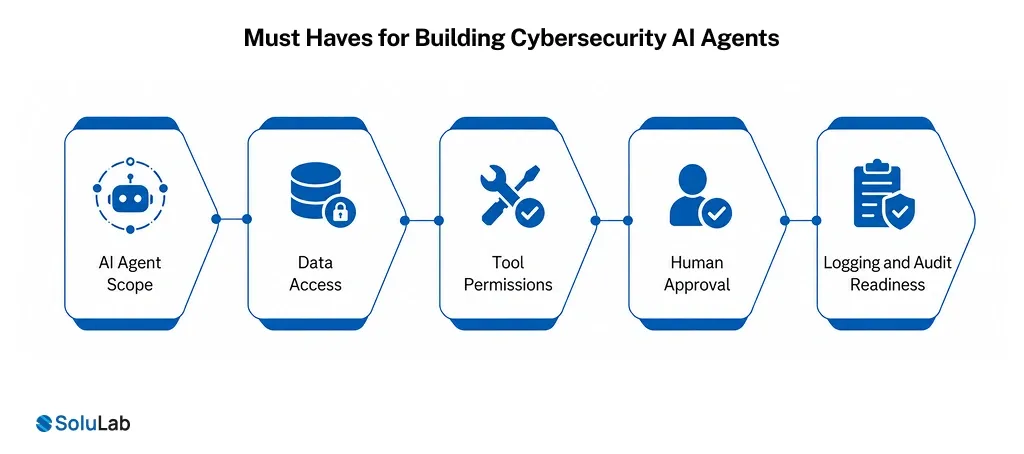
A cybersecurity AI agent is not just an AI feature. It is a security product with operational impact. Before AI-led development starts, businesses need clear answers on scope, data access, tool permissions, compliance, integrations, and risk controls.
AI Agent Scope
The business should define what the agent can and cannot do. A phishing agent should not manage cloud permissions. A compliance agent should not disable users. A vulnerability agent should not change production systems without approval. Clear scope reduces risk and prevents over-automation.
Data Access
The agent should only access the data needed for its task. Security logs, customer records, identity data, cloud activity, and tickets may contain sensitive information. Access should follow the least-privilege principle from the beginning.
Tool Permissions
AI agent systems become risky when they can call powerful tools without limits. A secure design should define which tools the agent can use, what actions it can perform, and when approval is required.
Human Approval
Businesses should keep people involved for high-risk actions. The agent can recommend account suspension, but a human should approve it. The agent can prepare a firewall rule, but a security lead should review it. This keeps the speed high without losing control.
Logging and Audit Readiness
Every agent action should be traceable. The system should record what the agent reviewed, what it decided, which tool it used, who approved the action, and what happened next. This helps with audits, debugging, compliance, and incident review.
AI Agent Security Framework for Enterprises: Key Controls Businesses Need
A strong Agentic AI framework helps businesses connect AI governance with cybersecurity architecture. It defines how AI agents for cybersecurity should access data, use tools, make decisions, and stay within safe operational limits.
1. Define Clear Agent Objectives
Every cybersecurity AI agent needs a defined purpose, workflow, success metric, approved data source, permitted tool, and escalation rule before development begins.
2. Apply Least-Privilege Access
The agent should only access what it needs. Narrow, role-based, monitored, and revocable permissions reduce major AI agent security risks.
3. Separate Instructions From Data
System rules, user requests, developer instructions, and external content should stay separate to reduce prompt injection and unsafe agent behavior.
4. Validate Every Tool Call
Before an agent uses an API or takes action, the system should verify that the step is safe, relevant, and allowed.
5. Add Human-in-the-Loop Controls
Sensitive actions such as disabling accounts, deleting data, or changing production settings should require human approval before execution.
6. Monitor Agent Behavior
Businesses should track outputs, tool use, failures, unusual activity, and repeated risky decisions to keep cybersecurity AI agents accountable.
7. Red Team the Agent
Security teams should test prompt injection, malicious documents, poisoned memory, unsafe commands, and privilege escalation before AI deployment.
8. Build a Kill Switch
If an agent behaves unexpectedly, teams should be able to pause activity, revoke access, and switch to manual security operations.
Best Practices for Deploying AI Agents Securely
Best Practices for Deploying AI Agents Securely should guide every production rollout.
- Start with one focused workflow, such as SOC alert triage, phishing investigation, or vulnerability prioritization. Use clean and relevant data because poor data creates poor decisions. Keep permissions limited and avoid admin access unless it is truly required.
- Add approval gates for sensitive actions. Validate outputs before they affect real systems. Log every decision and tool call. Test with hostile inputs, including malicious emails, PDFs, tickets, and web pages.
- Businesses should also review AI model behavior regularly. Agent performance can change when prompts, models, tools, or data sources change. Teams should protect sensitive data through masking, access control, or tokenization where possible.
- Security analysts also need training. They should understand what the agent can do, where it may fail, and when to challenge its recommendation.
- A staged rollout is the safest path. Start with read-only access, move to controlled recommendations, and then allow limited action after the agent proves reliable.
Step-by-Step Process for AI Agent Development in Cybersecurity
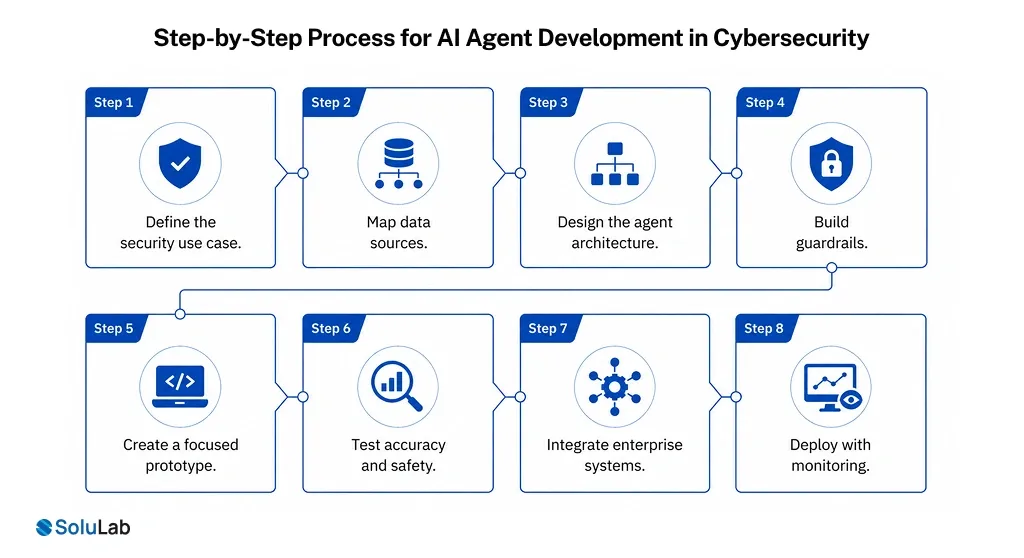
Step 1: Define the security use case.
Decide whether the agent will support SOC triage, phishing analysis, cloud monitoring, vulnerability prioritization, identity risk, compliance, or incident response.
Step 2: Map data sources.
Identify which systems the agent needs to read, such as SIEM, SOAR, EDR, IAM, cloud platforms, email gateways, threat feeds, ticketing tools, and asset databases.
Step 3: Design the agent architecture.
Define the model, orchestration layer, memory, APIs, workflows, permissions, and monitoring tools. This is where experienced AI consulting solutions become important.
Step 4: Build guardrails.
Control inputs, outputs, tool calls, sensitive data access, and escalation paths. Security should shape the prototype, not follow it.
Step 5: Create a focused prototype.
It should solve one real business problem instead of trying to automate every security workflow at once.
Step 6: Test accuracy and safety.
Check false positives, missed threats, hallucinations, prompt injection, unsafe tool use, and data leakage.
Step 7: Integrate enterprise systems.
Connect the agent with ticketing, analyst review, case management, dashboards, and approval workflows.
Step 8: Deploy with monitoring.
Start with limited access and expand autonomy only after performance and safety are proven.
Secure vs Weak Cybersecurity AI Agent Development
| Area | Secure AI Agent Development | Weak AI Agent Development |
| Planning | Starts with use case, risk model, and workflow design. | Starts with a generic chatbot demo. |
| Access | Uses least-privilege permissions and clear roles. | Gives broad access to tools and data. |
| Prompt Injection | Treats external content as untrusted. | Allows emails, files, or tickets to control behavior. |
| Tool Use | Validates actions before execution. | Let the agent call APIs without guardrails. |
| Oversight | Requires approval for sensitive actions. | Pushes automation too quickly. |
| Logging | Records decisions, access, approvals, and tool calls. | Keeps incomplete records. |
| Testing | Includes red teaming and hostile input testing. | Tests only normal prompts. |
| Scaling | Builds for governance, audits, and enterprise use. | Requires major rework before production. |
Common Mistakes in AI Agent Security
1. Giving AI Agents Too Much Access
Broad permissions increase AI agent security risks. Businesses should use least-privilege access, role-based controls, and approval gates.
2. Ignoring Prompt Injection Risks
Prompt injection can manipulate AI agents for cybersecurity through emails, documents, tickets, or web pages. Test agents with malicious inputs.
3. Trusting AI Output Blindly
Cybersecurity AI agents can make confident mistakes. Add validation, confidence scoring, analyst review, and rollback options before taking action.
4. Building Without Audit Logs
Without audit logs, businesses cannot explain agent decisions. Secure AI-powered cybersecurity solutions need traceable actions, approvals, and tool records.
5. Choosing the Wrong Development Partner
Some vendors build AI demos, not secure platforms. Choose an AI development company with cybersecurity and enterprise experience.
Build Secure AI Agents for Cybersecurity With SoluLab
SoluLab helps businesses build secure, scalable, and enterprise-ready AI-powered cybersecurity solutions. Our #1 AI development company in the USA supports strategy, architecture, AI agent development, workflow automation, cybersecurity integrations, cloud deployment, and secure product engineering.
Whether a business wants to build autonomous AI agents for cybersecurity, SOC automation tools, phishing investigation agents, threat detection platforms, or custom security copilots, Swe can help turn the idea into a practical product. From planning to deployment, our team creates secure, reliable, and market-ready AI agent solutions with clarity and confidence.
FAQs
Shipra Garg is a tech-focused content strategist and copywriter specializing in Web3, blockchain, and artificial intelligence. She has worked with startups and enterprise teams to craft high-conversion content that bridges deep tech with business impact. Her work translates complex innovations into clear, credible, and engaging narratives that drive growth and build trust in emerging tech markets.