
Key Highlights
- A crypto payment gateway gives businesses a structured way to accept digital assets.
- A solid cryptocurrency payment gateway handles checkout, settlement, wallet flows, and reporting in one place.
- A crypto to fiat payment gateway lets merchants accept crypto without sitting on price risk.
- The best crypto payment gateway balances security, usability, and merchant control.
- Well-planned crypto payment gateway development helps businesses reach global users more efficiently.
Payment teams feel pressure from two directions at once. Customers keep asking for more ways to pay. Merchants want faster cross-border settlement with less friction and fewer limits. That squeeze is exactly what’s pushing the Crypto Payment Gateway into the picture. Plenty of companies now find crypto payments genuinely useful for digital-first customers, global buyers, and markets where the usual payment rails are slow or costly.
The market for crypto payment gateways is projected to reach $5.37 billion by 2032, having 17.8% CAGR. A Cryptocurrency payment gateway solution can support digital asset payments, help manage settlement, and give the business more control over its funds. This guide walks through why a crypto payment gateway matters for business transactions in 2026.
Deciphering The Crypto Payment Gateway
A Crypto Payment Gateway is a payment system businesses use to accept cryptocurrency from customers in a merchant-friendly way. Through these payment rails, a business can verify a payment, track it, and settle in cryptocurrency, fiat, or both.
A good payment gateway for cryptocurrency does more than just display a wallet address. It can bundle hosted checkout, QR payments, wallet support, payment confirmation, merchant alerts, dashboards, and payout controls. That’s why more companies now treat a crypto payment provider as a real piece of their payment infrastructure, not an add-on.
A cryptocurrencies payment gateway sits between the customer making the payment and the merchant receiving the funds. It turns a blockchain transaction into a checkout flow the business can actually work with.

Why Do Businesses Need Crypto Payment Gateways?
Businesses need payment systems that keep up: faster transactions, global customers, lower friction, more flexibility. Here’s why that’s pushing crypto gateways forward.
- Customer habits are changing
More customers already hold crypto in personal wallets. Some would rather spend those assets on purchases, subscriptions, and online services than let them sit idle. That shift alone is driving demand for crypto payment gateways that make paying with crypto simple at checkout.
- Cross-border payments still have gaps
International payments can still be slow, expensive, and a hassle to manage. A cryptocurrency payment gateway gives businesses another route for taking payments from customers anywhere.
- Merchants want more control
Most businesses don’t want to depend on a single payment rail. They want a real say in how they accept funds, how those funds settle, and which customers they can actually serve. That’s where a Crypto Payment Gateway for Businesses earns its place.
Core Features That Define A Strong Crypto Payment Gateway
A strong gateway pulls together security, direct payment flows, global coverage, fast processing, and flexible settlement controls for the merchant.
- Security
Security sits at the center of any cryptocurrency payment gateway solution. Blockchain technology records already make tampering with a transaction harder. On top of that, providers typically layer in encryption, multi-signature controls, and secure transaction checks to protect both merchant and customer data.
- Direct payments
A strong cryptocurrency payment solution supports direct transfers without stacking unnecessary layers between customer and merchant. Fewer layers means less friction in the payment process.
- International coverage
A useful payment gateway for cryptocurrency should handle payments from users across regions without the delays typical of traditional systems. That matters a lot once a company starts selling across borders.
- Fast processing
Crypto gateways can move fast because they rely on blockchain verification rather than a chain of banking intermediaries. That speed shows up directly in how quickly merchants can handle a payment.
- Lower fees
Compared with a lot of traditional processors, crypto payment gateways can cut transaction costs. Worth a close look if you’re watching payment margins.
How A Cryptocurrency Payment Gateway Works?
Here’s the step-by-step version of how a crypto payment gateway actually functions.
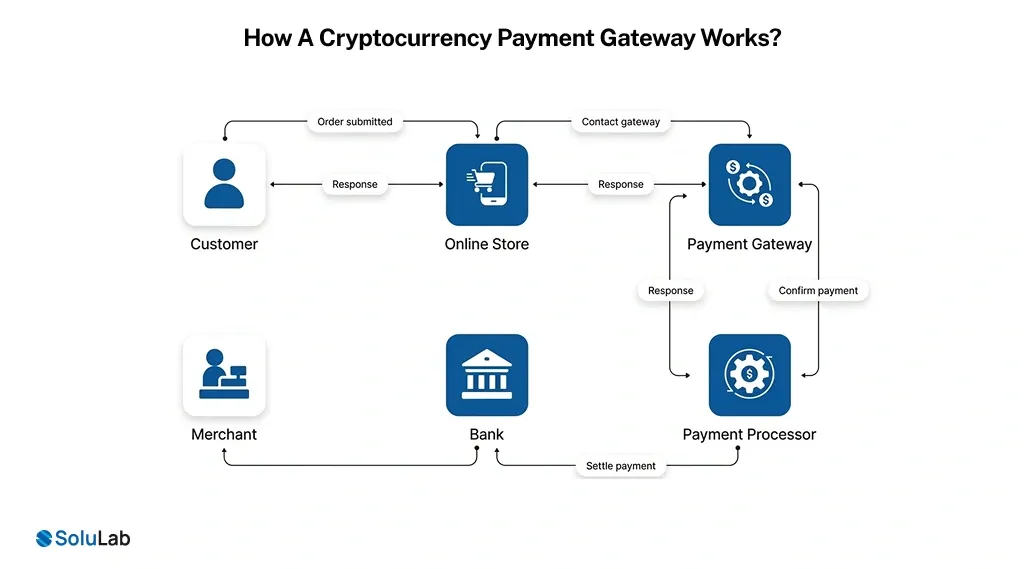
Step 1: The customer chooses crypto
It starts the moment the buyer picks cryptocurrency at checkout. The system shows the supported payment asset and prepares the payment request.
Step 2: The gateway creates the payment request
The cryptocurrency payment gateway generates a wallet address, QR code, or payment link tied to that specific order. The customer sends funds from a crypto wallet against that request.
Step 3: The blockchain confirms the payment
Once the payment goes out, the blockchain network checks and confirms the transaction. The gateway watches that process and verifies the expected amount actually arrived.
Step 4: The system applies settlement rules
After confirmation, funds move according to however the merchant has things set up. Some businesses take crypto directly. Others run it through a crypto-to-fiat payment gateway, so the amount converts before payout.
Step 5: The merchant gets notified
Once the payment clears, the merchant gets notified and can move straight into fulfillment or service delivery. A good cryptocurrency payment gateway solution keeps this step fast and unambiguous.
Step 6: The customer gets confirmation
The customer gets their own confirmation too, whether that’s a receipt, an order message, or a success screen. That closes the loop and builds trust in the checkout flow.
Why Businesses Invest In Crypto Payment Gateway Development?
Businesses invest here to add a new payment rail, reach global customers, cut friction, and build more payment flexibility over time.
- It helps them add a new payment rail.
A sound crypto payment gateway development plan gives a business a workable way to accept digital assets without ripping out its entire payment setup.
- It supports global sales
A cryptocurrencies payment gateway helps businesses reach customers in more regions, especially where crypto usage runs high or banking access is spotty.
- It reduces payment friction for some users
Customers who already prefer crypto don’t want to slog through a long payment process at checkout. A clean cryptocurrency payment gateway keeps that flow simple.
- It gives product teams more room to build
A custom cryptocurrency payment gateway solution can support stablecoin payments, merchant payout settings, loyalty use cases, smart automation, and custom integrations. That matters if you’re building a payment product for the long haul.
Benefits for customers and merchants
- Benefits for customers
Customers get more privacy, stronger control over their own funds, and easier access to cross-border payments. Crypto-based payments also loosen dependence on banking limits in a lot of cases. Token-based rewards and similar models can sweeten the payment experience further.
- Benefits for merchants
Merchants can trim processing costs, lower chargeback exposure, reach global customers more easily, and support smaller transactions where it makes sense. A capable crypto payment provider can also back loyalty models and automate chunks of payment handling.
How To Plan A Crypto Payment Gateway For Businesses?
A payment gateway plan that actually works starts with business goals, asset choices, security requirements, compliance needs, and clear launch priorities.
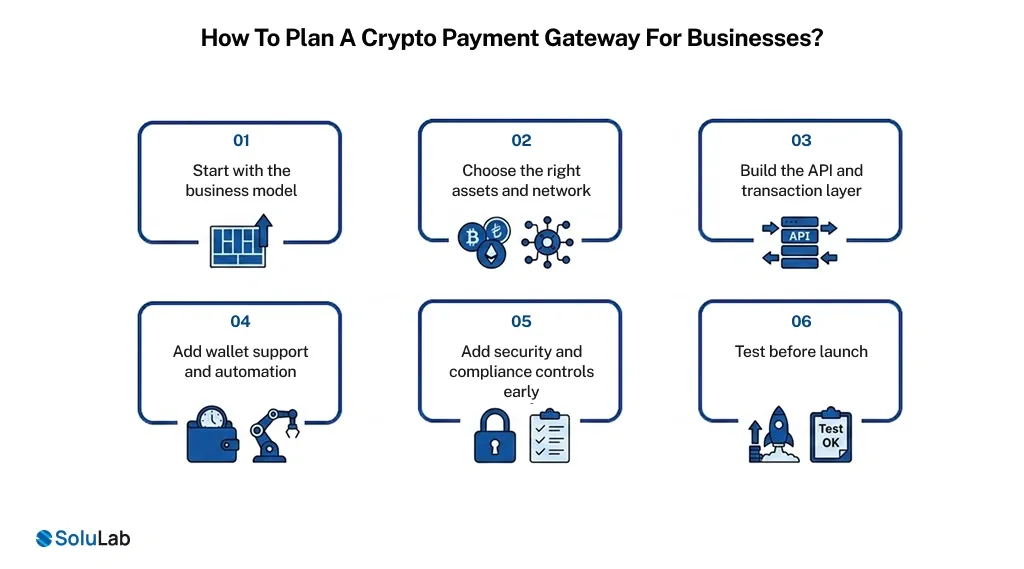
- Start with the business model
Step one is deciding how the business actually plans to use the gateway. A marketplace, a SaaS product, an ecommerce store, and a fintech platform each need a different payment flow. A strong Crypto Payment Gateway for Businesses starts from that business case, not from the tech.
Read more- https://www.solulab.com/launch-crypto-payment-gateway-like-stripe/
- Choose the right assets and network
Some companies want Bitcoin and Ethereum support. Others want stablecoins first, full stop. The blockchain and asset mix you pick shapes settlement speed, cost, and what users actually prefer.
- Build the API and transaction layer
The API ties together the checkout flow, merchant backend, wallet interaction, and blockchain handling. It’s the core of the whole cryptocurrency payment gateway solution.
- Add wallet support and automation
Wallet integration is table stakes for any payment gateway for cryptocurrency. Automation can also take on payment checks, internal triggers, and settlement handling.
- Add security and compliance controls early
KYC, AML, transaction monitoring, and access controls need to be planned in from day one, not bolted on later. Businesses eyeing crypto payment gateway services need more than the ability to accept payments. They need a system that holds up under real operating conditions.
- Test before launch
A live payment product needs security testing, performance checks, and end-to-end payment validation before it goes anywhere near production. That’s just part of responsible crypto payment gateway development.

What Shapes Crypto Payment Gateway Development Cost?
The cost of crypto payment gateway development tracks how simple or advanced the product needs to be. A basic version might cover wallet payments, a dashboard, payment tracking, and simple KYC. A bigger build might add fiat conversion, advanced reporting, merchant roles, external integrations, and heavier compliance tooling.
Major crypto payment gateway development cost factors usually come down to blockchain choice, security layers, custom features, compliance requirements, testing, and third-party integrations. Costs climb further when a business wants enterprise-grade performance, deeper reporting, or broader asset support.
There’s no single standard price tag for building a cryptocurrency payment gateway. The budget comes down to product scope and operating requirements, full stop.
What To Look For In The Best Crypto Payment Gateway?
Before picking a provider, businesses should compare usability, security, settlement options, integration fit, reporting quality, and asset support:
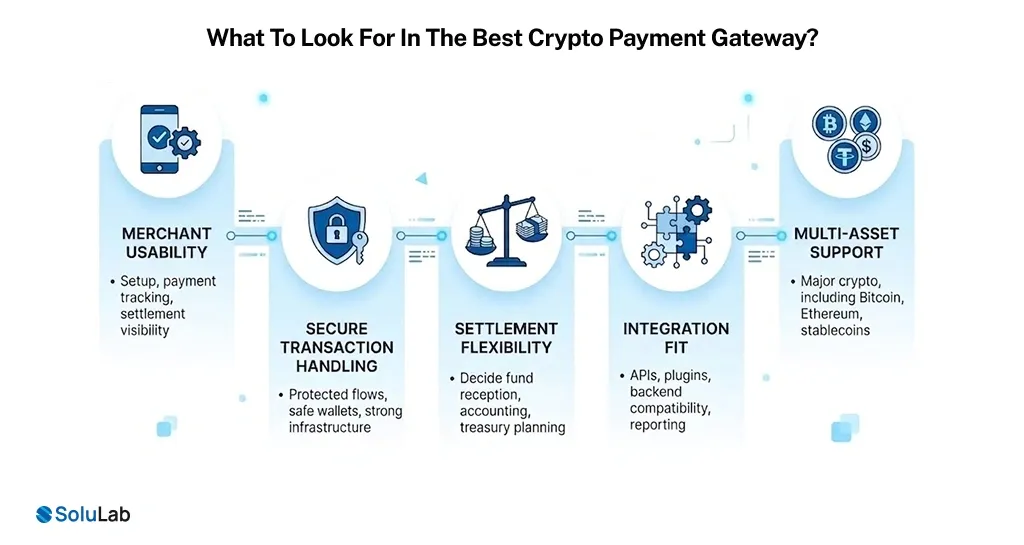
- Merchant usability
The best crypto payment gateway should be easy for a merchant to run day to day: setup, payment tracking, settlement visibility, basic operations, all of it.
- Secure transaction handling
A reliable crypto payment provider should support protected payment flows, safe wallet handling, and solid infrastructure controls.
- Settlement flexibility
A good crypto-to-fiat payment gateway should let merchants decide how they want to receive funds. That choice matters for accounting, treasury planning, and managing volatility.
- Integration fit
The Best Cryptocurrency Payment Gateways fit into real business systems. APIs, plugins, backend compatibility, and reporting tools all come into play here.
- Multi-asset support
The best crypto payment gateway supports whatever assets merchants and customers are actually likely to use, Bitcoin, Ethereum, and stablecoins included where relevant.
Leading Names Businesses Often Benchmark
When businesses compare the Best Cryptocurrency Payment Gateways, they often look at providers such as Coinbase, BitPay, and PayPal. These names matter because they reflect the features merchants now expect from a modern cryptocurrency payment gateway.
The bigger point is simple. Merchant expectations have gone up. The best crypto payment gateway needs usability, settlement flexibility, reporting, and trust, all in one system.
Future trends in crypto payment gateway solutions
Stablecoins, hybrid settlement models, and sharper merchant tools are shaping the next phase of crypto payment gateway adoption for businesses.
1. Stablecoins will keep gaining ground
Stablecoins are likely to play a bigger role in where the Crypto Payment Gateway heads next, mostly because they’re easier for merchants to work with than more volatile assets.
2. Hybrid settlement will matter more
More businesses will want crypto acceptance paired with fiat payout. That keeps the crypto-to-fiat payment gateway model firmly in play.
3. Merchant infrastructure will improve
The next wave of crypto payment gateways will get judged on reliability, reporting, compliance support, payout options, and how practical the merchant controls actually are.

Final thoughts
A useful Crypto Payment Gateway Guide should focus on the business decisions, not just the payment mechanics. The real question is how you want payments to work across checkout, settlement, reporting, and day-to-day operations.
A well-built cryptocurrency payment gateway gives merchants another way to serve customers, handle global payments, and build in more payment flexibility. If you’re evaluating the best crypto payment gateway, the right option is whichever one actually fits your payment model, your users, and where you’re headed.
Why SoluLab fits this opportunity?
SoluLab, a top cryptocurrency development company, is well placed to help businesses build a secure and scalable Crypto Payment Gateway with real commercial use behind it. With experience across blockchain, Web3, neobanking, and cryptocurrency solutions, the team can support crypto payment gateway development, merchant payment flows, wallet integration, and broader crypto payment gateway services for businesses that want a practical cryptocurrency payment gateway solution.
Have a unique idea in your mind? We are all in to assist you with the best!
FAQs
Shipra Garg is a tech-focused content strategist and copywriter specializing in Web3, blockchain, and artificial intelligence. She has worked with startups and enterprise teams to craft high-conversion content that bridges deep tech with business impact. Her work translates complex innovations into clear, credible, and engaging narratives that drive growth and build trust in emerging tech markets.