A quiet yet irreversible shift is underway in the UAE’s payment ecosystem. With $34B in crypto inflows, 500,000+ daily traders, and 1 in 3 residents projected to use crypto by 2026, customer behavior has already shifted. The only question is whether your payment stack has kept up.
For founders and enterprises in Dubai or Abu Dhabi, the real risk isn’t regulation or demand – it’s being late. While competitors run compliant crypto payment gateways in the UAE, businesses stuck with cards and wires bleed margins, lose speed, and quietly forfeit global customers.
This is why UAE Crypto Payment Solutions are no longer optional in innovation; they are core payment infrastructure. Choose the right crypto payment gateway development partner like SoluLab now, or pay later in lost revenue, trust, and market relevance.
Key Takeaways
- Traditional payment systems carry high fees, delayed settlements, and limited cross-border reach, hindering retail and enterprise growth.
- Crypto payment gateways offer real-time settlement, lower fees, and broader global acceptance.
- Enterprises adopting crypto payments see improved conversion rates, reduced chargebacks, and access to new markets.
- SoluLab builds compliant, enterprise-grade crypto payment gateways by integrating wallets, POS, and settlement systems to boost adoption, reduce costs, and maximize ROI for UAE businesses.
What Is a Cryptocurrency Payment Gateway?
Think of a Crypto Payment System as another payment rail that sits next to cards, bank transfers, and real‑time local schemes. A customer pays you in BTC, ETH, USDT, or another supported asset; underneath, the gateway handles rates, confirmations, and settlement, and you receive either crypto, fiat (AED), or a mix based on your policy.
When people talk about crypto payment systems in the UAE, they are usually referring to regulated providers that can:
- Quote prices in AED or USD in real time
- Accept a basket of cryptocurrencies and stablecoins
- Instantly convert to AED and send funds to your corporate bank account
- Expose clear reporting for audit, tax, and reconciliation.
Under that umbrella, a Crypto Payment Gateway Solution is the specific product that plugs into your stack – your website, app, invoicing tool, or POS.
Is It Legal for UAE Companies to Integrate Crypto Payment Gateways?
This is the first thing every board asks, and rightly so. The short answer: yes, accepting crypto is possible and increasingly common, if you do it through the right regulated rails.
Using a Crypto Payment Gateway in the UAE legally mainly comes down to two questions:
- Who holds the licence?
- What exactly are you doing with the assets (payments vs trading vs investing)?
At the federal level, the Securities and Commodities Authority (SCA) and the Central Bank of the UAE oversee virtual assets, while Dubai’s VARA, ADGM’s FSRA in Abu Dhabi, and free zones like DMCC and DIFC provide detailed regimes for virtual-asset activities.
Read More: How to Ensure VARA Compliance in Your Blockchain Solution?
If you simply accept payments via a licensed provider offering UAE Crypto Payment Solutions, you are usually not acting as a virtual asset service provider yourself. Instead, you sit on top of their licence, similar to how merchants use card acquirers.
Note: Regulators treat crypto payments in the UAE as part of the supervised financial system. This means strict adherence to KYC/AML, sanctions checks, and travel-rule requirements is mandatory.
Why UAE Businesses Are Adopting Crypto Payment Gateway Solutions?
Let’s look at this the way a CFO or founder would, not as hype, but as P&L, risk, and customer experience.
First, when you integrate crypto payments, you are not turning your business into a speculative trading desk. You are adding one more rail that can settle faster, reduce FX spread, and open doors to customers who hold a big chunk of their wealth in digital assets. Below is a comparison of why businesses are switching:
| Feature | Traditional Payment Gateway | Crypto Payment Gateway (UAE) |
| Transaction Fees | 1.5% – 3.5% + fixed fees | Typically 0.5% – 1% |
| Settlement Time | T+2 to T+5 days | Minutes to T+1 (Instant for Stablecoins) |
| Chargebacks | High risk of reversible transactions | No chargebacks (Final settlement) |
| Cross-Border | High FX fees & delays | Border-agnostic & low cost |
Compared with legacy acquiring, well‑designed crypto payment systems in the UAE can reduce effective per‑transaction costs, lower chargeback risk, and shrink settlement times from days to minutes or hours. As more affluent customers and global clients expect smooth crypto payments in the UAE, not offering them becomes quite a competitive disadvantage.
And at the enterprise level, a reliable Crypto Payment Gateway in the UAE is less about marketing and more about treasury agility: instant global settlement, better control over FX, and new ways to route liquidity
Who Should Integrate Crypto Payments in the UAE?

If you map UAE industries using crypto payment gateways today, a few obvious clusters show up.
1. Real estate and property developers.
High‑net‑worth buyers already hold a large share of their wealth in digital assets. Crypto‑denominated deposits or full payments can shorten sales cycles and attract international investors who prefer not to move large fiat amounts through legacy correspondent banking every time. Many of the early Crypto Payments projects in the UAE have been in real estate and tokenised property deals.
2. Luxury retail and automotive.
For watches, jewellery, and high‑end cars, crypto is often the least painful way for certain customer segments to spend. A clean checkout, powered by the same rails as other UAE Industries using Crypto Payment Gateways, lets you capture those tickets without friction.
3. E‑commerce and digital businesses.
Here, crypto is less about ticket size and more about reach. Freelancers, SaaS platforms, and marketplaces can get paid by users in regions where card acceptance is poor, but crypto liquidity is strong. Fast settlement and stablecoins can make margins more predictable.
4. Hospitality, travel, and experiences.
Hotels, resorts, and experience platforms see crypto as a way to smooth bookings from guests who already use digital assets daily. With proper KYC and monitoring in place, it becomes another way to de‑risk long international card authorisations.
Across all of these, being visibly part of the group of UAE Industries Using Crypto Payment Gateways is also a signalling effect. It says we understand where finance is going to both customers and potential investors.
Read More: How to Build a Crypto Exchange Like Bybit in Dubai?
Key Features to Evaluate Before Choosing a Crypto Payment Gateway in the UAE
When you evaluate a Crypto Payment Gateway Solution, it helps to break the checklist into a few buckets: regulation, currencies, integration, security, and operations, and you need to ensure your provider offers:
- Auto-Conversion: Ability to instantly convert crypto to AED to avoid volatility.
- Multi-Currency Support: Acceptance of USDT, USDC, BTC, and ETH.
- Integration: Robust SDKs and APIs that fit into your ERP or POS.
- Security: Enterprise-grade wallets, encryption, and regular audits.
How to Choose a Crypto Payment System for Businesses Operating in the UAE?
Start with a simple rule – define your constraints before you talk to anyone’s sales team. That means listing the must‑haves before you engage any crypto payment gateway development company:
- Which regulators are you comfortable with (VARA, ADGM, DIFC, DMCC, offshore)
- What volumes and ticket sizes you expect
- Whether you want to hold crypto on the balance sheet or always convert to AED
- Which banks you use today and their stance on digital assets?
Now you know the question, but you still need to do a few things –
1. Bring product and engineering in from day one.
If crypto payments are being added to checkout, invoices, or subscriptions, don’t treat it like a plug-in. Engineers will spot things early – refunds, partial payments, currency mismatches- that are painful to fix later.
2. Ask what happens after go-live.
A gateway isn’t done at launch. You’ll want clarity on monitoring, incident handling, uptime guarantees, and whether they can give you reports that banks or regulators might ask for.
3. Work with teams that understand the UAE, not just crypto.
Mid-market and enterprise setups need expert blockchain companies who know free-zone vs mainland rules, token classifications, and how cross-border flows actually clear in the UAE.
4. Think about where this fits in your overall payments stack.
Crypto will sit alongside cards, open banking, Aani, and eventually the Digital Dirham. Decisions made now are hard to undo once volume starts flowing.
Our UAE Cryptocurrency Payment Gateway Implementation Roadmap
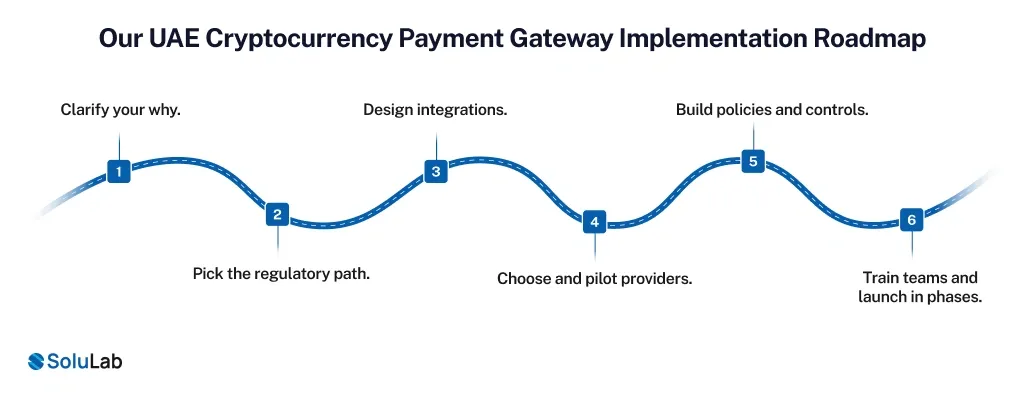
You don’t need a 200‑page strategy deck to move. But you do need a simple, realistic roadmap, and this is what we follow with our clients –
1. Clarify your why.
Be specific about why you want to integrate crypto payments – lower fees, faster settlement, new customer segments, or treasury diversification. Rank these, because they shape design choices.
2. Pick the regulatory path.
Decide whether you will simply use a licensed provider or eventually seek your own licence. For most merchants, the first option is faster and safer in the short term.
3. Design integrations.
In parallel, your tech team sketches how to integrate a crypto payment gateway into web, mobile, POS, or billing flows – ideally behind existing middleware so you do not hard‑wire one provider everywhere.
4. Choose and pilot providers.
Some enterprises test one or two crypto payment platforms in parallel for redundancy, with strict limits and clear success metrics.
5. Build policies and controls.
Before going live, write simple internal playbooks for who can change settings, who talks to regulators or banks, and how incidents are handled. This is where you walk through edge cases in your crypto payment systems in the UAE – sanctions hits, fraud flags, major price swings, or tech outages.
6. Train teams and launch in phases.
Start with one geography, product line, or customer tier and expand once finance, ops, and support are comfortable.
How SoluLab Helps UAE Businesses Integrate Crypto Payment Systems?
SoluLab has worked on crypto development services in the UAE across different stages, from small pilots to enterprise systems.
What matters here isn’t just building the tech. It’s knowing how VARA, ADGM, and local banks actually think about risk. As a leading crypto payment gateway development company, SoluLab can help you:
- Develop custom White Label Crypto Payment Gateways.
- Integrate secure crypto payment APIs into existing apps.
- Ensure full compliance with UAE regulatory standards.

Conclusion
The UAE has already chosen its direction: clear digital‑asset regulations, tax advantages, and huge investment in infrastructure have made it one of the top global hubs for crypto and Web3. For businesses, that means the wait-and-see window is closing.
A well‑designed crypto payments strategy, built on the right partners, licences, and controls, can improve cash flow, reduce payment friction, open new customer segments, and strengthen your positioning with investors.
A Crypto Payment Gateway in the UAE is not a magic growth hack, but it is quickly becoming a standard expectation, just like cards and mobile wallets once did. The decision now is whether you want to shape that future in your sector or respond to it later on less favorable terms.
FAQs
Deepika is a content writer who blends storytelling with strategic thinking. She explores topics across digital innovation, emerging tech, and the evolving blockchain industry. She enjoys breaking down complex ideas into simple, engaging narratives in the growing global markets.