If you’re reading this, you’re probably not a curious beginner. You’re not just playing around with blockchain; you want to ship something that scales, stays secure, and doesn’t blow your budget when user numbers jump.
| Here’s one hard data point to start with – ZK rollups are already securing over $28 billion in Total Value Locked (TVL) as of late‑2025, and that number is growing fast year‑on‑year. |
Blockchain development solutions, especially Layer 2 networks, now handle millions of transactions per day, and a big chunk of that is running on ZK‑powered chains like zkSync, StarkNet, and Polygon zkEVM. In other words, choosing the right ZK‑rollup is a strategic business decision, and you should take the right call.
Key Takeaways
- The problem: Ethereum works well early on, but once real users show up, fees climb and things slow down, which quietly eats into UX and margins. That’s when DeFi, NFT, or gaming apps start leaking users, not because the product is bad, but because the base layer can’t keep up.
- The solution: ZK-rollups move most of the work off-chain and only send proofs back to Ethereum, which brings costs down and speeds up. But picking between zkSync, StarkNet, or Polygon zkEVM isn’t cosmetic; it comes down to EVM fit, gas economics, and how much enterprise-grade control you actually need.
- How SoluLab helps: This is where SoluLab steps in, so you’re not forced to learn cryptography on the job. We help you choose the right rollup, then design, build, and audit the full stack in a way that’s realistic on cost, timelines, and production readiness.
What Is a ZK‑Rollup?
A ZK‑rollup (zero‑knowledge rollup) is a Layer 2 scaling solution that moves computation and state‑storage off the Ethereum mainnet, then submits a compact cryptographic proof of validity back to L1.
Instead of each transaction carrying its own gas cost on Ethereum, thousands of transactions are batched off‑chain, and only one proof is verified on‑chain.
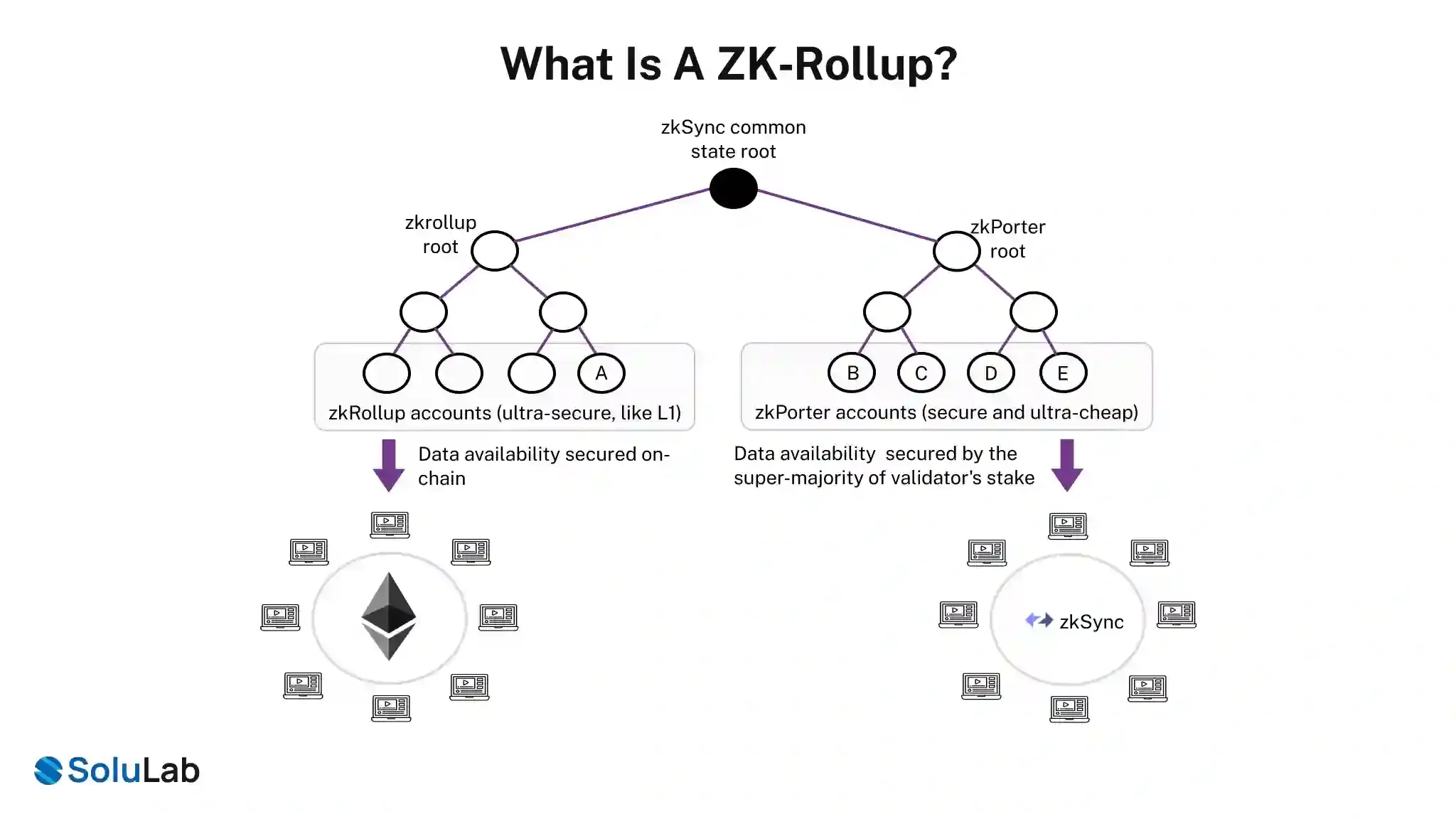
This is the core of any ZK‑rollup architecture. The result is:
- Much lower gas fees because you’re not paying full Ethereum gas for every operation.
- Much higher throughput because the rollup can process many transactions per second, far beyond Ethereum’s base layer.
- Strong security because Ethereum still anchors the final state; the proof mathematically guarantees that the off‑chain batch is valid.
If you’re exploring zero‑knowledge proof blockchain projects or ZK‑rollup implementation for startups, this is the foundation you’re building on top of.
How to Choose the Right ZK-Rollup for Their Blockchain Project?
When you compare zkSync vs StarkNet vs Polygon zkEVM, you shouldn’t just look at which team has the better website or the sexier tokenomics.
You’re an operator. You care about:
1. EVM compatibility and developer experience
- How hard is it to migrate your Solidity contracts?
- How much extra work is needed for your existing stack?
This is where Polygon zkEVM shines because it aims for near‑full EVM equivalence, so most Solidity contracts deploy with minimal changes.
2. Performance and throughput (TPS, latency, finality)
- How many transactions per second can your app realistically handle?
- How fast do users see confirmation?
There are zk‑rollup comparison analyses that show StarkNet and zkSync Era both targeting thousands of transactions per second, while Polygon zkEVM focuses on Ethereum‑like UX but with lower gas fees.
3. Gas fees and cost structure
Every founder cares about zk‑rollup gas fees comparison.
- Polygon zkEVM has been quoted with average gas around 0.000157 ETH per transaction, roughly $0.3, for typical DeFi‑style actions.
- zkSync Era and StarkNet sit in the sub‑cent to a few cents per transaction range when network usage is normal.
- Which ZK‑rollup has lowest gas fees depends on time of day, batch size, and activity, but generally: zk‑rollups are cheaper than Ethereum L1, and zk‑rollups using newer proof schemes are cheaper than older optimistic rollups.
4. Security, maturity, and ecosystem CV
- Is there a strong community, audited core contracts, and battle‑tested infrastructure?
- Are big DeFi protocols, NFT marketplaces, and gaming studios already live there?
zkSync vs StarkNet vs Polygon zkEVM all have respectable ecosystems, but TVL and adoption metrics matter for your liquidity and user acquisition.
5. Enterprise fit and tooling
- Does it support enterprise‑grade tooling (KYC‑friendly on‑ramps, compliance‑ready analytics, private‑L2‑style options)?
- How easy is it to integrate with existing enterprise stacks?
Polygon zkEVM is often positioned as the enterprise‑friendly ZK‑rollup, with strong partnerships and CDK‑style tooling for regulated use cases.
If you’re running an internal Web3 team, this is where ZK‑rollup development services and enterprise zk‑rollup implementation cost planning become critical.
Is zkSync the Best ZK-Rollup for Startup and Enterprise Blockchain Projects?
zkSync Era has been one of the most talked-about ZK-rollups going into 2026, and that attention isn’t random. Built by Matter Labs, it’s designed to feel familiar to Ethereum developers while still delivering the cost and speed benefits people actually come to L2s for.
The positioning is clear: make ZK usable for real products, not just research demos.
Architecture:
- Under the hood, zkSync Era uses a Type-4 zkEVM. It’s not bytecode-level EVM equivalent, which means Solidity gets compiled into its own ZK-friendly runtime called eraVM.
- That tradeoff matters.You get higher throughput and cheaper execution, but you may need to tweak or refactor parts of your contracts if you want everything to run efficiently at scale.
Performance & fees:
- In practice, zkSync Era can push serious volume. Under ideal conditions, it’s often cited in the 15,000–20,000 TPS range, and when the network isn’t congested, swap fees regularly land under $0.01.
- For DeFi, payments, or any user-facing app where friction kills growth, that difference is not cosmetic; it’s existential.
Ecosystem & adoption:
- The ecosystem is already meaningful. zkSync Era hosts a growing set of DeFi protocols, NFT platforms, and bridges, with TVL that’s held up through market cycles.
- Native USDC support and liquidity incentives have helped pull in serious builders and users, which is usually the signal operators care about most.
If you’re building something DeFi-heavy or consumer-facing and asking which ZK-rollup actually makes sense today, zkSync Era is very hard to ignore.
When StarkNet Makes Sense in a zk-Rollup Comparison?
StarkNet takes a very different path, and that’s intentional. Built by StarkWare, it doesn’t try to feel like Ethereum; it tries to move past Ethereum’s constraints altogether.
That makes it powerful, but also less forgiving.
Architecture:
- StarkNet is based on STARK proofs rather than SNARKs, which means no trusted setup and stronger long-term security assumptions, including quantum resistance.
- The flip side is that it runs on Cairo, not the EVM. If your team lives and breathes Solidity, this is a real shift, not a small adjustment.
Performance & scalability:
- Where StarkNet shines is raw compute. It’s built for high-throughput, high-complexity workloads, the kind that start to hurt on more EVM-aligned rollups.
- Thousands of transactions per second are realistic, especially for applications that lean heavily on ZK logic and custom execution paths.
- This is where StarkNet feels less like an L2 and more like a new execution layer altogether.
Ecosystem:
- The developer community is strong, and the tooling around Cairo has matured a lot, but the learning curve is still steep.
- If your team isn’t already comfortable with this stack, time-to-market can stretch, which matters when shipping speed is part of your competitive edge.
If you’re choosing a ZK-rollup for compute-heavy or performance-critical applications and you’re willing to invest in a deeper tech stack, StarkNet is a serious contender.
Is Polygon zkEVM the Right ZK-Rollup for your Blockchain Projects?
Polygon zkEVM often ends up being the safe choice in the zkSync vs StarkNet vs Polygon zkEVM conversation, especially for teams that care about shipping without rewriting everything.
Architecture:
- Polygon zkEVM is a Type-3 zkEVM focused on near-full EVM equivalence. It uses ZK proofs under the hood while keeping Solidity and existing Ethereum tooling largely intact.
- In practical terms, that means many teams can deploy existing contracts with minimal changes, which saves time, money, and internal bandwidth.
Performance & fees:
- Fees typically average around 0.000157 ETH per transaction, roughly $0.30 at current prices. That’s not the cheapest in the ZK world, but it’s predictable and stable.
- Throughput is more than enough for most DeFi, NFT, and Web3 gaming use cases, and TVL growth has been steady rather than speculative.
Enterprise fit:
- This is where Polygon zkEVM really leans in. With CDK-style tooling and a strong focus on compliance-friendly infrastructure, it’s often the easiest path for enterprises, RWAs, and regulated DeFi projects that want ZK security without experimental risk.
If your priority is enterprise-grade deployment with EVM compatibility and fewer surprises, Polygon zkEVM is a very rational choice.
Head-to-Head zk-Rollup Comparison: Architecture, Performance, TVL, and Ecosystem Differences
Let’s compare zkSync vs StarkNet vs Polygon zkEVM more directly.
| Category | zkSync Era | StarkNet | Polygon zkEVM |
| Architecture | Type-4 zkEVM with Solidity transpilation into eraVM. Uses SNARK-style proofs, trading perfect EVM equivalence for speed and cost efficiency. | Cairo-based VM with no EVM bytecode compatibility. Uses STARKs, meaning no trusted setup and stronger long-term security assumptions. | Type-3 zkEVM with near-full EVM equivalence. Uses zk-SNARKs, enabling small proofs and cheap verification with minimal contract changes. |
| Throughput (TPS) | 15,000–20,000 TPS (theoretical under ideal conditions). | 1,000–2,000 TPS in real workloads, highly dependent on compute complexity. | 100–500 TPS in practice, but steadily improving with upgrades. |
| Gas Fees | Typically sub-cent to $0.01–$0.10 per transaction when uncongested. | Comparable to zkSync in many cases, but varies based on workload complexity. | Around $0.30 per transaction on average at current prices. |
| TVL & Adoption | Strong TVL growth, peaking around $273M, with significant momentum from native USDC adoption (reported ~7× growth). | High TVL and active DeFi usage, though more volatile across market cycles. | TVL is growing steadily, but at a slower pace compared to zkSync Era. |
| Ecosystem Maturity | DeFi-heavy ecosystem with multiple DEXs, liquidity pools, and user-facing apps already at scale. | Strong and technically mature developer community, but a steeper learning curve slows adoption. | Enterprise-oriented ecosystem with CDK-style tooling and regulatory-friendly infrastructure. |
This comparison makes the tradeoffs clear – zkSync optimizes for user-facing scale, StarkNet for deep compute and long-term cryptographic strength, and Polygon zkEVM for enterprises that want ZK security without breaking their existing Ethereum stack.
Which ZK-Rollup Should Developers Choose for DeFi, Gaming, and Enterprise Apps?
DeFi
- If you’re running high-volume DeFi where fees and speed decide retention, zkSync Era usually makes sense, as swaps stay cheap and liquidity moves fast.
- But if your protocol is more complex and compute-heavy, StarkNet gives you room to build deeper logic without choking on throughput.
- And when compliance, tooling, and enterprise comfort matter more, Polygon zkEVM tends to be the safer, more familiar choice.
Gaming
- For games that push a lot of transactions like NFT mints, in-game actions, marketplaces, zkSync Era works well because costs stay predictable.
- StarkNet fits better when gameplay logic lives on-chain and needs heavy computation, which is common in strategy or simulation games.
- Polygon zkEVM sits in the middle, useful for NFT-driven or EVM-native games where teams want fewer surprises during development.
Enterprise-grade apps (RWA, tokenized assets, etc.)
- Polygon zkEVM is usually the first stop here, mainly because enterprise tooling and regulatory alignment are easier to manage.
- zkSync Era works when the use case leans more toward DeFi-style volume and asset movement.
- StarkNet makes sense if the application logic is complex, custom, and performance-intensive, even if that means a steeper learning curve.
Emerging ZK-Rollups Shaping the Future of Blockchain Scaling Solutions
Right now, most teams are comparing zkSync, StarkNet, and Polygon zkEVM. That makes sense. But the ZK space is moving fast, and a few newer players are quietly shaping what comes next, especially if you care about long-term architecture choices.
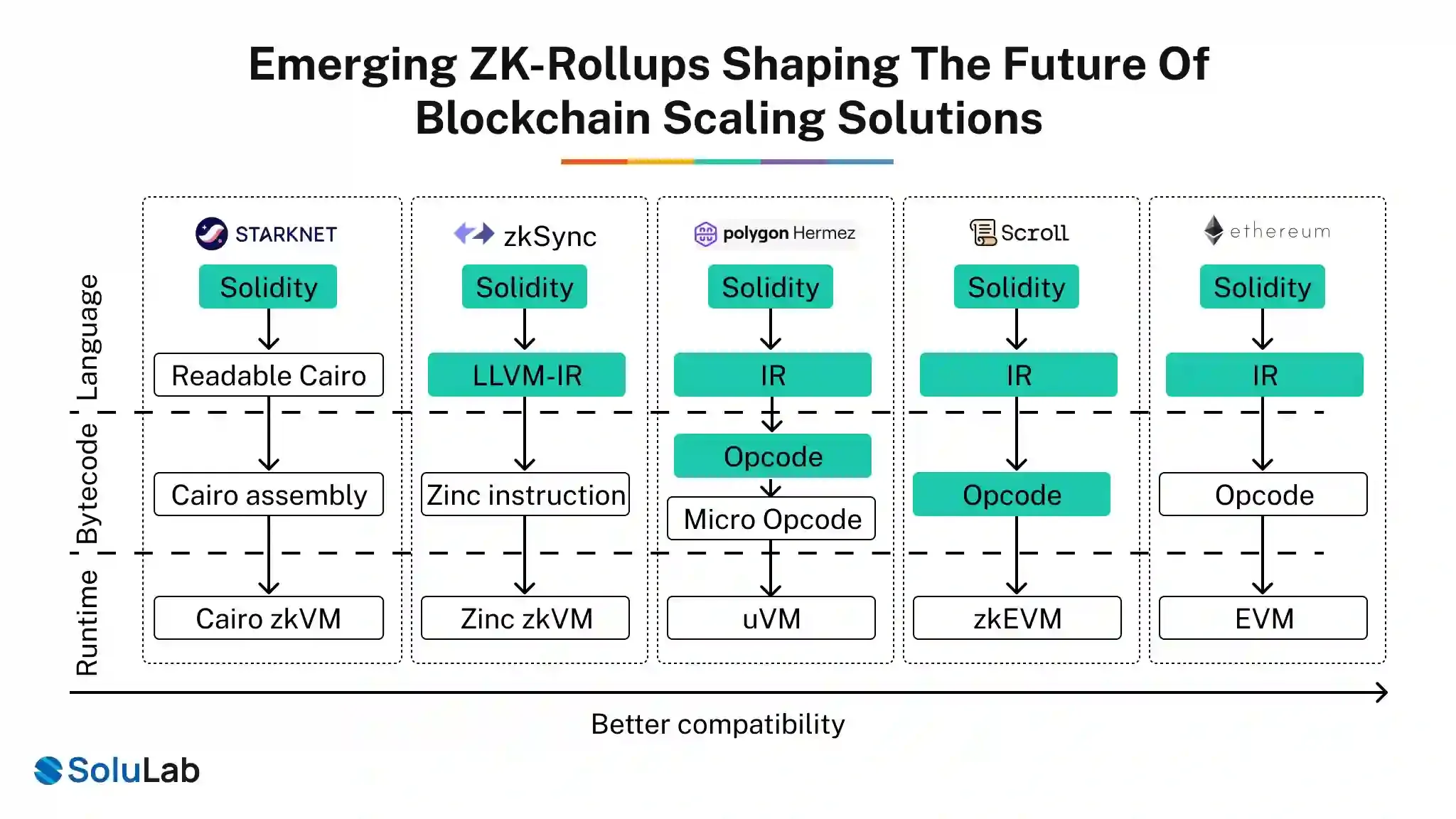
- Scroll is betting hard on full EVM equivalence. That means fewer surprises for Ethereum developers, lower friction when migrating, and gas costs that stay predictable as usage grows.
- Taiko takes a different route. It uses SNARK-based proofs while staying EVM-compatible, which helps push higher throughput without forcing teams to rethink how they build or deploy.
- Herodotus is more niche but important. It focuses on privacy-first rollups and quantum-resistant proofs, which matter if you’re thinking beyond today’s compliance models and into long-term data security.
If you’re building privacy-sensitive products or planning enterprise-grade ZK infrastructure, these are not side projects. They’re signals of where ZK rollups are heading next.
Conclusion
Choosing the right ZK‑rollup is critical for enterprise‑grade Web3 projects. zkSync vs StarkNet vs Polygon zkEVM each have their strengths and weaknesses, but zkSync Era is often the best choice for high‑volume DeFi and gaming, StarkNet for compute‑heavy DeFi, and Polygon zkEVM for enterprise‑friendly DeFi.
If you’re building a ZK‑rollup project, hire blockchain developers from a blockchain development company like SoluLab to ensure your stack is production‑ready and secure.
FAQs
With over 3 years of experience, I specialize in breaking down complex Web3 and crypto concepts into clear, actionable content. From deep-dive technical explainers to project documentation, I help brands educate and engage their audience through well-researched, developer-friendly writing.