GPT-3 and BERT did not spring into existence knowing how to do your job. They were built on transfer learning, a machine learning approach where a model trained for one task gets pointed at a second task that resembles it without being the same thing. The bet behind it is simple: whatever a model figured out while solving problem A probably carries over to problem B.
Some of the earliest wins came from pre-trained word embeddings such as Word2Vec, which gave NLP models a head start they had not had before. Then the big pre-trained language models arrived, BERT and GPT-3 among them, and the range of things transfer learning could plausibly be asked to do widened enormously. Fine-tuning became the default move. You take a pre-trained model, feed it a smaller pile of labeled data for your particular task, and nudge it into shape.
Then the parameter counts exploded. Tuning every weight in a model with billions of them is expensive, and for a lot of teams it is simply off the table. So attention shifted to in-context learning, where you prompt the model and it updates its behavior inside the context window instead of inside its weights. That helps, but it has its own drag: the prompt gets reprocessed on every single prediction, and the results are inconsistent. Parameter-efficient fine-tuning is the answer to that squeeze. Research by Houlsby et al. (2019) shows that PEFT methods such as adapters can cut trainable parameters by as much as 99% against full fine-tuning and still hold competitive scores across a spread of NLP tasks.
Train a small slice of the weights, get most of the quality, pay a fraction of the compute bill. That is the whole pitch. This piece walks through how PEFT works, what it buys you, and why it has quietly turned into the standard way of adapting LLMs to downstream work, including the practical snags people hit along the way, like that maddening no module named ‘PEFT’ error.
What is PEFT?
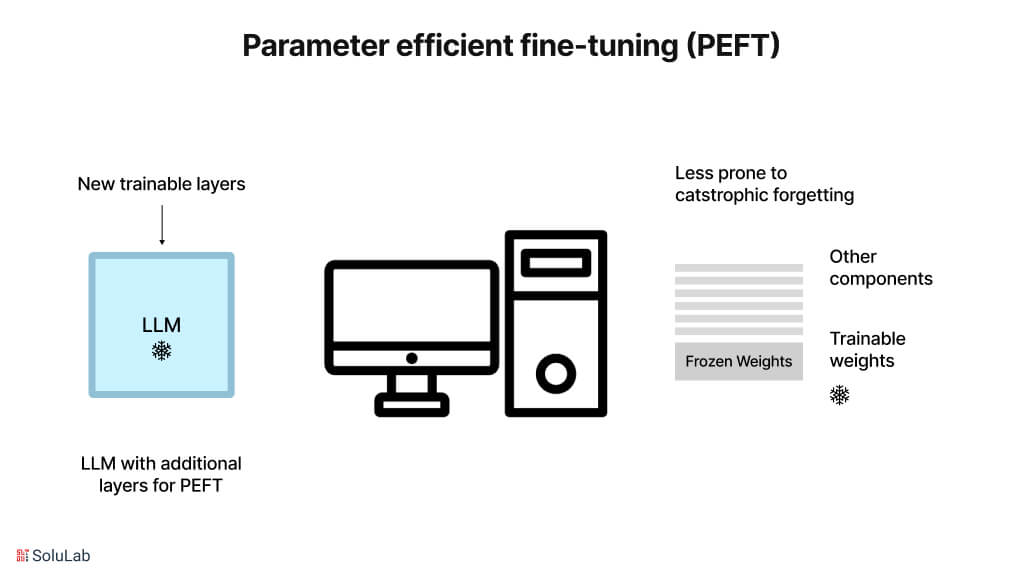
Parameter-efficient fine-tuning is a natural language processing (NLP) approach for making pre-trained language models good at a named downstream task without retraining them wholesale. You reuse the parameters the model already has, tune them against a smaller dataset, and skip the enormous cost of starting from zero.
The mechanism is blunt. Freeze most of the pre-trained layers. Tune only the last few, the ones that actually matter for the job in front of you. What you get back is a model that has learned a new task on modest hardware and a short list of labeled examples.
Why is Parameter-efficient Fine-tuning Important?
The name is new. The instinct is not. Computer vision people have been retraining just the final layer since transfer learning took hold there, and NLP researchers were already comparing static against non-static embeddings early on. According to a study from Google Research, methods like Low-Rank Adaptation (LoRA) and prefix-tuning reach more than 95% of full fine-tuning performance while training as little as 0.4% of the parameters.
What PEFT is really after is accuracy from models like BERT and RoBERTa on downstream work: sentiment analysis, named entity identification, question answering. And it goes after that accuracy in exactly the conditions where full fine-tuning falls apart, meaning thin data and borrowed GPUs. Touching only a fraction of the weights has a second effect people underrate. The model has less room to overfit.
Difference Between Fine-Tuning and Parameter-Efficient Fine-Tuning
Both routes end in the same place: a pre-trained model that performs better on your task. They get there very differently.
Fine-tuning means taking the pre-trained model and continuing PEFT training on fresh data for a fresh task. Every layer moves. Every parameter gets an update. On a large model that is slow, and the cost climbs with the parameter count.
PEFT trains a chosen subset instead. The trick is picking well, which is where adaptive budget allocation for parameter-efficient fine-tuning comes in: it works out which parameters carry the most weight for the new task and updates those alone. Narrow the target, and the compute and the clock time both drop sharply.
Parameter-efficient Fine-tuning vs. Standard Fine-tuning
| Parameter-efficient Fine-tuning | Standard Fine-tuning |
| Goal | Push a pre-trained model to perform on one task when data and compute are both tight. |
| Training Data | Runs on a small dataset, fewer examples. |
| Training Time | Trains faster than full fine-tuning. |
| Computational Resources | Asks for fewer computational resources. |
| Model Parameters | Updates only a small subset of the model’s parameters. |
| Overfitting | Overfits less, since the model changes less. |
| Training Performance | Good, though usually a shade below full fine-tuning. |
| Use Cases | Low-resource settings, or anywhere a large training set does not exist. |
Benefits of PEFT
So what do you actually gain by not touching most of the model? Five things, and the last one is the reason anybody bothers.
- Reduced Computational and Storage Costs
Most of the pre-trained LLM sits frozen. You adjust a handful of extra parameters and nothing else, which pulls both the compute bill and the storage footprint down hard.
- Resolving Catastrophic Forgetting
Fully fine-tune a PEFT LLM and it can lose things it knew from pretraining. Change a small number of settings and that risk largely goes away, because there is nothing to overwrite.
- Superior Performance in Low-data Regimes
When examples are scarce, PEFT has been shown to beat full fine-tuning outright, and it handles out-of-domain inputs more gracefully too.
- Portability
A full fine-tuning checkpoint is a monster. A PEFT checkpoint is a few megabytes. That difference changes how you ship: you can keep one base model and swap trained weights per application instead of hauling around a separate copy of everything.
- Performance Equivalent to Complete Fine-tuning
And the payoff: full fine-tuning quality out of a tiny set of trainable parameters.
Few-shot Learning in Context (ICL) vs Parameter-efficient Fine-tuning (PEFT)
Parameter-efficient fine-tuning and few-shot in-context learning are both ways to train NLP models, and mechanically they have almost nothing in common. What they share is the outcome: both let large language models that have already been taught something take on a new task without a full retraining cycle. ICL does it without gradients at all. You show the model prompted examples and it performs the job from those. The catch is the bill, paid in memory, processing, and storage on every inference. PEFT fine tuning takes the other road, adding or selecting a few parameters and training those so the model learns the new job with very little modification.
Look closer at ICL and it is about feeding context in at fine-tuning time to sharpen few-shot behavior. You hand a pre-trained model extra material along with the few-shot task: sentences, paragraphs, whatever supplies more detail about what is being asked. The hope is that the extra context lets the model generalize from a handful of instances rather than needing hundreds.
PEFT gets at the same goal from the opposite direction. It identifies the parameters that matter, freezes the rest, and makes downstream fine-tuning cheaper as a result.
In practice that means freezing part of the model to hold off overfitting, then tuning the pre-trained model on a limited set of data. Choosing which parameters to freeze is the real skill here. Freeze the right ones and the model keeps more of what pretraining gave it, which is precisely what carries performance when the training data is sparse.

Is PEFT or ICL More Efficient?
Time to settle ICL vs. PEFT. In small language model programs, where a model has to pick up a new task from a few samples and do it fast, parametric few-shot learning (PFSL) is the job that matters. ICL has been the popular answer for years. But a 2021 study put forward parametric efficient few-shot learning, which turned out to be more reliable than ICL while asking for a small fraction of the compute.
Part of why comes down to a scaling mechanism called (IA)^3, which rescales inner activations using learned vectors. Add a handful of parameters that way and you beat fine-tuning the whole model. ICL, by contrast, tunes the entire model from a small sample, and small samples plus a very large parameter count is how you get overfitting and a drop in accuracy.
There is a second reason. PEFT methods fold in two extra loss factors: one pushes the model toward lower probability on wrong answer choices, the other accounts for how long each candidate response is. Both act as brakes on overfitting, and those PFT training loss terms are a big part of why the model generalizes to new tasks at all.
Then there is the hardware. The study reports PEFT training on a single NVIDIA A100 GPU in under 30 minutes, and needing over 1,000 times fewer floating-point operations (FLOPs) at inference than few-shot ICL with GPT-3. Numbers like that are what move NLP applications from a research demo to something you can actually run in production.
Taken together, PEFT is what moved few-shot learning for NLP forward. When a task demands quick adaptation to a new few-shot setting, PEFT beats ICL on three counts: the (IA)^3 scaling, the extra loss terms, and raw computing efficiency.
The efficiency story is worth repeating, because it is the part that decides budgets. The study report of the PEFT paper puts training on a single NVIDIA A100 GPU at under 30 minutes, with over 1,000 times fewer floating-point operations (FLOPs) at inference than few-shot ICL with GPT-3. That is the gap that makes PEFT scalable for real NLP applications.
So yes: PEFT is the reason few-shot learning for NLP applications stopped being a research curiosity. For anything that has to adapt fast to a novel few-shot context, the (IA)^3 scaling, the extra loss terms, and the computing efficiency together make it the better call.
Use Cases of PEFT
Classification of Texts
- Adapt a huge language model for sentiment analysis in an afternoon rather than a sprint. Online reviews, customer feedback, live social listening: all of it fits this shape.
- Pull out the entities that matter, names, organizations, locations, by tuning a model efficiently. In healthcare and finance, that extraction step is the whole pipeline.
Translation by Machine
- Point a pre-trained model at one language pair or one industry vocabulary. The translation quality holds up, the compute demand stays low enough to run where resources are constrained.
AI that can Converse
Tune a conversational model to your sector or your company’s way of speaking, and it handles the odd, specific questions that a generic assistant fumbles.
Computer Vision
- Make small parameter changes to a pre-trained vision model against your own dataset. Hospital imaging is the obvious example: the model gets adjusted to spot particular features clinicians care about.
- Improve how quickly a model recognizes and categorizes objects in images and video. Retail inventory counts, autonomous driving, surveillance, all of it depends on that.
Recognition of Speech
Accents break speech models. PEFT lets you adapt a pre-trained recognizer to a particular accent, dialect, or language, which lifts accuracy and makes the thing usable across the linguistic contexts you actually serve.
What are the Techniques of Parameter-efficient Fine-tuning?
Research keeps adding to the list, but today PFT approaches come down to four:
1. Adapter
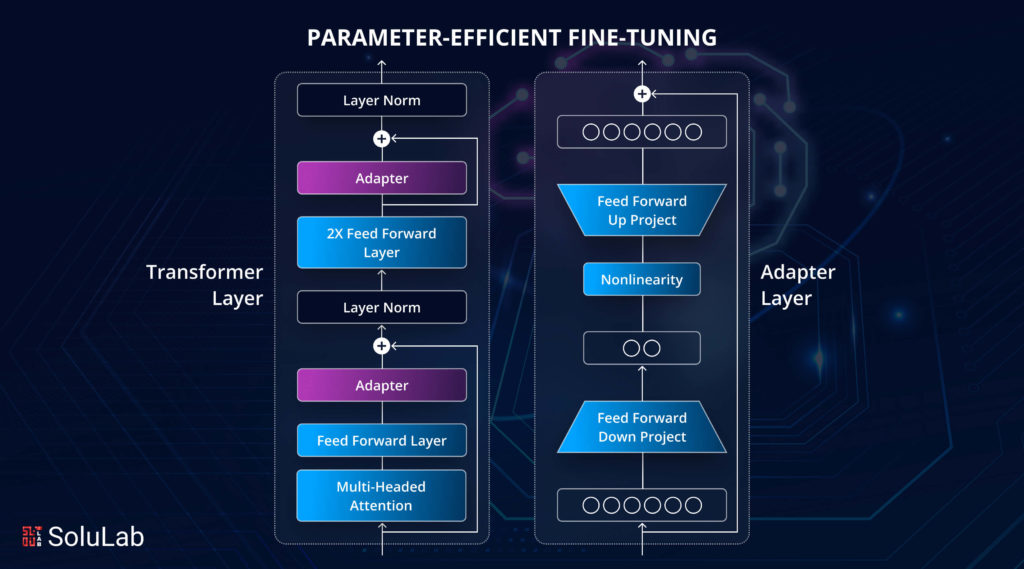
An adapter is a small sub-model dropped into a pre-trained language model to shift its internal representation during fine-tuning. Sit the adapter after the transformer’s multi-head attention and feed-forward layers, and you can train the adapter parameters alone while everything else stays frozen.
2. LoRA
Low-rank adaptation is the other way to tune a big language model for a task or a domain. Like an adapter, LoRA is a small module that slots into the PEFT transformer design. You freeze the model’s trained weights and inject rank decomposition matrices into each transformer layer, which collapses the number of trainable parameters for the downstream task. The reported reduction is dramatic: up to 10,000 times fewer trainable parameters and roughly a third of the GPU memory, while matching or beating fine-tuned model quality across a range of jobs.
3. Quick Training
Prompt tuning is PEFT’s third route to adapting a pre-trained model. Ordinary model training rewrites every pre-trained parameter for every job. Prompt tuning instead learns soft prompts through backpropagation against labeled samples, refining them per task. It has proven competitive with GPT-3 few-shot learning, and the gap narrows further as the model gets bigger. Domain transfer becomes more reliable and assembly gets faster. Best of all, you stop duplicating the full model per job: a short task-specific prompt is stored instead, and one frozen model serves many downstream tasks.
4. Prefix Tuning
For natural language generation, prefix tuning is the lightweight alternative to fine-tuning a large pre-trained model. Given how big current models are, fine-tuning means changing and then storing every variable for every task, which gets expensive fast. Prefix tuning optimizes a small continuous task-specific vector, the prefix, and leaves the language model’s own parameters frozen. Only those free parameters get trained. What the method is really doing is searching for a context that steers the language model toward task-specific output.
What is the Process of Parameter-efficient Fine-tuning?
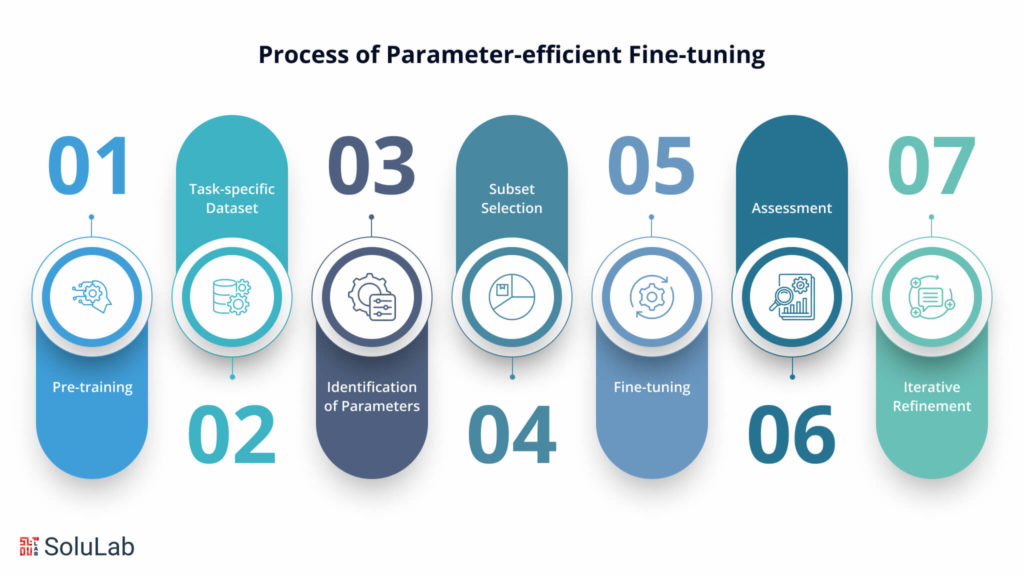
Your setup and your base model will shift the details. Still, the broad shape of a PEFT run looks like this, snags such as the no module named ‘PEFT’ error included:
- Pre-training: A large-scale model gets built on a big dataset for a generic job, language modeling or picture classification being the usual two. This stage is where the model picks up the features and representations everything later depends on.
- Task-specific Dataset: Assemble or generate a dataset for the task you want the trained model to handle. It has to be labeled, and it has to look like the job you are actually asking for.
- Identification of Parameters: Work out which parameters in the trained model matter for your use. Gradient-based algorithms, importance estimates, sensitivity analysis: each gives you a read on what to target during fine-tuning.
- Subset Selection: Now pick. Take the portion of the pre-trained parameters that best fits the job, either by grabbing the top k most significant attributes or by setting a threshold on the significance scores.
- Fine-tuning: Hold everything else fixed and initialize the chosen subset from the trained model’s values. Then train those settings on your task-specific dataset using stochastic gradient descent or Adam.
- Assessment: Check the adjusted model against a validation set or whatever metrics fit the goal task. This is where you find out whether fewer parameters really did get you where you wanted to go.
- Iterative Refinement (optional): If the numbers are close but not there, loop. Change the parameter selection criteria, try different subsets, or run more epochs on the PEFT model from pretrained. Whether it is worth it depends on your performance target.
One caveat worth carrying with you: implementations differ. Papers and production code make different choices about the specifics, so treat the above as the outline, not the recipe.
Related: Comparison of Large Language Models
Step-by-Step Guide to Fine-Tuning with PEFT
Fine-tuning is the step that turns a general AI system into one that does your job well. PEFT makes that step cheap by tuning only a subset of the model’s parameters. Here is the sequence, with the no module named ‘PEFT’ error flagged where it tends to bite:
Step 1: Select a Pre-Trained Model
Start with a base that suits the application. BERT, GPT, and RoBERTa are the usual picks for NLP. Check it works with PEFT methods before you go further, because discovering otherwise later is painful.
Step 2: Define the Task
Say precisely what you are fine-tuning for. Text classification, sentiment analysis, named entity recognition, something else entirely. That definition drives both the data you gather and the approach you pick, so vagueness here costs you twice.
Step 3: Prepare the Dataset
Gather the data, clean it, tokenize the text, split it into training, validation, and test sets. The one thing that decides your result more than any hyperparameter: whether the dataset actually looks like the task.
Step 4: Choose PEFT Techniques
Pick your method:
- Adapters: Small neural networks added to each transformer layer. They learn the task-specific features while the main model weights stay frozen.
- Prefix-Tuning: Trainable prefixes prepended to the input embeddings, letting the model take on new tasks with the original weights untouched.
- Low-Rank Adaptation (LoRA): Low-rank matrices that adapt the model weights efficiently.
Step 5: Configure the Training Parameters
Set learning rate, batch size, epoch count, and optimizer. PEFT wants its own settings here, not the ones you would use for full fine-tuning, and getting that wrong lands you in overfitting or underfitting territory.
Step 6: Implement Fine-Tuning
Build it with Hugging Face Transformers or PyTorch. Both ship support for PEFT methods, so you are wiring together existing pieces rather than writing the machinery yourself.
Step 7: Evaluate the Model
Run the tuned model against the test set. Accuracy, F1, precision, recall: compute all four, because any one of them alone can flatter a model that is quietly failing on the cases you care about.
Step 8: Optimize and Iterate
Read the results and adjust. Sometimes the fix is a training parameter. Sometimes the PEFT method itself was the wrong choice. Keep looping until the numbers hold.
Step 9: Deploy the Model
Ship it to production once it performs. Then keep watching, because a model that met the bar on your test set can drift once real traffic hits it, and adjustments will be needed.
Work through those nine and you get a pre-trained model tuned to your task without the compute bill that used to come attached.

Conclusion
PEFT changed the economics of adapting a model. Tuning a subset of parameters instead of all of them cuts both the compute and the calendar time, which is what makes performance gains on a pre-trained model affordable in the first place. Text classification, sentiment analysis, named entity recognition: these are exactly the tasks where you need to point a model at a new dataset quickly, and where waiting weeks for a full fine-tuning run is not an option. Adapters, prefix-tuning, and low-rank adaptation each widen what you can do inside that budget.
None of which makes it easy. Choosing between the techniques, configuring training parameters, holding performance steady across several different tasks: these are the places teams stall. As a leading AI development company, SoluLab works through those decisions regularly and brings that experience to fine-tuning pre-trained models with PEFT.
Our AI developers can help you get real value out of PEFT and keep your AI use cases solutions both capable and cheap to run. Hiring AI specialists, or looking for full AI development services? Either way, SoluLab is a partner worth talking to. Contact us today and let us look at what your AI stack could do next.
FAQs
Shipra Garg is a tech-focused content strategist and copywriter specializing in Web3, blockchain, and artificial intelligence. She has worked with startups and enterprise teams to craft high-conversion content that bridges deep tech with business impact. Her work translates complex innovations into clear, credible, and engaging narratives that drive growth and build trust in emerging tech markets.