Google Gemini is a multimodal AI model family built natively to handle text, images, audio, video, and code in a single model pass. It comes in three tiers: Gemini Ultra for complex reasoning, Gemini Pro for production API workloads, and Gemini Nano for on-device inference on Pixel hardware. Unlike GPT-4, Gemini was trained from scratch on multimodal data rather than adapted from a text-only base.
Understanding Google’s Gemini AI
Definition and Background
Google Gemini AI is the system behind a lot of what’s changed across Google’s services lately. It’s built to tackle hard problems, running on algorithms and models that hold up across a wide range of tasks. In search, it’s the reason results feel more relevant: it works through huge volumes of web pages, images, and video to surface what actually matches what you typed. It’s also reshaped how ads get targeted, pulling on user data and behavior patterns to serve ads that are more likely to land. In Google’s voice assistant, it’s what lets a conversation feel natural instead of stilted, parsing spoken requests and holding up its end of a back-and-forth. The reach goes further still: image and speech recognition, translation, spam filtering, and plenty else that most people never think about but touches their day constantly. As it keeps evolving inside Google’s products, Gemini AI is a pretty clear signal of where Google is putting its bets.

Key Components and Architecture
Gemini AI runs on layered machine learning models built to process huge amounts of data quickly and accurately. Those layers are what let it spot patterns, pull out insights, and make predictions that actually hold up. Through deep learning, it keeps refining its read on the world, which is why its results and recommendations get sharper over time rather than staying static. Its natural language processing applications makes communication feel seamless, which is a big part of why it works well for everything from customer service to serious research.
The Evolution of Gemini AI within Google
Gemini AI’s path says a lot about Google’s approach to AI: start with foundational research, then move toward practical use, translation, image recognition, and beyond. Along the way came real milestones, the Transformer model chief among them, plus the Pathways Language Model. Google’s responsible AI commitment keeps ethics and transparency part of the conversation, not an afterthought. Gemini AI keeps pushing further, and its footprint across industries keeps growing.
Capabilities of Gemini AI
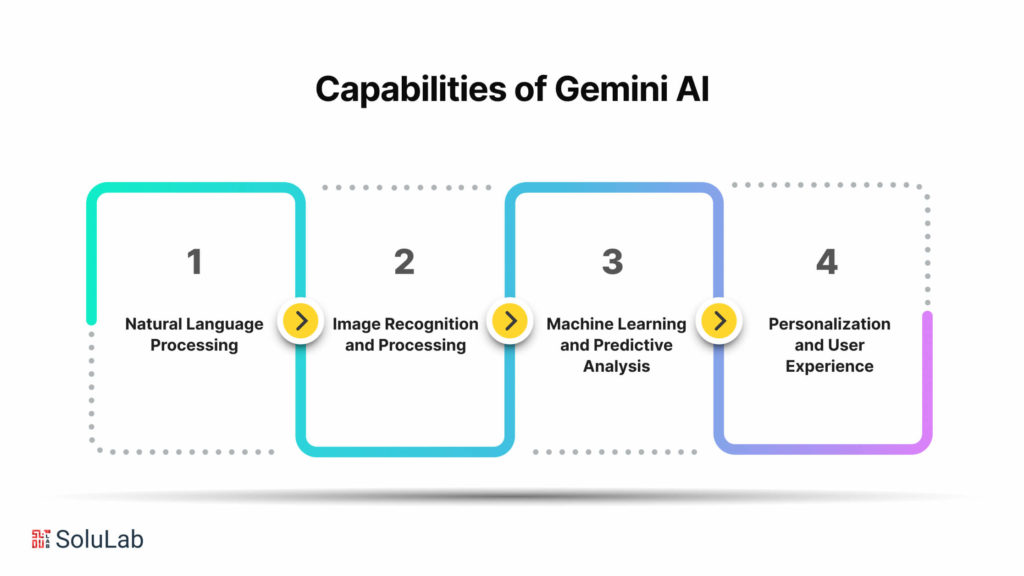
Here’s what Google Gemini AI actually does. Its algorithms and machine learning stretch what’s possible in artificial intelligence,, and this section digs into where it shows real strength: natural language processing, image recognition, and a handful of other capabilities worth knowing about.
A. Natural Language Processing (NLP)
Gemini AI’s NLP work is a genuine leap for Google’s systems, letting them understand and respond to human language in ways that feel intuitive rather than robotic. That capability powers everything from voice assistants to automated chatbots, keeping interactions smooth. Its knack for picking up on speech nuances and linguistic patterns is what makes the understanding feel deeper than simple keyword matching. Across Search and Assistant, it delivers results and responses that actually track with context. Beyond where it stands today, there’s real potential here: better healthcare diagnostics, improved accessibility, and a shift in how people interact with technology day to day. As it keeps developing, it could change human-computer interaction more than most people realize yet.
B. Image Recognition and Processing
Gemini AI has changed how Google handles image recognition and, with it, how search results look visually. Its algorithms and deep learning models let Google surface results that are both relevant and visually strong, tuned to what a given user tends to want. By reading visual content with real precision and speed, it boosts both the aesthetics of search and how satisfied users end up feeling with it. Folding this into Google’s search engine marks a real shift in visual search, and in how people explore visual content online generally.
C. Machine Learning and Predictive Analysis
Google Gemini AI is good at reading user behavior and preferences to deliver recommendations that actually feel personal. Because it keeps learning, it adapts to the messy, complicated patterns real users have and surfaces content that fits. Google Gemini AI keeps refining its predictive models against fresh data, so recommendations track evolving preferences rather than lagging behind them. That tailoring drives more engagement, more exploration, and, over time, more loyalty and retention. In short, Google Gemini AI shows what machine learning development can actually do when it’s aimed at improving user experience and driving growth.
D. Personalization and User Experience
In a digital world where users are flooded with information and choices, personalization isn’t optional anymore if you want a good user experience. Google Gemini AI takes that further by tailoring experiences around individual preferences and behaviors rather than a one-size-fits-all approach.
1. Customizing Search Results: Google Gemini AI starts from the idea that every user’s information needs are a little different. When someone searches, Google Gemini AI factors in their search history, current context, even location, to return results that are genuinely relevant. That means people find what they’re after faster, with less digging.
2. Refining Content Recommendations: Google Gemini AI goes beyond search with content recommendations matched to each user’s actual interests. By reading behavior, engagement patterns, and how people interact with different content types, Gemini AI builds a feed of articles, videos, and other media that resonates with that specific person.
3. Elevating the User Journey: With this level of personalization, Gemini AI makes the whole journey feel more engaging and less like a chore. Users aren’t stuck wading through generic content. Instead, they get a curated set of information built around what they actually need.
Benefits of Gemini AI’s Personalization Engine:
1. Enhanced User Engagement: Personalized experiences push engagement up, since the content actually matches what each person cares about.
2. Improved User Satisfaction: When people find what they need quickly, satisfaction with the whole experience goes up with it.
3. Increased Conversion Rates: Personalized experiences tend to drive higher conversion, since users are more likely to follow through, whether that’s a purchase or a subscription.
4. Strengthened Brand Loyalty: By delivering experiences that go beyond what users expect, Gemini AI Google helps businesses build stronger relationships and loyalty with their users.
In a world where attention is scarce, Gemini AI’s personalization engine is a real asset for businesses trying to build strong user experiences, drive engagement, and grow sustainably.
Applications of Google’s Gemini AI
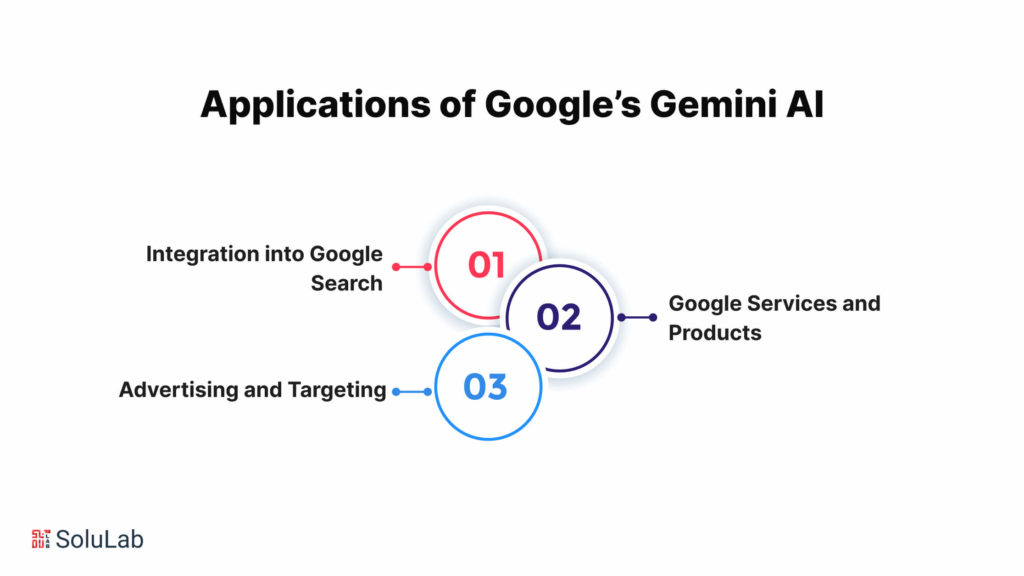
Google’s Gemini AI shows up across a wide range of applications now. This section walks through where it’s built into Google’s services, from reshaping the Search experience to changing how digital advertising gets targeted and personalized.
1. Integration into Google Search
Folding Gemini AI into Google Search marks a real shift in how people get information. Using this advanced AI technology, Google Search now delivers search experiences that feel more refined and personal. As a sophisticated language model, Gemini AI helps Search actually interpret what a user means, not just match keywords, which is what makes results feel tailored instead of generic. It reads the contextual nuance in a query to get closer to real intent. It also extends to multimedia content, identifying relevance and surfacing it as part of the results. That opens up a wider range of content for people to explore in ways that feel more interactive. Put simply, folding Gemini AI into Google Search has pushed the boundaries of how accessible information is, turning search into something that adapts to each person using it.
2. Google Services and Products
Gemini AI is doing real work behind the scenes across various Google services, tying the whole ecosystem together so products complement each other rather than feeling separate. You can see it in Gmail’s intelligent email filtering, which prioritizes what matters and cuts down on noise, and in Google Photos, where it automatically curates albums and collages from your memories. Beyond those two, it touches plenty of other Google services too, streamlining search results, personalizing recommendations, and pointing users toward what they actually need. Altogether, Gemini AI has become a core part of how the Google ecosystem hangs together as something connected and user-centric.
3. Advertising and Targeting
Gemini AI has changed how businesses reach their target audience through digital advertising. It works through huge volumes of data using its algorithms and machine learning to build a real picture of user behavior and preferences, which lets businesses zero in on their ideal customer segments and tailor campaigns accordingly. It moves past old-school targeting by using predictive analytics to anticipate what a user actually wants and serve ads that fit. Its real-time optimization keeps watching campaign performance and adjusting ad delivery to squeeze out better results. And its reporting tools give businesses clear, transparent insight into how campaigns are performing, so decisions can be made with data instead of guesswork. Put together, Gemini AI helps businesses run sharper digital campaigns and drive real engagement, conversions, and growth.
Real-world Examples
Gemini AI Google’s impact isn’t just theoretical, there are real success stories across industries to back it up. In healthcare, it’s improved patient care and streamlined operations, leading to better outcomes and shorter wait times. In manufacturing, it’s optimized production lines and cut downtime, which translates into real cost savings and better productivity. In customer service, it’s changed how interactions work through real-time assistance and AI-powered chatbots, resolving queries fast and pushing decisions to be more data-driven. Gemini AI Google’s versatility keeps proving itself as a driver of real innovation and growth for the businesses using it.
Read More: Top Generative AI Development Companies
Challenges and Future Developments
Like any advanced technology, Gemini AI runs into real challenges that need careful attention and real solutions, not quick patches. Spotting potential hurdles early and dealing with them matters for keeping its momentum going. The ongoing research behind it is a clear sign the team isn’t treating these challenges as an afterthought.
Some notable challenges that Gemini AI faces include:
1. Adaptability and Contextual Understanding: Getting Gemini AI to adapt across different contexts and domains takes real work: learning algorithms robust enough to handle new environments, data distributions, and tasks without breaking down.
2. Ethical Considerations: As Google Gemini AI grows more capable, keeping its use ethical and aligned with human values matters more, not less. That means real frameworks and guidelines for responsible development and deployment, not just good intentions.
3. Scalability and Infrastructure: Handling growing demand and massive datasets means Gemini AI’s infrastructure has to scale without buckling. That means optimizing algorithms for efficient computation, investing in serious computing power, and keeping data privacy and security intact along the way.
4. Human-AI Collaboration: Human-AI Collaboration matters for real adoption and smooth integration across industries. Building intuitive, user-friendly interfaces and clear communication protocols is what actually builds trust here.
5. Data Quality and Bias: The quality, and potential bias, in training data can shape Gemini AI’s performance and decisions more than people realize. Getting access to diverse, high-quality data while working to cut bias out of it matters for building AI systems that are actually fair.
Even with these challenges, the ongoing work from the team behind Gemini AI shows a real commitment to tackling them head-on and pushing what Gemini AI can do further. Treating challenges as opportunities rather than roadblocks is part of why it has real potential to reshape industries and drive change.

Conclusion
Google’s Gemini AI, an advanced AI model, has left a real mark on the Google ecosystem. Combining algorithms, neural networks, and machine learning, it’s changed how user experiences actually work: personalizing Search results, sharpening visual search through image recognition, and showing real adaptability across advertising and targeted content. It’s not without its challenges, but addressing them is what will keep it moving forward, and Google, alongside partners like SoluLab, keeps investing in research and development to push past those obstacles.
At its core, Google’s Gemini AI is more than a technical achievement, it’s a bet on delivering a smarter, more personalized, more streamlined digital experience. As development continues, it’s clear Google gemini AI will play a central role in what comes next for AI inside the Google ecosystem. SoluLab, a leading AI development company, sees real value in technologies like Gemini AI and stays focused on delivering solutions that keep pace with where this is all heading.
FAQs
Bhavya is driving growth through data-backed demand generation for AI and Web3 solutions. With 9+ years in digital marketing, he has spearheaded initiatives that led to a 40% increase in qualified inbound leads. Bhavya shares insights on marketing ROI and scaling a digital presence via AI workflows. He is open to connecting with startups and enterprise teams to help them overcome their challenges.