Switzerland didn’t turn into a crypto hub by luck. It already had a strong financial base, but more importantly, it chose not to panic when blockchain showed up. Instead of pushing it away, it made room for it, which is why serious teams came here to actually build, not just register a company and disappear.
Over time, that’s how the Crypto Nation tag started to make sense. Zug’s Crypto Valley now hosts more than 1000+ blockchain companies, many working on core infrastructure. The CV VC Top 50 Report puts their combined valuation at USD 584.33 billion in 2024, up sharply from last year, which tells you this is growth with substance, not noise.
What really sets Switzerland apart is clarity. FINMA is strict, but predictable. The 2021 DLT Act gave legal backing to tokenized assets, and some cantons still offer zero capital gains tax on crypto. Because of this balance, long-term players like Ethereum, Tezos, and Solana built real operations here.
If you’re planning to launch a crypto exchange, this context matters more than most people admit. Writing code is only part of the job; regulation and compliance decide whether you survive. That’s why picking the right Swiss development partner isn’t a technical choice; it’s a strategic one.
Key Takeaways
- Many crypto exchange providers offer generic builds that lack Swiss compliance, scalability, or institutional-grade features.
- Top crypto exchange developers enable faster go-to-market, stronger investor trust, and higher trading volume potential.
- SoluLab appears among leading Swiss exchange development firms– offering secure, Swiss-ready builds, advanced matching engines, multi-asset support, and regulatory alignment to maximize adoption and ROI.
Why Is Switzerland a Hotspot for Crypto Exchange Development?
If you strip away the hype and talk to people who’ve actually built crypto businesses, Switzerland keeps coming up for very practical reasons. It’s not about marketing. It’s about certainty, speed, and infrastructure that doesn’t fight you at every step.
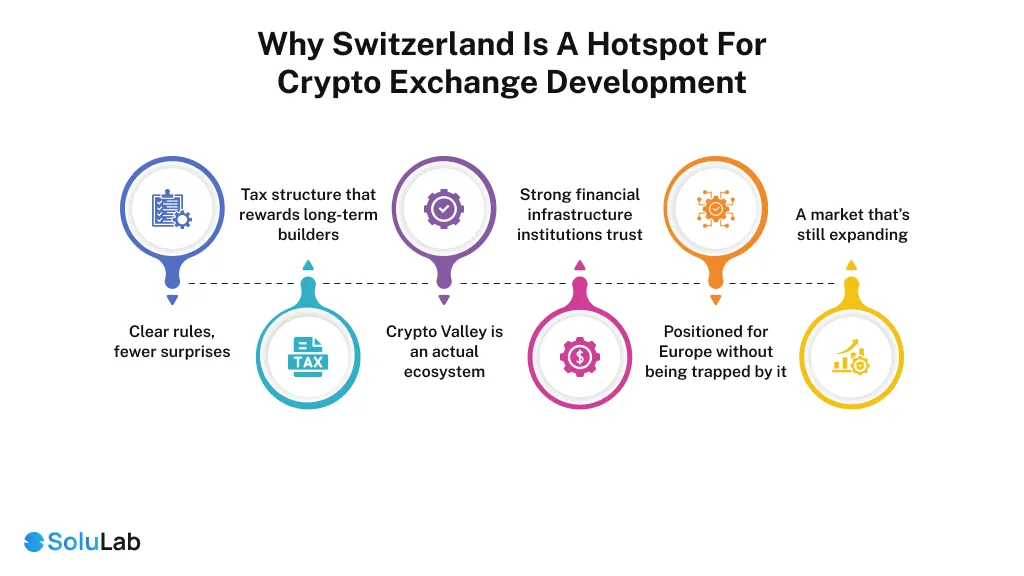
- Clear rules, fewer surprises
One of Switzerland’s biggest strengths is that the rules are understandable and stable. FINMA doesn’t operate in grey areas – it gives clear licensing paths for exchanges, custodians, and fintech companies. You know what’s allowed, what isn’t, and how long things will take.
The 2021 DLT Act made a real difference. Blockchain-based tokens and digital securities were formally recognized in law, which means founders can structure products without constantly worrying about legal reversals.
For early-stage teams, the SRO route is especially practical. Instead of waiting endlessly for a full license, companies can become compliant through a Self-Regulatory Organization in roughly 2–3 months. That time saved often decides whether a product launches or dies on the roadmap.
- Tax structure that rewards long-term builders
Switzerland’s tax environment quietly does a lot of heavy lifting.
| Factor | Switzerland | EU / US (Typical) |
| Crypto capital gains (individuals) | 0% in many cantons | Often taxable |
| Corporate tax | 11–24% | 25–30% (EU), 21%+ (US) |
| Canton-level optimization | Yes | Limited |
Cantons like Zug, Zurich, and Basel attract founders because profits can be reinvested instead of drained by taxes. That matters when you’re building secure, compliant infrastructure.
- Crypto Valley is an actual ecosystem
Zug didn’t become Crypto Valley by accident. Ethereum, Bitcoin Suisse, and later Sygnum set the foundation early. Since then, over 1,000 blockchain companies have followed.
What that gives operators is leverage:
- Developers who’ve shipped real products before
- Auditors and lawyers who already understand crypto risk
- Faster partnerships with custody, banking, and liquidity providers
And most importantly, banks that don’t treat crypto development companies as a compliance nightmare.
- Strong financial infrastructure institutions trust
Switzerland’s traditional finance credibility carries over into crypto. That’s why institutions are comfortable operating there.
SIX Digital Exchange (SDX) offers regulated digital asset trading. Sygnum and SEBA are FINMA-licensed banks providing custody and institutional services. Even BIS-backed initiatives like Project Agorá are based in Switzerland. For an exchange, that kind of institutional proximity builds trust much faster than marketing ever could.
- Positioned for Europe without being trapped by it
Switzerland sits at the center of Europe but outside the EU’s slow regulatory machinery. Exchanges built there can align with MiCA while still benefiting from Swiss legal flexibility.
Add to that multilingual reach (German, French, Italian) and convenient overlap with both Asian and North American time zones, and it becomes a natural base for global platforms.
- A market that’s still expanding
Switzerland is growing.
- 45% year-on-year crypto user growth
- 11.5% population has crypto adoption
- Steady increase in FINMA-licensed crypto and fintech entities
And the signal is clear that regulators aren’t closing doors, and users aren’t slowing down. So Switzerland works because it reduces uncertainty. For crypto exchange operators, that’s often the difference between building defensively and building with confidence.
How to Choose the Right Crypto Exchange Development Company in Switzerland?
Choosing a crypto exchange development partner isn’t a technical decision; it’s a business one.
- If you pick right, you move faster, avoid regulatory landmines, and build something that can actually scale.
- If you pick wrong, you burn months, rewrite core systems, and end up stuck between developers and regulators, with no one owning the problem.
Switzerland adds another layer to this. It’s one of the best jurisdictions for crypto, but only if your partner truly understands how things work here.
Below is how operators usually evaluate this, whether they say it out loud or not.
| # | Area to Evaluate | What Actually Matters | What to Ask Them | Red Flags | Known Strong Players |
| 1 | Regulatory & Compliance | FINMA experience, AML/KYC built-in, DLT Act understanding, custody & insurance-ready architecture | Have you worked with FINMA-aligned clients? Is compliance part of core architecture or added later? | “We’ll handle compliance after launch”, no FINMA exposure | Linum Labs, Innowise, S-PRO |
| 2 | Architecture & Scalability | Matching engine speed, TPS capacity, uptime under volatility, clean APIs | What’s your matching engine design? How do you handle peak load & gas optimization? | Buzzwords, vague answers, no real TPS benchmarks | S-PRO, RedDuck, Innowise |
| 3 | Security & Audits | Third-party audits, MPC wallets, cold/hot wallet split, incident response | Can you share past audit reports? Do you use MPC or HSMs? | No audit history, “we’ve never been hacked” | Linum Labs, SoluLab, Validity Labs |
| 4 | Liquidity & Trading | Market maker access, order depth, advanced order types, oracle integration | Which market makers can you connect us to? How do you manage slippage? | No liquidity plan, AMM-only without rationale | S-PRO, BrightNode, SapientPro |
| 5 | Timelines & Delivery | Realistic MVP timelines, regulatory buffers, post-launch roadmap | What does your MVP include? How do you factor FINMA delays? | Unrealistic speed promises | Linum Labs, Innowise, Token Develop |
| 6 | Cost Transparency | Clear pricing, audit & infra costs disclosed, predictable scaling | What’s included vs extra? How does cost change at 1,000 TPS? | Hidden costs, vague maintenance pricing | SoluLab, Token Develop, S-PRO |
| 7 | Team Quality | Senior Solidity devs, backend engineers, DevOps depth, account ownership | Can we see GitHub profiles? Who’s our day-to-day owner? | Junior-heavy teams, rotating contacts | Linum Labs, S-PRO, Innowise,SoluLab |
As of December 31, 2024, Switzerland had only 5 FINMA-licensed fintech entities, with more in progress. That alone tells you how selective and slow the system is. Which means your development partner isn’t just writing code, they’re shaping whether your exchange ever goes live. Choose accordingly.
Top 7 Crypto Exchange Development Companies

1. SoluLab
 $49 – $75 / hr
 200 – 999
 2015
2015
SoluLab is one of those teams that’s been around long enough to know what not to build. They’ve shipped through multiple cycles, which matters more than a fancy tech stack. You’ll find them working with both startups and enterprises across the UAE, the US, Singapore, and Switzerland.
Most teams come to them for wallets or exchanges and end up expanding scope. Mobile, web, hardware wallets, multi-currency support, NFTs, t’s all fairly standard for them at this point. Things like MPC, cold storage, 2FA, QR transactions, recovery flows, nothing experimental, but solid and production-ready.
Key Strengths: Long operating history, large delivery team, wallets + exchanges together, practical RWA execution
Best For: Teams that want one partner to handle most of the stack without juggling five vendors

2. LINUM LABS
$50 – $99 / hr
10 – 49
2016
Linum Labs is very DeFi-heavy, and they don’t hide that. If the work involves complex smart contracts, edge-case logic, or things that break easily, they’re usually a good fit.
They’re based in Switzerland, with teams spread across Berlin and Cape Town. Many of their developers have worked at places like ConsenSys, ShapeShift, or directly with Ethereum-linked projects. That background shows up in how clean their contracts are.
They don’t take tiny projects, and honestly, that helps. Most of their clients already know what they’re building. Security audits, OTC tooling, perps infrastructure, regulatory-sensitive work, that’s their lane.
Key Strengths: Strong DeFi focus, excellent audits, Swiss regulatory familiarity, high technical bar
Best For: Protocol teams, DeFi platforms, security-critical builds where mistakes are expensive

3. S-PRO
Premium Pricing
250+
2014
S-PRO feels very enterprise from day one. Based in Zurich, with delivery teams across Europe and the US, they’ve worked on hundreds of projects outside crypto as well like banking, healthcare, or energy.
Their crypto work includes exchanges, wallets, DeFi systems, and custom blockchains. Some of their platforms handle serious volume, which explains why they spend a lot of time on performance, liquidity, and scaling issues.
Process matters to them. Jira, Agile, timelines, reporting, all very structured. If you like chaos, this won’t be your team. If you want predictability, it probably will.
Key Strengths: Enterprise process, multi-chain experience, large team, proven delivery at scale
Best For: Institutional exchanges and companies that need structure more than experimentation

4. INNOWISE
Enterprise Scale
1000 – 9,999
Established Company
Innowise is big. Really big. That’s the main reason companies hire them.
They can build CEXs, DEXs, L1s, L2s, PoCs, and MVPs. They can staff them fast. Ethereum, Solana, Polygon, Arbitrum, BSC, NEAR, Hyperledger, coverage isn’t the issue here.
What’s interesting is that they don’t just build. They spend time upfront on feasibility, KPIs, and sometimes even investor narratives. That makes them useful for funded teams that don’t want to burn capital blindly.
Key Strengths: Scale, wide protocol coverage, structured validation, enterprise consulting depth
Best For: Large companies and funded startups running complex, multi-chain roadmaps

5. BRIGHTNODE
Premium Consulting
30+
2018
BrightNode sits more on the strategy side than pure development. They’ve worked on a lot of token-driven projects and know how badly things go when token economics are rushed.
They help with token design, incentive models, and Web3 go-to-market planning. A lot of their work involves helping Web2 companies move into Web3 without breaking their existing business.
If your product depends on tokens actually making sense, this is where they add value.
Key Strengths: Tokenomics expertise, strategy-led thinking, enterprise advisory, market alignment
Best For: Token-centric platforms and companies transitioning from Web2 to Web3

6. PIXELPLEX
$25 – $49 / hr
50 – 249
2014
Pixelplex is based in Zug, and that already tells you a lot. Crypto Valley access, regulatory context, and a very practical approach to exchange builds.
They focus mostly on exchange software, not buzzwords. The goal is to get something live, compliant, and usable, especially for startups that don’t want enterprise pricing.
Their team understands Swiss regulations well enough to flag problems early, which saves time later. That alone is worth a lot if Switzerland is your base.
Key Strengths: Zug presence, cost-effective builds, exchange focus, and regulatory awareness
Best For: Early-stage founders launching exchanges with Swiss exposure

7. SAPIENTPRO
Project-Based
51 – 250
7+ Years Experience
SapientPro is a solid middle ground between heavy enterprise teams and small studios. Based in Switzerland, with delivery teams in Eastern Europe, they’ve shipped a lot of Web3 products over the years.
Their leadership is very technical, which shows in how they approach architecture. They follow a proper SDLC – requirements, MVP, iterations, QA, and launch, without overcomplicating things.
Clients usually stick with them because timelines feel realistic and the right engineers get assigned to the right problems.
Key Strengths: Strong technical leadership, full-stack Web3 delivery, structured execution
Best For: Founders who want a long-term technical partner rather than a quick build
Switzerland’s Real Edge in Crypto (Why Operators Still Choose It)
Switzerland made a very deliberate choice early on and then kept removing friction instead of adding confusion. That’s why, even today, serious crypto exchanges and infrastructure players still prefer launching here over louder but messier jurisdictions.
What you get isn’t hype. You get predictability. And in this industry, that matters more than slogans.
Regulation That Actually Makes Sense
The biggest advantage is not that Switzerland is lightly regulated. It’s that regulation is clear, fast, and consistent. FINMA, the regulator, tells you upfront what’s expected. If you meet the requirements, you move forward. If you don’t, you know exactly why.
In practice, this looks like:
- The licensing timeline is usually 2–6 months, which is significantly faster than the EU or the US
- Minimum capital starts around CHF 300,000+
- Application fee is roughly CHF 1,750, with annual supervision around CHF 3,500+
- You need at least three local employees
- A physical office is mandatory; no mailbox companies
It’s not easy, but it’s fair. And once licensed, you’re not constantly looking over your shoulder, wondering if rules will change mid-operation.
The DLT Act Changed Everything
In 2021, Switzerland passed the DLT Act, and most people outside the ecosystem didn’t notice. Operators did.
This law removed the biggest legal headache around tokenization.
- Tokenized securities are treated the same as traditional securities
- Crypto custody has clear legal rules, not interpretations
- Smart contracts are legally enforceable, not just code is law theory
- There’s no regulatory grey area like you see in the EU or the US
This is why tokenization projects, compliant DeFi structures, and real-world asset platforms feel safer building here. The law backs the tech instead of chasing it.
Taxes That Don’t Kill Momentum
Taxes are where Switzerland quietly wins again, especially if you structure things properly.
- Capital gains on crypto are 0% for individuals in many cantons
- Corporate tax usually falls between 11–24%, depending on location
- Many cantons have no wealth tax on crypto assets
Zug, in particular, has been aggressive about attracting crypto companies. Not with marketing, but with incentives that actually show up on balance sheets.
Institutional Rails Are Already in Place
This part is often underestimated. Switzerland doesn’t just allow crypto; it has real banking and market infrastructure around it. Some examples operators already know:
| Infrastructure | Why It Matters |
| Sygnum Bank | FINMA-licensed crypto bank for custody, trading, settlement |
| SEBA Bank | Institutional and HNWI crypto banking |
| SIX Digital Exchange (SDX) | Regulated digital asset exchange |
| Project Agorá | BIS-backed tokenized payment system |
This means fewer banking rejections, smoother fiat rails, and less improvisation just to stay operational
Adoption Isn’t Theoretical Anymore
Switzerland isn’t experimenting, it’s already deep into execution.
- Over 1,000 blockchain companies operate locally
- Around 11.5% of the population already uses crypto
- Top 50 blockchain companies here represent $584B+ in valuation (2024)
- User growth is strong, with 4M+ users projected by 2026
- As of Dec 31, 2024, 5 FINMA-licensed fintech entities are active
This creates a feedback loop: talent stays, capital stays, regulators keep learning, and the ecosystem compounds.
So if you’re building an exchange or serious crypto infrastructure and you want legal clarity, stable banking, and rules that don’t shift every quarter, it’s still one of the safest bets in the world. That’s why operators keep coming back.
Conclusion
Launching a crypto exchange is not a light build. It is one of those projects where tech, compliance, and timing collide and if you pick the wrong partner, you lose months, sometimes a year. The right team, however, can cut that journey down to 6–8 months, help you move through regulation without constant dead ends, and ship a platform that serious liquidity and users actually trust.
That is why Switzerland still stands out. FINMA brings clarity, banks like Sygnum and SEBA bring real infrastructure, and a top crypto exchange development company like SoluLab brings execution maturity. The seven companies covered here are operators’ choices. Your job now is simple but critical – match one of them to your budget, timeline, technical depth, and regulatory path, and use the evaluation framework to make that decision with your eyes open.
FAQs
With over 3 years of experience, I specialize in breaking down complex Web3 and crypto concepts into clear, actionable content. From deep-dive technical explainers to project documentation, I help brands educate and engage their audience through well-researched, developer-friendly writing.