Key Takeaways
- All EU stablecoin payroll must use licensed Electronic Money Tokens (EMTs).
- FCA 2026 Roadmap : The UK “Cryptoasset Gateway” opens Sept 2026; “Fiat-backed” is the gold standard for payroll.
- Tax Transparency : DAC8 (EU) and HMRC’s new auto-access powers (UK) make “invisible” crypto pay impossible.
- Stablecoin development reduces settlement from 3-5 days to <10 minutes, saving 3-6% on intermediary fees.
Salaries to employees are a big aspect of every company. And this is also true: Cross-border payments still take 3–5 days, incur hidden FX costs, and lock working capital in transit. This leads to employees’ impatience and contacting the finance department. For companies managing distributed teams, this inefficiency is no longer acceptable.
Then there is a stablecoin development that came into the solution picture. In 2026, it became a board-level infrastructure decision. At the same time, regulations have caught up. The EU’s MiCA framework and the UK’s FCA-led crypto regulations now define exactly how a stablecoin payroll platform in the UK and EU must operate.
This led to new opinions and solutions.
Therefore, fintech, finance companies, government, Saas companies are forwarding their hands towards building or integrating a compliant, scalable, and tax-ready stablecoin payroll system.
MiCA & FCA Explained: What Makes a Stablecoin Payroll Platform Compliant
Compliance is no longer a backend function. It is now the core product layer of any stablecoin payroll platform in the EU or the UK.
1. EU: MiCA and the Rise of EMT-Based Payroll
Under MiCA compliant stablecoin solutions, enterprises must use regulated tokens:
- Electronic Money Tokens (EMTs) → Fiat-backed, 1:1 redeemable
- Asset-Referenced Tokens (ARTs) → Basket-backed (less relevant for payroll)
For payroll, EMTs dominate because they mimic fiat behavior.
Under MiCA Article 48, EMTs are legally classified as Electronic Money. This is the only token type suitable for payroll because:
- Article 49 (Redemption): Issuers must grant holders a right of redemption at par value (1:1) against the fiat currency at any moment.
- Article 54 (Investment of Reserves): 100% of funds must be invested in secure, low-risk, and highly liquid assets denominated in the same currency as the EMT.
- If a non-EU stablecoin exceeds 1 million transactions or €200 million in daily value as a “means of exchange,” the issuer must cease issuance and submit a phase-out plan.
If you pay an employee in a Euro-pegged token that isn’t a licensed EMT, you are technically not paying them in “money” under EU law, creating massive labor law liabilities.
While the market still loves USDC, the 2026 MiCA Article 58 caps create a “ticking time bomb” for EU-based enterprises.
A top 1% payroll platform doesn’t just offer USDC; it defaults to EURC (Circle) or other MiCA-licensed EMTs for EU residents to bypass the €200M cap risk.
2. UK: FCA’s Systemic Stablecoin Payroll Framework
The UK takes a slightly different approach through phased regulation:
- In the UK, the Financial Services and Markets Act (FSMA) 2026 has officially moved stablecoins from the “speculative asset” bucket into the Regulated Payment Perimeter.
- Unlike a standard bank deposit, where your money is an unsecured loan to the bank, FCA-regulated stablecoins must be segregated.
- The FCA has set a clear deadline. Authorization opens in September 2026. Using offshore or unregulated stablecoins or crypto banking solutions after this is risky. It is not just a tech issue. It is a compliance breach.
Under UK Payment Services Regulations (PSRs), the risk sits with the employer. If a payment fails, you are responsible. If the stablecoin loses its value, you must repay the salary in GBP. This can double your payroll cost.
Use only fiat-backed stablecoins for salary payment. They must be 1:1 backed by cash or UK Gilts. Avoid algorithmic or synthetic coins. Regulators do not treat them as real payroll. They treat them as a risk.
How Do You Actually Run Payroll in Stablecoins Without Breaking Tax Laws?
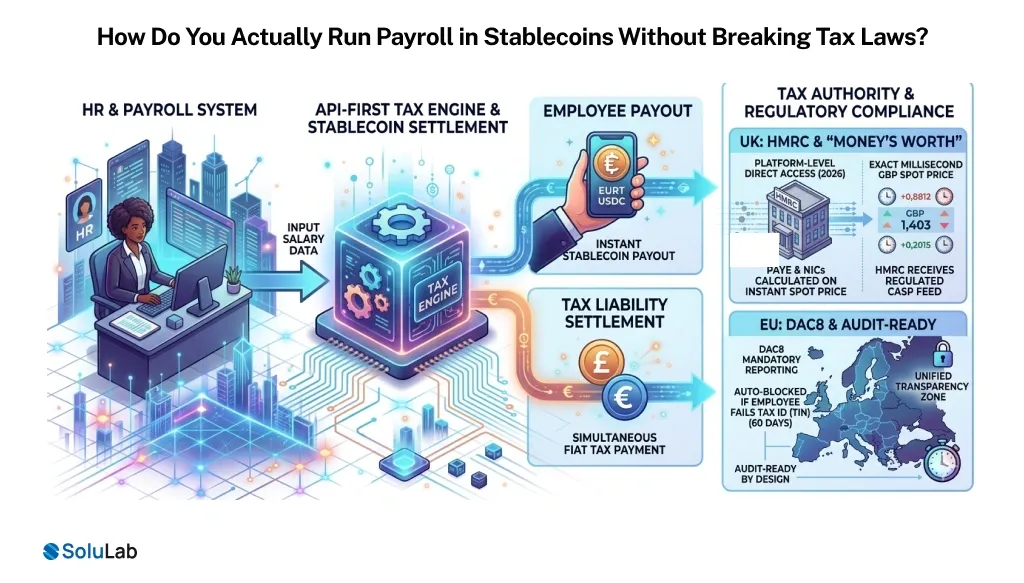
This is where most enterprise payroll platforms fail. Payouts are easy; tax-compliant settlement is the actual engineering challenge. In 2026, the era of “estimate and adjust” is over. We are tailoring a stablecoin payroll platform for the EU and UK.
1. UK: HMRC and the “Money’s Worth” Reality
HMRC doesn’t see a stablecoin as a “currency”; they see it as “Money’s Worth.” This legal distinction is the pivot point for your entire payroll stack.
- Under HMRC 2026 Guidelines, you cannot use an “end-of-day” average. PAYE and National Insurance (NICs) must be calculated based on the exact GBP spot price at the millisecond the stablecoin hits the employee’s wallet.
- As of January 1, 2026, HMRC has transitioned to “Platform-Level Direct Access.” This means they don’t wait for your annual filing; they receive an automated XML data feed from regulated CASPs (Crypto-Asset Service Providers).
If your salary payout platform requires your HR team to manually upload CSVs to a tax tool, you are already behind. In 2026, a “Top 1%” platform must feature an API-first Tax Engine that settles the tax liability in fiat simultaneously with the stablecoin payout.
2. EU: DAC8 and the End of “Ghost” Payroll
The EU DAC8 Directive (fully operational as of Jan 2026) has turned every member state into a unified transparency zone.
- While DAC8 mandates reporting for all transactions above €1,500, trigger “Enhanced Due Diligence.” For most enterprise salaries, this is a monthly event.
- Under the latest DAC8 implementation (e.g., Germany’s KStTG), if an employee fails to provide a verified Tax Identification Number (TIN) or self-certification within 60 days, the platform is legally required to block their transactions.
There is no “off-the-books” payroll anymore. Your stablecoin salary taxation EU system must be audit-ready by design.

Stablecoin vs SWIFT: Are You Really Saving 3-5% on Cross-Border Payroll?
At first glance, stablecoins seem cheaper. But let’s see whether it’s cheaper than the SWIFT model.
Cost Comparison Table
| Factor | Traditional Payroll (SWIFT) | Stablecoin Payroll Platform |
| Settlement Time | 3–5 days | <10 minutes |
| FX Fees | 3–5% | ~0.5–1% |
| Intermediaries | 2–4 banks | 0–1 providers |
| Liquidity Lock | High | Minimal |
| Transparency | Low | High |
The real winner in 2026 isn’t “crypto”, it’s Just-in-Time (JIT) Funding. The real ROI is not just lower fees. It is cash flow optimization + operational speed.
Your platform should allow a CFO to keep their cash in a high-yield treasury until 10 minutes before the payroll run.
This is why cross-border stablecoin platforms are gaining traction across SaaS, logistics, and Web3-native companies.
What Happens After You Get Paid in USDC?
The #1 fear of enterprise HR is an employee being unable to use their salary because their high-street bank flagged a “crypto transfer.”
1. The Problem: Banking Friction
Traditional banks still:
- Flag crypto payment platforms
- Delay large transfers
- Freeze accounts in edge cases
This creates a trust gap for employees.
2. Solution for the Traditional Banking System
In 2026, a professional USDC salary payment platform doesn’t send money to an exchange; it uses Regulated Virtual IBANs.
- The Direct-to-Bank Bridge
We integrate with providers like Circle or Bvnk to ensure that when an employee “off-ramps” their USDC to GBP, it arrives at their bank as a standard FPS (Faster Payments) or SEPA transfer.
- Banking-as-a-Service (BaaS) Layer
To attract enterprise leads, you must highlight that your Banking-as-a-Service (BaaS) infrastructure uses MiCA-compliant custodians (like SocGen-Forge or AllUnity).
This ensures the “Source of Funds” is pre-verified, preventing the “Account Frozen” nightmare that plagued the 2024 era.
How Do Stablecoins Salary Payout Platform Connect With Your Existing Payroll Stack?
Integration is where most stablecoin payroll ideas either work… or quietly fail.
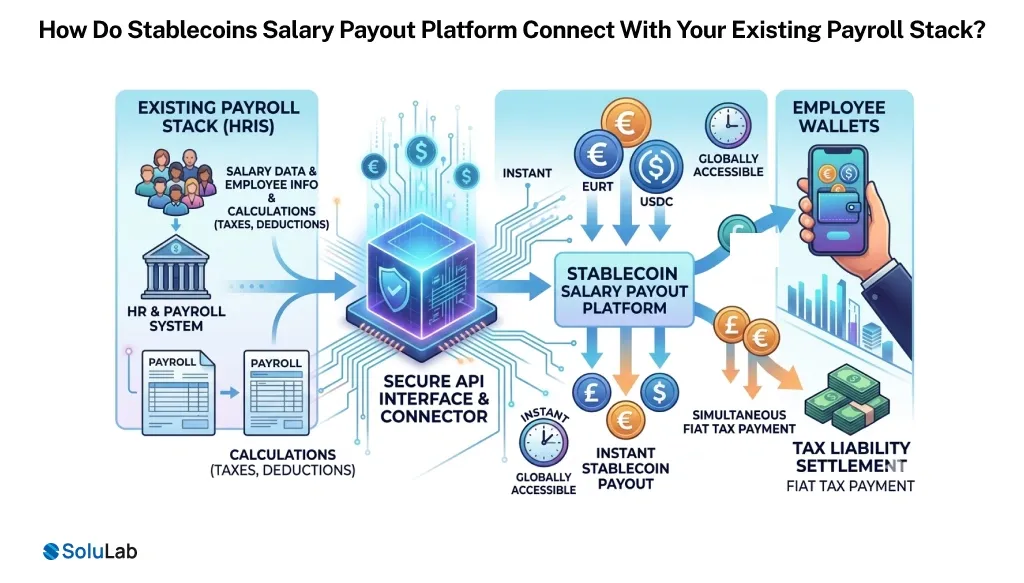
In 2026, no enterprise wants another dashboard. Your stablecoin payroll platform UK or EU has to sit inside your existing stack, not outside it.
1. What Good Integration Actually Looks Like
At the enterprise level (SAP, Workday), the logic is simple. Payroll is still calculated in fiat. Once the pay cycle is approved, an API triggers the payout in stablecoins. No manual uploads. No switching tools.
For mid-market teams using Xero or NetSuite, the flow is more event-based. When a payment is marked “paid,” the system automatically executes the transfer and logs the transaction back into the ledger. That’s what a real blockchain technology payroll integration tool should do.
2. What to Choose (Based on Your Stage)
- Large enterprise (1,000+ employees): Go with API-first platforms that integrate with SAP or Workday. You need compliance checks, policy layers, and audit logs built in.
- Scaling companies: Choose blockchain platforms that connect directly with Xero or NetSuite. Focus on automation and reconciliation, not complexity.
3. Where Most Platforms Get It Wrong
They focus on payments. Enterprises care about reconciliation and audit trails. In a proper enterprise stablecoin payroll platform, every transaction should:
- Sync back to your ERP
- Carry metadata (invoice ID, employee ID)
- Close books automatically
That’s the real value. Not faster payments, but zero manual finance work at scale.

Conclusion
From everything discussed, one thing is clear. Stablecoin payroll is becoming the standard for global businesses. The shift is not just about faster payments, but about building a compliant, scalable financial system.
To make this work, enterprises need the right technology partner. A reliable stablecoin payment platform development company can help
- design compliant infrastructure,
- integrate with ERP systems, and
- ensure smooth USDC to GBP or EUR execution.
At SoluLab, we focus on building enterprise-ready stablecoin payroll platforms aligned with MiCA and FCA frameworks.
From integration to compliance, the goal is simple: make payroll faster, safer, and easier to manage.
Contact us today to build your stablecoin payroll platform for the UK and EU.
FAQs
Deepika is a content writer who blends storytelling with strategic thinking. She explores topics across digital innovation, emerging tech, and the evolving blockchain industry. She enjoys breaking down complex ideas into simple, engaging narratives in the growing global markets.