As of 2026, the European crypto market is worth over $1 trillion, and an estimated 92% of all crypto trades in the EU are expected to flow through MiCA‑compliant platforms. If you’re planning to launch an OTC crypto exchange platform, choosing to ignore MiCA is no longer a risk you can afford; it’s more like operating without a license in plain sight. That’s why CXOs and founders are now asking the same question: How do we build a MiCA‑compliant OTC exchange in 2026… without burning €1.8–2.7M and 6–9 months?
This guide is written from the lens of someone who has helped founders and fintechs actually build MiCA‑compliant crypto exchange platforms, not just talk about them. Before we go deep, here’s how you can think about it in one line: if you want to run a crypto OTC trading platform in Europe, you’re basically building a MiCA‑compliant crypto OTC desk where MiCA vs MiFID crypto regulation differences define your license, your risk profile, and your go‑to‑market strategy.
Key Takeaways
- The Problem: Most founders don’t get MiCA vs MiFID wrong because they’re careless, but because the rules are still unclear in practice, which leads to the wrong license and 30–50% more spending than planned. On top of that, building an OTC desk from scratch quietly stretches to 12–24 months and $3–10M+, while the market is already moving toward MiCAR-ready desks.
- The Solution: Instead of reinventing everything, teams are moving to MiCA-ready OTC stacks where KYC, AML, and audits are already part of the system, not bolted on later. This is how timelines drop from 18–24 months to 6–9 months, without fighting regulators or slowing down onboarding.
- How SoluLab Helps: SoluLab handles the full journey, from MiCA licensing guidance to building a live, compliant OTC desk that actually works in production. We wire in KYC, AML, Travel Rule, and audit readiness early, so you launch faster and don’t end up fixing compliance under pressure later.
Why Building a MiCA-Compliant OTC Exchange in the EU Matters in 2026?
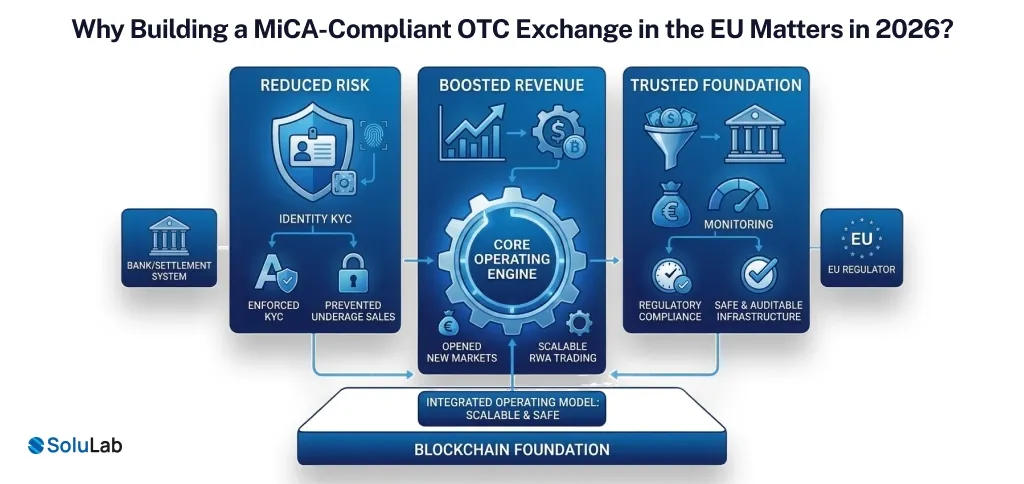
By 2026, regulators expect that 90%+ of EU crypto volume will be routed through regulated CASPs, and non‑compliant platforms are being shuffled out or forced to partner with licensed entities. For an OTC desk, this means:
- If you’re acting as a crypto‑asset service provider (CASP) – even if you only do OTC,, you’re under MiCA if you’re in the EU or serving EU customers.
- OTC trading isn’t lighter compliance, because of how MiCA affects OTC crypto trading, you still need strong AML requirements under MiCA, KYC rules for MiCA crypto exchanges, and proper reporting above certain thresholds.
- Institutional money is coming in from Asset managers, corporates, and payment processors are increasingly using crypto OTC trading platforms Europe‑wide, but they will only work with MiCAR‑compliant crypto OTC desks.
If you want to be a crypto OTC trading platform provider in Europe, you’re selling a MiCAR‑compliant crypto OTC desk with MiCA KYC AML integration services, bundled into a single offering.
How MiCA Applies to OTC Crypto Trading and CASPs in the EU?
Many founders assume OTC is off‑exchange and therefore off‑regulation, but that’s a dangerous myth. Under MiCA, OTC trading is still a crypto‑asset service, which means:
If you’re matching or arranging trades between parties, you’re likely a CASP under MiCA unless you fall into a narrow exemption. Even if your white label crypto exchange development feels like a negotiation desk, regulators will look at:
- Who initiates the trade?
- Who settles it?
- Who holds custody or acts as counterparty?
These three factors usually push you into the MiCAR‑compliant crypto OTC desk bucket.
The key thing many founders miss is that MiCA vs MiFID crypto regulation differences determine whether your OTC desk is under MiCA or under MiFID II (for security‑like tokens).
If your token is classified as a financial instrument under MiFID, you may need both MiCA and MiFID‑level controls, which can double your cost to build MiCA compliant exchange.

What MiCA Actually Requires When Building an OTC Crypto Exchange in the EU?
Before you jump into starting your own crypto exchange, you need to internalize the core MiCA caps that will shape your product:
1. CASP licensing: You need to apply as a crypto‑asset service provider (CASP) in an EU member state, which gives you passporting rights across the EEA.
2. AML requirements under MiCA:
- You must be a full AML‑obliged entity, which means you do CDD, EDD, transaction monitoring, suspicious activity reporting, and Travel‑Rule‑compliant data sharing.
- All of this applies even if you’re running a MiCAR‑compliant crypto OTC desk instead of a public order book.
3. KYC rules for MiCA crypto exchanges:
- Multi‑layered KYC, including corporate‑level ownership structure checks, beneficial ownership, and periodic refreshes.
- Risk‑based approach: higher scrutiny for PEPs, sanctions‑exposed geographies, and large‑value OTC trades.
4. Capital and governance: MiCA imposes prudential requirements, a fit‑and‑proper test for directors, and internal governance policies that mirror traditional finance.
5. Market transparency and records: You must keep detailed records of every crypto OTC trading platform transaction and maintain transparent pricing and execution policies.
For a founder, this means your crypto OTC platform development stack must be built around MiCA KYC AML integration services, not bolted on later.
8 Step Guide to Building a MiCA Compliant OTC Exchange in 2026
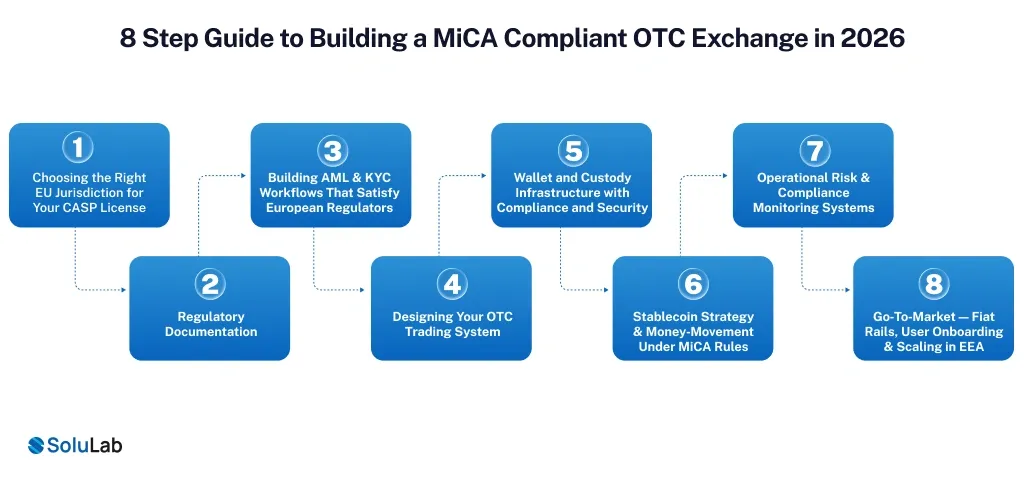
Building a MiCA-compliant OTC exchange in 2026 isn’t really about keeping up with regulation, but about getting a few critical decisions right before you write too much code.
This guide walks through how teams are actually doing it today, starting with licensing clarity and ending with a live, EU-ready OTC desk, without burning months or capital fixing compliance problems that could have been avoided early on.
Step 1: Choosing the Right EU Jurisdiction for Your CASP License
Your choice of jurisdiction will directly impact your cost to build MiCA compliant exchange and how fast you can go live. Some options:
- Lithuania: Known for a dual‑license track (CASP + EMI) and relatively fast authorization, useful if you also want fiat rails.
- Germany, France, Spain: Strong EU‑wide credibility, but slower, more expensive licensing, and stricter interpretation of MiCA vs MiFID crypto regulation differences.
- Smaller EU hubs (e.g., Czech Republic): ESMA has already approved the first six MiCA CASPs in the Czech Republic, showing that regulators are active and ready to say “yes” to compliant platforms.
As a founder, you’re not just picking a country, you’re picking a regulatory partner. Treat your national competent authority like a co‑architect of your MiCA‑compliant OTC exchange, not just a gatekeeper.
Step 2: Regulatory Documentation
MiCA is not just a tech regulation; it’s a documentation‑heavy regime. You will need:
- White paper or product disclosures for each token you support, especially if they fall under MiCA’s Article 4.
- Risk management policy: How you handle liquidity risk, operational risk, and market‑manipulation risk on your crypto OTC trading platforms.
- AML/CFT policy: Aligned with national AML laws and AML requirements under MiCA, including how you treat OTC trades above certain thresholds.
- Governance and internal controls: Board‑level oversight, internal audit, and IT‑resilience plans under DORA‑like expectations.
Many founders underestimate the effort here, which is why MiCA compliance solutions for crypto development and MiCA audit services for crypto companies are becoming must‑haves.
Step 3: Building AML & KYC Workflows That Satisfy European Regulators
If you’re building a crypto OTC trading platform that serves EU‑based institutions, you need to design KYC rules for MiCA crypto exchanges and AML requirements under MiCA as first‑class product features.
What this looks like in practice:
1. Tiered onboarding:
- Retail/small tickets: Standard KYC (ID, address, device with biometrics).
- Institutions/high‑net‑worth: Corporate KYC, ownership structure, sanctions checks, source‑of‑funds, and periodic reviews.
2. Real‑time risk‑based AML engine:
- Assign risk scores to each client and transaction.
- Flag high‑value OTC trades, unusual patterns, and connections to sanctioned entities.
3. Travel‑Rule‑ready data:
Capture and store sender/receiver data for transfers above the MiCA threshold, even if they’re done via OTC.
Here is where MiCA KYC AML integration services for crypto providers become your leverage. Instead of building everything in‑house, you can integrate KYC/AML stacks that are already tuned to KYC rules for MiCA crypto exchanges and AML requirements under MiCA.
Step 4: Designing Your OTC Trading System
On the product side, your OTC crypto exchange development cannot look like a clunky plugin on top of a spot‑only exchange. You’re building a MiCAR‑compliant crypto OTC desk that must:
1. Aggregate liquidity: Pull from multiple exchanges, market makers, and internal inventory so you can give tight quotes on large blocks.
2. RFQ‑based workflow:
- Client submits a request for a quote.
- Your desk or system returns a fixed price, duration, and settlement terms.
3. Low‑slippage execution:
Especially important for crypto OTC trading platforms doing institutional volumes.
From a technical angle, you’ll need:
- A custom matching engine or white‑label OTC exchange solutions that already support OTC workflows.
- Integration with liquidity providers and crypto OTC trading platforms‑style APIs.
If you try to retrofit an existing spot engine into an OTC desk, you’ll quickly hit bottlenecks in pricing, settlement, and how MiCA affects OTC crypto trading compliance.
Step 5: Wallet and Custody Infrastructure with Compliance and Security
For a MiCAR‑compliant crypto OTC desk, wallet, and custody are not just security modules; they’re regulated infrastructure. You must:
- Segregate client assets: No more merging hot‑wallet balances; you need clear segregation between you and your clients.
- Use multi‑sig or MPC‑based custody: Preferably with EU‑based custody providers that understand AML requirements under MiCA and KYC rules for MiCA crypto exchanges.
- Proof‑of‑reserves transparency: Many MiCA‑compliant platforms now publish proof‑of‑reserves so clients can verify that their assets are actually backed.
This is where MiCA KYC AML integration services, crypto, and MiCA compliance solutions for crypto platforms matter at the infrastructure layer, not just at the UI.
Every withdrawal, every sweep between wallets, every OTC settlement must be logged and tied back to a KYC’d counterparty.
Step 6: Stablecoin Strategy & Money‑Movement Under MiCA Rules
MiCA is especially strict if you understand stablecoins, which directly affects how MiCA affects stablecoins and money‑movement.
Under MiCA, stablecoins are split into two main buckets: e‑money tokens (like euro‑backed tokens) and asset‑referenced tokens (multi‑asset or non‑traditional pegs). Both are heavily regulated, and that changes how your OTC crypto trading platforms can route large‑value settlements.
Here’s what you need to know:
- Reserve backing: Issuers must keep 100% liquid reserves backing the circulating supply, audited monthly for large‑scale tokens.
- No algorithmic stablecoins: MiCA bans algorithmic designs, so anything like the old Terra‑style models is not allowed in the EU.
- Redemption at face value: Users must be able to redeem stablecoins for fiat at par, on demand.
- No interest on stablecoin balances: They cannot behave like bank deposits, which pushes payout‑style products into banking or e‑money‑license land.
For your MiCAR‑compliant crypto OTC desk, this means:
1. You cannot accept large‑value OTC trades in non‑MiCA‑compliant stablecoins and treat them as safe settlement rails.
2. If your OTC crypto exchange development is moving €100k+ settlements per trade, you must verify that the stablecoin is either:
- An EU‑authorized e‑money token, or
- An asset‑referenced token that meets MiCA reserve and reporting standards.
Money‑movement across stablecoins and fiat must also be aligned with MiCA KYC AML integration services for crypto.
Every redemption, every sweep between stablecoins, every large‑ticket OTC payout must be profiled and monitored, which is why many crypto OTC trading platforms are opting for MiCA‑compliant wallet providers that can handle both KYC and liquidity in one layer.
Step 7: Operational Risk & Compliance Monitoring Systems
MiCA is not just about front‑end KYC, it’s about back‑end operational resilience. A crypto OTC trading platform that fails to log, monitor, and report properly is as risky as one that ignores KYC.
From a founder’s POV, you need:
1. Transaction monitoring and suspicious‑activity reporting:
- Real‑time rules for unusual patterns, high‑velocity deposits and withdrawals, and trades just below AML thresholds.
- Integration with blockchain‑analysis tools so you can trace illicit flows and satisfy ESMA’s expectation that CASPs assist authorities in tracing illicit flows.
2. IT‑resilience and business‑continuity:
- Downtime, data loss, or liquidity‑sweep errors can be treated as serious operational failures under MiCA.
- You also need to comply with overlapping frameworks like DORA in some cases, especially if you’re dealing with critical financial infrastructure.
3. Third‑party‑risk management:
If you’re using a white‑label exchange solutions provider, you must document their controls and treat them as part of your MiCA‑compliant stack.
Many founders are now investing in MiCA compliance solutions for crypto platforms to avoid last‑minute scrambles before the national competent authority review.
Step 8: Go‑To‑Market — Fiat Rails, User Onboarding & Scaling in EEA
By the time you’re ready to launch, your build MiCA-compliant crypto exchange EU setup must feel like a full‑fledged CASP, not a side‑project. That means:
1. Fiat on‑ramp and off‑ramp:
- Either through a partner bank or a licensed payment institution, so you can process EUR, GBP, and other EEA‑friendly currencies under MiCA‑aligned KYC.
- These fiat rails must be integrated with your AML requirements under MiCA and KYC rules for MiCA crypto exchanges workflows, including PE‑P and sanctions‑screening.
2. User onboarding experience:
- Fast, but risk‑based: retail clients get a streamlined KYC; institutional clients get a deeper onboarding that includes corporate governance and source‑of‑funds checks.
- All of this should be part of your MiCA KYC AML integration services crypto design, not bolted on after MVP.
3. Scaling in the EEA:
Once you have your CASP license in one member state, you can passport across the EEA, which is a huge advantage for OTC crypto exchange development aimed at EU‑based quants, hedge funds, and Family Offices.
Founders who treat MiCA vs MiFID crypto regulation differences as a core part of their GTM strategy end up with cleaner, more credible positioning. Whereas Institutional clients are looking for MiCAR‑compliant crypto OTC desks that can explain how MiCA shapes every piece of their stack, from stablecoin choices to liquidity sources.
White-Label vs Custom OTC Crypto Exchange Development Under MiCA
Here’s where white‑label OTC exchange solutions often make sense for founders who want to build MiCA compliant crypto exchange in the EU but don’t want to reinvent the wheel.
| Aspect | White-Label OTC Exchange Solutions | Custom OTC Crypto Exchange Development |
| Time to market | Much faster, typically 6–9 months to launch a MiCA-ready OTC desk | Slower, often 12–24 months once MiCA compliance and audits are included |
| Compliance setup | Pre-built KYC, AML, wallets, and matching engine with MiCA controls already embedded | Full compliance stack must be designed, integrated, and audited from scratch |
| Flexibility | Limited when it comes to custom pricing logic, liquidity sourcing, or bespoke institutional workflows | High flexibility across execution logic, liquidity models, and internal risk systems |
| Cost profile | Lower upfront cost and more predictable compliance spend | Higher build cost and ongoing compliance overhead |
| Best fit | Early-stage teams or non-bank financial institutions prioritizing speed and regulatory alignment | Mature teams with specific institutional requirements and long-term customization goals |
| MiCA risk | Lower, as compliance is built in from day one | Higher if compliance is added late or mis-scoped |
A good strategy is to start with a MiCA‑ready core (often white‑label‑based) and gradually replace or extend components as you grow. This way, you respect the cost to build MiCA compliant neo banking solution while still getting the benefits of crypto OTC platform development tailored to your business model.
How to Audit and Maintain Ongoing MiCA Compliance for Crypto OTC Trading Platforms?
After going live, MiCA compliance solutions for crypto platforms and MiCA audit services for crypto companies become recurring costs, not one‑time line items.
What this typically involves:
- Annual and interim audits: Internal and external reviews of KYC, AML, and governance frameworks.
- Regulatory‑reporting cycles: Regular submissions to your national competent authority, including transaction‑volume reports, serious incident reports, and risk‑assessment updates.
- Policy updates: As ESMA and national regulators clarify MiCA vs MiFID crypto regulation differences, you’ll need to update your internal policies and staff training.
If you’re running a crypto OTC trading platform with high‑frequency OTC flows, you cannot afford to treat compliance as a once‑a‑year chore. So, integrate MiCA KYC AML integration services crypto into their product roadmap, treat compliance as a continuous improvement loop, not a sprint.
What OKX, Bybit, and Kraken Learned While Building MiCAR-Compliant OTC Desks in the EU?
Several top global crypto exchanges are already running MiCA‑compliant operations in Europe, and their choices are instructive for anyone building a crypto OTC trading platform under MiCA.
1. OKX: Secured MiCA pre‑authorization in the EU, positioning itself as one of the first global exchanges to operate a MiCA‑compliant CASP‑level structure.
2. Kraken: Invested hundreds of millions in MiCA‑readiness, including MiCA KYC AML integration services, crypto, AML requirements under MiCA, and KYC rules for MiCA crypto exchanges across their EU entities.
3. Bybit: Established its European headquarters in Vienna in 2025 under full MiCA authorization from Austria’s Financial Market Authority, focusing on compliant spot and derivatives trading.
This shows that MiCA vs MiFID crypto regulation differences are not just theoretical; they are driving real‑world capital allocation decisions.
Even if you’re smaller than Binance or Kraken, you can still emulate their approach at scale: build a tight, MiCAR‑compliant crypto OTC desk, keep your cost to build a MiCA-compliant exchange under control, and iterate rather than rebuild.
How SoluLab Can Build a MiCA‑Compliant OTC Exchange for You?
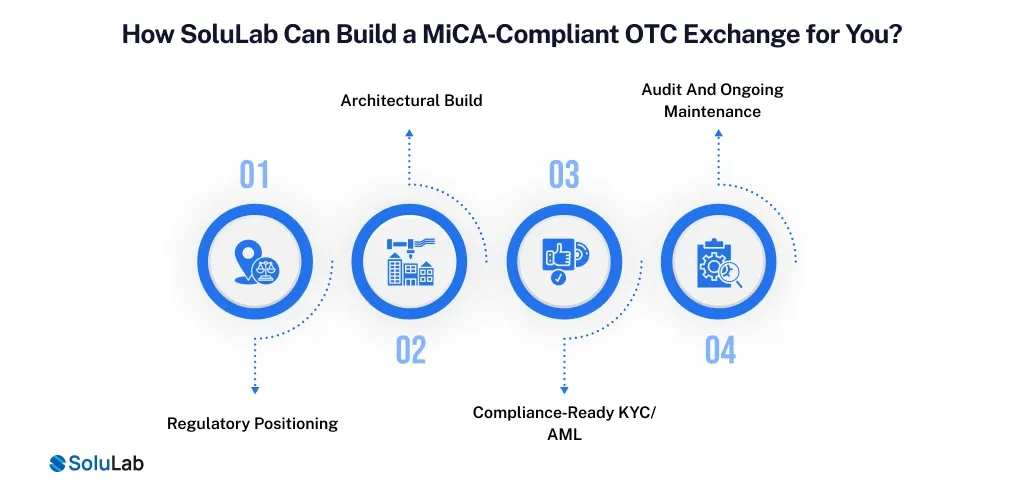
If you’re a founder or CTO evaluating crypto exchange development company options, SoluLab can help you at every stage:
1. Regulatory positioning:
We help you navigate MiCA vs MiFID crypto regulation differences and decide whether your OTC desk should be MiCA‑only or hybrid‑regulated if you’re dealing with security‑like tokens.
2. Architectural build:
We design and implement the crypto OTC platform development stack, including a matching engine, liquidity aggregation, wallet‑custody, and settlement, all aligned with MiCA KYC AML integration services crypto.
3. Compliance‑ready KYC/AML:
We integrate KYC rules for MiCA crypto exchanges and AML requirements under MiCA into your flows, including risk‑based scoring, transaction monitoring, and Travel‑Rule‑compatible data structures.
4. Audit and ongoing maintenance:
We help you prepare for MiCA audit services for crypto companies and plug in MiCA compliance solutions for crypto platforms so you can adapt to future clarifications without rebuilding.

Conclusion
By 2026, building a MiCA-compliant OTC exchange isn’t really a choice anymore, but the way you approach it makes all the difference. The real shift is understanding how MiCA and MiFID play out in practice and using that clarity to move faster, not slower, while others are still debating what applies to them.
In practice, this means designing your OTC desk with MiCAR in mind from the start, choosing between white-label or custom builds based on what you can realistically afford and ship, and SoluLab, as a blockchain development company, can help you make the right choice by putting KYC and AML in early so they don’t become a drag later.
If you’re serious about institutional OTC flow in Europe, MiCA isn’t something to work around; it’s what lets the right desks stand out and earn trust when it actually matters.
FAQs
With over 3 years of experience, I specialize in breaking down complex Web3 and crypto concepts into clear, actionable content. From deep-dive technical explainers to project documentation, I help brands educate and engage their audience through well-researched, developer-friendly writing.