Key Takeaways
- Integration is different because you control only one end. You are working against systems someone else designed, some predating the standards everything else assumes. That constraint, not the code, is what shapes the architecture.
- Discovery and system mapping decide the cost. What the APIs actually support versus what the documentation claims is the single biggest source of overrun. A fixed quote offered before mapping is a guess.
- Cost scales with connections, not systems. Point-to-point multiplies faster than teams expect, which is what eventually forces a move from direct API integration to middleware or an event bus.
- Pick the simplest pattern your estate actually needs. Direct API for a few modern systems, middleware for many or hybrid, iPaaS for mostly-SaaS, event-driven for real-time. Teams commonly over-engineer the pattern and under-invest in monitoring.
- Legacy systems get wrapped, not replaced. An adapter or middleware layer over the existing platform is almost always faster and cheaper than a rebuild, whether through database access, file transfer, or a custom connector.
- The failure modes are the project. Timeouts, rate limits, partial responses, duplicate events and schema drift at the far end. A proposal that only describes the happy path is incomplete.
- The integration layer holds credentials to everything. Least privilege per connection, secrets in a managed vault, audit logging, and an agreed system of record for each entity before build starts.
- Integrations fail quietly, so monitoring is not optional. Alerting on failed syncs and a named owner for out-of-hours breaks is the difference between finding out in minutes and hearing it from a customer.
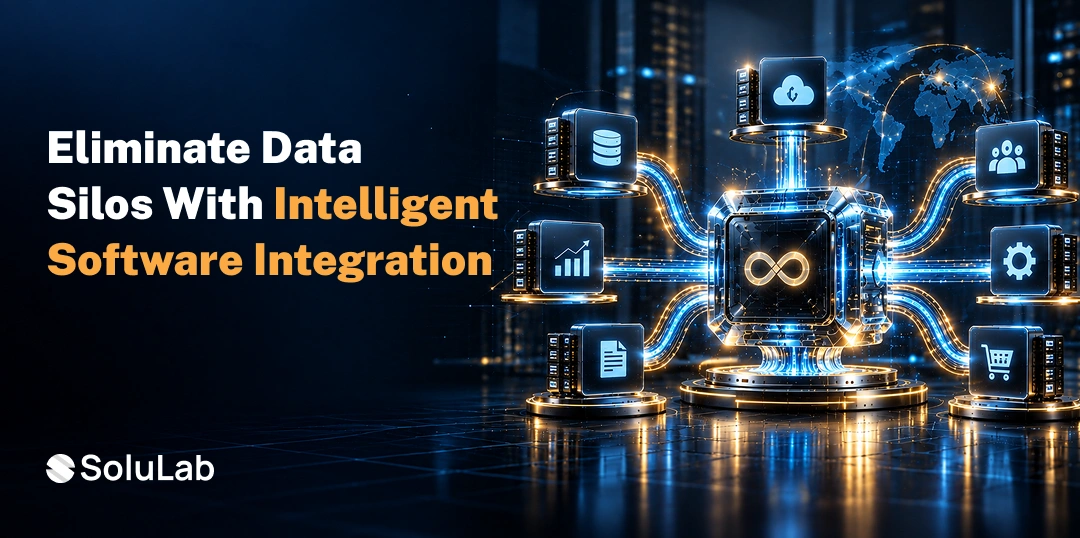
Software integration services connect separate systems — CRM, ERP, payment platforms, data warehouses, legacy databases, and third-party APIs — so they exchange data and trigger each other’s workflows without manual re-entry. The work spans discovery and system mapping, choosing an integration pattern, building and testing the connections, and monitoring them once live. What makes integration different from a normal build is that you rarely control both ends: you are working against systems someone else designed, some of which predate the standards everything else assumes.
On this page: what these services include, the main types of integration, API versus middleware versus iPaaS, the tech stack, the delivery process, what drives cost, the security and governance questions, and how to evaluate a partner.
What do software integration services actually include?
A full-scope engagement covers five things, and the first is the one most often skipped.
- Discovery and system mapping. Which systems hold which data, who owns each one, what the APIs actually support versus what the documentation claims, and where the current manual workarounds are. This phase surfaces the constraints that decide the architecture.
- Integration architecture. Choosing the pattern — direct API, middleware, an event bus, or a managed iPaaS — and defining the data model that everything maps into.
- Build and data mapping. The connectors themselves, plus field-level mapping, transformation logic, and the reconciliation rules for when two systems disagree.
- Testing. Not just “does data move” but what happens when the far end is down, rate-limits you, returns a partial response, or changes its schema without notice.
- Monitoring and support. Integrations fail quietly. Logging, alerting, and retry handling are the difference between finding out in minutes and finding out from a customer.
Discovery is worth paying for separately. A vendor that quotes a fixed integration price before seeing your systems is pricing a guess.
What types of software integration are there?
Most projects are one of these, or a combination.
- API integration. Point-to-point connections between systems that both expose modern REST or GraphQL APIs. The cleanest case, and increasingly the default.
- Legacy system integration. Connecting platforms that predate modern APIs — on-premises ERPs, core banking systems, older databases — usually through an adapter or middleware layer rather than a rebuild.
- Enterprise application integration (EAI). Connecting the core business stack: CRM, ERP, HR, finance, and support, so a record created in one appears correctly in the others.
- Data integration and ETL/ELT. Moving and transforming data into a warehouse or lake for reporting and analytics, rather than for live transactional use.
- Third-party and SaaS integration. Payment gateways, identity providers, shipping, messaging, and marketing platforms — where you control neither the API nor its roadmap.
- Cloud-to-on-premise integration. Hybrid estates where some systems will not or cannot move to cloud, and the integration layer has to bridge both.
- AI and emerging-tech integration. Connecting models, agents, or a distributed ledger to systems never designed for them. SoluLab covers the AI side through AI integration services and generative AI integration, and the ledger side in the guide on integrating blockchain with legacy systems.
API, middleware, or iPaaS: which integration approach fits?
This decision drives cost, timeline, and how much of the result you own. There is no default answer, only a fit.
| Approach | Best when | Trade-off |
| Direct API integration | Two or three systems, modern APIs on both ends, stable requirements | Connection count grows quadratically; ten systems point-to-point becomes unmaintainable |
| Middleware / ESB | Many systems, complex routing and transformation, on-premise or hybrid estate | Higher upfront build and a component your team must run and understand |
| iPaaS (managed platform) | Mostly SaaS systems, standard connectors cover the need, speed matters | Recurring licence cost, and you are inside the vendor’s limits when a connector does not exist |
| Event-driven architecture | Real-time reactions across services, high volume, loose coupling wanted | More moving parts; debugging is harder than a synchronous call |
| Custom connector | A system with no usable API, or a proprietary protocol | Most expensive per connection, and you own it forever |
A practical rule: start with the simplest pattern that covers the systems you actually have, and move up only when connection count or transformation complexity forces it. Teams commonly over-engineer at the start and under-invest in monitoring, which is the wrong way round.
What does the integration tech stack look like?
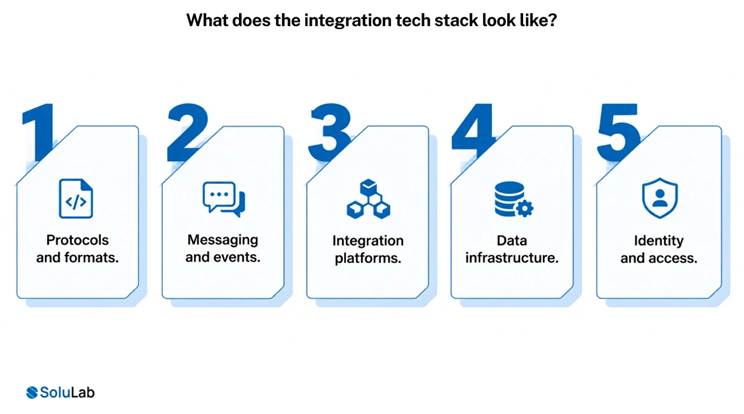
Protocols and formats. REST and GraphQL for modern systems, SOAP and XML where enterprise software has not moved, webhooks for push events, and scheduled file transfer for the systems that still only do CSV overnight.
Messaging and events. Kafka, RabbitMQ, or a cloud-native equivalent where services need to react to changes rather than poll for them.
Integration platforms. MuleSoft, Boomi, Workato, and Zapier at the lighter end, or a custom middleware layer where none of them fit.
Data infrastructure. Warehouses and pipelines for analytics workloads, built alongside proper cloud infrastructure and DevOps practice rather than after.
Identity and access. OAuth 2.0, service accounts, API gateways, and secret management, because an integration layer with broad credentials is a large attack surface.
What drives software integration cost?
There is no honest flat rate, because connecting two modern SaaS tools and untangling a fifteen-year-old ERP are different orders of work. What actually moves the budget:
- Number of systems and connections. Cost scales with connections, not systems, and point-to-point connections multiply faster than people expect.
- API maturity at the far end. A documented REST API is cheap. An undocumented one, a SOAP endpoint, or a system with no API at all each cost progressively more.
- Data complexity and quality. Field mapping is quick; reconciling two systems that hold the same customer differently is not. Existing data quality problems surface during integration and have to be resolved.
- Real-time versus batch. Overnight batch sync is meaningfully cheaper to build and run than sub-second event propagation.
- Compliance scope. Regulated data adds audit logging, access review, and often a formal security assessment before go-live.
- Ongoing maintenance. Third-party APIs change, deprecate, and break. Budget maintenance as a line item, not a contingency.
For how these interact with a wider build, SoluLab’s custom software development and enterprise software development practices cover the surrounding engagement models.
How do you keep an integration layer secure and governed?
An integration layer holds credentials to everything, which makes it the highest-value target in the estate.
Least privilege on every connection. Each integration gets its own service account, scoped to the minimum data and operations it needs. Shared admin credentials across integrations is the most common finding in an integration audit.
Secrets management. Credentials and tokens in a managed vault, rotated on a schedule, never in config files or source control.
Encryption and transport. TLS in transit as a baseline, plus encryption at rest for any staged or cached data, which integration layers accumulate more of than teams expect.
Audit logging. Who accessed what, when, and what changed — needed for regulated data and invaluable for debugging regardless.
Data governance. Agree the system of record for each entity before build. Without it, two systems will disagree and nobody will be able to say which is right.
If the integration carries regulated data, the compliance framework shapes the architecture from discovery, not before go-live. Which obligations apply depends on your jurisdiction and the data types involved, so confirm scope with legal counsel before the architecture is fixed.
How do you choose a software integration partner?
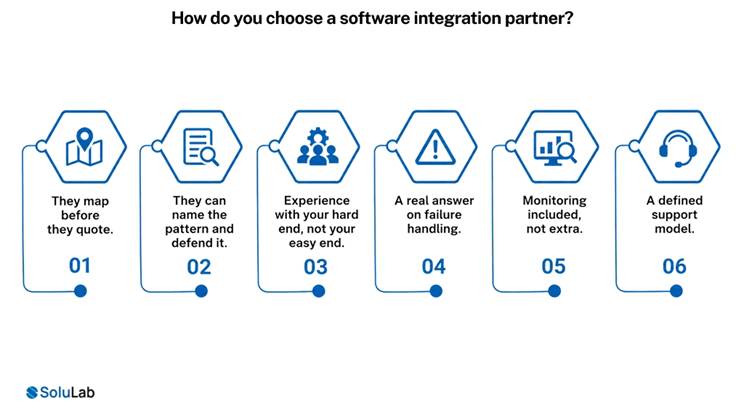
Six checks, in rough order of how much they predict the outcome:
- They map before they quote. A fixed price offered before seeing your systems is a guess you will pay for in change requests.
- They can name the pattern and defend it. Ask why API over middleware, or middleware over iPaaS, for your specific estate. A house default is not an answer.
- Experience with your hard end, not your easy end. Anyone can connect two SaaS tools. Ask what they have done with an undocumented legacy system.
- A real answer on failure handling. Retries, idempotency, dead-letter queues, and reconciliation. If the proposal only describes the happy path, it is incomplete.
- Monitoring included, not extra. An integration with no alerting is one that fails silently.
- A defined support model for when a third-party API changes, because it will.
Walk away from a proposal with no discovery phase, no mention of testing beyond functional, or no named owner for post-launch failures.
Why work with SoluLab on software integration?
SoluLab runs integration work strategy-first: system mapping and architecture decisions happen before a fixed quote, because pattern choice in week one drives most of the cost and nearly all of the maintenance burden.
The practice sits alongside in-house AI, data, and blockchain engineering, which matters when the integration is not just system-to-system — connecting an LLM to a CRM, wiring AI agents into real business workflows, or bridging a ledger to an ERP are architecture problems a general integration shop meets rarely. That depth also covers the ordinary cases: software consulting for estate assessment, SaaS platform and web application integration, IoT device data pipelines, and mobile app backends.
Frequently asked questions
Neha is a curious content writer with a knack for breaking down complex technologies into meaningful, reader-friendly insights. With experience in blockchain, digital assets, and enterprise tech, she focuses on creating content that informs, connects, and supports strategic decision-making.