Blockchain changed one thing above all: you no longer need a middleman you trust to hold up your end of a deal. The code does it. That is the whole promise of Web3 smart contracts, agreements that run themselves in an environment where nobody has to trust anybody. This guide walks through how Smart Contracts in Web3 work, and then spends most of its time on the part people underestimate. Security. What breaks, why, and what you can actually do about it.
Understanding Web3 Smart Contracts
Before we get to attacks and audits, it helps to be clear on what a Web3 smart contract is. So here are the basics: the core ideas, how these digital agreements behave on decentralized platforms, and the mechanics that make them tick. Skip ahead if you already write Solidity for a living.
A. Introduction to Web3 Smart Contracts
Web3 smart contracts are agreements that live on a blockchain and carry themselves out. Think of them as the digital cousin of a paper contract, except they can automate all sorts of tasks. They also bring a few real advantages:
- Transparency: The contract sits on a public blockchain, so anyone can read its terms. That openness makes fraud harder to pull off, and both parties know exactly what they signed up for.
- Immutability: Once deployed, the contract can’t be changed. Neither side can quietly rewrite the terms later, which is a big part of why people trust it.
- Automation: Certain tasks just happen on their own, saving time and money. Rent gets paid automatically. Funds get released the moment the agreed conditions are met.
And in Web3, it isn’t only about money moving from one wallet to another. Smart contracts show up in plenty of other places:
- Governance: They’re the backbone of decentralized autonomous organizations (DAOs), groups run by code instead of a board. With no central authority in the way, a DAO can cut costs and move faster.
- Decentralized applications (DApps): DApps are apps that run on a blockchain, and smart contracts are what they’re built from. You see them in decentralized finance (DeFi), non-fungible token (NFT) marketplaces, and prediction markets, among other things.
- Supply chain management: A contract can follow goods and materials as they move from one hand to the next. Fewer blind spots means better efficiency and less room for fraud.
- Web3 smart contracts are, put simply, a very capable automation tool. Transparent, immutable, automatic: that combination fits a lot of use cases. As Web3 keeps growing, expect them to turn up in more and more industries.
B. The Role of Smart Contracts in Web3
Smart Contracts in Web3 are quietly rewriting how a lot of businesses operate. They’re the bricks decentralized applications are made of, running predefined rules with no human pressing buttons. Compared to a centralized system, you get more efficiency, more transparency, and better security.
Take finance. Loan origination and settlement can run on a smart contract, which saves time and money for the business and the customer alike. Art is another good example. Smart contracts can mint NFTs that are tamper-proof and can’t be counterfeited, so artists and collectors can actually be confident about authenticity and value.
Because Web3 smart contracts are decentralized, some security comes built in. Every transaction, every execution, gets written to a blockchain and is very hard to tamper with. Users can see that. It makes them more comfortable putting their money on a decentralized platform.
DeFi is where this matters most. Lending, borrowing, trading: smart contracts run all of it. Get the security wrong and real funds are at risk, so the contract has to execute transactions exactly as intended and keep the money where it belongs.
The short version? Smart contracts can make a wide range of businesses more efficient, more transparent, and more secure. And as Web3 grows, the uses people find for them will only get more inventive.
Security Considerations in Web3 Smart Contracts
Here’s the uncomfortable part. In Web3, security isn’t one feature among many; it’s the thing everything else rests on. This section looks at where smart contracts are weak, what makes them hard to protect, and why sloppy security practice costs so much more here than in ordinary software.
A. Common Security Challenges
Smart Contracts in Web3, for all they change, come with problems of their own. Security holes sit at the top of the list for developers and anyone with a stake in the project. The usual suspects:
Smart Contracts in Web3: A quick recap. These are digital contracts that execute themselves, live on a blockchain, and are enforced by code. They could reshape plenty of industries by automating transactions and cutting out intermediaries. But they are far from trouble-free.
Security Vulnerabilities: This is the big one. Because Web3 smart contracts are decentralized, they don’t always get the level of security scrutiny that traditional software does. That leaves them more exposed. A mistake that looks tiny in review can turn into a serious breach once the contract is live.
External Dependency Risks: Plenty of contracts depend on outside data, usually through oracles. An oracle feeds real-world information into the contract, and the contract acts on it. So now your security is only as good as that feed. If the oracle serves bad data, whether by accident or on purpose, the contract will happily execute the wrong thing.
Unintended Consequences: Immutability cuts both ways. You can’t alter a smart contract after deployment. Which means a bug shipped is a bug kept, forever. In practice that can look like locked or lost funds, or a contract that executes in ways nobody planned.
Smart contracts are a strong new technology that could change a lot of industries. Still, you have to go in with eyes open about security vulnerabilities, external dependency risks, and unintended consequences. Once developers and stakeholders understand these problems, they can take concrete steps to reduce them and run smart contracts safely.
B. Best Practices for Web3 Smart Contract Security
So how do you harden Web3 Smart Contract Security, in practice? You stick to a few habits that are known to work.
Code Audits: Audit the code, properly and often, to find weak spots and fix them. The earlier a risk is caught, the cheaper it is to deal with.
- Your auditors need to know smart contract security inside out, well enough to find vulnerabilities and actually exploit them.
- One audit isn’t enough. New classes of vulnerability keep being discovered, so audits should happen on a regular schedule.
- Publish audit results so other developers can learn about the risks too.
Secure Development Standards: Follow established secure coding standards, like the ones published by ConsenSys and OpenZeppelin. Contracts written to these standards hold up far better against the common attacks.
- These standards usually spell out how to write safe code: use safe functions, stay clear of known vulnerabilities, validate your inputs.
- Every developer on the contract should know them, and use them, every time.
Multi-Signature Wallets: Put multi-signature wallets in front of anything sensitive. Critical operations then need more than one approval, which makes unauthorized access much harder.
- A multi-signature wallet won’t approve a transaction until several signers agree.
- You decide how many signatures are needed, based on what the application actually has to protect.
- Use them to guard funds, to deploy smart contracts, and for any other operation you can’t afford to get wrong.
Those three are the foundation. There are a few more steps worth adding if you want to tighten up Web3 smart contracts. They include:
- Static Analysis: Static analysis tools read through contract code looking for likely vulnerabilities.
- Dynamic Analysis: Dynamic analysis tools run the contract under simulated real-world conditions to see what cracks.
Related: Top 10 Smart Contract Development Companies in 2024
- Penetration Testing: Penetration testing tool means attacking your own contracts on purpose to find and exploit the holes before someone else does.
- Security Education: Developers need training on security best practice and on the specific risks of writing smart contracts. Tools don’t replace people who know what to look for.
Do all of this, and keep doing it, and you give your users and their assets a real shield against attackers.
Advanced Security Measures
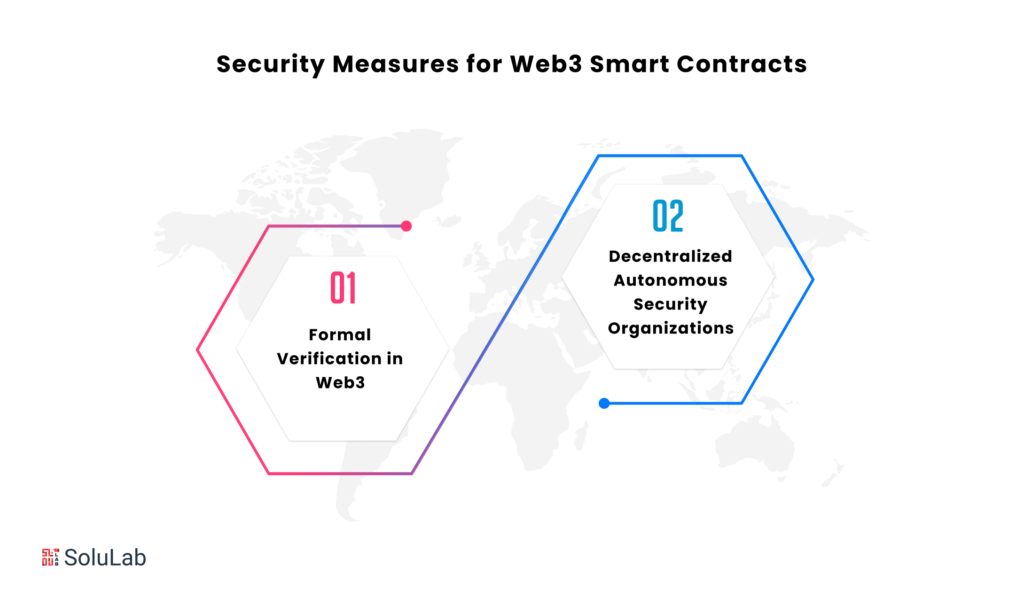
The basics get you most of the way. Past them sits a set of more advanced defenses built specifically for Web3 Smart Contracts. Two stand out: formal verification, and a newer idea called Decentralized Autonomous Security Organizations (DASOs). Both are about raising the bar well above what testing alone can offer.
A. Formal Verification in Web3
Formal verification uses mathematics to prove that a program is correct. Not tested. Proven. For smart contracts, the aim is to rule out the errors that lead to security holes or lost money.
It starts with a formal specification, a precise mathematical description of how the contract should behave. From that specification you build a proof of correctness. The proof shows the contract’s code does exactly what the specification says it should.
It’s a strong technique. It catches errors that ordinary testing would struggle to find, or never find at all. The catch is cost: formal verification is complex and slow, and it isn’t realistic to apply it to every contract you write.
In practice, teams save it for the most critical parts of a contract, the pieces where a failure would hurt most. That way the key security features get the strongest guarantee. It also makes sense for contracts running in high-stakes settings, financial trading being the obvious one.
Just don’t treat it as a silver bullet. Formal verification works best alongside the other layers, testing and code review included, not instead of them.
B. Decentralized Autonomous Security Organizations (DASOs)
DASOs take a group approach to Smart Contract Security in Web3. They’re decentralized groups that pool money and know-how to keep watching and auditing smart contracts on an ongoing basis. Many eyes instead of one firm: that’s the added layer, and it means less dependence on a single centralized audit.
A typical DASO brings together security experts, auditors, and dedicated developers, all working to find and fix vulnerabilities in smart contracts. Their toolkit is broad: static analysis, dynamic analysis, and plenty of manual review.
What does a developer get out of working with one?
- Increased security: More people hunting for vulnerabilities means fewer slip through, and fewer exploits.
- Reduced costs: Because resources and expertise are pooled, audits can cost less.
- Faster audits: DASOs can often finish an audit sooner than a traditional security firm, since they draw on the combined knowledge of all their members.
The idea is still young. But it’s picking up steam across Web3. More smart contracts in use means more demand for audits, and DASOs look well placed to help keep individual contracts, and Web3 as a whole, secure.
Future Trends in Web3 Smart Contract Security
Where is all this heading? Nobody has a crystal ball, but a few directions are already visible: new trends, better technology, and a push across the industry toward shared standards. Each of them will shape how secure decentralized transactions become.
Innovations and Developments
For Smart Contracts in Web3 the security outlook is genuinely encouraging.
- Automated Security Tools: New automated tools built on artificial intelligence and machine learning will make finding and fixing vulnerabilities in smart contracts much faster. They’ll scan a contract for likely weak spots, then suggest how to fix them. Fewer holes, fewer exploits.
- Standardization Efforts: The industry is slowly settling on standard secure coding practices and audit processes. The goal is simple: every smart contract built securely and checked by qualified auditors. That raises the floor for everyone and cuts the risk of exploits further.
- Increased Awareness: The more people understand what can go wrong with smart contracts, the more they’ll insist on secure ones. That puts pressure on developers to get it right, and it pushes the market toward new security tools and standards.
Put together, these shifts will make smart contracts more reliable and easier to trust, which is exactly what wide adoption needs.

Conclusion
Smart contracts are digital contracts that execute themselves on the blockchain. Web3 is built on them, and they’re changing how people deal with digital platforms. They make possible new kinds of interaction that are more secure, more efficient, and easier to inspect. A few examples of what you can build with them: decentralized applications (dApps), non-fungible tokens (NFTs), Decentralized finance (DeFi), supply chain management, and voting systems. The list keeps growing. It’s still early days for smart contracts, yet they could change how we deal with the world around us. Which brings us back to security.
It matters more here than almost anywhere. Smart contracts run themselves and can’t be changed after deployment, so any flaw left in the code is an open door for attackers. You close that door with secure coding standards, regular audits, automated security tools, and industry-wide standardization. SoluLab is a Web3 development companythat offers a full set of Web3 services, with a team of seasoned Web3 developers. We build Web3 products that are secure first and innovative second, shaped around what you actually need.
FAQs
Bhavya is driving growth through data-backed demand generation for AI and Web3 solutions. With 9+ years in digital marketing, he has spearheaded initiatives that led to a 40% increase in qualified inbound leads. Bhavya shares insights on marketing ROI and scaling a digital presence via AI workflows. He is open to connecting with startups and enterprise teams to help them overcome their challenges.