Key Takeaways
- The status quo: Speed-to-launch often overrides security, with insufficient audits and poorly tested smart contract logic.
- The problem: DEX platforms frequently face exploits due to vulnerable smart contracts, poor testing, and flawed liquidity logic, eventually leading to millions in losses.
- The solution: Risk reduction requires secure smart contract design, multi-layer audits, automated testing, and real-time monitoring.
- How SoluLab helps: Our team develops secure DEX smart contracts with rigorous testing, third-party audits, and best-practice security frameworks by helping projects launch safer, protect assets, and scale confidently.
The decentralized exchange market is reaching a structural turning point. DEXs now stands nearly $10 billionin average daily volume across spot and perpetual futures markets. This signals real adoption beyond early DeFi experimentation. Fees are becoming competitive with centralized exchanges, and institutional interest is growing as regulatory clarity improves.
But growth brings responsibility. As trading volumes rise and capital deepens, DEX Smart Contract Security becomes critical. In decentralized exchange solutions, execution and settlement happen through smart contracts within seconds. That efficiency is remarkable, but it also means any vulnerability can scale instantly.
For enterprises, secure smart contract architecture is now the foundation of sustainable DEX development. Therefore, enterprise leaders must know how to invest in smart contracts that can elevate their 100% growth.
Why Are Enterprises Prioritizing Smart Contract Security in DEX Architecture?
Enterprise interest in DeFi is rising, but so is caution.
According to the Grayscale report, a single vulnerability can drain hundreds of millions in minutes. For institutions managing treasury assets or client funds, that risk is unacceptable.
1. The Cost of Smart Contract Failures
- Flash loan attacks and reentrancy bugs remain common
- Oracle manipulation affects pricing integrity
- Cross-chain bridges remain high-risk attack surfaces
- Over 60% of major DeFi exploits stem from smart contract weaknesses
For enterprises, this is not a technical issue. It is a balance sheet issue.
2. Regulatory Pressure Is Increasing
Under frameworks like MiCA in Europe and growing SEC oversight in the US, platforms must demonstrate:
- Code transparency
- Auditability
- Governance accountability
- Risk mitigation controls
Smart Contract Security in DEX is now linked directly to regulatory readiness.
3. Institutional Capital Demands Protection
Banks, hedge funds, and asset managers require:
- Formal audit trails
- Permissioned liquidity options
- On-chain transaction traceability
- Insurance-compatible architecture
This is why enterprise buyers increasingly partner with a specialized blockchain development company that understands both cryptocurrency exchange engineering and institutional compliance.
What Security Standards Should a Smart Contract–Powered DEX Follow?
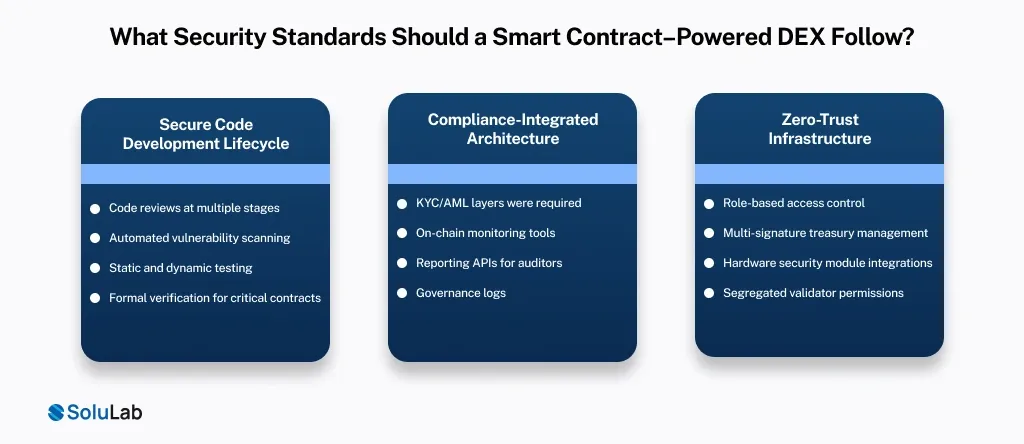
Security must align with global enterprise IT and banking standards. Not only alignment, but these standards are updated according to the latest government rules and elevate the security system to the maximum.
1. Secure Code Development Lifecycle
Enterprises expect structured processes:
- Code reviews at multiple stages
- Automated vulnerability scanning
- Static and dynamic testing
- Formal verification for critical contracts
Smart contract audits in DEX development must follow the same rigour as fintech backend systems.
2. Compliance-Integrated Architecture
Security today includes regulatory alignment. A DEX must integrate:
- KYC/AML layers were required
- On-chain monitoring tools
- Reporting APIs for auditors
- Governance logs
This hybrid crypto exchange model balances decentralization with regulatory compatibility.
3. Zero-Trust Infrastructure
Large enterprises follow zero-trust principles. A DEX should include:
- Role-based access control
- Multi-signature treasury management
- Hardware security module integrations
- Segregated validator permissions
This approach significantly reduces internal and external exploit exposure. When enterprises evaluate DeFi Exchange Development Services, they now assess governance, compliance readiness, and audit methodology alongside technical features.

How Do Enterprises Reduce Smart Contract Exploit Risk in DEX Platforms?
Risk reduction is not a single factor in the smart contract audit checklist. It is an ongoing strategy to implement. With 24/7 monitoring through current technology, it can help you give better security for your customers.
1. Multi-Layer Smart Contract Auditing
Enterprise-grade Smart Contract Security includes:
- Internal pre-audit testing
- Third-party independent audits
- Bug bounty programs
- Continuous code monitoring
One-time audits are no longer enough.
2. Real-Time Threat Monitoring
Modern DEX platforms use:
- AI-driven anomaly detection
- On-chain transaction monitoring
- Suspicious wallet tracking
- Liquidity pool abnormality alerts
Continuous monitoring can reduce exploit response time by over 40%.
3. Upgradeable and Modular Contract Design
Proxy patterns and modular contracts allow:
- Patch deployment without disrupting liquidity
- Governance-approved upgrades
- Controlled feature expansion
This is critical in fast-evolving markets.
4. Treasury Risk Segmentation
Enterprises now design DEX architecture where:
- Liquidity pools are compartmentalized
- Admin controls are time-locked
- Emergency pause mechanisms exist
Decentralized Crypto Exchange Security is increasingly about damage containment, not just prevention.
Can Institutional Liquidity Enter a DEX Without Compromising Security?
Yes, but only with a hybrid blockchain architecture. Purely permissionless systems often conflict with institutional risk requirements. Enterprises are now building structured crypto exchange models.
1. Permissioned Liquidity Pools
Institutions can participate through:
- Whitelisted wallet pools
- Verified participant frameworks
- Tiered access smart contracts
This reduces AML exposure while maintaining blockchain transparency.
2. Custody Integrations
Enterprise DEX platforms integrate with:
- Regulated custodians
- MPC-based wallets
- Multi-signature institutional custody solutions
This ensures private keys are never exposed to protocol-level vulnerabilities.
3. Institutional Reporting Layers
Enterprises require:
- Real-time liquidity reports
- Compliance-ready transaction exports
- Risk dashboards
Smart Contracts in Decentralized Exchange Development must support off-chain reporting modules. The result is a model where decentralization coexists with compliance.
What Does an Enterprise-Ready Smart Contract Security Framework Look Like for DEX?
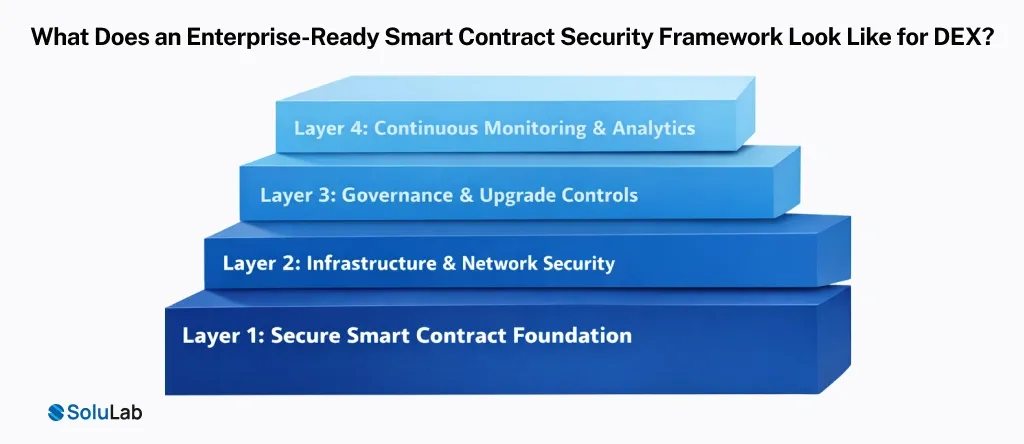
A mature framework of DEX in smart contract development means combining technical, operational, and governance layers. This not only helps you scale maximum growth but also keeps you at the top of the industry.
Layer 1 – Secure Smart Contract Foundation
- Formal verification of core trading logic
- Audited automated market maker algorithms
- Gas-optimized and attack-resistant code
- Built-in circuit breakers
Layer 2 – Infrastructure and Network Security
- Secure node infrastructure
- Distributed validator setup
- DDoS-resistant architecture
- Encrypted RPC endpoints
Layer 3 – Governance and Upgrade Controls
- DAO-based or board-approved governance
- Transparent proposal systems
- Time-locked contract upgrades
- Emergency control mechanisms
Layer 4 – Continuous Monitoring and Analytics
- On-chain risk analytics
- AI-based anomaly alerts
- Wallet behaviour tracking
- Liquidity concentration monitoring
Enterprises that adopt this layered approach see measurable benefits:
- Reduced exploit probability
- Faster regulatory approvals
- Higher institutional trust
- Stronger long-term liquidity retention
This is where working with an experienced white label crypto exchange development company becomes strategic rather than technical.

Conclusion
As discussed above, building a secure and scalable DEX today starts with strong DEX Smart Contract Security and enterprise-grade architecture.
A practical example of this shift is DLCC- Leading the Movement from TradFi to DeFi. Designed as a next-generation DeFi platform, DLCC simplifies automated crypto trading, lending, and borrowing while removing geographic barriers.
Built with enterprise-focused Smart contracts in DEX development, the platform delivers measurable impact:
- 85% improvement in transaction security, strengthening user and capital protection
- 60% faster decision-making through real-time analytics and smart automation
- A real-time collateral marking system, dynamically adjusting asset values based on market movement to protect both lenders and borrowers
SoluLab, a top decentralized exchange development company designed DLCC with a strong focus on:
- Scalable decentralized architecture supporting automated trading and lending
- Real-time monitoring and collateral intelligence systems for risk mitigation
If your organization is exploring crypto exchange development services or looking to strengthen decentralized crypto exchange security, now is the time to move from strategy to execution.
Let’s discuss how we can build a secure, compliant, and scalable DEX tailored to your business goals.
FAQs
Deepika is a content writer who blends storytelling with strategic thinking. She explores topics across digital innovation, emerging tech, and the evolving blockchain industry. She enjoys breaking down complex ideas into simple, engaging narratives in the growing global markets.