
Two decades is not a long time, and yet the Internet has been rebuilt twice over in that stretch. Web 1.0 handed us pages that simply sat there. Web 2.0 made them talk back, refresh, recommend, and remember. Web 3.0 is the next swing, and it wants to change who owns the thing underneath. Blockchain sits right in the middle of that argument.
So this blog looks at what blockchain actually does inside Web 3 development, and how much of the Internet it could genuinely rearrange.
The Evolution of the Internet Leading to Web 3.0
You cannot judge what blockchain means for Web 3 technology without knowing what came before it. Two chapters, really. Web 1.0 and Web 2.0, and each one solved a problem the previous one could not.
Web 1.0 showed up in the late 1980s. Read-only pages, published by a small handful of people who knew how. That sounds thin now. At the time it was astonishing, because a document written on another continent was suddenly yours to read. The catch was that you could only read. You had no way to answer back, contribute, or change anything you saw.
Web 2.0 fixed exactly that. Accounts arrived. Profiles arrived. Suddenly every person on the network could assemble an identity out of usernames, photos, and posts, and carry it between apps. E-commerce grew into the space. So did social platforms, chasing audiences that had never been reachable before. The plumbing kept pace too, with HTML5, CSS3, and JavaScript turning browsers into something closer to software than paper.
Read Our Blog: Top 10 Web3 Development Companies 2024
Which brings us to the current moment. Web 3.0. What is it actually promising, and where does blockchain slot into it?
The Emergence of Web 3.0 and the Role of Blockchain Platforms
Web 3.0 changes the default assumptions. Decentralization instead of central ownership. User control instead of platform control. Security treated as structure rather than as a feature bolted on later. And blockchain platforms are what make those assumptions hold.
Web 3.0 leans on blockchain technology applications so data lives spread out and resists tampering. No central server means no single box for an attacker to pry open, which cuts down the odds of a breach considerably. There is a second effect, and it may matter more: blockchain makes self-sovereign digital identity possible. Your data, your keys, your call on who touches it.
Then there are smart contracts. They come out of blockchain platforms like Ethereum, and they automate agreements that would otherwise need a middleman and a week of paperwork. Transactions settle on rules instead of on trust. Those same contracts are the engine under decentralized applications, which is how we ended up with decentralized finance (DeFi) and non-fungible tokens (NFTs) in the first place.

Interoperability is the other piece. Blockchain platforms let data and assets move between networks instead of getting stuck inside one. For the person using it, the decentralized web starts to feel like one place rather than twelve.
Head far enough into top Web platforms and blockchain stops looking like a component and starts looking like the load-bearing wall. Decentralization, user sovereignty, data security: all three rest on it. What comes out the other side is an Internet that is more open, harder to compromise, and built around the person using it.
Defining Web 3.0: The Next Phase of the Internet
Definitions first, because the term gets thrown around loosely. Web 3.0 is the third generation of Internet services, and it runs on Artificial Intelligence (AI), the Internet of Things (IoT), and blockchain. AI and machine learning are front and center. Security is not an afterthought this time. But you only see why any of that was necessary once you look at what Web 2.0 left unsolved.
Web 2.0 rewired how people behave online. Producers and consumers of goods, services, and information landed in the same digital room, and peer-to-peer transactions went global almost overnight. There was a cost. Every one of those exchanges needed a platform in the middle, vouching for two parties who had no reason to trust each other. The platforms did the job well. They also set the rules, took their cut, and kept the user data. That tension is precisely what Web 3.0 exists to resolve.
Read Also: Top Blockchain Trends in 2024
Web 3.0: Applications and Use Cases
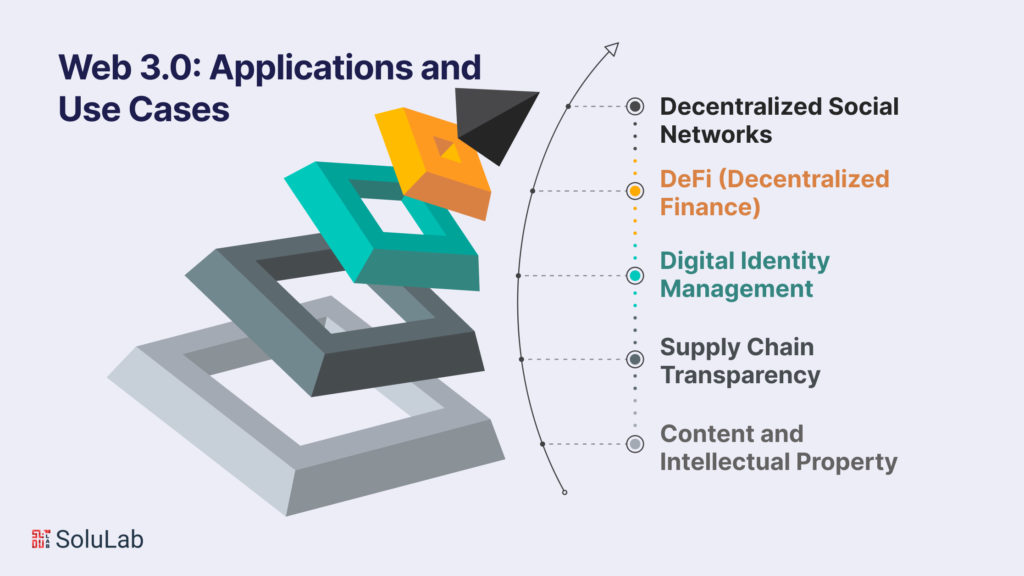
Most Web 3.0 use cases are, at heart, answers to something Web 2.0 got wrong:
- Decentralized Social Networks: Web 3 use cases hand the feed back to the people in it. Users keep their data and their connections. Nobody sitting above the network gets to quietly decide what disappears.
- DeFi (Decentralized Finance): The loudest Web 3.0 application by far. DeFi platforms runs financial products on blockchain and smart contracts, in the open, where anyone can audit the rules. Your assets stay under your control instead of someone else’s ledger.
- Digital Identity Management: Self-sovereign identity means you hold your credentials. No central authority gets to issue, revoke, or resell who you are.
- Supply Chain Transparency: Write a product’s history to an immutable ledger and provenance stops being a claim on a label. It becomes something you can check.
- Content and Intellectual Property: Creators get paid closer to the source, largely through NFTs, which rewrites both monetization and how IP is tracked.
Short version: Web 3.0 is the Internet’s next step, powered by newer technology and pointed squarely at user control and data security. It takes the failures of Web 2.0 seriously. And it brings a genuinely varied set of Web 3 use cases along with it, all aiming at an online experience that is decentralized, safer, and built around you.
The Role of Blockchain in Web 3.0 Advancements
Think about Siri or Alexa for a second. Ordinary now, faintly magical a decade ago, and a clean demonstration of what machine learning does to internet services once it gets good enough. Web 3.0 stacks more on top: machine learning, IoT devices talking to each other, and decentralized protocols holding the whole arrangement together. That last layer is where blockchain earns its place, and it deserves a closer look.
Web 3.0 networks behave differently from what came before. They interoperate. Smart contracts automate the parts that used to need a human signature. Systems connect without a broker in the middle, and peer-to-peer file storage becomes hard to censor by design. Put those together and blockchain reads less like one option among several and more like the substrate for whatever the Internet becomes next.
Check Our Blog Post: Top 5 Enterprise Blockchain Platforms of 2024
Storage and data management are where the break is sharpest. Blockchain gives you a shared state layer, a single collection of data that no one party owns and everyone maintains together. Build on that and you get a value settlement layer for the Internet itself. You also get file transfers that are secure and copy-protected, plus peer-to-peer transactions that clear without a middleman taking a slice.
Inside Web 3.0, blockchain development companies and blockchain ecosystem protocols are what turn that theory into working systems, reshaping how data gets managed and pushing the web toward something more decentralized and less wasteful.
How Blockchain Paved the Way for Web 3.0?
It started with Bitcoin. Bitcoin’s blockchain, and the protocols that followed it, built networks where an attacker could not simply find the one server that mattered. To reach the data you would have to compromise copies sitting in many places at once, all over the world. That single structural choice, storing data as multiple copies across a peer-to-peer network, is the idea Web 3.0 inherited. The protocol spells out how the network governs itself. A consensus mechanism involving every participant keeps the data honest. And participants get paid in native network tokens for the work of keeping it secure and running.
Read Our Blog: Top 10 Blockchain Ecosystem Protocols of 2024
Blockchain is the floor Web 3.0 stands on, mostly because it changed the data structures under the Internet’s infrastructure. There is another consequence, and it is easy to miss. Blockchain added a governance layer that runs alongside the Internet we already had. Two strangers who have every reason to distrust each other can now reach an agreement and settle it online, safely, without either one needing to take the other’s word.
Here is the part people skip. Blockchain’s role in Web 3 development is mostly a backend story. Technically speaking, Web 3.0 is a stack of blockchain-based protocols rebuilding the Internet’s foundations from underneath. Blockchain behaves like one distributed global computer. Once that lands, your mental model of the Internet does not survive intact.
Blockchain in Web 3.0: Practical Applications
Mechanically, blockchain stores data on distributed ledgers. That buys you immutability, strong security, and interconnectivity between systems. Smart contracts come with it, self-executing programs that fire the moment their conditions are met.
It is a real break from how this used to work, and the Internet stands to change substantially because of it.
- Digital Universal Identification Through Blockchain
Right now, websites still identify you with third-party cookies. That method is unreliable and it is not secure, and it is getting harder to defend every year. Web 2.0 never really solved identity, not for people, not for devices, not for organizations. The practical result is that consumer identity management sits with a handful of centralized providers, each one walled off from the rest.
Read Also: Web 3.0 Development Trends: What’s Next for the Internet
- How Does the Current Consumer Identity Management Process Function?
You sign up somewhere using an email address from Google, Yahoo, or Meta. Every permission you grant and every action they track after that generates data. That data belongs to them, not to you.
As enterprise blockchain consulting firms and blockchain technology keep maturing, a different global identification system becomes plausible. Digital identities that are self-sovereign and encrypted, issued to you rather than about you. They hold up better against theft and breaches, and they retire the sprawl of usernames and passwords you are currently keeping track of.
Benefits of Employing Blockchain in Identity Management
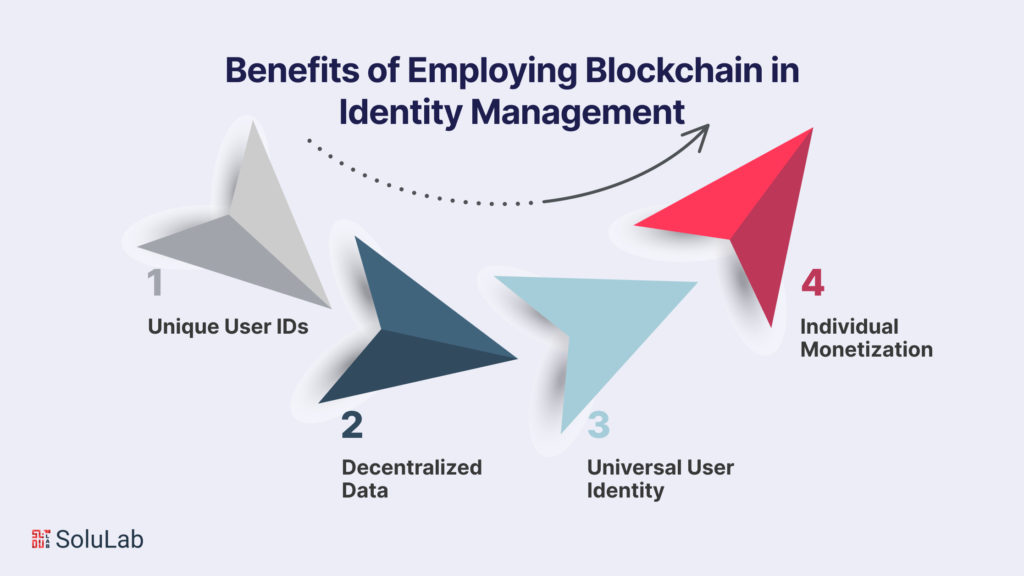
- Unique User IDs: Every user gets one distinct identifier. Better security, and more of the control sits with the person.
- Data Control: You decide who gets access to your data and what they are allowed to do with it.
- Decentralized Data: Data sits across the network instead of in one company’s vault, which cuts dependence on central authorities and hardens security.
- Universal User Identity: One digital identity that works everywhere becomes realistic, so moving between platforms stops meaning starting over.
- Individual Monetization: If your data and your online presence have value, blockchain gives you a way to capture some of it yourself.
Read Our Blog Post: The Rise of Web 3.0: Exploring its Impact on the Digital Landscape
Leveraging Blockchain Technology in Marketing
Smart contracts let two people exchange value online with nobody standing between them. Everything is visible, so the usual disputes about who owed what simply have less room to start. For marketing under Web 3.0, that is not a small detail.
A smart contract lives at a fixed address on the blockchain. It carries its own rules and its own penalties for every agreement it governs. No bank, no arbitrator, no third party enforcing anything. The code does the enforcing.
Online marketing in the Web3 era is going to look different because of this. Any organization, a Web3 game development company included, can start testing decentralized campaign models that were not buildable before.
Utilizing Blockchain in the Digital Advertising Sector
Digital advertising has several problems blockchain is well shaped to attack. Start with publishers: give them access to consumer metadata and their campaigns get measurably tighter. Then there is fraud, which is the industry’s oldest tax. A blockchain immutable ledger system records impressions in a way that cannot be quietly edited afterward, and that alone closes a lot of doors.
Smart contracts are worth adopting here too, because they give both sides a verifiable audience and keep ad operations running without the usual finger-pointing. Blockchain also anonymizes metadata, which keeps you on the right side of privacy regulation while still giving users a decent brand experience. Their personal information stays theirs.
Web 3.0 changes how data gets stored, reached, and managed across the Internet. The shift favors the individual. More control over your own data, more control over your own interactions, and a web experience that reflects that.
Blockchain Technology in the Healthcare Sector
Healthcare has gained real ground from enterprise blockchain solutions and services. How information moves between the different parts of the sector is simply not what it was.
Consider what healthcare runs on: drug development, research programs, and a long chain of processes that all depend on contracts holding up. Blockchain produces documents that cannot be altered after the fact, which is exactly what a company wants backing a contract.
Read Also: Blockchain Security: Best Practices Every Developer Should Know
Blockchain-powered Learning Management Systems have changed the sharing side too. Information travels further, reaches stakeholders anywhere in the world, and arrives with its source attached, so what people receive is both relevant and traceable back to someone trustworthy.
Blockchain in Web 3.0: Real-World Examples
Take Follow. It is a decentralized autonomous organization, and it built a decentralized social protocol that points at what web services could become. The goal is blunt: users should own their social identity and their data outright, not rent it from a platform. That ambition runs through a lot of Web 3.0 work right now, this effort to build social infrastructure that actually matches what the Internet was supposed to be. Blockchain’s contribution is removing the trusted middleman while still letting a network record and remember what its members did. It is a powerful lever, and a more decentralized internet is what it opens.
If you are a business trying to move on this, you have two practical routes. You can hire blockchain developers or you can hire dedicated developers and build the capability in house.

Conclusion
Strip away the noise and blockchain is doing the heaviest lifting in Web 3 development. It is what makes the next Internet decentralized, secure, and built around its users instead of its platforms. Data management is being rebuilt. So are digital identities, and so is the shape of ordinary online interaction. Decentralization, immutable data, and smart contracts are the three pieces that make it work, and together they produce a web where you hold your data, privacy is the default rather than a setting, and trust comes from being able to check rather than from being asked to believe. That reaches into decentralized finance, supply chains, digital content, and intellectual property alike.
And it is not only a technical story. Web 3.0 is a shift in who holds power online, toward something more equitable and more user-driven. With blockchain underneath, people get real sovereignty over their own presence on the Internet, and the Internet itself stops concentrating and starts distributing. The more work gets done in this space, the clearer it becomes that blockchain will decide a great deal about what the web looks like next: sturdier, safer, open to more people.
SoluLab is a Blockchain development company and Web3 development company, and we build blockchain and Web3 solutions for a living. Our developers and specialists handle the full range of it: decentralized applications, smart contracts, and the unglamorous work of wiring blockchain into systems you already run and cannot afford to break. We work across a wide set of blockchain platforms and protocols, which matters because the right answer for a logistics client is rarely the right answer for a fintech one. What we bring is real depth in Web3 technologies and a habit of building for the business in front of us. So if you are looking to hire Web3 developers, talk to us.
FAQs
Shipra Garg is a tech-focused content strategist and copywriter specializing in Web3, blockchain, and artificial intelligence. She has worked with startups and enterprise teams to craft high-conversion content that bridges deep tech with business impact. Her work translates complex innovations into clear, credible, and engaging narratives that drive growth and build trust in emerging tech markets.