Say you’re a cook trying to invent a new dish. You’re new at this, so your ideas come out bland or just strange, and you don’t have the experience to know why. So you find a mentor, someone who has spent years at the stove, and they taste your food and tell you what’s off. Over time, you pick up the craft. AI can learn the same way. Long Ouyang, a research scientist at OpenAI, has described Reinforcement Learning from Human Feedback (RLHF) as learning from human guidance to speed up training. [SOURCE NEEDED]
Two roles, then. There’s the human mentor, and there’s the AI apprentice. Like the chef in the story, the human gives feedback that shapes how the AI makes decisions. The apprentice takes that guidance and gets better at the job, one correction at a time.
Below, we cover what RLHF is, how it works, and where it’s showing up in the real world.
What is Reinforcement Learning from Human Feedback?
Reinforcement Learning from Human Feedback (RLHF) is a way for machines to learn a task, and get better at it, with people in the loop. In ordinary machine learning the computer works things out by itself. RLHF blends that with human guidance.
Put plainly: say you want a computer to chat with you the way a friend would. A chatbot, basically. RLHF is how you make it good at that. The model learns from what people tell it, and people step in when it gets something wrong. The result is a system that’s sharper and far more useful in conversation.
Where does it shine? Language work. Chatting, summarizing, anything where the machine has to grasp what you mean and answer in a way that makes sense. You’re teaching it to talk, and to listen.
OpenAI’s ChatGPT is one program that uses RLHF. It learns from human input to make its replies better and more appropriate, which is a big part of why it feels friendly and useful to talk to.
Key Components of RLHF
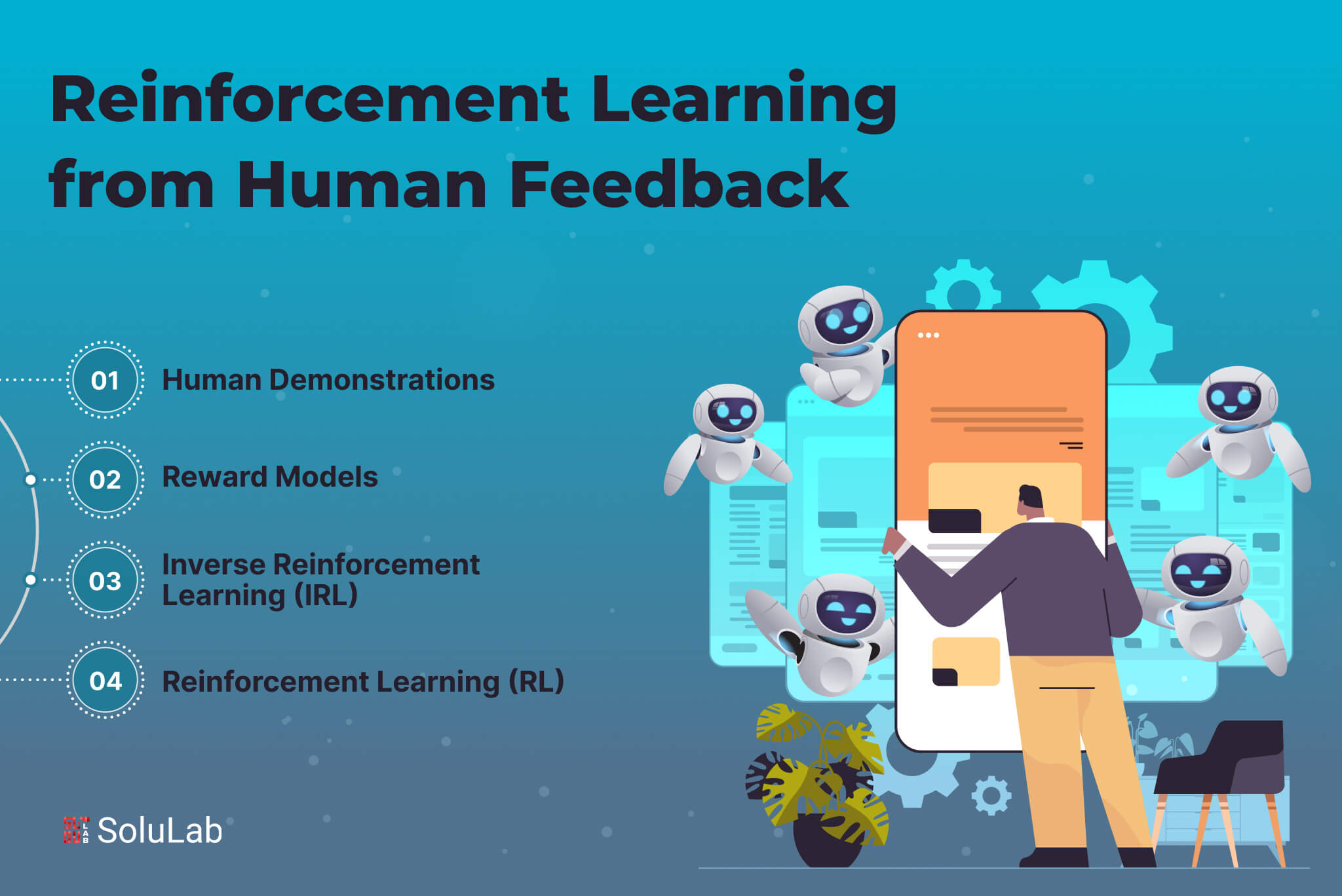
RLHF, or Reinforcement Learning with Human Feedback, is much easier to follow once you split it into parts. Each part helps build systems that learn from human demonstrations and feedback, connecting what people know with what machines can learn. Here they are, without the jargon:
- Agent
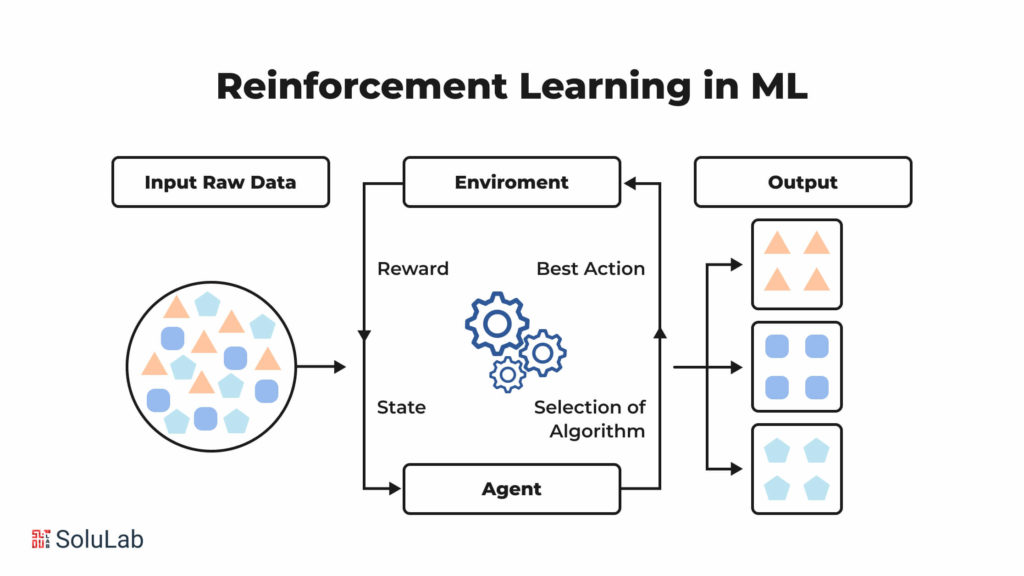
Everything starts with the agent. It’s the AI system that learns to do a task through reinforcement learning (RL). The agent acts inside an environment and gets feedback back: a reward when it does well, a penalty when it doesn’t.
- Human Demonstrations
How does the agent know what good looks like? People show it. A demonstration is a sequence of actions a human takes in a given situation, a worked example of the behavior you want. The agent learns by copying those actions.
- Reward Models
Demonstrations only go so far, so reward models add more guidance on top. A reward model gives a score to states or actions depending on how desirable they are. The agent then tries to collect as much total reward as it can, and in doing so learns to pick the choices that lead somewhere good.
- Inverse Reinforcement Learning (IRL)
IRL flips the usual question around. Rather than being handed a reward function, the agent watches human demonstrations and works backward to figure out what reward those humans must have been chasing. Then it learns to reproduce that.
- Behavior Cloning
Behavior cloning is imitation, pure and simple. The agent builds a set of rules by matching its actions as closely as possible to what humans did. Copy enough good examples and you pick up good habits.
- Reinforcement Learning (RL)
After learning from demonstrations, the agent switches to RL to sharpen its policy. Now it has to observe the environment, act, and take the feedback that comes back. Trial and error, over and over, until the policy performs as well as it can.
- Iterative Improvement
RLHF is usually a loop, not a single pass. People keep feeding the agent demonstrations and feedback, and the agent keeps refining its policy with a mix of imitation learning and RL. Round after round, until its performance is good enough.
RLHF: Potential Benefits
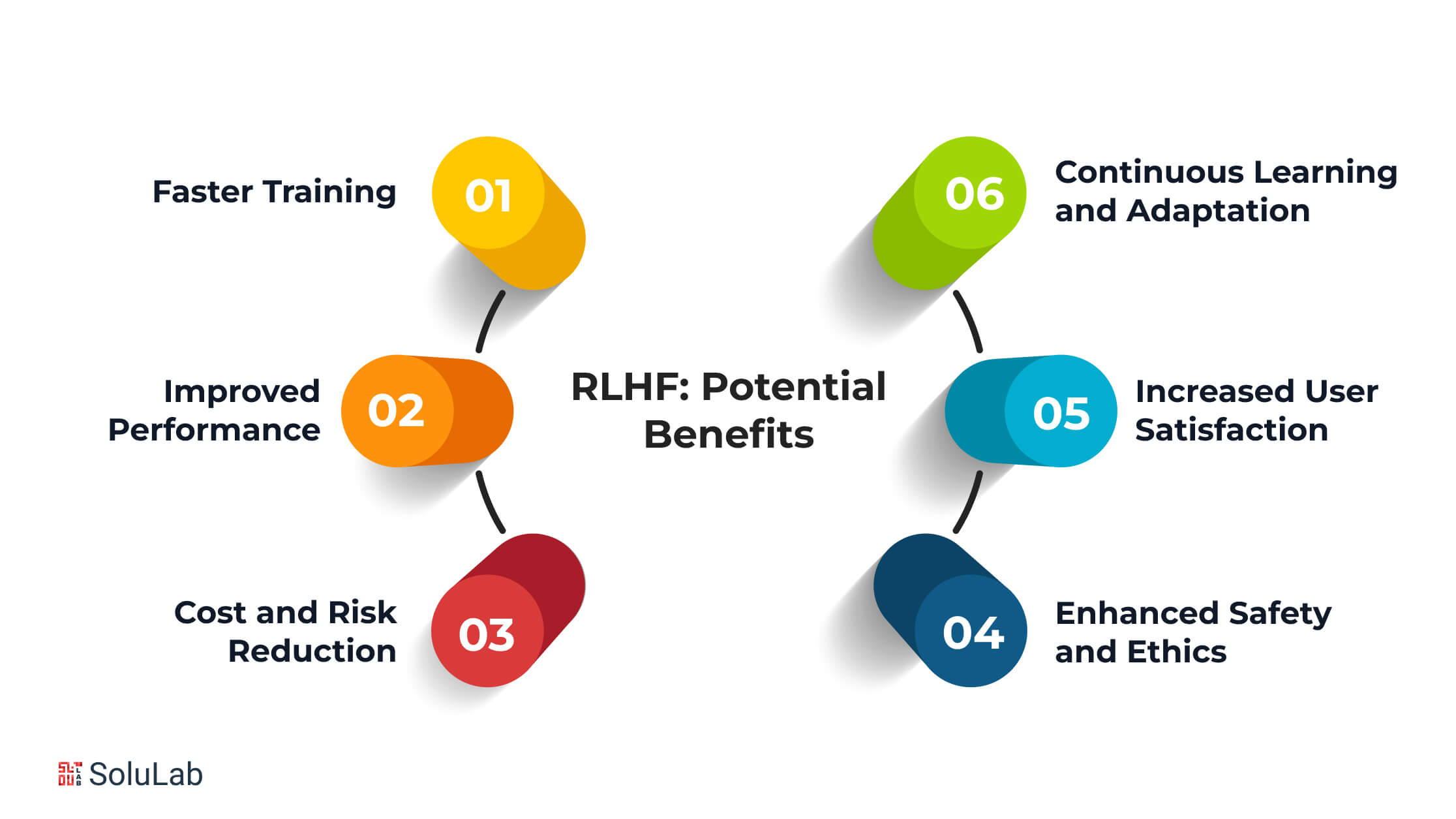
For a business, RLHF, or Reinforcement Learning with Human Feedback pays off in a few concrete ways. Operations run with less friction, decisions get smarter, and performance and efficiency go up across the board. Here’s what that looks like in practice:
- Faster Training
Human feedback cuts out a lot of guessing, so reinforcement learning models train faster. Take AI summary generation. With people weighing in, it can adjust to new topics or situations quickly instead of stumbling toward them.
- Improved Performance
You can make a reinforcement learning model better by feeding it human feedback. Mistakes get fixed. Choices get better. In a chatbot, for instance, that feedback polishes the replies, and customers walk away happier with the conversation.
- Cost and Risk Reduction
Training a reinforcement learning model from scratch is expensive and risky. RLHF sidesteps a good part of that. Human expertise lets you skip much of the costly trial and error and catch errors early. In drug discovery, for example, RLHF can help pick out promising molecules to test, which saves both time and money.
Related: What is an AI Copilot?
- Enhanced Safety and Ethics
Human feedback can teach reinforcement learning models to make safe, ethical calls. In a medical setting, that means treatment recommendations that put patient safety and values first. Responsible decisions, not just statistically likely ones.
- Increased User Satisfaction
RLHF lets you shape a reinforcement learning model around what users say and prefer. That personal fit is what people notice. Recommendation systems are the obvious case: fold in user feedback, and the suggestions get better.
- Continuous Learning and Adaptation
Models trained with RLHF don’t have to freeze in place. They keep learning and adjusting as human feedback comes in, which keeps them current when conditions change. Fraud detection is a good example. Fraudsters invent new tricks, and RLHF helps the model catch up to those new patterns, so accuracy holds.
How Does the RLHF Work?
RLHF isn’t usually used on its own. Human trainers are expensive, so running the whole thing from zero would cost a fortune. Instead, it’s used to fine-tune a model that already exists and push its performance further. Here’s how that goes, step by step.
- Step 1: Start with a Pre-trained Model
First, pick a pre-trained model. ChatGPT, for example, came out of an existing GPT model. Models like this have already been through self-supervised learning, so they can already predict and generate sentences.
- Step 2: Supervised Fine-tuning
Next, fine-tune that model to make it more capable. This is where human annotators earn their keep. They write sets of prompts along with the answers they want to see. Training on these teaches the model to spot particular patterns and line its responses up with them. A training example might look like this:
Prompt: Write a simple explanation about artificial intelligence.
Response: Artificial intelligence is a science that…
- Step 3: Create a Reward Model
Now bring in a reward model, a large vision model whose job is to send a ranking signal back to the original model during training. It looks at what the base model produced and returns a single number, a scalar reward. To train it, human annotators build comparison data: prompt and answer pairs, ranked by which answers they prefer. Yes, that’s subjective, since it depends on how people see things. Even so, the reward model learns to output a score that reflects how well a response matches human preference. Once it’s trained, it ranks the RL agent’s output on its own, no human needed.
- Step 4: Train the RL Policy with the Reward Model
With the reward model ready, you set up a feedback loop to train and fine-tune the RL policy. The policy is a copy of the original model that changes its behavior according to the reward signal. As it goes, it keeps sending its output to the reward model to be scored.
Guided by those scores, the policy starts producing the responses it expects to be preferred, carrying the human judgment baked into the reward model. The loop keeps running until the agent performs the way you want it to.
RLHF: Approaches
RLHF (Reinforcement Learning with Human Feedback) approaches all do one thing: they pair human judgment with machine computing power, so each covers for the other and learning becomes more effective and more intuitive.
- Learn from Likes and Dislikes
Here, people simply tell the machine what they liked and didn’t like about what it did. Say you’re teaching a robot to cook. You like it when it stirs slowly. You don’t like it when it dumps in too much salt. The machine takes that in and changes what it does, getting better over time.
- Watch and Imitate
Or you can just show it. A person does the task the right way and the machine learns by copying. Teaching a virtual assistant to book appointments? Walk through the process yourself, and it learns to do it properly by watching you.
- Correct Mistakes
People can also step in when the machine gets it wrong. If a program learning a game makes a bad move, you tell it what went wrong. It changes its strategy so it doesn’t repeat the mistake.
Related: AI and ML in data integration
- Guide with Rewards
Rewards work too. Picture an AI trying to find its way through a maze. When it hits the right path, you give it a “reward,” and it becomes more likely to repeat whatever got it there.
- Mix Human and Machine Skills
And sometimes the best setup is a team. People bring knowledge. Machines bring raw computing power. Think of a good teammate: you each cover what the other can’t, and the problem gets solved faster.
Limitations of RLHF
Reinforcement Learning with Human Feedback has a good track record for training AI on complex tasks. It isn’t free of problems, though.
- Expensive Human Preference Data
Collecting human input directly costs money, and lots of it, which puts a ceiling on how far RLHF can scale. One proposed fix, from Anthropic and Google, is reinforcement learning from AI feedback (RLAIF), where another language model does part of the evaluating instead of people.
- Subjectivity in Human Input
What counts as “high-quality” output? Annotators often don’t agree on how a model should behave. With that much disagreement, it’s hard to pin down a firm “ground truth” to measure the model against.
- Fallible or Adversarial Human Evaluators
People get things wrong. Some will even feed the model bad guidance on purpose. Because human and bot interactions can turn toxic, you need some way to judge how trustworthy each piece of human input is, and to defend against adversarial data.
- Risk of Overfitting and Bias
If all the feedback comes from one narrow group of people, the model can struggle once a wider audience starts using it, or when it’s asked about topics where its evaluators carry biases. The fix is obvious, if not easy: get feedback from as many different perspectives as you can.
Applications of Reinforcement Learning from Human Feedback
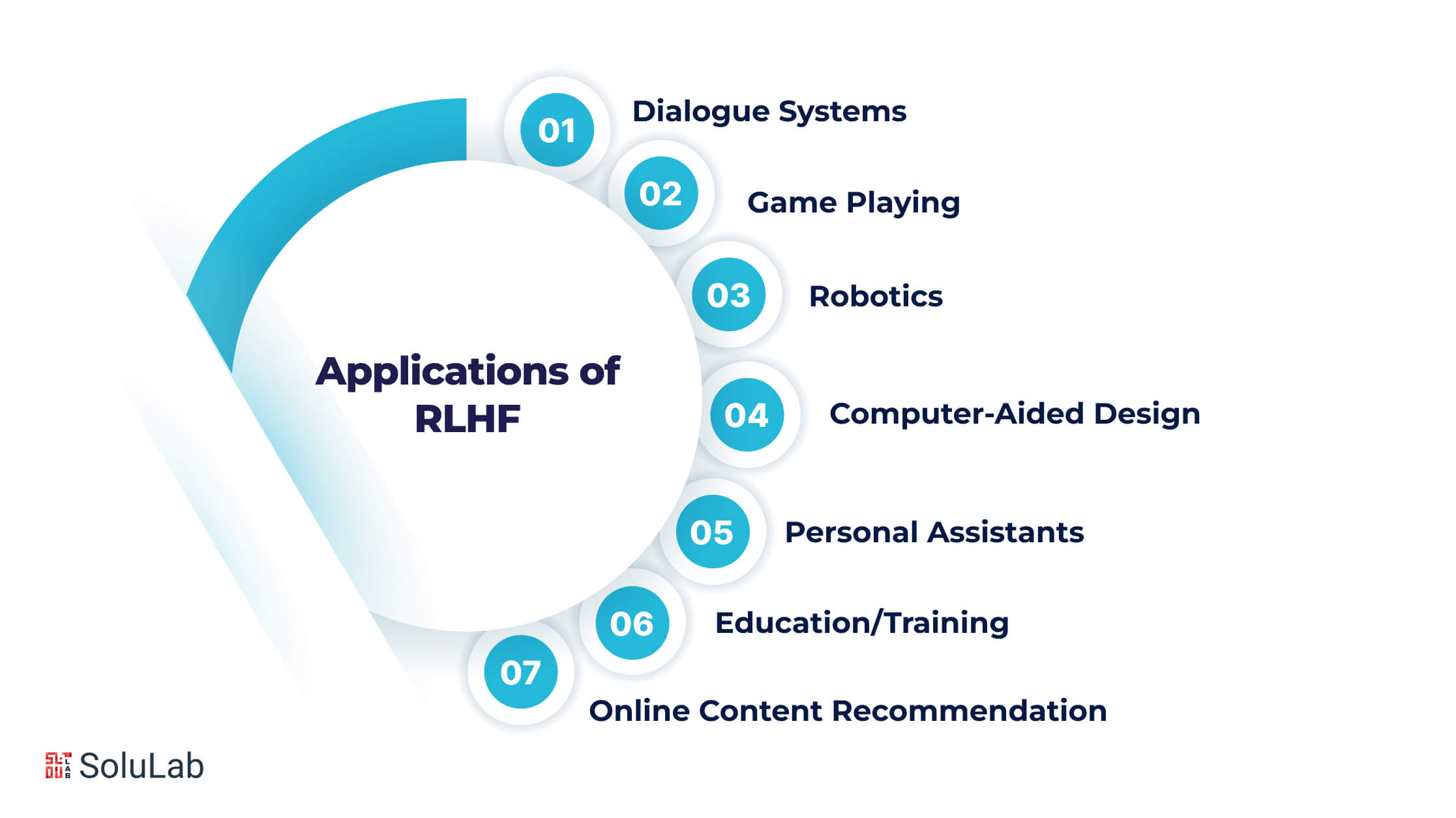
Reinforcement Learning (RL) methods that learn from human feedback already have plenty of practical uses. A few straightforward ones:
- Dialogue Systems
RL agents can hold conversations with people. By paying attention to how people react, the agent learns to talk in a more natural, engaging way as time goes on. Virtual assistants and chatbots stand to gain the most.
Related: How to Build an AI-Powered Chatbot For Your Business?
- Game Playing
Feedback on wins and losses can teach agents to play Go, chess, or video games. AlphaGo is the famous case. It used RL guided by human experts on its way to mastering Go.
- Robotics
A robot can do something like pick up an object, then ask a person how its movement and grip looked. That feedback helps it handle objects more safely and more reliably next time.
- Computer-Aided Design
RL agents can come up with design concepts and prototypes, and human designers react to them: how they look, how easy they are to use, how practical they are to manufacture. Repeat that cycle and the designs get better.
- Personal Assistants
Alexa and Google Assistant can learn from feedback you never consciously give, just by being used. Whether tasks get completed, how customers answer satisfaction surveys, what long-term usage looks like: all of it shapes how the assistant behaves next, making it more helpful and quicker to respond.
- Education/Training
Interactive learning and training apps can use RL, steered by a human trainer or teacher, to adjust to how each student is doing and what they say. The learning becomes personal, and that tends to make it stick.
- Online Content Recommendation
Websites can use RL to push up engagement, satisfaction, and time on site. Quiet signals from real users, like what they do and what they seem to prefer, steer the recommendation algorithms so the content stays relevant.
RLHF: Case-Studies
Reinforcement Learning from Human Feedback (RLHF) is changing what natural language processing AI systems can do. It takes models that ramble without direction and turns them into focused, capable, safer applications. Three examples make the difference obvious.
- Email Writing
Give a model without RLHF a plain prompt like “Write an email requesting an interview” and it can trip up. Instead of writing the email, it may read the prompt as a to-do list and hand back something jumbled. A model fine-tuned with RLHF gets what the user expects. It writes a clean email that actually does the job. For everyday tasks, that gap is the whole point.
- Mathematical Problems
Large language models are great with words. Numbers, less so. Ask a non-RLHF model “What is 5 + 5?” and it might treat it as a language question and answer with something that isn’t math at all. An RLHF model trained for arithmetic reads the question correctly and just gives you the answer. Tuning with RLHF is what lets these models stretch beyond language into other kinds of work.
- Code Generation
Large language models can code, but how well depends on their training. Ask a non-RLHF model to “Write a simple Java code that adds two integers,” and it may drift into unrelated instructions or give you half a program. A well-trained RLHF model gives you precise, working examples, plus an explanation of how the code works and what it should output. Same request, very different usefulness.
RLHF: What is in the Future?
Using human feedback to improve learning in Artificial Intelligence (AI) could do a lot of good in areas like healthcare and education. The goal is AI that understands people better and serves what they actually need, which means more customized experiences and cheaper training. The hard parts are managing bias and dealing with vague or unclear input, so the system doesn’t do something nobody intended.
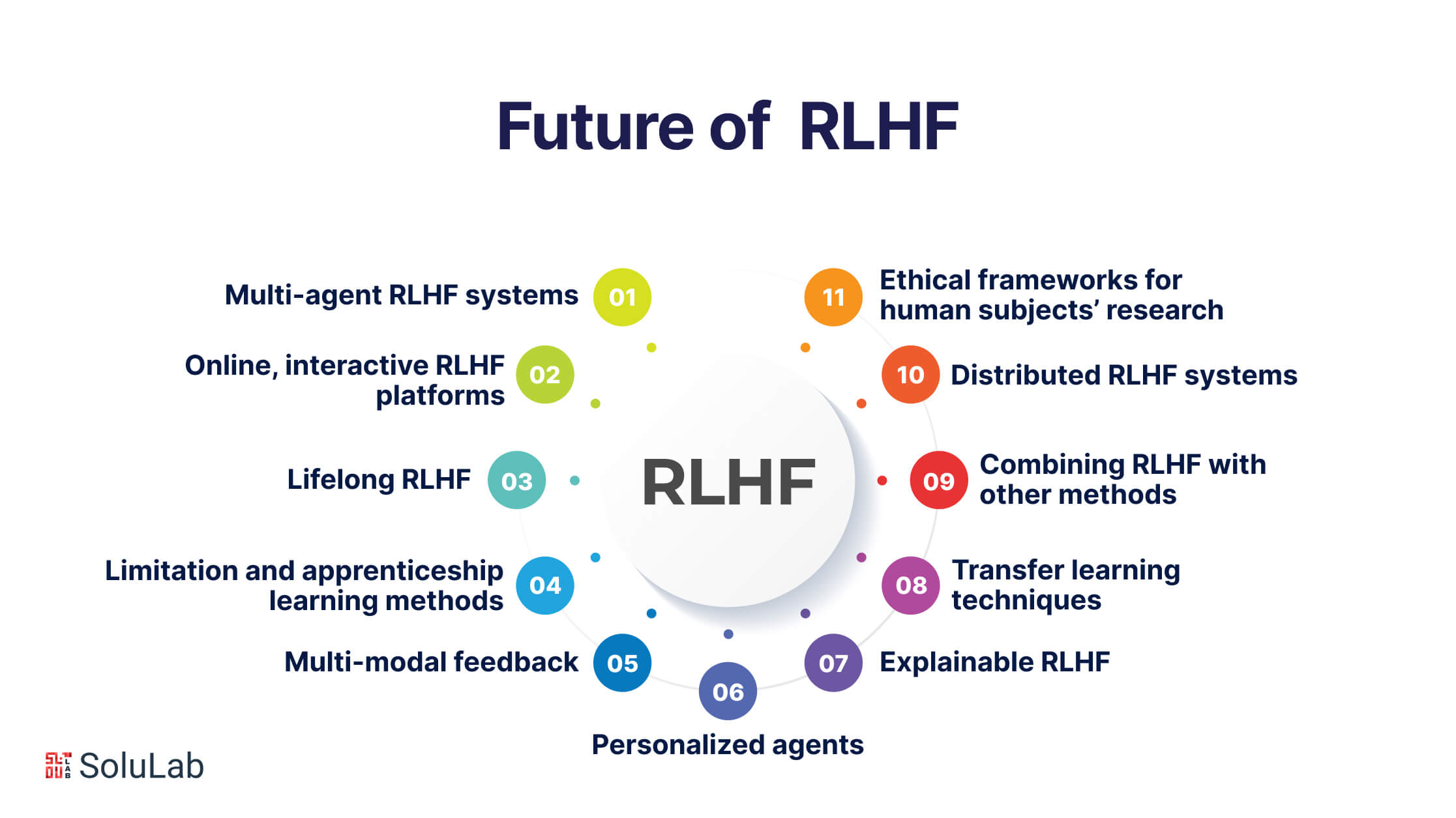
Where could RLHF go from here? A few likely directions:
1. Multi-agent RLHF systems: Several agents cooperating, or competing, to get tasks done based on guidance from a group of people.
2. Online, interactive RLHF platforms: Platforms where people give feedback continuously, in real time, while the agent is still learning.
3. Lifelong RLHF: Agents that go looking for human feedback on their own, and use it over long stretches of time to slowly get better.
4. Limitation and apprenticeship learning methods: Pairing human demonstrations with feedback to teach complicated skills efficiently.
5. Multi-modal feedback: Drawing on language, gestures, facial expressions, and emotions as feedback, not just rewards.
6. Personalized agents: Tailoring RLHF training so an agent builds a one-to-one relationship with a single user.
7. Explainable RLHF: Models that are open and readable, so you can see how a learning agent is progressing and why it decided what it did.
8. Transfer learning techniques: Letting agents carry what they learned from feedback in one setting over to related environments or tasks.
9. Combining RLHF with other methods: Strengthening RLHF by pairing it with approaches like self-supervised learning, generative models, theory of mind, and others.
10. Distributed RLHF systems: Running large, collaborative human and AI training efforts on cloud and edge computing.
11. Ethical frameworks for human subjects’ research: Putting guidelines in place that protect people’s privacy, autonomy, and well-being as RLHF spreads into more uses.
Take Away
RLHF is one of the more promising ways to build AI that learns from ordinary human interaction. It mixes human judgment with data-driven algorithms, and the aim is agents that are more personal, more dependable, and able to take on harder tasks. The problems are real: it needs a lot of data, it can be hard to interpret, and learning never really stops. But it sets up something valuable, a working partnership between people and AI. As the field matures, reinforcement learning with human feedback could open up new possibilities in robotics, education, healthcare, and further afield. The bottom line is simple. RLHF is how we get from AI that sounds helpful to AI that actually is.
Talk to our team to see how SoluLab, an AI development company, produces top-quality training data for RLHF systems. Better human feedback makes for AI models that learn in a more personal, more effective way. Tell us what you need, and we’ll look at what reinforcement learning guided by human input could do for you, whether your project is in robotics, education, healthcare, or somewhere else entirely. Let SoluLab be your partner in building more capable AI. Hire an AI developer and take your projects further.
FAQs
– Bias and fairness: Make sure the human feedback is diverse and representative so the AI system doesn’t lock in existing biases.
– Transparency and interpretability: Build ways to see how human feedback shapes the AI’s decisions.
– Privacy and security: Protect user data, and collect and use human feedback responsibly.
– Human-AI interaction and control: Spell out what humans are responsible for and what the AI is responsible for, and keep a human in charge where it matters.
Shipra Garg is a tech-focused content strategist and copywriter specializing in Web3, blockchain, and artificial intelligence. She has worked with startups and enterprise teams to craft high-conversion content that bridges deep tech with business impact. Her work translates complex innovations into clear, credible, and engaging narratives that drive growth and build trust in emerging tech markets.