










RAG as a service
Days to weeks
Limited to settings
Provider environment or yours, by contract
Light
Standard knowledge search
RAG as a service means a provider builds and runs a retrieval-augmented generation system for you: it indexes your documents, retrieves the right passages, and has a language model answer from them, with sources. SoluLab delivers enterprise RAG with permissions, compliance, and monitoring built in, starting with an architecture review.
RAG as a service is a managed way to get a retrieval-augmented generation system without building it in-house. The provider handles ingestion, search, the language model, evaluation, and hosting, so your team gets accurate answers grounded in your own data.
Retrieval-augmented generation (RAG) was introduced in a 2020 research paper by Lewis and colleagues at Facebook AI Research (Lewis et al., 2020). The idea is simple. Before the model answers, the system searches your documents, finds the relevant passages and gives them to the model. The answer is based on your content, not only on what the model learned in training.
RAG as a service packages that pattern. You supply the content and the use case; the provider builds the pipeline, connects it to your tools, tests it, and keeps it running. That managed model is what separates it from a one-off build through our large language model development or RAG development services. For the concept itself, see our explainer on retrieval-augmented generation.
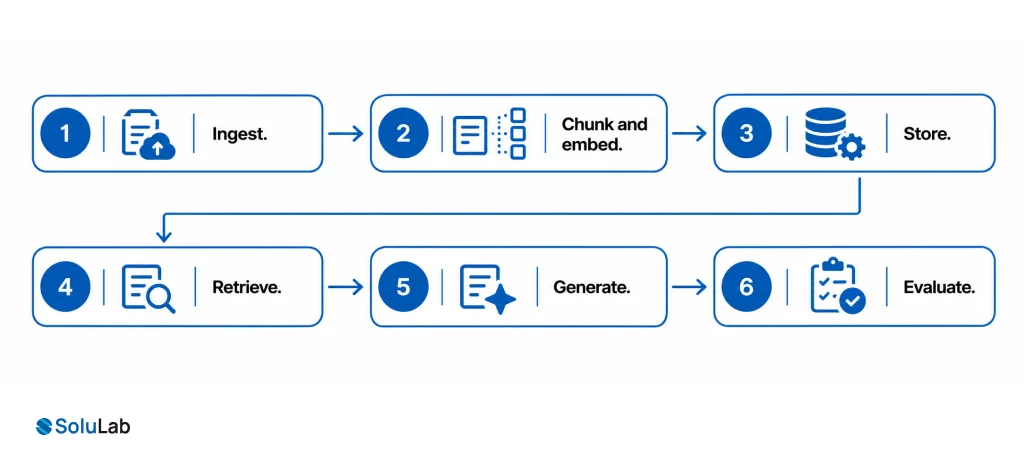
A RAG system works in two phases. Offline, it splits documents into chunks, turns them into vectors and stores them. At question time, it finds the closest chunks, gives them to a language model and returns an answer with citations.
The permission filter sits between the index and the model, which is why retrieval access rules matter more than the choice of LLM.
Ingest. Collect documents from drives, wikis, tickets, databases and sites.
Chunk and embed. Split text into passages and convert each into a vector.
Store. Save vectors and metadata in a vector database or search engine.
Retrieve. For each question, find the most relevant passages the user is allowed to see. Many systems combine keyword and vector search and rerank the results.
Generate. The language model writes an answer from the passages and cites them.
Evaluate. Test answer accuracy and source quality on real questions.
Turns text into vectors
Finds similar passages
Orders results by relevance
Writes the answer
Connects the steps
Measures quality
SoluLab's RAG as a service covers the full lifecycle: architecture review, data ingestion and connectors, permission-aware retrieval, LLM integration, evaluation, hosting and ongoing monitoring. You get a managed enterprise RAG system that answers from your own content with citations, while your team keeps ownership of the data, code, and indexes.
We study your use case, content, security rules and budget, then recommend the retrieval design, model and hosting before any build. It's a fixed-fee, 1 to 2 week engagement that's credited against the build.
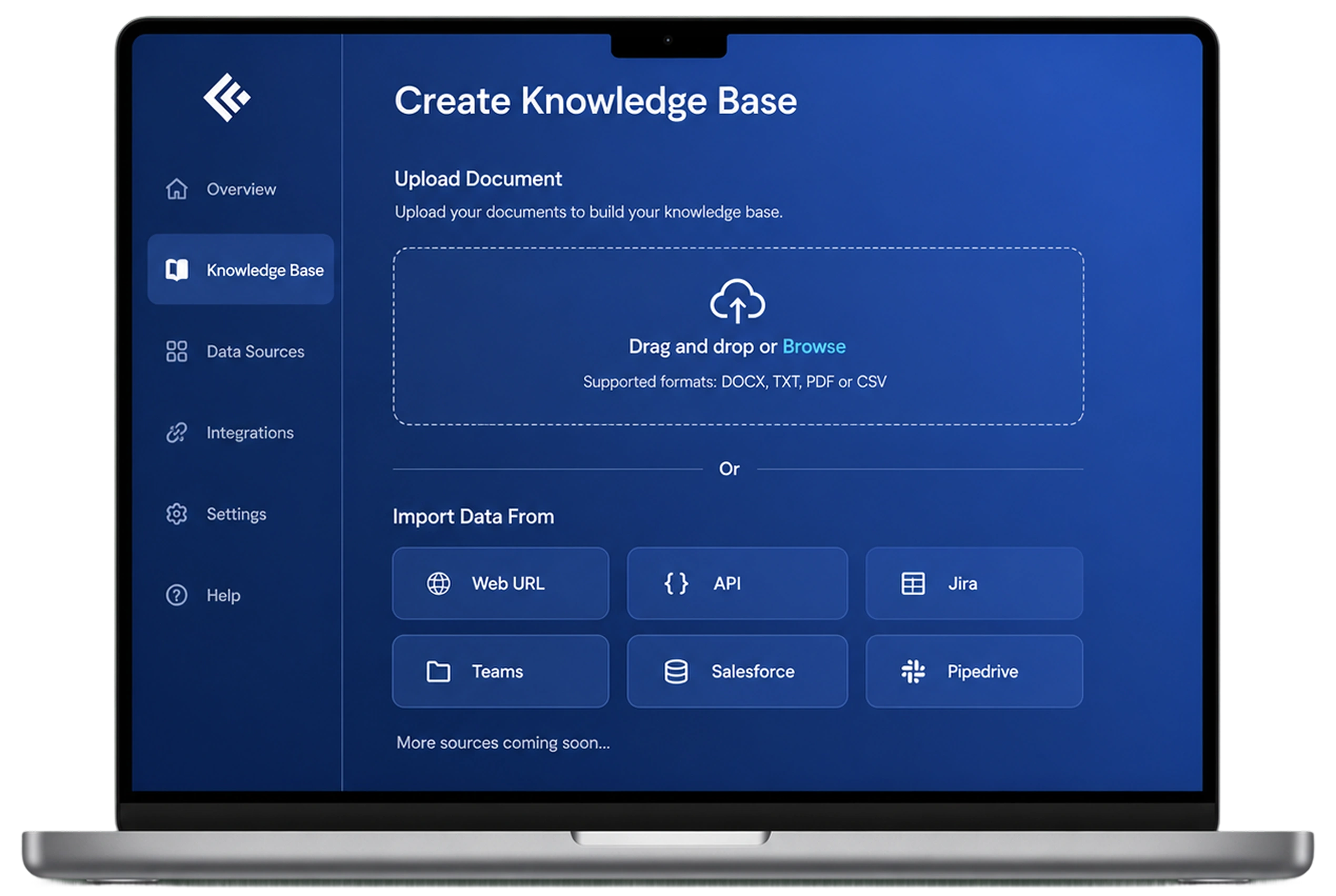
We connect SharePoint, Google Drive, Confluence, ticketing systems, databases, and websites, clean and chunk the content, and keep the index in sync as documents change. The InfuseNet AI platform we built integrates with over 80 data sources.
Retrieval filters results by each user's access rights, so staff and customers only see answers drawn from documents they're allowed to read. This is the control most off-the-shelf tools get wrong.
We combine keyword and vector search and rerank results, which catches exact terms like product codes and policy numbers that pure vector search misses.
We connect GPT-4o, Claude, Gemini or open-source models through enterprise LLM integration, with prompts that force citations and say "I don't know" when the sources don't cover a question.
We build a test set of your real questions with approved answers and score accuracy, citation quality and refusals before launch and after every change.
We host the system in your cloud or a managed environment, monitor answer quality, latency, and cost per query, and tune retrieval as your content grows.
When answers should trigger actions, we extend RAG with agentic RAG patterns and connect it to your CRM, help desk, or internal APIs.
Your documents already hold the answers your teams and customers
keep asking
for.
The work is getting the right passage to the
right person, safely, every time. That's what we build.
A good RAG as a service provider shows how it measures answer quality, how it protects your data, how it handles updates to your content, and how it lets you leave. Ask for a test on your own documents before you sign.
Demos on clean data hide real problems
Privacy, contracts and regulation
Stale answers break trust
Staff should only see what they may see
Avoid lock-in
Buy RAG as a service when you want a working system quickly and your use case is common. Build your own when your data, security or workflows are unusual. A custom build costs more up front and gives you more control.
Days to weeks
Limited to settings
Provider environment or yours, by contract
Light
Standard knowledge search
Months
Full
Your environment
Search, ML and DevOps
Complex or regulated use
Common RAG use cases are internal knowledge search, customer support, sales enablement, compliance question answering and decision support. All share one trait: the answer must come from your own, changing content. Enterprise teams usually start with support or internal search, where volume is highest and answers are easiest to check.
Answer customer questions from help articles and past tickets.
Staff ask questions across policies, wikis, and files.
Pull product facts and case studies into proposals.
Answer questions from regulations and internal policies, with citations.
Summarize evidence before a decision. See our article on a RAG system for decision making .
For more on applications, read about RAG app development and its applications in AI .
RAG systems must control who sees which documents, resist hostile text hidden in sources, show citations, and be tested for accuracy. Treat retrieval permissions and evaluation as core features, not extras. For regulated data, map these controls to SOC 2, HIPAA, GDPR or the EU AI Act as your market requires.
Retrieve only what the asking user may see.
Documents can contain text that tries to hijack the model, so we treat retrieved text as untrusted. The OWASP Top 10 for LLM Applications describes this risk.
Personal data is masked before prompts reach the model, as in our One Wallet build.
Every answer links to its sources.
Keep a test set of real questions with approved answers and re-run it after every change.
Record questions, retrieved passages and answers for review.
The NIST AI Risk Management Framework gives a structure for assigning ownership of these controls.
SoluLab builds RAG on proven, swappable components: OpenAI, Cohere or open-source embeddings; Pinecone, Weaviate, Milvus or pgvector for retrieval; LangChain or LlamaIndex for orchestration; GPT-4o, Claude, Llama or Mistral for generation; and AWS Bedrock, Azure or Google Vertex AI for hosting, so you can change any layer without a rebuild.
RAG as a service with SoluLab typically costs $15,000 to $30,000 for a RAG MVP in 4 to 8 weeks, $30,000 to $75,000 for a production system in 8 to 16 weeks, and $80,000+ for an enterprise RAG platform over 3 to 6 months. Hosting, model fees, and optimization continue monthly after launch.
Retrieval design, model and hosting recommendation
Fixed fee, credited against build
1 to 2 weeks
One content set, one interface, scored test set
$15,000 to $30,000
4 to 8 weeks
Permissions, integrations, monitoring
$30,000 to $75,000
8 to 16 weeks
Multiple sources, departments and access tiers
$80,000+
3 to 6 months
Monitoring, re-indexing, evaluation, tuning
Monthly retainer
Ongoing
Price ranges match SoluLab's published RAG development services pricing.
Build a production-ready RAG solution around your documents,
databases, and
business
knowledge.
SoluLab builds enterprise RAG for industries where answers must come from controlled, changing documents: financial services, healthcare, insurance, legal and professional services, aviation and manufacturing, SaaS and software, and retail. Each build follows that sector's permission rules, retention policies and regulators.
Each system is built around the sector's documents, access rules and regulators.
Support and compliance copilots over policies, product terms and past tickets, as in our One Wallet build.
Clinical guideline and policy search with HIPAA-grade access control and audit logs.
Policy wording, claims guidance and underwriting rule lookups with cited answers.
Contract, precedent and knowledge search that respects matter-level permissions.

Search and extraction across maintenance records, manuals and specs, building on our engine valuation work.
In-product help assistants and support deflection grounded in your docs and tickets.
Product, policy and order-help answers for shoppers and support teams.
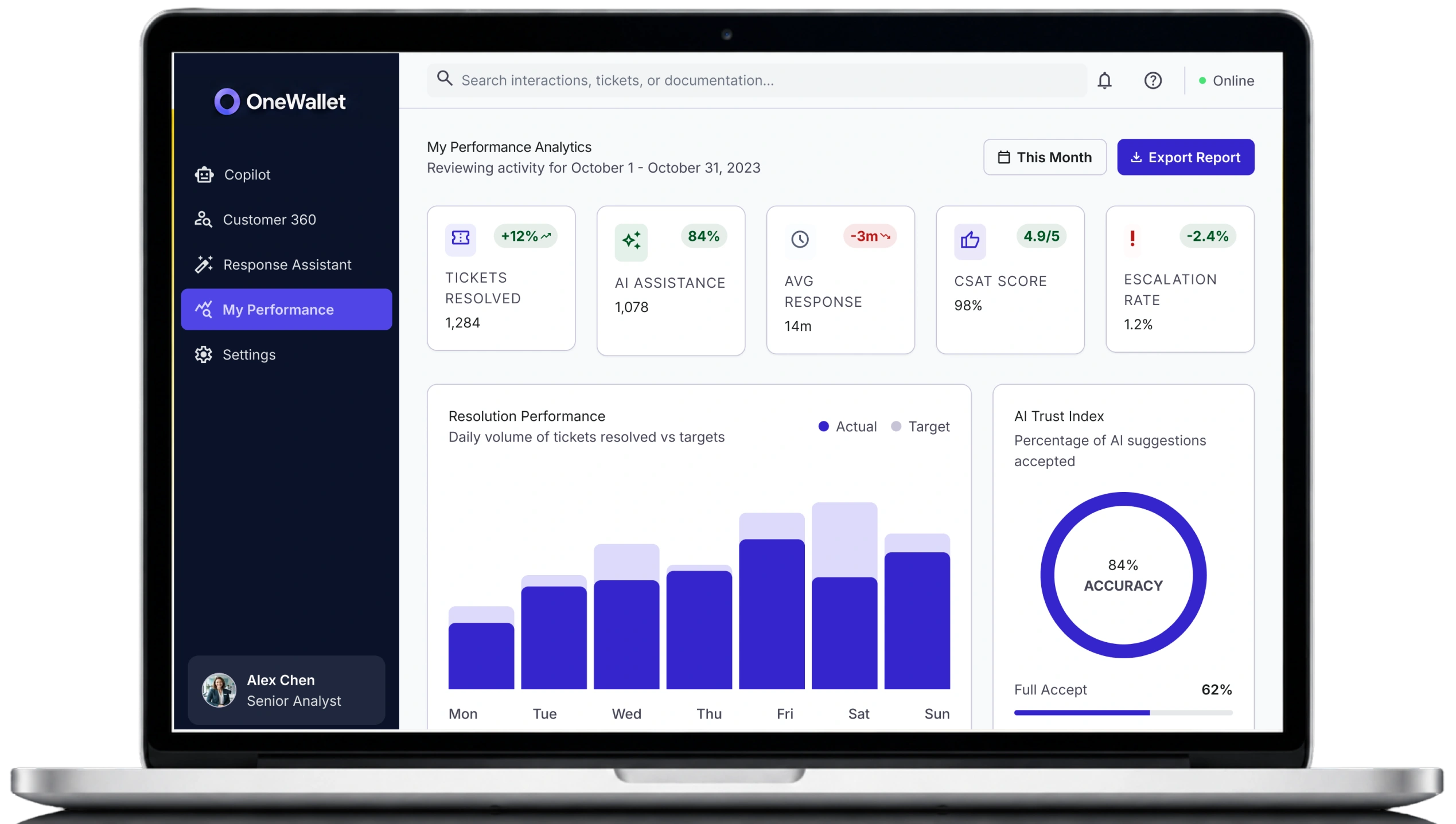
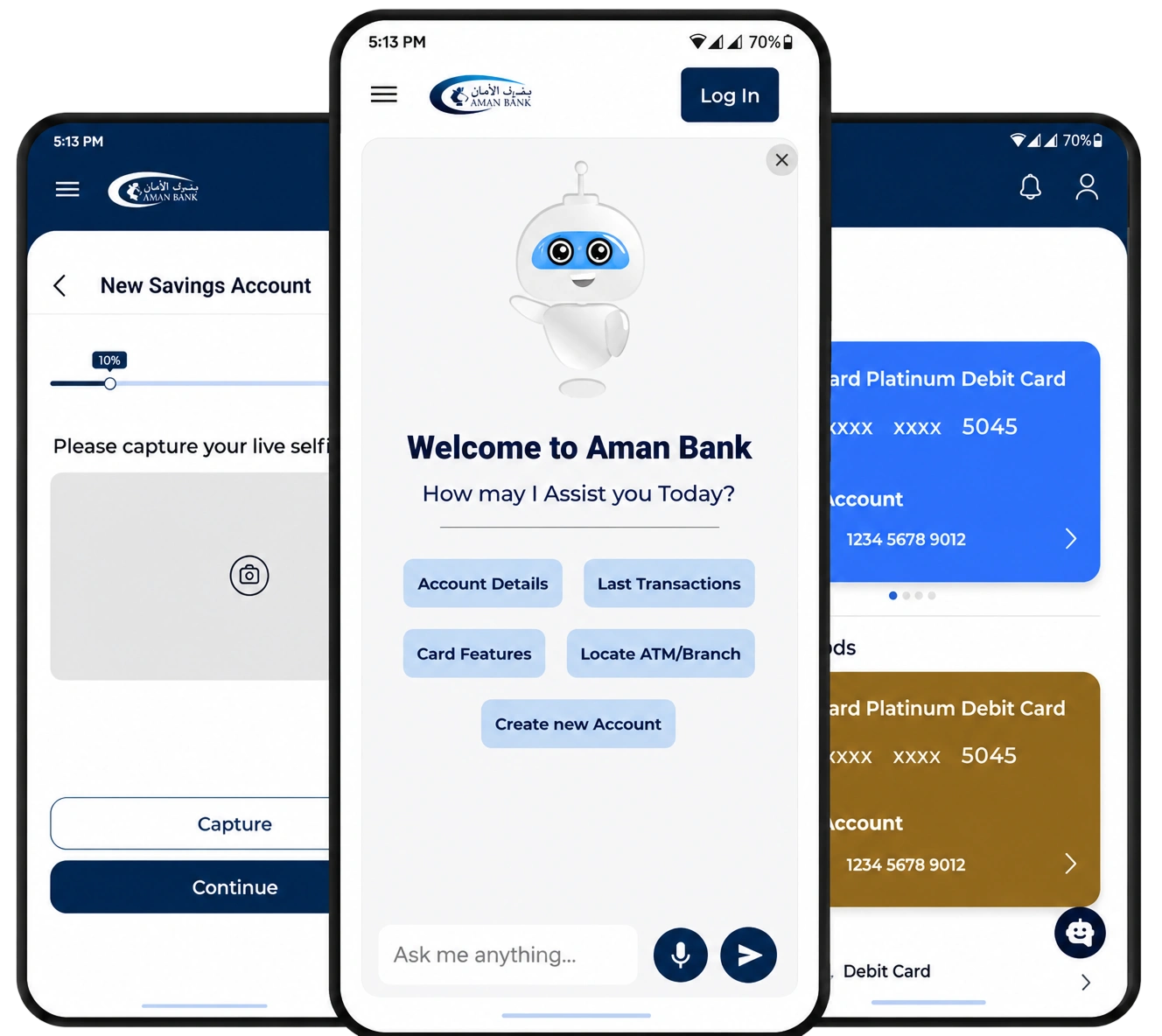
SoluLab's RAG and conversational AI work runs in production: a compliance-governed RAG copilot for One Wallet searches 50K+ documents and cut ticket load by 72%, Amanbank's AI banking assistant answers customer questions 24/7 and halved support agent workload, and the InfuseNet platform we built connects private knowledge bases to 80+ data sources.
One Wallet, a digital payments platform with 1.8M+ users, handled 60K+ support requests a month with data spread across 10+ systems. SoluLab built a support copilot with compliance-governed RAG over 50K+ support documents, policies and playbooks in 100+ knowledge categories, a PII-masking pipeline before the LLM, role-based access and logging of every response, API call and retrieval source.
Amanbank, which serves about 750,000 customers, could only offer support during set hours, and answers varied by agent. SoluLab built a generative AI chatbot and voice assistant that answer questions on account details, transactions, transfers, cards, bill payments and statements in multiple languages, drawing on the customer's own banking data rather than generic model knowledge.
InfuseNet needed a way for businesses to build ChatGPT-style apps on their own data without exposing it. SoluLab built the platform: a drag-and-drop flow builder linking models from OpenAI, Anthropic and Google, a private knowledge base, data connectors for databases, cloud storage and CRMs, and encryption, access controls and self-hosted deployment options.
Enterprise teams choose SoluLab for RAG as a service because we run it like a product, not a demo: permission-aware retrieval, PII masking, audit logs, and a scored test set come standard; prices are published, and you own the data, code, and indexes.
Our One Wallet copilot retrieves across 50K+ documents in 100+ categories with responses in about 5 seconds.
Answers only draw on documents the asking user may see.
Every build ships with a test set of your real questions and a quality bar agreed before launch.
PII masking, prompt-injection defenses, encryption, and full audit logs.
Open formats, exportable indexes, and IP assigned to you from the first commit.
GPT-4o, Claude, Llama, or Mistral, chosen on accuracy and cost per query for your content.
"Rajat has spent more than 14 years building platforms used by millions of people. Before co-founding SoluLab, he was a principal software architect at Citrix, where he led enterprise mobile engineering. He heads SoluLab's 50+ member technical organization and reviews every RAG architecture for retrieval design, access control and running cost."
RAG as a service is a managed offering where a provider builds, hosts and maintains a retrieval-augmented generation system over your data. A language model answers questions using passages retrieved from your own content, with citations, while the provider handles ingestion, search, evaluation, hosting and ongoing tuning so your team doesn't have to.
Retrieval-augmented generation is a method in which a system retrieves relevant passages from a knowledge source and gives them to a language model before it answers. The answer is based on that content rather than only on the model's training. The approach was introduced by Lewis and colleagues at Facebook AI Research in 2020.
Enterprise RAG is retrieval-augmented generation built for company-wide use: it connects to many content sources, enforces each user's document permissions, masks personal data, logs every query and answer, and is tested against a set of real questions. Those controls separate it from a basic chatbot over a folder of files.
There's no single best provider. Compare accuracy on your own documents, data handling, permission support, update speed and export options. Run the same set of real test questions with two or three providers, including at least one cloud platform and one development partner, and choose on measured results rather than demos.
Ask how accuracy is measured on your content, where data is stored, how new and changed documents are indexed, whether user permissions are respected at retrieval, and what you can export if you leave. Then request a paid pilot on your own documents with a scored test set before signing a longer contract.
Pricing depends on content volume, permissions, query volume, model choice and quality testing. With SoluLab, a RAG MVP typically costs $15,000 to $30,000, a production system $30,000 to $75,000, and an enterprise RAG platform $80,000 or more. Hosting, model fees and monthly optimization continue after launch.
An architecture review takes 1 to 2 weeks, and a pilot on a defined set of documents usually takes 4 to 8 weeks. A production system with permissions, integrations and monitoring typically takes 8 to 16 weeks, and an enterprise platform across many sources 3 to 6 months, depending on data quality.
A managed service starts quickly and needs fewer in-house skills. An in-house build gives full control and suits unusual data or strict security rules, but needs search, ML and DevOps expertise. Many teams start managed and move parts in-house later, so insist on open formats and exportable indexes from day one.
Use RAG when answers must come from changing documents and show sources. Use fine-tuning to change a model's style or teach it a narrow skill. Many systems use both, and RAG is usually the easier first step because you update the index rather than retraining the model whenever content changes.
Yes. Retrieval can miss the right passage, and the model can misread it. Reduce errors with good chunking, hybrid search and reranking, required citations, an "I don't know" response when sources don't cover a question, a test set of real questions and a human review step for risky answers.

It can be, if the system enforces user permissions at retrieval, keeps data in an approved environment, masks personal data, logs access and treats retrieved text as untrusted to resist prompt injection. Check these points in any provider contract, and confirm where embeddings, indexes and logs are stored.
Yes, if it's built for it. The ingestion pipeline copies each document's access rules into the index, and retrieval filters results by the asking user's identity, so answers only use documents that person could open in the source system. Ask any provider to demonstrate this on your own content.
Yes. SoluLab builds, hosts and maintains RAG systems for enterprises and growing companies, starting with a 1 to 2 week architecture review of your data and use case. Our compliance-governed RAG copilot for One Wallet searches 50K+ documents and cut support ticket load by 72%.