
Key Takeaways
- A peer-to-peer crypto trading platform enables direct transactions between buyers and sellers without relying on centralized custody.
- Escrow systems, AI-powered fraud detection, KYC verification, and AML monitoring are essential components of enterprise-grade P2P crypto exchange platforms.
- The cost to develop a P2P crypto exchange typically ranges from $30,000 to $500,000+, depending on customization, blockchain integrations, and compliance requirements.
- Businesses can choose between white-label crypto exchange development and custom-built cryptocurrency exchange solutions based on growth objectives.
We had centralized exchange models and traditional brokerage methods, but these won’t give a seamless experience to users, right? Time-consuming, extra costs, and no user control. Therefore, P2P Crypto Exchange Development has become one of the fastest-growing segments of the digital asset industry as businesses seek secure, scalable, and cost-efficient ways to facilitate cryptocurrency trading.
The global cryptocurrency market recorded between $2.2 trillion and $3.1 trillion. While stablecoin circulation has surpassed $300 billion. This highlights the growing demand for peer-to-peer crypto trading platforms.
Unlike traditional exchanges, a P2P crypto exchange platform enables buyers and sellers to trade directly through escrow-protected transactions, reducing dependency on centralized intermediaries.
Why Are Businesses Investing in P2P Crypto Exchange Development in 2026?
No one wishes to wait a moment long during payments, and they don’t like visiting multiple sites for local payments. That’s why industries are leaning towards crypto exchange solutions to give users control over transactions.
Unlike traditional exchanges that act as intermediaries, a peer-to-peer crypto trading platform allows users to trade directly, while the platform secures the transaction through escrow.
Several market indicators explain why businesses are actively launching P2P crypto platforms.
1. Global Cryptocurrency Adoption Continues to Grow
According to Crypto.com research, global cryptocurrency ownership exceeded 741 million users in 2025. This represents a massive audience for businesses planning to launch a P2P crypto exchange.
At the same time, institutional adoption continues to accelerate through Bitcoin ETFs, tokenized assets, and stablecoin-based payment networks.
2. Stablecoin Market Capitalization Has Crossed $322 Billion
Stablecoins have become the backbone of P2P trading.
USDT and USDC now process billions of dollars in daily trading volume because users prefer stable assets for:
- Cross-border payments
- Merchant settlements
- International remittances
- OTC transactions
- Peer-to-peer trading
Every modern P2P cryptocurrency exchange development company now prioritizes stablecoin support during platform development.
3. Cross-Border Payments Create a Multi-Billion Dollar Opportunity
The Yahoo estimates that global remittance is expected to grow $ 310 plus in the next 5 years.
As cross-border remittances exceed $310 billion annually, and crypto adoption continues to expand beyond 700+ million users worldwide. This is resulting in enterprises increasing investment in P2P crypto exchange development services to capitalize on emerging opportunities.
Traditional remittance providers often charge between 5% and 7%.
A P2P crypto exchange platform can reduce settlement costs dramatically while enabling near-instant transactions through blockchain infrastructure.
4. Financial Inclusion Is Driving Adoption
According to the World Bank, approximately 1.4 billion adults remain unbanked.
For these users, a mobile-based p2p crypto trading platform provides access to:
- Digital payments
- Savings instruments
- International transfers
- Alternative financial services
This is one of the strongest long-term drivers behind crypto exchange software development.

P2P Crypto Exchange vs Centralized Exchange Development: Which Model Is Better?
One of the most common questions founders ask before investing in P2P crypto exchange development services is whether a peer-to-peer model is better than a centralized exchange.
The answer depends on business objectives.
| Feature | P2P Crypto Exchange | Centralized Exchange |
| Asset Custody | User Controlled | Exchange Controlled |
| Escrow System | Required | Not Required |
| Regulatory Burden | Moderate | High |
| Liquidity Source | Community Driven | Platform Driven |
| Launch Cost | Lower | Higher |
| Security Risk | Lower Custody Risk | Higher Custody Risk |
| Global Expansion | Easier | More Complex |
1. When Should You Build a P2P Crypto Exchange Platform?
P2P Crypto Exchange Development is ideal when your goal is:
- Cross-border payments
- Remittance services
- Emerging markets
- Stablecoin trading
- Community-driven liquidity
2. When Is Centralized Crypto Exchange Development Better?
Centralized crypto exchange development is better when:
- High-frequency trading is required
- Institutional liquidity is needed
- Advanced order types are essential
- Margin and futures products are planned
Many successful businesses eventually combine both models.
How Does a P2P Crypto Exchange Platform Work?
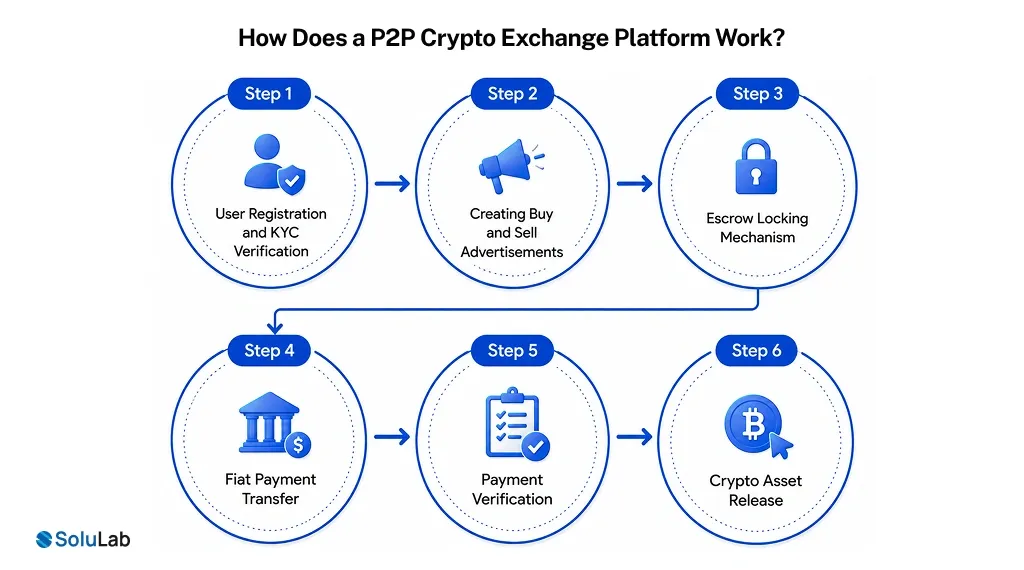
A P2P crypto exchange platform facilitates direct trading between buyers and sellers while protecting both parties through escrow mechanisms.
The complete workflow consists of six stages.
Step 1: User Registration and KYC Verification
Every user creates an account and completes identity verification.
A professional P2P crypto exchange development company typically integrates:
- Government ID verification
- Facial recognition
- Address validation
- AML screening
- Sanctions monitoring
Verified users gain higher trading limits and faster transaction approvals.
Step 2: Creating Buy and Sell Advertisements
Sellers define:
- Cryptocurrency type
- Price per coin
- Payment methods
- Minimum trade amount
- Maximum trade amount
Buyers browse available offers and select the most suitable option.
Popular P2P crypto platforms support more than 500 payment methods globally, including:
- UPI
- Bank transfers
- PayPal
- Skrill
- Wise
- Local payment rails
Step 3: Escrow Locking Mechanism
Once a buyer initiates a trade, the cryptocurrency moves into escrow.
This prevents the seller from withdrawing assets while payment is pending.
Escrow is the single most important component of crypto P2P exchange application development because it eliminates counterparty risk.
Step 4: Fiat Payment Transfer
The buyer sends payment using the selected payment method.
The platform records timestamps and payment confirmations.
Step 5: Payment Verification
The seller verifies payment receipt.
Advanced P2P crypto exchange software development solutions can automate verification through banking APIs and payment gateway integrations.
Step 6: Crypto Asset Release
Once payment is confirmed, the escrow system releases cryptocurrency to the buyer.
The transaction is finalized, and both users can submit ratings.
What Is the Complete P2P Crypto Exchange Development Process?
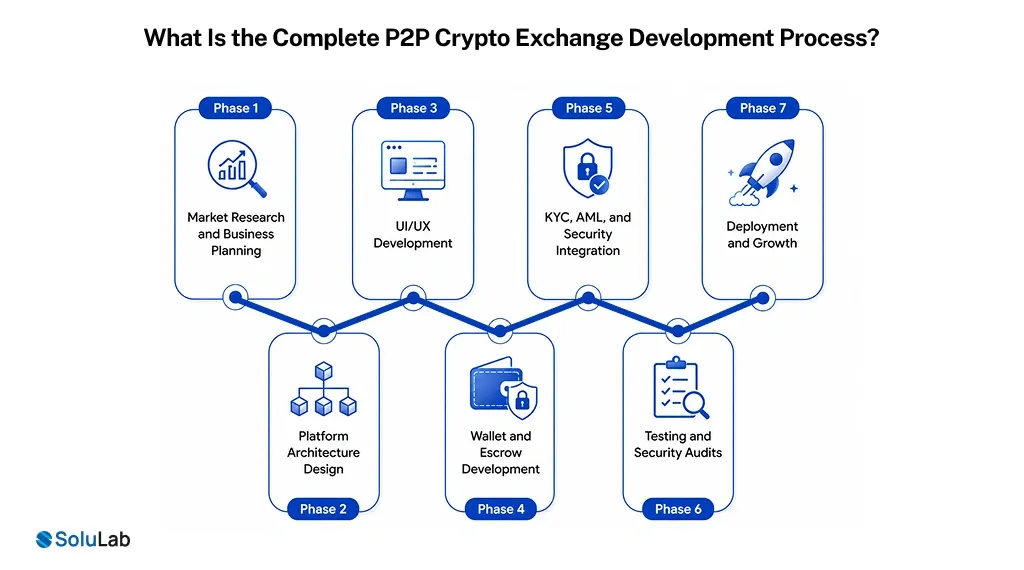
The P2P crypto exchange development process generally follows seven stages.
Phase 1: Market Research and Business Planning
Before DEX crypto exchange development begins, businesses must define:
- Target countries
- User personas
- Revenue model
- Supported cryptocurrencies
- Regulatory requirements
This phase typically takes 2-4 weeks.
Phase 2: Platform Architecture Design
The technical team creates:
- System architecture
- Wallet architecture
- Escrow design
- Security framework
- Compliance workflows
This phase determines future scalability.
Phase 3: UI/UX Development
The user interface directly impacts conversion rates.
Development focuses on:
- Registration flows
- Trade creation
- Payment confirmation
- Wallet management
- Mobile responsiveness
Phase 4: Wallet and Escrow Development
This is the foundation of every peer-to-peer crypto trading platform.
Development includes:
- Hot wallets
- Cold wallets
- Escrow smart contracts
- Asset transfer mechanisms
Phase 5: KYC, AML, and Security Integration
Security components include:
- Identity verification
- Fraud detection
- Risk scoring
- Multi-factor authentication
- Transaction monitoring
Phase 6: Testing and Security Audits
Before launch, the platform undergoes:
- Functional testing
- Penetration testing
- Smart contract audits
- Load testing
- Stress testing
Phase 7: Deployment and Growth
After launch:
- Liquidity is onboarded
- Market makers are introduced
- Marketing campaigns begin
- Regional payment methods are added
The complete custom crypto exchange development timeline usually ranges from 4 months to 12 months, depending on complexity.
What Features Should a P2P Crypto Exchange Development Company Include?
A successful P2P crypto exchange platform requires more than basic trading functionality.
Modern users expect enterprise-level performance, security, and convenience.
1. Multi-Currency Wallet Infrastructure
Every P2P crypto exchange development project should support:
- Bitcoin
- Ethereum
- USDT
- USDC
- Solana
- BNB Chain assets
2. Multi-Chain Asset Management
Users increasingly hold assets across multiple blockchains.
Wallet infrastructure should support:
- Ethereum
- Polygon
- BNB Chain
- Solana
- Avalanche
- Arbitrum
3. Advanced Escrow Management System
Escrow infrastructure protects users from fraud and payment disputes.
Features should include:
- Automatic asset locking
- Time-based trade expiration
- Dispute handling
- Escrow release automation
- Admin intervention controls
4. Reputation and Trust Scoring System
Trust drives liquidity. Modern P2P crypto platforms use:
- User ratings
- Trade completion rates
- Verification badges
- Risk scores
- Reputation rankings
These systems help reduce fraudulent activity significantly.
5. Integrated Communication Channels
In-app messaging improves transparency and dispute resolution.
Essential capabilities include:
- Encrypted chat
- File sharing
- Trade-specific messaging
- Real-time notifications
6. Multiple Payment Gateway Support
A modern peer-to-peer crypto trading platform should support:
- UPI
- IMPS
- NEFT
- ACH
- SEPA
- PayPal
- Wise
- Mobile wallets
Payment flexibility directly impacts user acquisition and liquidity.
All these features make your P2P crypto exchange platform world-class, and your users will visit often to make their transfers.

Conclusion
As you can see, P2P Crypto Exchange Development is becoming a strategic investment for businesses looking to capitalize on the growing adoption of digital assets, stablecoins, and cross-border payments. A successful platform requires more than just trading functionality. It needs secure mechanisms, multi-currency wallet infrastructure, compliance automation, AI-powered fraud detection, and scalable architecture.
As an ISO 27001-certified company, SoluLab follows industry best practices for security, data protection, and platform reliability.
Our crypto development experts work closely with clients to define business requirements, design compliant architectures, develop secure trading ecosystems, and support post-launch growth. If you’re planning to launch a P2P crypto exchange platform, the next step is identifying your target market, compliance requirements, and platform features to create a solution that can scale with demand. Contact us today to discuss your idea and requirements.
FAQs
Deepika is a content writer who blends storytelling with strategic thinking. She explores topics across digital innovation, emerging tech, and the evolving blockchain industry. She enjoys breaking down complex ideas into simple, engaging narratives in the growing global markets.