Key Takeaways
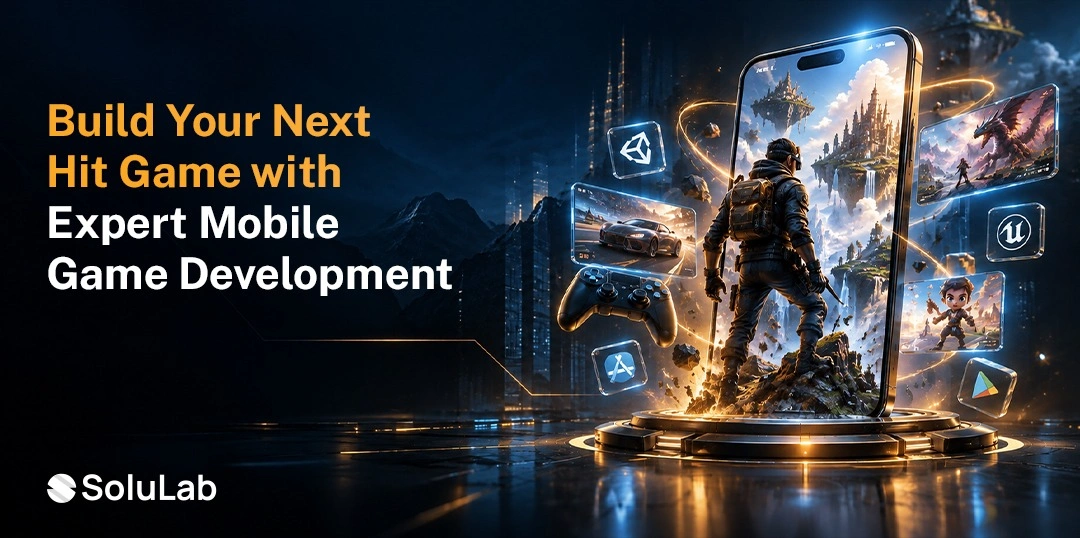
- Mobile game development services cover the full build of an iOS and Android game, from concept, art, and prototyping through engineering, QA, store launch, and LiveOps.
- A simple 2D or hyper-casual game typically costs $15,000 to $40,000 and takes 6 to 10 weeks. Live-service and Web3 games start at $200,000 and take 8 months or more.
- Unity fits most mobile games, including casual, mid-core, and cross-platform titles. Unreal Engine fits graphically rich 3D games.
- A prototype and soft launch test whether the game is fun and retains players before you commit a full production budget.
- SoluLab builds standard, AR/VR, and Web3 mobile games with in-house Unity and blockchain teams, backed by 11 years in business and 1,500+ delivered projects.
What are mobile game development services?
Mobile game development services are the end-to-end activities a studio performs to turn a game concept into a live app on the Apple App Store and Google Play. The work usually spans research, game design, prototyping, art production, engine programming, backend and networking, quality assurance, store submission, and ongoing operations after launch.
For a founder or product owner, hiring these services means you get one accountable team instead of stitching together freelancers for art, code, and testing. SoluLab runs each of these stages under a single roadmap, so design decisions, technical constraints, and monetization goals stay aligned from the first sketch to the first update after launch.
Our mobile game development services
SoluLab offers the full set of services a mobile game needs across its life. Each area below can be delivered on its own or as part of a full build.
Full-cycle mobile game development
We take a game from idea to store and beyond. That includes discovery, design, art, engineering, QA, launch, and post-launch support, managed as one program with a single point of contact. Full-cycle work suits teams that want to hand off the whole build rather than manage separate vendors.
2D and 3D mobile game development
We build both 2D and 3D mobile games. 2D suits puzzle, casual, and hyper-casual titles where fast iteration and small download size matter. 3D suits action, RPG, racing, and simulation games that need depth, physics, and richer environments. The engine and art pipeline are chosen to fit the genre and target device range.
Game concept, design, and prototyping
Before heavy production, we shape the core loop, progression, and economy, then build a playable prototype. A prototype lets you test whether the game is fun and worth funding before you commit to a full budget. This stage reduces the risk of building the wrong thing.
Game art and UI/UX production
Our artists produce characters, environments, animations, and the in-game interface. UI/UX work covers onboarding, menus, HUD, and store screens so the game is easy to learn and comfortable to play in long sessions. Art style is set early and kept consistent across every screen.
MVP development for mobile games
An MVP is a lean, launchable version of the game with the core mechanic and enough content to test the market. We use MVPs and soft launches to gather real player data on retention and monetization before scaling up features and marketing spend.
Cross-platform (iOS and Android) development
We build games that run on both iOS and Android from a shared codebase, most often in Unity. Cross-platform work lets you reach both stores without maintaining two separate builds, while still tuning performance and controls per platform.
AR/VR and metaverse mobile games
We build augmented reality, virtual reality, and metaverse games for mobile and connected headsets. This includes 3D world building, spatial interaction, and multiplayer presence. See our AR/VR app development and metaverse game development work for related capability.
Blockchain, Web3, and NFT games
This is a genuine SoluLab differentiator. Our in-house blockchain team builds Web3 games with on-chain assets, tokens, and play-to-earn economies alongside standard game engineering. Explore our Web3 game development, NFT game development, blockchain game development, and play-to-earn game development services for chain-integrated titles.
QA, testing, and game porting
We test functionality, performance, and compatibility across a range of devices and OS versions before launch. We also port existing games to new platforms or engines so a title can reach a wider audience without a full rebuild.
Post-launch support, LiveOps, and monetization
Launch is the start, not the finish. We run LiveOps, which means live events, content drops, balancing, and bug fixes that keep players engaged after release. We also design monetization through in-app purchases, ads, subscriptions, and in-game economies, chosen to fit the genre and audience.

Which platforms do we build mobile games for?
We build for the two major mobile platforms and support shared cross-platform builds where that fits the project.
iOS game development
We build native and cross-platform games for iPhone and iPad, tuned for Apple hardware and App Store requirements. See our iOS game development service for detail on this platform.
Android game development
We build games for the wide range of Android devices and screen sizes, with performance tuning so the game runs well on both flagship and mid-range phones. Google Play submission and compliance are handled as part of launch.
Cross-platform development
For teams that want both stores from one build, we develop cross-platform games, usually in Unity. This keeps a single codebase while still allowing platform-specific tuning for controls, resolution, and store rules.
What technologies and engines do we use?
We select the stack per project. The common tools across our mobile game work are listed below.
- Engines: Unity and Unreal Engine.
- Programming languages: C# for Unity, C++ for Unreal and performance-critical modules.
- Art and design tools: Blender, Adobe Photoshop, Substance 3D, and Figma.
- Backend and infrastructure: cloud hosting on AWS, Node.js services, and MongoDB or Amazon DynamoDB for player and progression data.
- Blockchain layer: Solidity smart contracts and wallet integration (MetaMask, WalletConnect) for Web3 and NFT titles, added only where the game design calls for on-chain assets.
Unity vs Unreal for mobile
Both engines ship strong mobile games. The table below is a neutral summary to help you choose.
| Factor | Unity | Unreal Engine |
|---|---|---|
| Talent pool | Large, deep for mobile | Growing, strong for high-end 3D |
| Cost and licensing | Unity Personal is free for teams with under $200,000 in revenue or funding in the last 12 months. Above that, Unity Pro costs $2,310 per seat per year. No runtime fee. | Free to build with. A 5% royalty applies once a game passes $1 million in lifetime gross revenue. Epic Games Store sales are royalty-free. |
| 3D fidelity | Strong, scales to most mobile needs | Very high, favored for photoreal 3D |
| Iteration speed | Fast for 2D and mid-core | Fast for high-end 3D pipelines |
| Best-fit game type | Casual, hyper-casual, mid-core, cross-platform | Graphically rich 3D and console-quality mobile |
Licensing terms are from Unity’s plans page and Unreal Engine’s licensing page, as of October 2026.
What types of mobile games do we develop?
We build across the main mobile genres, including:
- Casual and hyper-casual
- Puzzle
- Arcade
- Action
- Adventure
- Role-playing (RPG)
- Strategy
- Simulation
- Sports and racing
- Casino and card games
- Multiplayer and social
- Educational
- Survival
- Battle royale
Genre shapes the engine, art budget, backend, and monetization model, so we scope each project around the specific genre rather than a fixed template.
What is our mobile game development process?
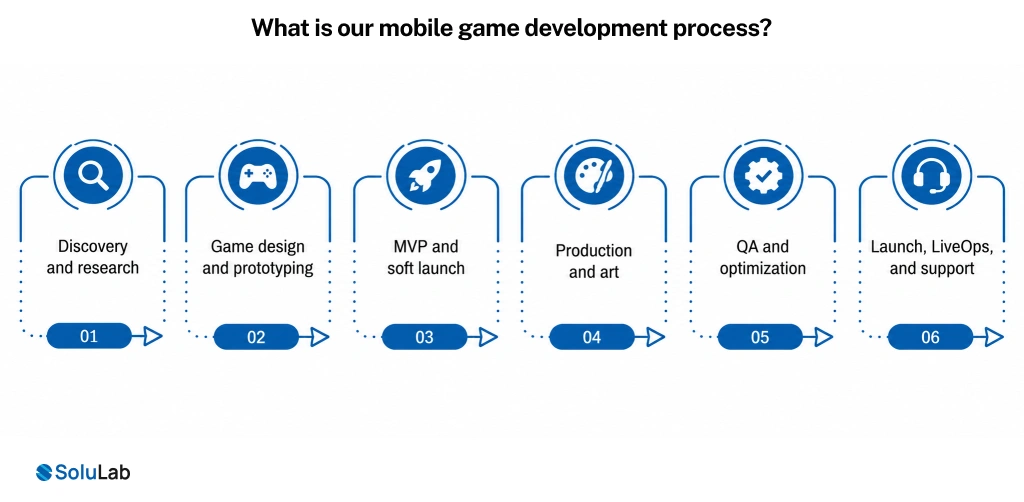
We run a six-stage process. Each stage has clear deliverables so you can review progress and adjust before the next phase begins.
1. Discovery and research
We align on the target audience, core fantasy, platforms, budget, and success metrics. Output is a game concept document and a build plan.
2. Game design and prototyping
We define the core loop, progression, and economy, then build a playable prototype to test whether the game is fun before full production.
3. MVP and soft launch
We build a lean, launchable version and soft-launch it to a limited market to measure retention and monetization with real players.
4. Production and art
With the concept validated, we scale content, build out art and animation, and implement the full feature set and backend.
5. QA and optimization
We test across devices and OS versions, fix defects, and optimize performance, load time, and battery use.
6. Launch, LiveOps, and support
We handle App Store and Google Play submission, then run live events, content updates, and maintenance to keep players active.
How much do mobile game development services cost?
Mobile game development typically costs between $15,000 for a simple 2D game and $200,000 or more for a live-service or Web3 title. The figure depends on genre, art complexity, engine, number of platforms, backend and networking needs, and how much live content you plan after launch. The table below gives indicative bands.
| Game type | Typical scope | Indicative cost range | Indicative timeline |
|---|---|---|---|
| Hyper-casual / simple 2D | Single mechanic, minimal art | $15,000 to $40,000 | 6 to 10 weeks |
| Casual / mid-core | More features, custom art | $40,000 to $90,000 | 3 to 5 months |
| 3D / multiplayer | Networking, richer art, backend | $90,000 to $200,000 | 5 to 9 months |
| Complex / live-service / Web3 | Full ecosystem, LiveOps, chain integration | $200,000+ | 8+ months |
Costs vary by scope, art complexity, engine, and platform count. Request a custom estimate for figures matched to your game.
How long does it take to develop a mobile game?
A mobile game takes from about 6 weeks for a simple 2D title to 8 months or more for a live-service game. Timeline scales with complexity, because art volume, networking, and backend work all add time.
- Hyper-casual / simple 2D MVP: 6 to 10 weeks
- Casual / mid-core: 3 to 5 months
- 3D / multiplayer: 5 to 9 months
- Complex / live-service / Web3: 8 months or more
We confirm a firm timeline for each project once the scope is agreed in discovery.
Why choose SoluLab for mobile game development?
- Full-cycle team under one roof. Design, art, engineering, QA, and LiveOps in a single accountable team.
- Unity plus blockchain expertise. In-house capability for both standard mobile games and Web3, NFT, and play-to-earn titles, which few generalist studios offer.
- Flexible engagement models. Dedicated team, fixed-scope, and time-and-materials options to match your budget and stage.
- Portfolio proof. Shipped game projects include SportVerse, AnRKey X, and Casino Trustbet, covered below.
- Track record. 11 years in business, a team of 250+, and 1,500+ projects delivered for 500+ clients across 5 offices, including 20+ play-to-earn games.
Our game development portfolio
SportVerse: multi-sport play-to-earn game
SportVerse is an NFT-based multi-sport game with a play-to-earn model, built in Unity 3D for mobile and web. It runs on Binance Smart Chain and Ethereum, with bridge contracts for cross-chain swaps, a Node.js backend, and AWS hosting. Players earn NFT and token rewards through tournaments and trade assets in a built-in NFT marketplace. Read the SportVerse case study.
AnRKey X: NFT-based esports gaming platform
AnRKey X is a decentralized competitive esports gaming platform that combines DeFi with NFT-based gaming. SoluLab built its custom gDEX protocol on Polygon and worked on the Unity game Battle Wave 2323, using Node.js, MongoDB, Amazon S3, and Chainlink. Read the AnRKey X case study.
“I want to thank you to SoluLab Team for all the great work on the mobile game application.” Sean Leigh Hart, President of Production, AnRKey X
How to get started and engagement models
You can start with a full concept, a rough idea, or an existing game that needs new features. We offer three engagement models:
- Dedicated team: a full game team working only on your title, best for larger or evolving projects.
- Fixed scope: a defined build for a set price, best when the game design is locked.
- Time and materials: flexible hourly engagement, best for ongoing or exploratory work.
Ready to build? Tell us about your game and get a fixed-scope estimate.
FAQs
Chintan leads SoluLab's highest-level AI consulting conversations, assessing whether a client's business problem actually justifies an AI investment before any solutioning begins.