
Key Takeaways
- Staff augmentation is a workforce model where external professionals join your internal team and work under your direction, rather than delivering a fixed scope as a vendor. You keep control of the roadmap and the output. It suits teams that know what to build and are missing capacity or a specialised skill for 6 to 18 months.
What is staff augmentation?
Staff augmentation adds external specialists to your existing team. They work your hours, in your tools, on your backlog, reporting to your manager. The provider employs them and carries payroll, benefits, compliance and replacement risk.
The distinction that matters is direction of work. Under staff augmentation, you direct the work. Under outsourcing or managed services, the vendor directs the work and delivers against a scope or an SLA. Everything else, including cost structure and contract length, follows from that one difference.
How does staff augmentation work?
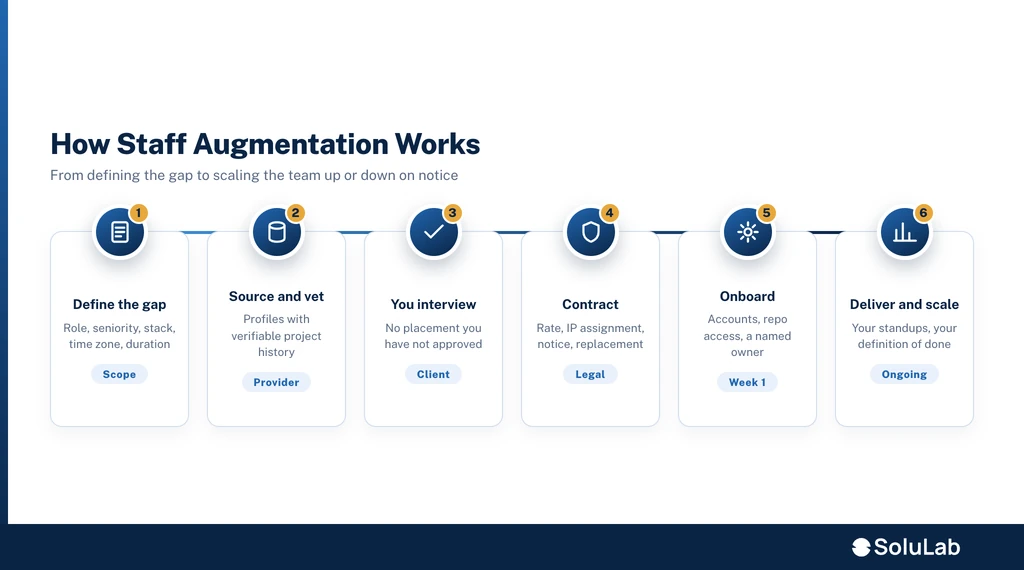
- Define the gap. Role, seniority, stack, time zone overlap, start date and duration.
- Provider sources and vets. You should receive profiles with verifiable project histories, not a resume database.
- You interview and approve. No competent provider places an engineer you have not interviewed.
- Contracting. Rate, notice period, IP assignment, replacement terms, data access and confidentiality.
- Onboarding. Equipment, accounts, repository access, and an internal owner for the first two weeks.
- Delivery under your process. The augmented staff attend your standups and are measured by your definition of done.
- Review and scale. Monthly review of fit and utilisation, then scale up, hold, or release on notice.
Types of staff augmentation
| Type | What you get | Typical use |
| Commodity augmentation | General skills, low specialisation | Overflow work, manual QA, basic support |
| Skill based augmentation | A specific, common technical skill | React, Node.js, Android, iOS capacity |
| Specialized skills on demand | One scarce capability for a defined window | Security review, data platform, ML evaluation |
| Highly skilled augmentation | Scarce or senior expertise | AI and ML engineers, blockchain, security, data platform |
A second axis matters as much as skill level. Short term augmentation covers a release or a seasonal peak. Long term augmentation runs for a year or more and behaves like an extension of your team, which changes how you onboard and how much documentation is worth writing.
Benefits of staff augmentation
- Time to productive work. A vetted engineer can start in days. A permanent hire for the same skill takes weeks of sourcing plus a notice period.
- No permanent headcount. Useful when the roadmap is funded but headcount is not.
- Access to scarce skills. Production AI and blockchain experience is hard to hire locally in 2026 and easier to rent.
- Control stays with you. Unlike outsourcing, you keep architecture and priority decisions.
- Lower hiring costs. No recruiter fee, no severance exposure, and the provider absorbs replacement.
- Knowledge transfer is possible. Because augmented staff sit inside the team, what they know can stay when they leave, if you require documentation as part of the engagement.
Challenges, and how to handle them
- Onboarding overhead. Every new person costs your team time. Reduce it by keeping a current README and a first week checklist.
- Knowledge walking out. Require documentation and pair rotation in the contract, not as a favour.
- Employment status and co-employment. Augmented staff are the provider’s employees. Treat them as your employees for tax or benefits purposes and you create a co-employment question. Keep performance management, benefits and termination with the provider, and keep work direction with you.
- Security and access. Scope repository and data access to the role, and remove it on the last day, not later.
- Team cohesion. Augmented engineers who are excluded from planning produce what they were told, not what was needed.
Staff augmentation vs other workforce models
| Model | Who directs the work | What you buy | Best when |
| Staff augmentation | You | Capacity and skills | Roadmap is known, skills or capacity missing |
| Project outsourcing | Vendor | A deliverable | Scope is fixed and stable |
| Managed services | Vendor | An outcome against an SLA | Run, support and monitoring work |
| Consulting | Vendor advises | Analysis and a plan | The problem is not yet defined |
| Freelancers | You, loosely | Individual tasks | Small, separable pieces of work |
| In house hiring | You | Long term ownership | The role defines your core product |
Staff augmentation vs outsourcing. Outsourcing moves responsibility for delivery to the vendor. That is an advantage when the scope is stable and a liability when it changes weekly, because every change becomes a change order.
Staff augmentation vs managed services. Managed services are bought by outcome. If you cannot write down the outcome and its SLA, you are not buying managed services, you are buying people, and augmentation prices that honestly.
Staff augmentation vs consulting. Consulting answers what to do. Augmentation does it. In consulting engagements the senior name on the proposal is rarely the person doing the work, which is the opposite of augmentation, where you interview the person who will do the work.
When to use staff augmentation
- A release date depends on capacity you do not have.
- The skill is needed for 6 to 18 months, which is too long for a contractor and too short to justify a permanent hire.
- The skill is scarce in your local market, for example production AI engineering.
- Headcount is frozen but the budget is operational.
- You want to test a skill in your team before committing to a permanent role.
When not to use it: roles that define your core product for the next several years, and any role where the person needs to hold institutional relationships rather than produce work.
How much does staff augmentation cost?
Cost is a rate per engineer per month, or per hour, plus your internal onboarding time. Published market ranges for mid to senior offshore and nearshore engineers in 2026 sit roughly between $2,000 and $6,500 per engineer per month, and rates rise with seniority, scarcity of the skill and hours of time zone overlap.
The comparison that matters is not rate against salary. It is total cost of the gap. A three month delay in hiring a permanent engineer has a cost in shipped roadmap, and that is usually the number that decides the model.
How to manage augmented staff well
- Give them the same access to context as your employees, including the why behind the
roadmap.
- Put them in your standups and retros from day one.
- Measure them with your existing definition of done, not a separate standard.
- Require documentation as a deliverable, so knowledge stays.
- Review fit at 30 days while replacement is still cheap.
- Keep performance management with the provider and work direction with you.

Ready to add engineers to your team?
SoluLab supplies vetted AI, blockchain, mobile app and full stack engineers who work inside your team under your direction. See it staff augmentation services for roles, engagement models and the onboarding process, or get vetted engineer profiles within 48 hours.
FAQ
Chintan leads SoluLab's highest-level AI consulting conversations, assessing whether a client's business problem actually justifies an AI investment before any solutioning begins.